The Daughter He Used As A Trophy Chose The Woman Who Raised Her-Teptep
By the time Elena turned eighteen, Sarah knew the shape of the girl’s silence better than Richard knew the sound of her laugh.
For ten years, Sarah filled those silences with ordinary devotion.
She packed lunches that came home half eaten during anxious weeks.
She learned the difference between Elena needing advice and Elena needing someone to sit on the edge of the bed without saying a word.
She did not do those things to earn a title.
She did them because a child had been left behind, and someone had to stay.
Vanessa had left when Elena was eight, after a summer of crying in bathrooms and calling motherhood a cage.
She kissed Elena on the forehead, told her she would be back soon, and flew overseas with two suitcases and a man whose name Elena never bothered to remember.
Sarah did not argue with Richard’s excuses then.
She was too busy teaching Elena how to sleep again.
Richard liked the image of being a father far more than the work of being one.
He liked photographs and Christmas cards where Elena stood between him and Sarah like proof of a home he had helped build.
He did not like early meetings, therapy invoices, or Elena’s trembling midnight questions about why her biological mother had not rung.
Sarah’s marketing agency paid for most of the life Richard displayed.
The estate had been bought with Sarah’s money before the marriage, renovated with Sarah’s profits, and filled with the kind of tasteful furniture Richard described to guests as if he had chosen every piece himself.
He was very good at standing in front of finished work.
He was less good at lifting a finger while it was being done.
Elena saw more than he realised.
Children almost always do.
She saw Sarah sign school forms when Richard forgot.
She saw Richard become charming whenever a camera came out.
She saw the way men at parties congratulated him for raising such an exceptional daughter while Sarah stood nearby with tired eyes and a polite smile.
By senior year, Elena had stopped correcting them in public.
In private, she corrected everything.
She wrote her Harvard essay about the woman who had stayed.
She did not name Sarah as her stepmother.
She named her as the person who taught her that love was not a speech, or a photograph, or a surname.
Love was turning up when nobody applauded.
When the acceptance email arrived, Elena screamed so loudly that Sarah dropped a mug in the kitchen.
Richard came in later, after the tears, after the hugging, after the first astonished phone calls, and placed himself neatly at the centre of the celebration.
“My daughter,” he kept saying.
“My brilliant girl.”
“My legacy.”
Elena’s smile changed every time he said it.
Sarah noticed, but she did not push.
The party was meant to be happy.
She wanted Elena to have one night that did not belong to absence, bitterness, or old wounds.
So Sarah planned everything with the careful tenderness she brought to all Elena’s milestones.
She chose white lights, lemon cake with raspberry filling, a quartet for the first hour, and a DJ for later.
She invited teachers, neighbours, agency partners, a few of Richard’s clients, and women from Elena’s old maths club.
Richard added his golf friends without asking.
Sarah let it go.
She had spent years letting little things go because there were always bigger things to protect.
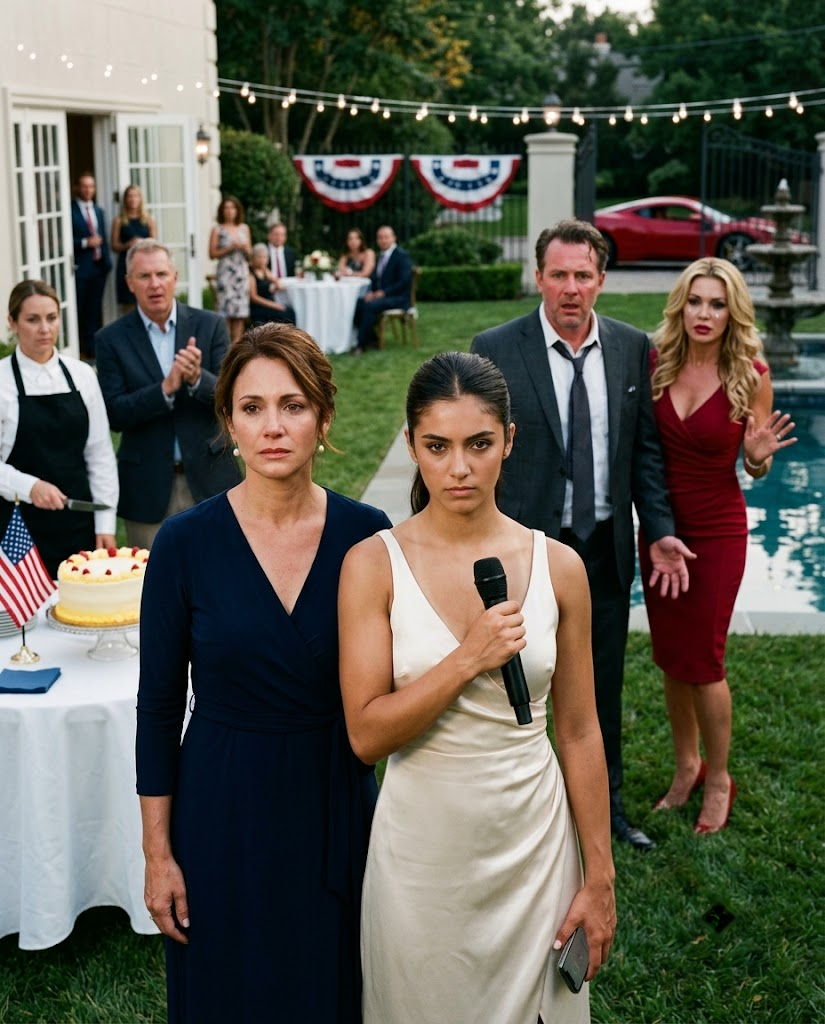
Then the cherry-red sports car came through the gates.
It did not arrive quietly.
It roared past the hedges, circled the fountain, and stopped where every guest could see it.
Vanessa stepped out as if she had been expected by the whole world.
Her crimson dress was too bright for the evening, her smile too practised for a woman walking into a child’s life after ten empty years.
For one foolish second, Sarah wondered whether Richard would be shocked.
Then she saw his face.
He was not shocked at all.
He was proud.
Richard crossed the lawn, wrapped his arm around Vanessa’s waist, and took the microphone from the DJ booth.
“Ladies and gentlemen,” he said, lifting his voice into the smooth tone he used for clients and lies.
The garden quietened.
Elena stood beside the pool, one hand curled around a glass of lemonade, watching her father as if she had been waiting for him to reveal the full size of himself.
“Tonight, we are not just celebrating my brilliant daughter’s acceptance to Harvard,” Richard said.
He paused long enough to enjoy the attention.
“We are celebrating a reunion. Vanessa and I have found our way back to each other.”
Someone gasped.
Sarah felt the sound move through the crowd like a crack through glass.
Richard looked directly at her.
“It’s a beautiful thing,” he went on. “My real, biological family is finally back together. Tomorrow, I will formally file for divorce from Sarah. Thank you, Sarah, for keeping the seat warm. Thank you for being a highly effective, unpaid nanny for a decade. But your services are no longer required. You are dismissed.”
Humiliation is strange because it does not always feel hot at first.
Sometimes it feels cold.
Sarah stood in her own garden, under lights she had paid for, beside tables she had arranged, wearing a dress Elena had helped her choose, and felt the cold spread from her throat to her fingertips.
A few of Richard’s friends clapped.
Not many.
Enough.
Enough to make the cruelty public.
Enough to tell Sarah that Richard had counted on an audience to make her smaller.
Vanessa lifted her hands towards Elena.
“My beautiful girl,” she called, voice wobbling with theatre. “Mummy is finally home. We are going to have so much fun in Boston. I’m already looking at luxury flats for us.”
That was when Elena set her cup down.
It made the smallest sound against the patio table.
Sarah heard it anyway.
Elena walked across the lawn.
Not quickly.
Not dramatically.
Calmly, with the terrifying steadiness of someone who had finished grieving before anyone else knew the funeral had begun.
Richard smiled at her because he still believed biology was a leash.
Vanessa opened her arms wider.
Elena passed her.
She walked straight to Richard, took the microphone from his hand, and stood between him and Sarah.
For one heartbeat, nobody moved.
Then Elena spoke.
“The woman you just dismissed is my mother, and I am done pretending either of you is my family just because you share my blood.”
The sentence did not sound shouted.
It sounded carved.
The applause died as if someone had closed a door on it.
Richard’s smile vanished.
Vanessa’s arms lowered slowly, uselessly, like props after a play had ended.
Elena turned so the whole garden could see her face.
“I was eight when you left,” she said to Vanessa. “You did not lose my number. You did not lose the address. You lost interest.”
Vanessa’s mouth opened.
Elena did not let her fill the air.
“And Dad,” she said, turning back to Richard, “you did not raise me either. You introduced me to people when I made you look good. Sarah raised me when I was a mess.”
Richard reached for the microphone.
Elena stepped back.
“Careful,” she said.
It was one quiet word, but it stopped him.
There are moments when a crowd decides whether it is watching a scandal or a reckoning.
That garden decided all at once.
The caterer lowered the cake knife, and one of Sarah’s agency partners put her champagne glass down.
Richard tried to recover his authority.
“Elena,” he said, forcing a laugh, “you are emotional. You do not understand marriage, money, or adult arrangements.”
“I understand arrangements,” Elena said.
She lifted her phone.
Sarah saw the screen from where she stood, bright against Elena’s palm.
A voice note was paused at the beginning.
Richard saw it too.
His face changed before the recording even played.
That was the first real confession.
Elena pressed play.
Richard’s voice came through the speaker, lower than his party voice and uglier without an audience to flatter.
“Let Sarah pay for the whole thing,” the recording said. “After Harvard, Elena will choose us. The court will see I have the real family unit, and Sarah will have to settle. She built the agency during the marriage. I can bleed her properly.”
Vanessa’s recorded laugh followed.
“And the girl?” she asked.
Richard answered, “She’s desperate for a mother. Give her Boston, shopping, attention. She’ll come round.”
The garden did not gasp this time.
It went silent in a deeper way.
The kind of silence that does not come from shock, but from recognition.
Sarah looked at Richard and saw, with painful clarity, the man she had kept explaining away.
A user.
Blood can open a door, but it cannot make a home.
And cruelty, once spoken plainly, rarely finds anywhere to hide.
Richard lunged for the phone.
Two men moved before Sarah could: the DJ, who caught Richard’s wrist, and Sarah’s solicitor, who had been invited as one of her oldest clients.
“Do not touch her,” the solicitor said.
Richard froze.
That was when Sarah realised the solicitor had not looked surprised by the recording.
Elena turned to her, and for the first time that night, the steel in her expression softened.
“I’m sorry,” she said. “I found out three weeks ago. I wanted to tell you, but the solicitor said we needed him to say it clearly.”
Sarah could barely speak.
“You went to him?”
Elena nodded.
“I went to him after I heard Dad on the terrace with Vanessa. They were talking about the divorce, the house, your agency, everything. He said you would be too kind to protect yourself unless someone made you look.”
The solicitor adjusted his glasses.
“She was right to come,” he said.
Richard tried another laugh, but there was no audience left willing to help him carry it.
“This is absurd,” he snapped. “Sarah and I are married. She cannot just cut me out of a life we built together.”
Sarah looked around the estate, the lights, the tables, the daughter standing before her like a shield.
For years, she had been careful not to say what was hers too loudly.
She had mistaken modesty for peace.
“No,” the solicitor said before Sarah could answer. “The estate was purchased before the marriage. The agency predates the marriage. The postnuptial agreement you signed five years ago confirms both. I have the originals.”
Richard’s eyes flicked to Vanessa.
Vanessa’s eyes flicked to the sports car.
It was the first honest exchange either of them had had all evening.
Elena was not finished.
“There is one more thing,” she said.
Sarah’s breath caught.
Elena reached into the pocket of her dress and took out a folded envelope, not dramatic, not flourished, simply held with care.
“I turned eighteen last week,” she said. “Yesterday morning, I filed the adult-adoption petition.”
The words took a second to land.
Then Sarah covered her mouth.
Elena’s voice trembled for the first time.
“If you want me,” she said, “I want to be your daughter legally, not just in every way that ever mattered.”
That was the moment Sarah broke.
Not when Richard humiliated her.
Not when Vanessa walked in.
Not when the recording exposed the plan.
She broke when the child she had loved without demanding anything in return offered her the one thing Sarah had never allowed herself to ask for.
Sarah stepped forward, and Elena came into her arms like she was eight years old again.
The guests did not applaud at first.
They cried.
Then Elena’s maths teacher started clapping, slowly, fiercely, and this time the sound did not belong to Richard.
It rolled through the garden for Sarah.
Richard shouted something about manipulation.
Vanessa called Elena ungrateful.
Neither insult travelled far.
There are words that lose their power the instant the truth stands up.
Sarah held Elena and looked over her shoulder at the man who had believed love was labour he could outsource until it became inconvenient.
“You said you would file for divorce tomorrow,” Sarah said.
Richard’s mouth tightened.
“Yes,” she said. “Do that.”
Vanessa blinked, startled by the calm.
Sarah continued, “But you will not file from my house, you will not take my agency, and you will not use my daughter as evidence for anything ever again.”
The solicitor nodded once, as if a long overdue meeting had finally been called to order.
Richard left before the cake was cut.
Vanessa left before Richard did.
That, more than anything, told the guests what kind of reunion they had been watching.
The red sports car reversed through the gates with none of the triumph it had arrived with.
The garden remained quiet after they were gone.
Then Elena wiped her cheeks, looked at the cake, and gave a small, shaky laugh.
“I still want lemon,” she said.
So Sarah cut the first slice herself.
She gave it to Elena on a china plate with raspberry filling sliding slightly down the side, and the absurd normality of it saved them both for a moment.
Weeks later, the divorce began with far less drama than Richard had promised.
Men like Richard often mistake noise for power.
Paperwork is quieter, and it can be far more brutal.
Vanessa discovered that Boston was less romantic when nobody else was paying for the flat.
Elena moved into Harvard with Sarah carrying two boxes and trying not to fuss.
On the dorm forms, under emergency contact and parent, Elena had written Sarah’s name first.
Sarah touched the paper with one finger, as if it were something fragile.
The final twist arrived a month later, in a thick envelope from Harvard’s scholarship office.
Elena had won a private fellowship attached to her admissions essay, and the letter included a printed excerpt from the piece that had moved the committee.
Sarah read the title three times before she could read the rest.
It was titled The Mother Who Stayed.
Elena had not written about Richard’s money, Vanessa’s glamour, the estate, the party, or the famous surname he thought mattered so much.
She had written about tea at midnight, marked-up practice essays, packed lunches, quiet drives, and the woman who never once asked to be called Mum before earning it every day.
At the bottom, in Elena’s careful handwriting, was a note.
You raised me for free, he said.
But nothing you gave me was cheap.
Sarah folded the letter against her chest and stood in the kitchen where so much of Elena’s childhood had been repaired one ordinary evening at a time.
For the first time in years, the house felt completely honest.
Not perfect.
Not untouched by betrayal.
Honest.
And upstairs, in Elena’s old room, the night-light she had once needed was still plugged into the wall, glowing softly in the late afternoon.
Sarah left it there.
Some lights are not for fear.
Some are proof that someone stayed long enough for morning to come.