The Navy SEAL Who Hit Me Didn’t Know Why an Admiral Was Coming-thuyhien

The hardest punch I ever took didn’t happen in combat.
It happened in a Navy mess hall packed with recruits, instructors, and one celebrated Navy SEAL who had already decided I was nobody worth respecting.
One second, I was carrying a tray through the noise of breakfast.
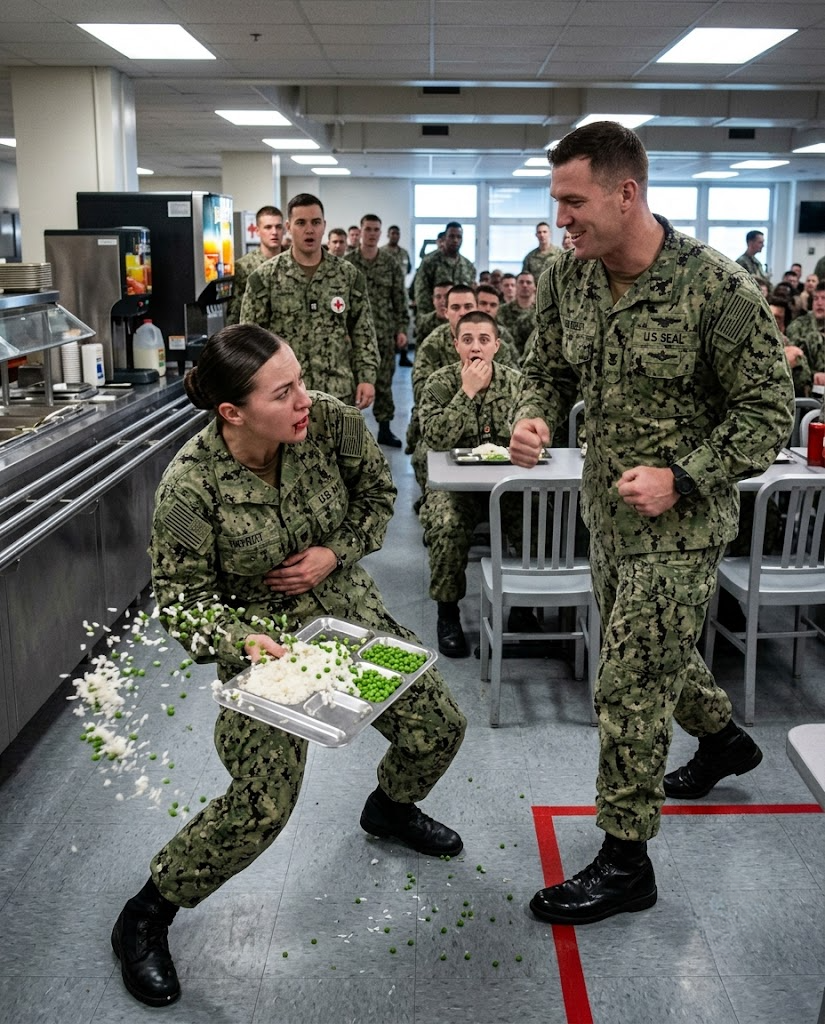
The next, the edge of that tray slammed into my ribs as Chief Walker Reed’s fist drove the air out of my lungs.
Rice sprayed across the tile.
Peas rolled between boots.
The metallic taste of blood spread across my tongue before I understood that I had bitten the inside of my lip.
And while the entire room went silent, Reed laughed.
He thought he was humiliating an insignificant woman who had wandered into a place reserved for men like him.
What he didn’t know was that an admiral arriving that morning carried sealed orders with my name on them.
Within minutes, everyone in that room was going to learn just how badly Walker Reed had misread me.
I remember the sound before I remember the pain.
The mess hall had been loud enough to blur individual conversations into one steady wall of noise.
Forks scraped plates.
Metal trays hit counters.
Recruits traded jokes across tables while instructors drank coffee and pretended not to hear half of what was being said.
Someone near the beverage station laughed so hard he nearly dropped his cup.
Then Reed hit me.
The impact turned all of that noise off as if someone had pulled a plug.
My right knee struck the tile first.
My palm followed, catching enough of my weight to keep my face from hitting the floor.
Pain wrapped around my ribs in a hard band, sharpest when I tried to breathe too deeply.
The tray spun once before landing upside down several feet away.
Food scattered farther than I expected.
A spoon skidded beneath a table.
One pea rolled in a slow green arc around the toe of a recruit’s boot before stopping.
For some reason, that tiny detail stayed with me.
Maybe because everyone else had stopped moving.
Chief Walker Reed stood over me.
He was tall, broad through the shoulders, and carried himself with the relaxed confidence of a man accustomed to people recognizing him before he introduced himself.
His reputation traveled ahead of him.
Recruits knew his name.
Instructors knew his record.
People told stories about him in the tone reserved for men whose accomplishments had become larger than their personalities.
He was the kind of operator recruiters liked to point toward when they wanted young sailors to imagine what toughness looked like.
Reed knew it too.
That knowledge showed in the way he occupied space.
He didn’t need to raise his voice to make people notice him, but he often raised it anyway.
That morning, he looked down at me and smirked.
“Didn’t know they let office girls eat with warfighters now.”
A few faces tightened.
Nobody stepped in.
The recruits nearest us stared at their trays or at the floor, as though eye contact alone might make them participants.
Two instructors exchanged a glance and stayed exactly where they were.
Even the corpsman standing near the juice machine hesitated.
I didn’t blame the recruits for freezing.
Most of them were young enough to still be learning the difference between rank, reputation, and character.
And Reed’s reputation was heavy enough to make hesitation feel reasonable.
Fear does strange things to a crowded room.
It doesn’t always send people running.
Sometimes it turns seventy-eight human beings into furniture.
Reed glanced at the mess on the floor.
“Pick it up,” he said.
I stayed on one knee for another second.
My mouth tasted like copper.
When I touched my lower lip, a thin smear of blood marked my fingers.
I looked down at it, then at the rice scattered around my boots, then at Reed.
His boots were perfectly polished.
That was when I noticed where he was standing.
Six inches inside a red boundary line painted across the floor.
Interesting.
I didn’t say anything about it.
Not yet.
“Pick it up,” Reed repeated.
His tone had changed slightly.
The first command had been for me.
The second was for the room.
He wanted witnesses.
He wanted every recruit in that mess hall to understand the hierarchy he believed existed between us.
Somewhere behind my left shoulder, a recruit whispered, “Oh, no…”
It was barely audible.
Reed heard it anyway.
His smile widened for half a second.
He thought the recruit was afraid for me.
Maybe he was.
I wasn’t thinking about fear.
I was thinking about my breathing.
Four seconds in.
Hold for two.
Six seconds out.
I had learned that rhythm years earlier from an old master chief who had a habit of teaching important lessons without announcing that he was teaching them.
He used to say that panic narrowed a room until all you could see was the thing directly in front of you.
Training did the opposite.
“Don’t fight the room,” he told me once. “Read it.”
So I read it.
Seventy-eight recruits.
Nine instructors.
One corpsman.
Three security cameras.
Four exits.
One red boundary line.
And one Navy SEAL standing over me who believed there was no person in that room willing or able to challenge him.
I pushed myself upright.
Slowly.
My ribs objected immediately.
The pain wasn’t dramatic in the way people imagine pain from movies.
It was practical.
It changed the mechanics of breathing.
It made every small turn of my torso something I had to calculate.
I kept my face neutral anyway.
Reed stepped closer.
“You got something to say?”
He wanted anger.
That part was obvious.
He wanted me to shove him, curse at him, cry, complain, or do anything else he could use to reduce what had happened to a story about an emotional woman losing control in front of a room full of sailors.
I wiped the blood from my lip with the side of my thumb.
“Yes,” I said.
His expression changed almost imperceptibly.
Not concern.
Anticipation.
He thought I was about to make the mistake he had prepared for.
I looked directly at him.
“You drop your right shoulder before you throw a punch.”
For the first time, his smirk lost some of its certainty.
“What?”
I had watched his body before he hit me.
I had watched it afterward too.
People reveal more through movement than they realize.
“And your left knee still favors an old ligament injury,” I continued.
The room changed.
Not loudly.
Nobody gasped.
Nobody suddenly rushed to my side.
But attention sharpened.
The people around us were no longer watching only to see what Reed would do to me.
They were watching him.
That distinction mattered.
Reed shifted his weight without meaning to.
It was small, but it confirmed what I had already seen.
“You hide it well on pavement,” I said. “Not so well on tile.”
His jaw tightened.
His eyes narrowed.
“You think you’re funny?”
“No.”
I tilted my head slightly, enough to study his hands.
His right hand was still half-curled from the punch.
The knuckles were swollen.
Not freshly from hitting me.
The swelling was already there.
“Your knuckles are swollen too,” I said. “Not from training. Impact trauma.”
A few instructors glanced at one another.
One looked at Reed’s hand.
Another looked at me, then back at him.
That was the first real crack in the scene Reed had built for himself.
Until then, the story was simple.
Famous operator humiliates anonymous woman.
Everyone stays quiet because everyone understands who matters more.
Now the room had a question.
Who was the woman on the receiving end of the punch, and why was she analyzing Walker Reed as calmly as if he were the one being evaluated?
Reed heard the question even though nobody asked it aloud.
His shoulders changed first.
The looseness disappeared.
Then he laughed.
Too loudly.
It was the kind of laugh people use when they need everyone else to believe a moment is still under control.
“You think you’re some kind of investigator?” he asked.
“No.”
I gave him a small smile.
“I just pay attention.”
That bothered him more than an insult would have.
An insult he could answer.
Anger he could dominate.
A complaint he could dismiss.
Observation was different.
Observation turned the spotlight around.
His face hardened.
I could see him deciding what version of himself he wanted the room to see next.
There was the decorated warfighter everyone already respected.
There was the intimidating senior man who expected obedience.
And underneath both of those was the man who had just punched someone in front of dozens of witnesses because he believed she had no power to make the moment matter.
That last version was the one he wanted buried fastest.
He took another half step toward me.
My ribs tightened when I adjusted my stance.
I didn’t move backward.
That mattered too.
Not because I intended to fight him.
I didn’t.
Throwing a punch would have handed him exactly what he wanted.
He had already supplied the physical evidence of his own decision.
I had no reason to contaminate it with mine.
The red line remained beneath his boots.
The cameras remained fixed in their corners.
The instructors remained within earshot.
The recruits remained witnesses whether they wanted to be or not.
And somewhere beyond that room, an admiral was arriving that morning with sealed orders carrying my name.
Reed knew none of that last part.
He knew only what he could see.
A woman in front of him.
No visible entourage.
No one rushing to defend her.
No badge of importance he recognized quickly enough to change his behavior.
That was the mistake beneath all his other mistakes.
He believed power was something that always announced itself before entering a room.
He believed status had to be visible to deserve restraint.
And because he had decided I possessed neither, he had shown everyone exactly how he behaved when he thought consequences were impossible.
A recruit near the end of one table slowly lowered his fork.
Another straightened in his seat.
The corpsman by the juice machine was no longer staring at the floor.
His attention had moved to my ribs and then to Reed’s hand.
One of the instructors closest to us shifted his stance as if reconsidering whether remaining still was still the safest choice.
Reed noticed that too.
His gaze flicked toward the instructor and came back to me.
For a man who had entered the moment believing he controlled the entire room, he was suddenly spending a lot of energy checking where everyone else stood.
He started to speak.
I watched the familiar preparation in his body again.
Not another punch.
Not yet.
Just tension.
His right shoulder sat slightly higher.
His left leg remained carefully positioned.
His injured knee was protected by habit so old he probably no longer realized he was doing it.
Every detail told a story.
That was what Reed still didn’t understand.
He thought the morning was about strength.
It wasn’t.
It was about information.
He had given away far more of it than I had.
The recruits knew he had hit me.
The instructors knew he had done it publicly.
The corpsman could see I was hurt.
The cameras had their own silent record.
And now everyone knew I had noticed things about Chief Walker Reed that an ordinary stranger probably would not have identified after being knocked to one knee.
The balance in the room hadn’t flipped.
Not yet.
Reed still had rank, reputation, size, and familiarity on his side.
But certainty had left him.
That was enough to change the next thirty seconds.
His mouth opened.
Before another word came out, a sound cut across the mess hall.
The doors behind the far row of tables swung open.
Every head turned at once.
Reed’s included.
I didn’t turn immediately.
I watched him first.
For the first time that morning, Chief Walker Reed was looking toward something he hadn’t planned for.
Only then did I shift my gaze toward the doorway.
The room that had frozen when Reed punched me now seemed to hold itself for an entirely different reason.
My ribs still hurt.
Blood still marked the side of my thumb.
Rice and peas still covered the tile between us.
Reed was still standing inside that red boundary line.
Nothing about the evidence of the last few minutes had disappeared.
But the next part of the morning had just arrived at the door.