
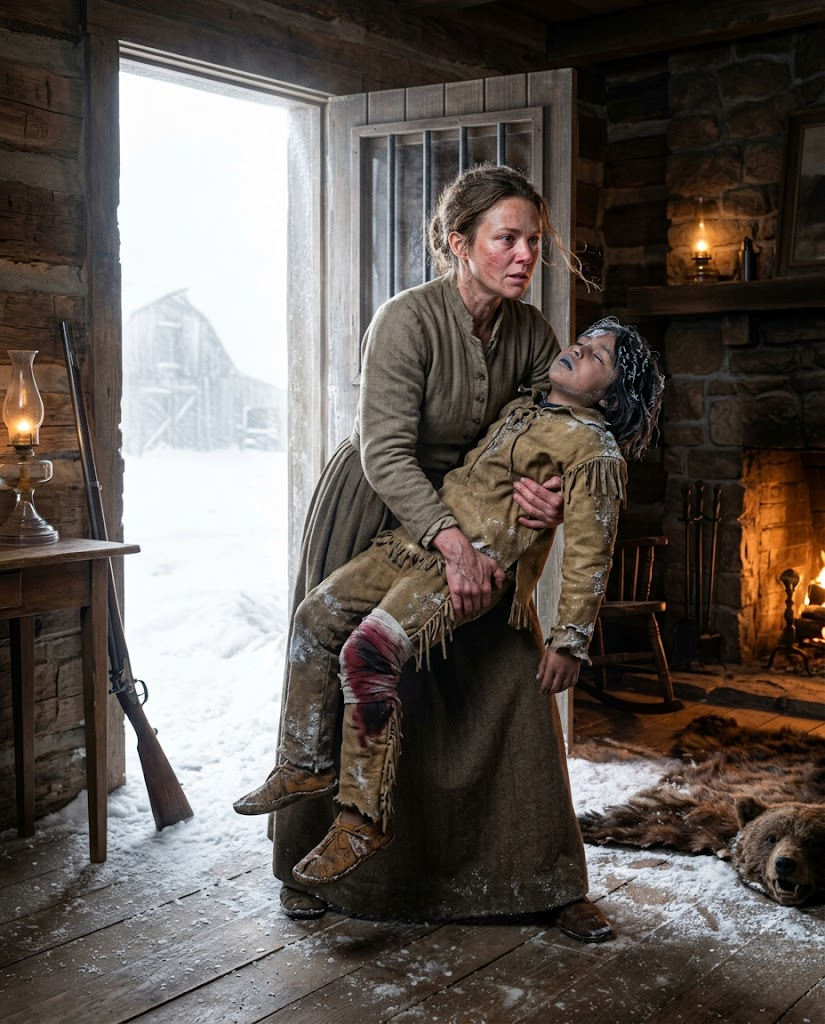
The Night Sarah Opened Her Door To A Frozen Comanche Child On The Plains-felicia

The blizzard announced itself before Sarah Callahan saw a single flake.
It came with a low moan rolling across the Texas plains, a deep, animal sound that made the cabin timbers seem smaller than they had been the day before.
Sarah stood at her kitchen window with the gray afternoon fading behind her and watched the horizon disappear.
The first snowflakes fell heavy and slow, turning in the air like ash from a fire nobody could see.
She had lived alone long enough to know the difference between a winter storm and a warning.
At thirty-two, she was not old, but grief had weathered her in places no mirror could show.
Thomas had died of fever three winters earlier, and ever since then, every chore on that isolated patch of Texas soil had passed through her hands alone.
She mended what tore.
She hauled what needed hauling.
She listened at night to every board that creaked and every animal that shifted in the barn, because a widow on open land learned to sleep lightly or not sleep at all.
That afternoon, she did not waste time hoping the weather would turn.
She pulled on her coat, wrapped a scarf tight at her throat, and crossed the yard while the wind shoved hard against her shoulder.
The small barn smelled of hay, damp wood, and nervous livestock.
She checked the animals, laid extra hay, and dragged one hand over the stall gate to make sure the latch had caught.
Then she checked it again.
A person could call that worry.
Sarah called it staying alive.
By the time she made it back to the cabin, the snow had thickened enough to sting her face, and the wind nearly stole the breath from her lungs as she pushed through the door.
She barred it behind her and stood still for a moment, listening.
The cabin answered with the old familiar sounds.
The fire settled.
The kettle ticked softly near the hearth.
Somewhere in the wall, a draft found a crack and whistled like a living thing.
Sarah shook snow from her sleeves and looked toward the mantle.
Thomas’s Springfield rifle hung where it always hung, cleaned and ready, more memory than comfort and more comfort than she liked to admit.
People said the treaty had settled the worst of the fear.
They said it in lowered voices, in small groups, with one eye still turned toward the plains as if peace were a horse that might spook at any sudden sound.
Sarah had heard every rumor.
Renegade bands moving at night.
A fence cut.
A rider seen near a creek bed.
A stockman who swore he had been watched from the ridge.
Some stories were probably true.
Some were probably fear dressed in boots and given a direction to walk.
Sarah had learned not to let either kind rule her house.
She barred the door.
She banked the fire.
She took up her mending and sat in Thomas’s old rocking chair with the oil lamp glowing beside her elbow.
The tear in her heavy wool skirt was small, but small things became large things if ignored long enough.
Outside, the storm stopped pretending it was weather and turned into something meaner.
It hit the cabin walls in waves.
It screamed down the chimney and sent sparks lifting from the fire.
It drove snow beneath the door in fine white dust that gathered along the floorboards.
Sarah bent closer to her stitching.
The needle passed through wool.
The lamp flame trembled.
Then the pounding came.
It struck the door hard enough to stop her hand in midair.
Sarah froze with the needle still held between her fingers.
No neighbor would be out in that.
No traveler could have found her cabin in that wall of snow unless he had been nearly on top of it already.
For a long moment, she listened to the wind and told herself she had imagined it.
Then it came again.
This time, the sound was weaker.
Not a fist demanding entrance.
A hand failing to make itself heard.
Sarah laid the mending across the arm of the chair and rose slowly.
She took the Springfield from above the mantle.
The wood was cold.
That cold steadied her, and she hated it for doing so.
“Who’s there?” she called.
The storm answered first.
Then, beneath it, came a thin sound that made every thought in her go still.
A child cried.
Not loudly.
Not with the full strength of a child expecting to be rescued.
It was a broken little sound, almost gone by the time it reached her.
Sarah moved to the door and stood with one hand on the bar.
She did not lift it.
Not yet.
A frightened person can make a holy thing out of caution.
Sarah had seen it happen in Willow Creek, where men spoke of safety while passing along stories they had never checked.
She had seen women clutch children closer at the mention of Comanche riders, then call that fear wisdom.
She knew the other side of the knife too.
Taking in a Comanche child could be called mercy by God and theft by the child’s own people.
A door opened in the wrong place could become an accusation.
The soft thud against the other side of the door decided for her.
It was the sound of a body sliding down wood.
Sarah lifted the bar.
The wind tore the door out of her hand and slammed it against the inside wall.
Snow burst into the cabin so fast that the lamp flame leaped and nearly went out.
For one blind second, she saw nothing but white.
Then she looked down.
The child was folded on the threshold, half-buried already by drifting snow.
He was small, no more than seven or eight, with dark hair crusted with ice and buckskin clothing stiff from cold.
His lips were blue.
His lashes were white with frost.
His body shivered in violent little jerks that looked less like life than the last argument life could make.
Sarah’s grip tightened around the rifle.
Then she saw his left leg.
A makeshift bandage had been wrapped around it, and the cloth was stained dark with frozen blood.
The sight pulled the air out of her chest.
Somebody had tried to help him before the storm took over.
Somebody had tied that cloth fast, maybe in fear, maybe in haste, maybe with hands that knew they were running out of time.
The boy’s eyes opened for half a breath.
They did not focus on her.
They only filled with the wild terror of a child who had suffered too much to understand where he had fallen.
Sarah lowered the rifle.
It did not feel brave.
It felt necessary.
“Easy,” she said, though she did not know if he understood the word.
She propped the Springfield against the wall, bent into the wind, and lifted him.
He was too light.
That was the first thing that frightened her.
The second was the cold of him, the way it moved through her sleeves as if she had picked up winter itself.
She kicked the door shut behind her and dropped the bar with her elbow.
The cabin seemed to shrink around them.
The fire snapped.
The lamp hissed.
The boy’s head lolled against her shoulder, and snow melted from his hair down the front of her dress.
Sarah carried him to the bearskin rug before the fireplace and lowered him gently onto it.
Her hands moved faster than her thoughts after that.
She pulled the kettle nearer.
She warmed cloths.
She cut away only what she had to, careful not to handle his clothing with the rough disrespect of panic.
The bandage on his leg had frozen into the edges of the wound.
Sarah did not rip it free.
She soaked it first.
She had seen fever take a man.
She had seen infection turn a simple injury into a bell tolling for the grave.
She had no doctor, no proper medicine beyond what a frontier widow kept in jars and tins, and no promise that the boy would survive the night.
But she had hands.
She had fire.
She had the stubbornness grief had left behind when it took everything else.
The boy stirred when the frozen cloth began to soften.
A thin sound broke from him, and his fingers clawed weakly at the rug.
“I know,” Sarah whispered.
Her own voice surprised her.
It sounded like the voice she had used once in another life, when Thomas had burned with fever and she had told him morning was coming even after she knew it might not.
The boy did not wake fully.
He fought the air, then sank back down, exhausted by even that small resistance.
Sarah worked until her knees ached from the floorboards and the storm outside had buried the bottom of the door in snow.
The wound was ugly, but not hopeless.
That was the word she chose because she needed one.
Not safe.
Not healed.
Not clean.
Hopeless was the only thing she refused to call him.
She wrapped the leg again with clean cloth and moved him closer to the fire, not close enough to burn cold skin, but close enough that warmth could return slowly.
Then she sat beside him with the rifle within reach and did not sleep.
All night, the storm hammered the cabin.
All night, Sarah watched the boy breathe.
Sometimes his breath came shallow.
Sometimes it hitched and made her lean forward, one hand hovering over his chest.
Once, near midnight, he whispered something she could not understand.
The word came out cracked and foreign to her ear, but the shape of it was familiar in the way grief is familiar in every language.
It sounded like a call for home.
Near dawn, when the wind softened for a few minutes, he opened his eyes and looked directly at her.
Sarah did not touch him right away.
She held up both hands, empty.
His gaze moved from her face to the fire, then to the door, then to the rifle leaning against the wall.
Fear sharpened him for a second.
Then pain pulled him under again.
Sarah understood that too.
Pain can turn even kindness into another threat until kindness proves itself over time.
So she proved it in the only ways she could.
She gave him water by drops.
She warmed broth and lifted it to his lips.
She changed the cloth on his leg when it needed changing, even when his small hands shook and tried to push her away.
She kept her movements slow.
She never stood over him with the rifle in her hands.
When she had to sleep, she slept in the rocking chair instead of her bed, waking every time he made a sound.
The second day came gray and hard.
The storm still moved over the prairie, but the worst of its rage had passed.
Snow lay deep against the cabin wall and covered the path to the barn.
Sarah forced herself outside twice to tend the animals.
Both times, she looked toward the blank white horizon and wondered who was looking for the boy.
That thought would not leave her.
Somewhere, if his people had survived the storm, a father might be counting tracks that had vanished.
A mother might be standing beneath a hide or a roof or a line of trees, listening to the weather and hearing only the space where her child should be.
Sarah had no right to make that pain smaller because it did not belong to her.
But she also had no way to send word.
The boy slept through most of the day.
By evening, color had begun to return faintly to his mouth, and the shivering no longer came in those violent waves.
He watched her more often.
Not trusting.
Not yet.
But watching.
Sarah placed a tin cup of water where he could see it and stepped back.
He reached for it himself.
His hand trembled badly, but he drank.
That small act nearly broke her with relief.
“You’re stubborn,” she said softly.
The boy stared at her.
Then, after a long pause, he closed his fingers around the cup as if it belonged to him for that moment.
Sarah took that as an answer.
On the third morning, the blizzard was gone.
The world outside had turned painfully bright, the kind of white that made the eyes water.
The sky was pale and empty, and the silence after the storm felt too large.
Sarah opened the door just enough to look out.
The air cut her cheeks.
The prairie rolled away under snow, smooth and shining, with the barn roof hunched dark against it.
For the first time in three days, she could see the ridge.
At first, there was nothing there.
Then one black shape appeared against the white.
Then another.
Then many.
Sarah did not understand what she was seeing until the sound reached her.
Hoofbeats.
Not one horse.
Not two.
A line of riders moved across the ridge, spreading wider as they came down toward her cabin.
Her stomach turned cold in a way the storm had not managed.
She closed the door and reached for the rifle.
The boy heard the sound too.
He pushed himself up on one elbow, went white with pain, and made a sound that was not fear this time.
It was recognition.
Sarah looked from him to the door.
The hoofbeats grew.
The cabin seemed to hold its breath around them.
By the time the riders stopped outside, Sarah had counted enough to know counting would not help her.
The hook of the story would later say one hundred warriors, and that was how it felt from inside that little room.
One hundred horses breathing steam into the cold.
One hundred men between her cabin and the open world.
One hundred reasons for a widow alone to remember every rumor she had ever heard and every grave she had ever stood beside.
But the boy was trying to sit up.
His hand reached toward the door.
Not away from it.
Toward it.
That told Sarah what fear could not.
The man at the front dismounted first.
He was tall, wrapped against the cold, his face carved with the kind of worry that anger borrows when it does not know how else to stand.
He did not rush the cabin.
He stood in the snow and looked at the door.
Then he called out.
Sarah did not know the words.
She knew the voice.
It was not the voice of a raider calling for blood.
It was the voice of a father who had followed a storm for three days and found the last place his son had been seen.
Sarah set the rifle on the table.
Not far.
Not hidden.
Just not in her hands.
Then she lifted the bar and opened the door.
Cold air poured in.
The riders watched her without speaking.
The man at the front looked past her shoulder and saw the boy on the rug.
Everything in his face changed.
He stepped forward once.
Sarah held up her hand.
It was not a command.
It was a plea for him to move carefully.
The boy was alive, but not strong.
The father stopped.
That pause mattered.
It told Sarah he could read fear without mistaking it for insult.
She stepped back from the doorway.
“He’s hurt,” she said, knowing the words might not cross the space between them the way she needed them to.
She pointed to the boy’s left leg.
Then to the clean bandage.
Then to the fire.
The father entered alone.
Every rider outside seemed to lean forward without moving.
Sarah’s heart hammered so hard she could hear it beneath the quiet.
The father crossed the cabin in three long steps and dropped to his knees beside the boy.
The child made a broken sound and reached for him.
No translation was needed after that.
The father gathered him carefully, as if the boy were both precious and made of cracked glass.
He touched the bandage.
He looked at the water cup.
He looked at the folded cloths, the damp towel near the hearth, the place where Sarah had slept in the rocking chair instead of leaving the child alone.
His eyes returned to her.
For a long moment, neither of them spoke.
There are truths no treaty can write down.
A child warmed by a stranger’s fire is one of them.
Sarah stood with her hands visible and waited for judgment from a man who had every reason to hate the story he might have imagined on the ride there.
The father said something to his son.
The boy answered weakly.
Sarah did not know the words, but she saw the father’s face when he heard them.
The anger did not vanish.
It changed direction.
It stopped looking for her.
One of the riders at the door shifted, and snow creaked under his horse outside.
The father raised one hand without looking away from Sarah.
The movement was small.
The effect outside was immediate.
No one entered.
No one reached for her.
No one shouted.
The father adjusted the boy in his arms, then stood.
The child’s head rested against his shoulder, his eyes half closed now, not from defeat but from the relief of being held by the person he had been calling for in fever.
Sarah felt her own knees weaken.
She gripped the back of Thomas’s rocking chair so she would not show it.
The father walked to the doorway and stopped there.
He turned back once.
His gaze moved over the cabin, the hearth, the rifle on the table, and Sarah’s empty hands.
Then he gave her a nod.
It was not small.
It was not soft.
It carried the weight of a man who had come with one hundred warriors to claim his son and found that a woman he had every reason to mistrust had kept him alive.
Sarah nodded back.
She did not smile.
It would have been the wrong thing.
Some moments are too solemn for smiling.
The father carried the boy into the bright cold, and the riders parted for him.
No one touched Sarah’s door.
No one took a thing from her cabin.
No one left a threat behind.
The horses turned slowly, one by one, until the whole line began moving back across the snow toward the ridge.
Sarah stood in the doorway long after the cold had numbed her fingers.
She watched until the last rider vanished beyond the white rise.
Only then did she close the door.
The cabin felt larger afterward and emptier too.
The bearskin rug still held the shape where the boy had lain.
The cup sat by the hearth.
The clean cloths were stained and drying.
Sarah picked up the Springfield and placed it back over the mantle with both hands.
Then she sat in Thomas’s rocking chair and finally let herself shake.
Not from fear alone.
From the weight of having been afraid and merciful at the same time.
A woman can survive three winters alone by learning to fear quickly, but fear is a poor god when a child is dying at your door.
Sarah learned that the night the blizzard came.
The boy’s father learned something too, though he spoke it only with a nod in a doorway and a hundred riders turning away from a widow’s cabin.
Willow Creek would keep telling stories, because towns always do.
Some people would make themselves the heroes of a danger they had never faced.
Some would say Sarah was foolish.
Some would say she was lucky.
Sarah knew better than both.
Luck had not lifted the bar on that door.
Foolishness had not warmed water, cut cloth, tended a wound, and stayed awake through the storm.
It had been a choice.
And on the plains, where every choice could become a grave or a bridge, Sarah Callahan had made the one that let a father ride home with his son alive.