Then the Millionaire said: “Jesus Christ… It’s Really Her?” – News

“Don’t Mind Her,” My Dad Laughed. “She Just Fixes Radios For The Navy.” Everyone Chuckled. Then My Sister’s Millionaire Fiancé Saw The Classified Insignia On My Phone Case. His Face Drained Of Color. “Jesus Christ! It’s Really Her?” The Laughter Died Instantly.
### Part 1
I should have listened to the rain.
That was my first thought when I pulled into the valet lane outside Harbor & Stone, the kind of waterfront steakhouse where every window had a view and every man over sixty seemed to be trying to prove something with his watch.
Rain slid down my windshield in crooked silver lines. Across the Elizabeth River, shipyard lights blurred into the dark water, and a tugboat horn groaned somewhere in the distance. I sat there with both hands on the steering wheel, my navy peacoat damp at the cuffs, wondering if fifty-two was too old to still hope your father might love you better this time.
My sister Claire had left three voicemails.
The first one was sweet.
“Hannah, please don’t be late. This dinner matters.”
The second one was sharp.
“Ethan’s investors might stop by. Please don’t talk about weird Navy stuff.”
The third one sounded like the real Claire.
“And don’t wear those clunky shoes.”
I looked down at my black practical shoes and almost turned the truck around.
Instead, I handed my keys to a valet who looked surprised my ten-year-old Ford pickup had made it into the lane at all, then walked inside.
Claire was easy to spot. She always was. Cream silk dress, gold bracelet, perfect hair, perfect smile. She stood beside Ethan Carlyle, her fiancé, a millionaire defense manufacturer from Richmond with silver at his temples and the calm posture of a man who had never wondered whether his debit card would clear.
My father sat at the head of the table with a bourbon already in his hand.
Walter Bennett was seventy-eight, a retired Navy mechanic with bad knees, a loud laugh, and a talent for making me feel twelve years old with one sentence.
“There she is,” he called out as I approached. “Government finally released you?”
Everyone laughed before I even sat down.
I smiled because that was what I had learned to do.
Claire gave me an air kiss that landed near my cheek.
“You made it,” she said, glancing at my coat. “I was starting to worry.”
“No, you weren’t.”
Her smile twitched.
At the table were Ethan’s parents, a banker named Lowell, a woman from some charity board, and my father, glowing like he had personally arranged the engagement between American royalty and his favorite daughter.
I took the empty seat at the far end near the window.
That was where they always put me. Close enough to count as family. Far enough not to interrupt the performance.
The waiter came with wine. I asked for iced tea. Claire made a face like I had ordered motor oil.
“So, Hannah,” Ethan’s mother asked politely, “what do you do for the Navy?”
Before I could open my mouth, my father waved his bourbon glass.
“Nothing exciting. She fixes radios. Computers. Wires. You know. Back-room stuff.”
Claire laughed first.
She always knew when to laugh at Dad’s jokes.
“Daddy, don’t be mean,” she said, in a tone that told everyone they were supposed to enjoy him.
“I’m not being mean,” he said. “Hell, Hannah knows I’m proud of her. Somebody’s got to keep the walkie-talkies working.”
The banker chuckled. Ethan’s father smiled. The charity woman pressed her lips together, trying not to look uncomfortable.
I looked out at the black river.
At my age, embarrassment doesn’t burn hot like it does when you’re young. It sinks instead. It settles behind your ribs like cold rainwater in your shoes.
Claire leaned toward Ethan.
“Hannah’s always been serious,” she said. “No husband, no kids, no real hobbies. Just Navy, Navy, Navy.”
My father grinned.
“Claire here knows how to live.”
That got another laugh.
I reached for my iced tea, slow and careful, and my phone shifted beside my plate.
The black case turned slightly under the chandelier light.
Just enough for the small silver insignia clipped to the back to catch a flash of gold.
It was no bigger than a nickel.
Most people would have thought it was decoration.
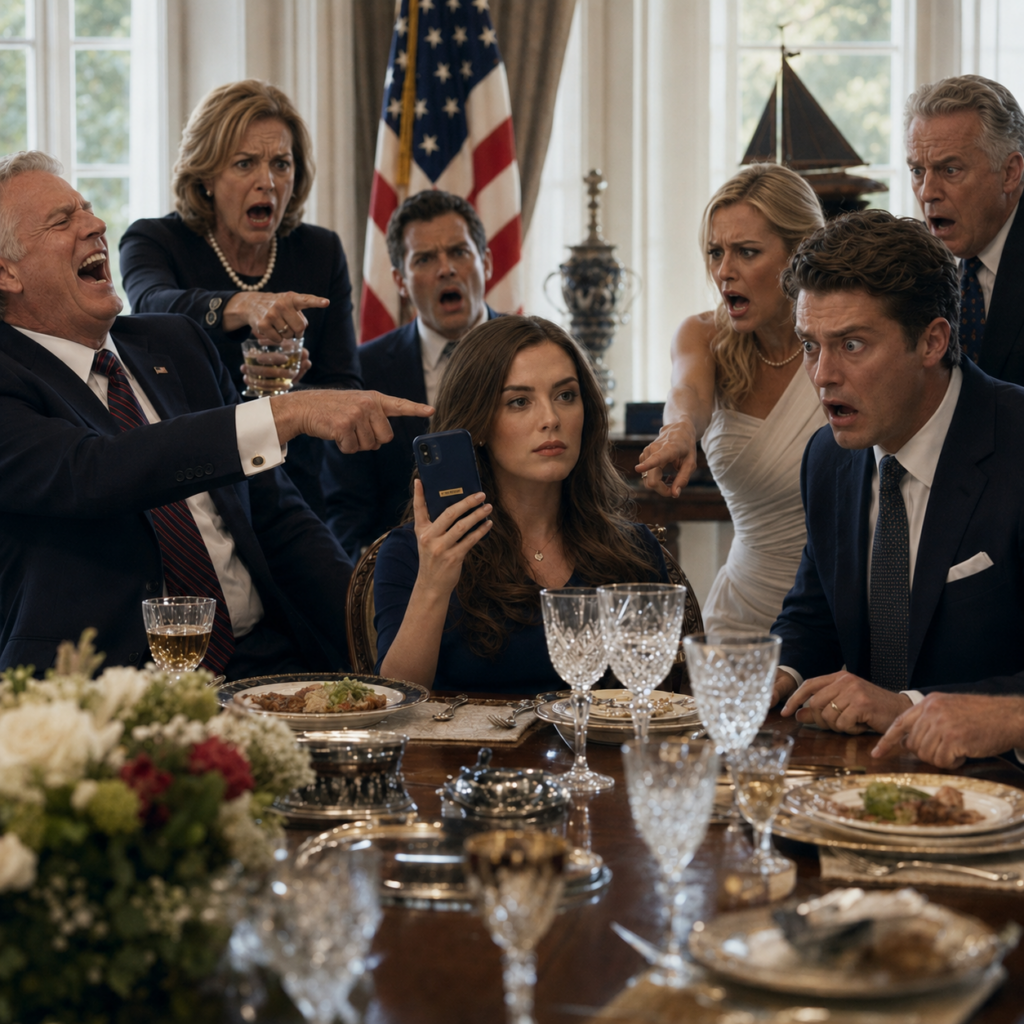
But across the table, Ethan Carlyle stopped smiling.
His eyes locked on my phone.
The blood drained from his face so fast I thought, for one strange second, that he might be having a heart attack.
Then he whispered, barely loud enough for the table to hear, “No.”
Everyone kept laughing.
Everyone except Ethan.
He stood so suddenly his chair scraped the hardwood like a warning shot.
“Jesus Christ,” he said, staring at me. “It’s really her.”
And just like that, the whole room forgot how to breathe.
### Part 2
My father was the first one to break the silence.
“What the hell does that mean?”
Ethan didn’t answer him.
He was still looking at me, not like a man admiring someone, and not even like a man recognizing someone famous.
He looked terrified.
That was what made my hand tighten around the iced tea glass.
Fear has a shape. I had seen it in operations rooms, in the pause before bad news came through a headset, in the eyes of men who knew something had gone wrong and were waiting for the cost.
Ethan Carlyle wore that same shape now.
Claire touched his arm.
“Ethan?”
He pulled away without meaning to.
That tiny movement cut her more deeply than any insult could have. Claire was used to men leaning toward her, not away.
Ethan straightened his jacket, but his hands were not steady.
“Commander Bennett,” he said.
The title hit the table harder than a dropped plate.
My father blinked.
“Commander?”
I picked up my phone and slipped it into my pocket.
“Retired,” I said.
Ethan’s father sat forward. The banker’s smile disappeared. Claire looked from Ethan to me like someone had changed the script and forgotten to hand her the new pages.
“No,” she said with a little laugh. “Hannah was never some big commander. She worked communications.”
Ethan gave her one quick look.
“That is not all she did.”
His voice had dropped. The polished millionaire tone was gone. Underneath it was something older, smaller, almost boyish.
My father snorted, but it came out weaker than usual.
“She fixed radios.”
Ethan turned to him then.
“Sir, with respect, there are people alive today because your daughter kept radios working when everyone else had already decided they were dead.”
Nobody laughed that time.
The jazz trio near the bar kept playing, soft brushes on drums, a lazy piano line floating over the steakhouse noise. Plates clinked at other tables. Somewhere a woman laughed too loudly.
But our table had become a sealed room.
I could feel every eye on me. Claire’s confusion. My father’s irritation. Ethan’s fear. His mother’s dawning curiosity.
I hated it.
There are people who spend their lives chasing applause. I spent mine avoiding attention because attention leads to questions, and questions lead to doors you nailed shut for a reason.
“Ethan,” I said quietly, “sit down.”
He did immediately.
That made everything worse.
My father noticed.
Walter Bennett had spent his whole life believing respect belonged to men who filled rooms with noise. Watching a millionaire obey his quiet daughter must have felt like seeing gravity fail.
“What did she do?” he demanded.
Ethan swallowed.
“I’m not sure how much I’m allowed to say.”
That sentence changed my father’s face.
For the first time that night, uncertainty entered his eyes.
I stood.
Claire grabbed her napkin.
“Hannah, don’t make this dramatic.”
I almost smiled.
That was rich, coming from a woman who once cried in a bridal boutique because the lighting made her collarbones look “uncommitted.”
“I’m not making anything,” I said. “I’m leaving.”
My father pushed his chair back.
“Oh, come on. You don’t get to drop some mystery act and walk out.”
I looked at him.
Really looked.
At the bourbon flush in his cheeks. At the old Navy ring on his finger. At the man who could praise every sailor he had ever served with but could not find one sincere sentence for me.
“You had thirty years to ask,” I said.
His mouth opened, then closed.
Outside, the rain hammered the windows harder.
I walked through the restaurant without looking back. The hostess smiled automatically, then seemed to sense something and stepped aside.
The valet took too long. My coat smelled like wet wool. My pulse stayed flat and cold, the way it always did after impact.
When my truck finally came around, I climbed in and shut the door.
For a few seconds, I just sat there while the windshield blurred.
Then my phone buzzed.
Claire.
I ignored it.
It buzzed again.
Dad.
I ignored that too.
Then a third name appeared.
Ethan Carlyle.
I stared at the screen until it stopped ringing.
Five seconds later, a text arrived.
Commander Bennett, I need to explain something before your family does something foolish.
I read it twice.
Then another message came through.
It’s about Operation Blue Lantern.
The rain suddenly sounded much farther away.
Because nobody at that dinner table should have known that name.
### Part 3
I did not sleep that night.
I made coffee at 3:17 in the morning, not because I wanted it, but because my hands needed something ordinary to do. My townhouse kitchen was dark except for the green glow of the microwave clock and the faint wash of streetlight through rain-streaked glass.
Operation Blue Lantern.
The name sat in my head like a locked metal box.
Most old operations fade at the edges. Faces blur. Dates drift. The body protects itself by sanding down memory until it becomes survivable.
Blue Lantern never sanded down.
It stayed sharp.
At 6:42, Claire called again.
I let it go.
At 6:56, my father called.
I let that go too.
At 7:10, Ethan called.
This time, I answered.
“This is Hannah.”
There was a pause.
“Commander Bennett.”
“Do not call me that in private.”
Another pause.
“Yes, ma’am.”
I closed my eyes.
Military respect can feel like a warm blanket or a knife, depending on who gives it to you.
“What do you want?”
“I owe you an apology for last night.”
“You owe me more than that if you’re texting me classified operation names.”
“I know.”
His voice was tight.
“How do you know Blue Lantern?”
“I was junior logistics support. Carlyle Systems had a subcontract. I wasn’t in command of anything. I was twenty-nine and stupid and scared.”
Carlyle Systems.
A memory flickered. A label on a crate. A relay unit that came in late. A procurement signature I had seen once at two in the morning under red emergency lighting.
I gripped the phone harder.
“You need to stop talking.”
“I’ve carried that night for twenty years.”
“So have I.”
The words came out before I could stop them.
Silence stretched between us.
Then Ethan said softly, “You saved Daniel Hastings.”
I stared at the cold kitchen tile.
“I saved who I could.”
“My company buried things after that operation.”
My breathing slowed.
That was not shock. Shock is loud inside the body.
This was worse.
Recognition.
“I don’t want to hear this over the phone,” I said.
“Then meet me.”
“No.”
“Commander—”
“No.”
I ended the call.
For almost a minute, I stood perfectly still.
Then someone knocked on my front door.
Not a polite knock. A Walter Bennett knock. Two heavy raps, like the door had personally offended him.
I opened it.
My father stood on my porch in an old Navy sweatshirt, rain dripping from the bill of his cap. He looked tired and angry, which was usually his way of hiding scared.
“You ignoring me now?”
“Yes.”
He frowned.
“At least you’re honest.”
I should have shut the door.
Instead, I stepped aside.
He walked into my townhouse like a man entering a museum exhibit he did not understand. His eyes moved over the bookshelves, the framed photo of Naval Station Norfolk, the folded flag in a case on the mantel.
He stopped there.
“Whose flag?”
“Michael’s.”
“Michael who?”
The question landed so hard I almost laughed.
He didn’t know.
Of course he didn’t know.
My fiancé had been reduced in my family history to an absence nobody noticed.
I went to the kitchen and poured coffee because if I looked at my father too long, I might say something cruel enough to be permanent.
He followed.
“What was that dinner last night?”
“A mistake.”
“You know what I mean.”
“No,” I said, setting a mug in front of him. “For once, I don’t think I do.”
He sat at my small kitchen table. He looked too big for it, too old, too late.
“Ethan acted like you were some kind of legend.”
“I’m not.”
“Then why did he look scared of you?”
I watched steam rise from my coffee.
“Because some men are afraid of the truth after they’ve profited from silence.”
My father’s brows drew together.
“What truth?”
I almost told him.
I almost opened the locked box right there in my kitchen, under the hum of the refrigerator, with rain ticking against the windows.
Then I saw his expression.
Not concern.
Curiosity.
The same curiosity people have when they slow down near a wreck.
And something inside me closed again.
“You wouldn’t understand.”
His face hardened.
“There it is. Same old Hannah. Secretive. Superior.”
I looked at him then.
“All my life, you called me boring because you couldn’t brag about me. Now you find out strangers respected me, and suddenly you want a tour of the damage?”
He went still.
For once, he had no joke ready.
Then his eyes shifted toward the folded flag again.
“Who was Michael?”
The room changed.
My throat tightened before I could stop it.
And in that tiny pause, my father finally understood something terrible.
He had not missed one chapter of my life.
He had missed the whole book.
### Part 4
Michael Reyes had a laugh you could hear through steel doors.
That was the first thing I remembered after my father asked about him. Not the uniform. Not the funeral. Not the classified briefings where his name appeared in clean black print like paper could hold the weight of a man.
His laugh.
Low, reckless, warm.
The kind of laugh that made other people believe the room was safer than it was.
I did not tell my father that.
I told him the version I could survive.
“He was Navy,” I said. “Special operations. We were engaged.”
My father stared at me.
“Engaged?”
“Yes.”
“When?”
“Twenty-one years ago.”
His face moved through confusion, then hurt, then something like embarrassment.
“Your mother knew?”
“Yes.”
“Claire?”
“No.”
He looked down at the coffee he had not touched.
“Why didn’t you tell me?”
That question carried so many years inside it that I had to breathe before answering.
“Because when I came home wearing an engagement ring, you spent the whole dinner asking Claire about her new condo. You never noticed.”
He flinched.
I did not feel good saying it.
Truth rarely feels good. It feels clean afterward, maybe, but in the moment it cuts both hands.
My father rubbed his mouth.
“I don’t remember that.”
“I do.”
He looked older then. Not just seventy-eight. Older in the way people age when they realize the past did not happen the way they told themselves it did.
“What happened to him?”
I looked toward the window.
Rain had softened into mist. Across the street, a neighbor’s porch light glowed yellow through the gray morning.
“He died overseas during Blue Lantern.”
My father whispered the name like it had a bad taste.
“That the thing Ethan mentioned?”
I nodded.
“There were communications failures. Bad equipment. Bad timing. Bad decisions. I was on recovery support.”
“You blame yourself.”
“Everybody who survives does.”
“Hannah—”
“No.”
The word came out sharper than I meant.
I set my mug down.
“You don’t get to walk in here after one embarrassing dinner and start comforting me like you were there.”
His eyes filled with something I had never seen from him before.
Shame.
I hated that too.
Anger was easier. I knew what to do with anger.
Shame made him human, and humanity complicated everything.
He stood slowly and walked toward the mantel. For a long moment, he looked at Michael’s folded flag.
“You loved him?”
“Yes.”
“And after he died, you just kept going?”
“What else was I supposed to do?”
He did not answer.
Because that was the thing civilians often misunderstood. Even family. Especially family.
When something inside you breaks, the world does not pause respectfully. The phones keep ringing. The missions continue. The bills arrive. Someone still needs you calm on the radio while young men bleed in places their mothers cannot find on a map.
My father left an hour later without asking for forgiveness.
That was the smartest thing he had done in years.
But before he stepped onto the porch, he turned back.
“Claire’s charity gala is Friday.”
“I know.”
“Ethan wants you there.”
“I’m sure he does.”
My father hesitated.
“I want you there too.”
I studied him carefully.
“Why?”
He opened his mouth, then closed it.
At least he was learning not to lie quickly.
“I don’t know,” he admitted. “Maybe because I want to see what everybody else saw.”
The answer was honest.
It was also not enough.
Still, Friday night I went.
Not for Claire. Not for Ethan. Not even for my father.
I went because Admiral Robert Hastings was listed as the keynote speaker, and if Ethan Carlyle knew about Blue Lantern, Hastings might know why.
The gala filled the downtown Hilton ballroom with chandeliers, white linens, and the expensive smell of perfume, bourbon, and polished money. Claire stood near the entrance in a blue gown, smiling like she had personally invented generosity.
When she saw me, her smile froze.
“You came.”
“You invited me.”
“Ethan invited you.”
“That sounds more accurate.”
Her eyes narrowed.
“Please don’t turn tonight into another scene.”
I almost laughed.
Then I saw him.
Admiral Hastings stood near the windows, white-haired and straight-backed, his cane more decoration than need.
He turned before I reached him.
For a second, his face was formal.
Then recognition broke through.
“My God,” he said softly. “Atlas.”
I had not heard that call sign in twenty years.
Claire was watching from across the room.
Ethan was watching too.
But the admiral’s next words were only for me.
“I hoped I’d see you before they found you first.”
My blood went cold.
“Who is they?”
### Part 5
Admiral Hastings did not answer immediately.
He took my elbow lightly and guided me toward the window, away from the nearest cluster of donors. Outside, the harbor sat black and glossy under scattered lights. Rain clouds hung low enough to make the whole city feel underwater.
“You look tired,” he said.
“I look fifty-two.”
“No. You look hunted.”
I gave him a sideways glance.
“Still dramatic, Admiral?”
“Still deflecting, Commander?”
That almost made me smile.
Almost.
Hastings had been the kind of officer enlisted men trusted and politicians resented. He listened more than he spoke. When he did speak, people leaned in without realizing it.
“Ethan Carlyle contacted me yesterday,” he said.
Of course he had.
“What did he want?”
“To know whether Blue Lantern records were still sealed.”
My fingers tightened around the glass of club soda I had been holding.
“What did you tell him?”
“That frightened men ask careless questions.”
Hastings looked across the ballroom.
Ethan stood beside Claire, but his attention kept drifting toward us. Claire was trying to introduce him to a couple in tuxedos. He barely seemed to hear her.
“Carlyle Systems supplied equipment for that operation,” Hastings said quietly.
“I remember.”
“There was an internal review after.”
“I never saw it.”
“You weren’t meant to.”
That settled between us like smoke.
For twenty years, I had carried my own version of that night. The dead channels. The relay failure. Michael’s team cut off longer than they should have been. My voice steady while my hands shook where nobody could see.
I had blamed weather, bad intelligence, timing, myself.
Maybe the truth had been wearing a company logo all along.
Before I could ask more, a reporter approached with a camera operator behind her.
“Admiral Hastings, could we get a quick comment for the veteran families segment?”
He smiled politely.
“In a moment.”
The reporter’s eyes shifted to me.
“And you are?”
“Nobody,” I said.
Hastings said, “Commander Hannah Bennett.”
I shot him a look.
The reporter’s face lit up with professional hunger.
“Commander Bennett? Were you involved with special warfare communications?”
“No interviews.”
Hastings stepped slightly in front of me.
“She said no.”
The reporter retreated, but not far.
People had noticed.
That is how attention works in wealthy rooms. It moves like spilled wine, spreading under every chair.
One older man approached first.
“Commander Bennett?”
I recognized his pin before his face.
“Chief Donnelly,” I said.
His eyes watered.
“My nephew came home because of you.”
Then another man came. Then a woman whose husband had been evacuated from a failed reconnaissance operation. Then a retired colonel who gripped my hand in both of his and said, “You were the calmest voice I ever heard in hell.”
I did not know what to do with any of it.
Praise embarrassed me more than insult. Insults I understood. My family had trained me well.
Across the ballroom, Claire watched the crowd gather around me, her perfect smile slowly cracking at the edges.
My father stood near the bar, bourbon untouched in his hand.
He looked stunned.
Not proud yet.
Stunned.
As if somebody had opened a door in his house and revealed a cathedral behind the laundry room.
Claire finally crossed the room.
“What is going on?” she asked, laughing too brightly.
No one laughed with her.
Chief Donnelly wiped his eyes and said, “Your sister carried half of us through the worst nights of our lives.”
Claire looked at me.
“You never told me.”
“You never asked.”
Her face went pale.
Ethan appeared behind her.
“Hannah,” he said quietly, “we should talk somewhere private.”
I turned toward him.
“Why? Afraid somebody here knows more than I do?”
His jaw tightened.
Claire blinked.
“What does that mean?”
Before Ethan could answer, an elderly woman in a black dress moved beside me. I had seen her earlier near the memorial display. She pressed a folded program into my palm.
Her voice was barely more than breath.
“My husband worked quality control at Carlyle Systems. He died with guilt in his throat.”
Then she walked away.
I opened the program.
Inside, written in shaky blue ink, were seven words.
Ask Ethan about the failed relay report.
The ballroom noise faded.
When I looked up, Ethan Carlyle was staring at the paper in my hand.
And he knew exactly what I had just read.
### Part 6
I did not confront Ethan at the gala.
That surprised him.
It surprised me too.
Twenty years earlier, I might have dragged him into a hallway and demanded every dirty detail with my voice low and my pulse steady. But age does something useful to anger. It teaches it patience.
Instead, I folded the program, slipped it into my purse, and stayed for the speeches.
Claire spent the rest of the night watching me like I had stolen something from her.
My father watched everyone else watching me.
Ethan watched the exits.
By the time I got home, my feet hurt, my dress smelled faintly of hotel flowers, and my phone had sixteen missed calls.
Three from Claire.
Two from my father.
Eleven from Ethan.
I turned the phone off.
Saturday passed in a strange quiet.
I cleaned my kitchen. Changed the air filter. Took my truck through a car wash even though rain was forecast again. Ordinary chores can hold a person together when memory starts pulling nails out of the walls.
Sunday morning, my father arrived with biscuits and sausage gravy from Davis Diner.
That was how Walter Bennett apologized. Food, not words. A paper bag instead of a confession.
I opened the door.
“You keep feeding me like this, I’ll start thinking you feel guilty.”
He looked down.
“I do.”
That stopped me.
He stepped inside more carefully than last time.
We ate at the kitchen table. The biscuits were still warm, steam rising when I split one open. Outside, gulls cried over the townhouse roofs, sharp and ugly, like the coast clearing its throat.
My father waited until I had taken two bites.
“Claire says Ethan was upset last night.”
“That must have been difficult for him.”
He sighed.
“Hannah.”
I set down my fork.
“If you came here to protect him, leave.”
“No.” He looked offended, then seemed to reconsider whether he had earned the right. “No. I came because I don’t know how to talk to you, and I’m trying anyway.”
That was unfair.
Not because it was cruel.
Because it was better than I expected.
I leaned back.
“Then talk.”
He stared at the table.
“I saw those men last night. The way they looked at you.” His voice roughened. “I never looked at you like that.”
“No.”
“I made you small.”
“Yes.”
He flinched again, but he stayed.
“When your mother was dying,” he said quietly, “she told me I had two daughters and only knew one of them.”
I looked away fast.
The kitchen blurred.
“She said that?”
“She said Claire was easy to love because she demanded it.” His mouth twisted. “She said you were harder because you never asked.”
I closed my eyes.
That sounded like Mom.
Soft voice. Sharp truth.
“She knew about Michael,” I said.
“I found that out after she died.”
“What?”
My father reached into his coat pocket and pulled out a small envelope, yellowed at the edges.
“She left this in her jewelry box. I didn’t open it until last night.”
My name was written on the front in my mother’s handwriting.
Hannah, when you are tired of being the strong one.
My fingers trembled when I took it.
Inside was a photograph of Michael and me outside a base chapel. I was younger, thinner, smiling in a way I barely recognized. Michael had one arm around my waist, his grin wide enough to challenge the sun.
Behind the photo was a note.
Baby girl, I saw him. I saw you with him. I saw what losing him did. Your father is blind in the places he is most afraid to look. Do not spend your whole life waiting for blind people to describe the light.
I pressed my hand over my mouth.
My father’s eyes were wet.
“I didn’t know,” he whispered.
“No,” I said. “You didn’t want to know.”
He nodded once.
That mattered.
But it did not fix anything.
A phone buzzed on the table. Mine. I had turned it back on only an hour earlier.
Claire.
This time, instead of a call, she sent a text.
You need to stop whatever you’re doing. Ethan says this could destroy him. Don’t punish me because Dad finally noticed you.
My father read my face.
“What is it?”
I handed him the phone.
He read the message.
Then, to my amazement, he did not defend Claire.
He only whispered, “Oh, honey.”
I looked at him coldly.
“Which daughter were you talking to?”
### Part 7
Claire arrived at my townhouse that afternoon wearing oversized sunglasses even though the sky was gray.
She did not knock so much as announce herself against the door.
When I opened it, she pushed the glasses onto her head and looked me up and down.
“Are you enjoying this?”
“No.”
“You always do that.”
“What?”
“Act calm so everyone else looks crazy.”
I stepped aside.
“Come in or don’t.”
She came in.
Claire had never liked my townhouse. Too quiet. Too plain. No marble island, no framed vacation photos, no curated evidence of joy. My life did not perform well, and Claire distrusted anything that refused to perform.
She stood in the living room, arms crossed.
“Ethan is under a lot of pressure.”
“I’m sure.”
“He has employees. Contracts. A reputation.”
I laughed once.
There was no humor in it.
“Interesting list of victims.”
Her eyes flashed.
“You don’t know what he’s been through.”
That almost impressed me.
Claire had known Ethan for fourteen months. I had spent twenty years waking up with Blue Lantern in my bones. But somehow, in her mind, his discomfort had already outranked the dead.
“What did he tell you?” I asked.
“That you’re exaggerating something old.”
“Something old?”
“It was wartime.”
I went still.
“Who taught you that phrase?”
She hesitated.
There it was.
Ethan.
Of course.
Men like Ethan rarely say, I made money while others paid the price. They say, It was complicated. They say, Systems failed. They say, We all did our best under difficult circumstances.
I walked to the bookshelf and took down a small metal box.
Claire watched as I opened it.
Inside were things I almost never touched. Michael’s ring. A folded chapel program. A scratched challenge coin. A piece of paper with coordinates written in my own hand.
I held up the ring.
“This belonged to the man I was going to marry.”
Claire stared.
“What?”
“He died during the operation your fiancé is calling ‘something old.’”
Her mouth opened.
Nothing came out.
For once, Claire Bennett had no line ready.
“I didn’t know,” she whispered.
“No. You didn’t.”
“You never told me.”
“You never cared why I came home different.”
Her eyes filled, but I did not soften.
Not yet.
Tears were not always remorse. Sometimes they were just panic leaving the body.
She sank onto the edge of my couch.
“Ethan said the report was unfair.”
“So there was a report.”
Her face changed.
She had given away too much.
I sat across from her.
“Claire.”
She looked at me like a cornered animal.
“What report?”
“I don’t know details.”
“But you know enough to come here and ask me to stop.”
She wiped under one eye carefully, protecting her mascara by instinct.
“He said Carlyle Systems supplied a relay unit. He said it failed in bad weather, but nobody could prove it caused anything.”
“Anything,” I repeated.
The room seemed to tilt.
Michael’s last confirmed position. Dead air. A rescue window shrinking minute by minute. Men cut off from command while I tried to rebuild a communications path from fragments.
Anything.
Claire leaned forward.
“Hannah, please. Ethan loves me. This wedding is my future.”
“And Michael was mine.”
That shut the room down.
For a moment, the only sound was the heater clicking on.
Claire’s voice shrank.
“What do you want?”
The question was honest in the ugliest possible way.
Not, What happened?
Not, How can I help?
What do you want?
As if truth were a negotiation.
“I want him to tell the truth.”
“He can’t.”
“Then he can live afraid.”
She stood fast.
“You have always judged me.”
I stood too.
“No, Claire. I envied you once. There’s a difference.”
That stunned her.
I walked to the door and opened it.
She looked small suddenly. Small and furious and frightened.
“You’ll ruin everything,” she whispered.
I shook my head.
“No. I’m just refusing to keep holding up the lie.”
She stepped onto the porch.
Before leaving, she turned back.
“Dad won’t choose you over me.”
The words hit an old bruise.
But this time, I did not bleed.
“He already chose,” I said. “Years ago.”
Her face crumpled.
Then she walked away.
Ten minutes later, my father called.
His voice was strained.
“Hannah, Ethan wants to meet. He says if you hear him out, you’ll understand.”
I closed my eyes.
Behind him, I could hear Claire crying.
And I knew then that my family had not come looking for me.
They had come looking for my silence.
### Part 8
Ethan chose a private club in downtown Norfolk for the meeting.
That told me everything before he said a word.
Men who want forgiveness choose kitchens, hospital rooms, park benches, places where human beings have to look at each other without polished wood between them.
Men who want control choose private clubs.
The lobby smelled like leather, lemon oil, and old money. Portraits of admirals and shipbuilders lined the walls, their painted eyes following me down the hall as if history itself had paid membership dues.
Ethan stood when I entered the library.
So did my father.
Claire stayed seated.
That hurt more than I expected.
Not because I needed her respect, but because I saw the calculation in it. She had decided stillness made her look wounded.
“Hannah,” Ethan said.
“Mr. Carlyle.”
He flinched slightly.
Good.
On the table between us sat coffee, untouched pastries, and a leather folder.
My father looked miserable.
Claire looked angry.
Ethan looked prepared.
Prepared men are dangerous.
“I asked you here,” Ethan began, “because there are misunderstandings about Blue Lantern.”
I sat down.
“No, there are secrets about Blue Lantern. Misunderstanding is what people call secrets after they get caught.”
His jaw tightened.
Claire snapped, “Can you not attack him for five minutes?”
I turned to her.
“Can you not defend him for five minutes?”
My father rubbed his forehead.
“Everybody calm down.”
I looked at him.
He lowered his hand.
Ethan opened the folder.
“The relay failure was investigated. Carlyle Systems was not found criminally liable.”
“Criminally,” I said.
“That word matters.”
“Yes,” he admitted. “It does.”
There was the businessman again. Careful, polished, making room for himself between syllables.
“What happened?” I asked.
He looked down.
“The unit had shown intermittent signal degradation in humidity tests.”
The library went silent.
I felt my pulse in my teeth.
“Say that again.”
Ethan swallowed.
“Engineering flagged possible degradation. The issue was considered manageable.”
“Manageable.”
“I was not the decision-maker.”
“But you knew.”
“I knew after.”
“After Michael Reyes died?”
His eyes closed.
Claire whispered, “Hannah.”
“No.” My voice stayed quiet. “He can answer.”
Ethan opened his eyes.
“Yes. After.”
My father’s face had gone gray.
He looked from Ethan to me to Claire, as if each of us had become someone else in the last thirty seconds.
“Did your company bury it?” I asked.
Ethan’s silence answered first.
Then he said, “The report was contained.”
Contained.
That word took me back to windowless rooms and redacted files. Contained was what people said when truth had been locked away neatly enough for promotions to continue.
Claire’s voice shook.
“But Ethan didn’t kill anyone.”
I looked at her.
“No. Negligence is usually less dramatic than murder. The dead stay just as dead.”
She recoiled.
My father whispered, “Jesus.”
Ethan leaned forward.
“I have spent years trying to build a better company.”
“With defense contracts funded by the same trust your father protected.”
“My father made decisions I can’t undo.”
“But you benefited from them.”
His face reddened.
“Yes.”
There it was.
A true word at last.
I looked at the leather folder.
“What do you want from me?”
Ethan hesitated.
Claire answered.
“We want you to sign a statement.”
I laughed because for a second I thought she was joking.
She was not.
My father would not meet my eyes.
“What kind of statement?” I asked.
Ethan slid a page across the table.
I did not touch it.
He cleared his throat.
“It says that, to your knowledge, multiple operational factors contributed to the communication failure, and no single contractor can be blamed.”
I stared at the paper.
Then at my father.
“You knew?”
He looked broken.
“Claire said this could save the wedding.”
The sentence emptied something inside me.
Not anger.
Hope.
Hope left quietly, like a tired guest slipping out during dessert.
I stood.
Claire started crying.
“Hannah, please. I love him.”
I looked at my sister, then at my father.
“I loved someone too.”
No one spoke.
I picked up the statement, folded it once, then tore it clean down the middle.
The sound was small.
The damage was not.
Outside the club windows, thunder rolled over the harbor.
By the time I reached my truck, my phone was already flashing with storm warnings.
And for once, the weather outside looked exactly like the weather inside my family.
### Part 9
The storm hit Norfolk sideways.
Not a hurricane. Not the kind of storm people in other states watch on the news while saying bless their hearts.
This was a local monster.
A coastal low that came in mean and fast, dragging tidewater into streets, ripping shingles off old roofs, turning familiar intersections into brown rivers.
I was home when the emergency alerts started stacking on my phone.
Flood warning.
Power outage.
Road closures.
Then my father called.
I almost ignored him.
Almost.
“Hannah,” he said when I answered.
Wind roared behind his voice.
“Where are you?”
“Near the marina apartments. Claire called me. Her friend’s grandmother lives here. Water’s rising fast.”
I stood.
“Dad, get out of there.”
“There are people trapped.”
Of course there were.
And of course Walter Bennett, stubborn old fool that he was, had driven straight toward trouble because men like him understood physical danger better than emotional repair.
I grabbed my coat, flashlight, and old field radio from the hall closet.
By the time I reached the marina district, police lights smeared red and blue across floodwater. Rain hammered my windshield so hard the wipers could barely keep up. The air smelled like salt, gasoline, and wet electrical lines.
The apartment building sat low near the water, a tired three-story structure from the seventies with balconies full of plastic chairs and wind-torn plants.
People were shouting from upper windows.
A firefighter was yelling into a radio.
Neighbors stood in ponchos, useless and terrified.
I found my father near a utility truck, soaked through, his face pale under the flashing lights.
When he saw me, relief broke over him.
“Hannah.”
“What’s the situation?”
He blinked.
That was the first time I had ever asked him that like he was not my father but another person on scene.
He answered fast.
“Stairwell’s partially collapsed. Six, maybe eight residents upstairs. Two can’t walk. Fire crew can’t get rear access because the alley’s flooded.”
A young police lieutenant turned.
“Who are you?”
“Retired Navy communications.”
He looked desperate enough not to care.
“Can you help with radios? Half ours are cutting out.”
I took the spare handset from him and listened.
Static. Overlapping channels. Panic chewing through procedure.
Old training woke up in me like a dog hearing its name.
“Separate traffic,” I said. “Fire on channel two. Police on four. Medical staging on six. Nobody talks over evacuation calls unless someone is dying right now.”
The lieutenant stared.
Then nodded.
“Do it.”
People listen when someone sounds calm enough to borrow.
Within five minutes, I had neighbors forming a human line, firefighters moving ropes to the east side, and a city worker cutting power to the flooded lower units.
Rain ran down my neck. My knees screamed. My bad shoulder burned.
I felt more alive than I had in months.
Not happy.
Useful.
There is a difference.
Inside the building, the air was wet and sour, full of mildew, seawater, and fear. Water pushed against my thighs in the lower hall. Flashlights jittered across cracked walls.
An elderly man clutched my sleeve.
“My wife can’t walk.”
“We’ll carry her.”
“You promise?”
I looked him in the eye.
“Yes.”
Promises in disasters are not poetry. They are tools. You use them carefully because people build survival around them.
We got his wife out strapped to a backboard, then a man with an oxygen tank, then two sisters in matching pink bathrobes who argued the whole way down because fear had turned them back into children.
Near the end, a little terrier got trapped under a bed.
A firefighter said no.
The building groaned.
The woman who owned the dog sobbed so hard she nearly collapsed.
I went back.
It was stupid.
It was also necessary.
I found the animal shaking behind a plastic storage bin, wrapped it inside my coat, and carried it out while the eastern wall made a sound like an old ship under pressure.
When I stepped into the rain, the woman screamed with relief.
Then everyone started clapping.
I hated that part.
I handed over the dog and walked toward the command truck.
That was when I saw Claire.
She stood under a canopy beside my father, mascara streaking down her cheeks, phone in her hand.
Recording.
My father was crying.
Not quietly.
Openly.
And when a local reporter pushed a microphone toward him and asked who had coordinated the rescue, he said in a voice full of wonder, “That’s my daughter.”
The words should have healed something.
Instead, they opened a new wound.
Because pride that arrives only after witnesses gather is not love.
It is a performance with better lighting.
### Part 10
By morning, my face was on the local news.
Retired Navy officer helps rescue flood-trapped residents.
The headline made me sound cleaner than I felt.
They showed footage of me in the rain, shouting instructions, carrying the terrier under my coat, guiding an elderly woman into an ambulance. They showed my father too, soaked and trembling, telling the reporter, “That’s my daughter.”
By noon, strangers were leaving comments under the video.
Hero.
Legend.
God bless our veterans.
Your family must be so proud.
That last one made me set the phone face down.
At 1:15, Claire posted the video with a caption.
My brave sister Hannah. So proud of our family’s legacy.
Our family’s legacy.
I stared at those words until they blurred.
Two weeks earlier, I had been the boring sister who fixed radios. Now I was legacy.
At 2:03, Ethan called.
I did not answer.
At 2:15, my father called.
I answered because I still had not learned.
“You okay?” he asked.
“Sore.”
“You were incredible last night.”
“Dad.”
“I mean it.”
His voice was thick. Emotional. Almost tender.
That made what came next worse.
“Ethan wants to make a public donation to the displaced residents,” he said. “Big one. Claire thinks it would help if you stood with them at the press conference.”
I said nothing.
He rushed on.
“Not for him. For the people. For the city.”
There it was.
Wrapped in charity paper, but still the same request.
Use your credibility to clean his hands.
“No.”
“Hannah—”
“No.”
“Just listen.”
“I have been listening my entire life.”
He exhaled.
“Claire’s falling apart.”
“Claire is experiencing consequences.”
“That’s your sister.”
“I know. I was there when she forgot.”
His voice hardened slightly.
Old Walter pushing through new remorse.
“Don’t be cruel.”
I almost laughed.
Cruel.
The word people use when boundaries inconvenience them.
“I’m not going to stand beside Ethan Carlyle.”
“He’s trying to do good.”
“He’s trying to survive.”
“Maybe both.”
“No.”
My father went quiet.
Then he said the sentence that ended us.
“After all these years, can’t you do one thing for this family?”
I felt something inside me go perfectly still.
Not break.
Settle.
Like a door closing gently but completely.
“One thing,” I repeated.
“Hannah, I didn’t mean—”
“Yes, you did.”
I hung up.
That evening, the three of them came to my townhouse anyway.
Ethan in a dark coat, looking exhausted. Claire in jeans and a sweater, her eyes swollen from crying. My father standing behind them like a man who had brought a match to a gas leak and only now smelled fumes.
I opened the door but did not invite them in.
Ethan spoke first.
“The press conference is tomorrow at ten.”
“Congratulations.”
“I would like you there.”
“No.”
Claire stepped forward.
“You are punishing me.”
“I’m protecting myself.”
“From what? Being loved?”
That one almost made me pity her.
Almost.
“Claire, love is not what people offer when they need a signature.”
My father looked away.
Ethan lowered his voice.
“I can release a statement acknowledging past mistakes.”
“Then do it.”
“With your support, people will believe I’m sincere.”
“Without my support, maybe you’ll have to actually be sincere.”
His eyes flashed.
There he was.
The frightened man beneath the polish.
“You think I’m a monster.”
“No. Monsters are simple. You’re worse. You’re respectable.”
Claire gasped like I had slapped him.
My father whispered, “Hannah, please.”
I looked at him.
For one second, I saw the man who brought biscuits, who read my mother’s letter, who almost understood.
Then I saw the man at the dinner table, bourbon in hand, teaching strangers how little I mattered.
“I will not forgive you just because you finally found a use for me,” I said.
My father’s face crumpled.
Behind them, thunder rolled again over the river.
Then my mailbox creaked in the wind.
A large envelope stuck out halfway, soaked at the edges.
Government return address.
My name printed in black.
I reached past them and pulled it free.
Inside was a notice I had requested years ago and forgotten.
A partial declassification release.
Operation Blue Lantern.
Ethan saw the header.
For the second time since I had met him, all the color left his face.
### Part 11
I did not open the Blue Lantern envelope in front of them.
That would have been satisfying.
I had learned not to confuse satisfaction with strategy.
Instead, I held the soaked envelope against my chest and looked at Ethan.
“You should leave.”
Claire’s eyes were fixed on the packet.
“What is that?”
“The past,” I said.
My father whispered, “Hannah.”
“No. You leave too.”
He looked like he wanted to argue, but something in my face stopped him.
They left in silence.
Ethan paused once at the walkway, rain misting his expensive coat.
“If that report says what I think it says,” he said, “you need to understand the consequences.”
I smiled.
For the first time, it felt real.
“I have lived with consequences for twenty years.”
I shut the door.
Then I made coffee, dried the envelope with a towel, and opened the past at my kitchen table.
The release was partial. Heavy redactions. Black bars swallowing names, locations, timings, entire paragraphs.
But enough remained.
Enough to confirm what my memory had always circled but never landed on.
Relay Unit CR-17 exhibited signal loss under sustained humidity exposure.
Prior quality concern noted.
Operational waiver approved by contractor liaison.
Communications disruption contributed to delayed extraction coordination.
Potential survivability impact: significant.
I read that line five times.
Potential survivability impact: significant.
That was how government language mourned.
No tears. No blood. No name.
Just significant.
Michael Reyes had been reduced to a category.
I sat there until sunrise.
At 8:30, Admiral Hastings called.
“I assume you received the release.”
“You knew it was coming?”
“I pushed it.”
“Why?”
“Because Ethan asked too many questions. Because his father is dead. Because men like him rewrite history unless someone keeps a copy.”
I looked at the pages spread across my table.
“What am I supposed to do with this?”
“That depends on whether you want peace or truth.”
I laughed quietly.
“Admiral, those have never been the same thing.”
He sighed.
“No. They haven’t.”
The press conference was at ten outside a temporary flood relief center near the marina.
I arrived at 9:57.
Not because Ethan asked.
Because Admiral Hastings had arranged for me to speak on behalf of the rescue volunteers.
Claire spotted me first.
Hope lit her face so quickly it hurt to see.
She thought I had come around.
My father looked relieved.
Ethan looked careful.
Cameras lined the sidewalk. City officials stood near folding tables stacked with bottled water and blankets. The air smelled like mud, wet cardboard, and diesel from generators.
Ethan stepped toward me.
“Hannah.”
I walked past him.
The mayor spoke first. Then a fire captain. Then Ethan announced a large donation in the smooth voice of a man practiced at public goodness.
People clapped.
Claire clapped hardest.
Then Admiral Hastings introduced me.
I stood behind the microphone in my plain navy coat.
For a moment, I saw everything at once.
The cameras. The flood victims. Ethan’s anxious eyes. Claire’s pleading face. My father’s trembling hands.
I had spent my life keeping other people steady.
I was tired.
“I’m not here to endorse anyone,” I said.
The applause died strangely.
Ethan froze.
“I’m here because last night, ordinary neighbors, firefighters, police officers, EMTs, and volunteers saved lives. No one person did that. Service is not a photograph. It is not a headline. It is not a donation made when cameras are rolling.”
Claire’s face went white.
I continued.
“Service is what you do when nobody important is watching. It is what you do when telling the truth costs more than silence.”
Ethan stepped back half an inch.
Reporters noticed.
Good reporters always notice fear.
One of them raised a hand.
“Commander Bennett, are you referring to something specific?”
I looked at Ethan.
Then at my father.
Then at the people who had lost homes in dirty floodwater and still had more honesty in their exhaustion than the wealthy men behind me had in their speeches.
“Yes,” I said.
Ethan whispered, “Don’t.”
The microphone caught it.
Every camera turned toward him.
And that was when I opened the folder.
### Part 12
I did not read the whole report.
I did not need to.
The truth, when it has been buried long enough, does not require decoration. It only needs air.
“In Operation Blue Lantern,” I said into the microphone, “a communications relay supplied by Carlyle Systems suffered failure under environmental conditions that had been previously flagged.”
A reporter said, “Carlyle Systems? Related to Carlyle Defense Manufacturing?”
Ethan’s mouth tightened.
“Yes,” I said.
Claire covered her lips with one hand.
My father closed his eyes.
I kept my voice steady.
“The released review indicates the failure contributed to delayed extraction coordination.”
Someone asked, “Were lives lost?”
The world narrowed.
For a second, I was not standing outside a flood relief center in Norfolk.
I was back in a blue-lit operations room, headset pressed to my ear, one channel dead, another breaking apart, Michael’s team overdue, my own voice calm enough to fool everyone but myself.
“Yes,” I said.
The word left me quietly.
It struck hard anyway.
Ethan moved toward the microphone.
“The report is incomplete,” he said quickly. “It was a complex operation involving many factors. My company today is not the company my father ran then.”
A reporter fired back.
“But you knew about this before today?”
Ethan hesitated.
That hesitation ruined him.
Cameras love hesitation. So do guilty rooms.
Claire grabbed his arm.
“Ethan, say something.”
He looked at her, and for the first time I saw resentment there.
Not love.
Resentment.
Because Claire had wanted the shine of his life, not the shadow. Now the shadow had reached for both of them.
“My legal team will respond,” he said.
There it was.
Not apology.
Legal team.
The crowd shifted. The donation banner flapped in the damp wind. Behind us, flood victims watched with blankets around their shoulders, seeing another kind of wreckage unfold.
My father stepped toward me.
“Hannah.”
I lowered the folder.
He looked destroyed.
Part of me wanted to comfort him.
That old reflex is hard to kill. The child in you still wants to pat the parent’s hand, still wants to say it’s okay even when it is not.
But I was not a child anymore.
Claire turned on me first.
“You couldn’t let me have one thing?”
I stared at her.
“One thing?”
“My wedding, my future, my life. You had to make it about you.”
The absurdity was so complete that I almost felt calm.
“Michael lost his future.”
Her face twisted.
“I didn’t kill Michael.”
“No. You just asked me to stand beside the man who helped bury why he died.”
Ethan snapped, “I was not responsible for every decision my father made.”
I turned to him.
“But you were responsible for every day you benefited from the silence afterward.”
He had no answer for that.
The press conference dissolved into shouting questions. City staff tried to redirect cameras. The mayor disappeared behind an aide. Admiral Hastings placed one hand lightly on my shoulder, not to guide me, just to remind me I was not alone.
My father followed me toward the parking lot.
Rain mist clung to his hair.
“Hannah, wait.”
I stopped beside my truck.
He looked smaller than I had ever seen him.
“I’m sorry,” he said. “For all of it. For the dinner. For Claire. For asking you to help them. I don’t know why I keep failing you.”
That was the closest he had ever come to the full truth.
It still arrived late.
“I believe you’re sorry,” I said.
Hope flickered in his eyes.
I hated having to put it out.
“But I don’t forgive you.”
His face broke.
I continued before he could speak.
“Forgiveness is not a prize people get for finally noticing the wound. You mocked me when I was quiet. You used me when I was valuable. Both versions hurt.”
Tears ran down his cheeks.
“I’m your father.”
“I know.”
That was the tragedy.
Claire called my name from across the lot, furious and crying. Ethan stood behind her surrounded by reporters, no longer looking like a millionaire, just a man watching polished glass crack around him.
My father reached for me.
I stepped back.
The movement was small.
Final.
He understood.
I got into my truck and drove away while he stood in the rain.
In the rearview mirror, he looked like every regret in America wearing an old Navy jacket.
And for the first time in my life, I did not turn around.
### Part 13
The investigation did not happen fast.
Real consequences rarely arrive like thunder. They arrive like paperwork.
First came the news segments. Then the defense industry statements. Then Carlyle Defense Manufacturing announced an “independent review.” Then two former engineers came forward. Then a senator’s office requested documents.
Ethan stepped down temporarily.
Temporarily is another word wealthy men use when they hope the country gets distracted.
Claire canceled the wedding but kept the ring for three weeks before returning it. I knew because she texted me a photo of the empty ring box at 11:48 p.m. with one sentence.
I hope you’re happy.
I deleted it.
My father called every day for a month.
I answered once a week at first. Then every other week. Then not at all.
Not because I hated him.
Hate keeps people close. Hate feeds on updates.
I wanted distance.
That was healthier and sadder.
He left voicemails that changed over time. The early ones were desperate. Then apologetic. Then quieter.
“I saw a documentary about women in military intelligence. Thought of you.”
“Fixed that loose porch rail you mentioned years ago.”
“Found another photo of your mother. You look like her when you’re annoyed.”
I listened to some.
Not all.
Boundaries are not walls built from anger. They are fences built from self-respect. People who benefited from your open fields will always call fences cruel.
Winter settled over Norfolk with cold rain and gray skies.
I took a part-time consulting job training emergency response teams in communications discipline. Nothing glamorous. Community centers, fire stations, county offices with bad coffee and flickering fluorescent lights.
I liked it.
Young responders listened when I told them panic wastes bandwidth. Older ones nodded when I said the calmest person in the room is not always the loudest.
Sometimes after class, someone would linger.
A firefighter with shaking hands after his first fatal call.
A dispatcher who could not sleep after hearing a child scream.
A veteran who laughed too loudly until I asked one gentle question and his eyes filled.
Quiet people found me.
Maybe because I had stopped hiding from them.
In March, I drove to Arlington.
The sky was pale and clean, the grass just beginning to green between rows of white stones. I carried yellow flowers because Michael had once said roses tried too hard.
His grave sat beneath an oak tree.
I knelt slowly.
“Your report finally learned how to speak,” I said.
Wind moved through the branches.
I stayed there a long time.
I told him about the dinner, about Ethan’s face, about Claire’s rage, about my father saying sorry too late. I told him I was tired. I told him I was alive.
That last part felt important.
Before leaving, I removed his ring from the chain around my neck.
For twenty years, I had carried it like proof that love had once chosen me.
Now I pressed it into the soil at the base of his headstone.
Not because I was done loving him.
Because I was done living as a monument to what I lost.
Back in Norfolk, spring came soft and salty.
One Sunday, my father left a letter in my mailbox instead of calling.
No pressure, the first line said. Just the truth.
I almost threw it away.
Instead, I made coffee and read it at the kitchen table.
He wrote about the first time he held me as a baby. How quiet I had been. How that quiet scared him because Claire had screamed at the world from the moment she arrived, and he understood need when it made noise.
You needed me quietly, he wrote. I mistook that for not needing me at all.
I cried then.
Not forgiveness.
Grief.
There is a difference.
I folded the letter and put it in a drawer.
I did not call him.
Maybe one day I would.
Maybe not.
A month later, I saw Claire at Davis Diner.
She was sitting alone in a booth, no makeup, stirring coffee she had not drunk. For a second, we simply looked at each other across the room.
Then she stood.
I thought she might leave.
Instead, she walked over.
“You look good,” she said.
“I look the same.”
“No,” she said. “You don’t.”
That was probably true.
She asked if we could talk sometime.
I said, “Not yet.”
Her eyes filled, but she nodded.
For once, she accepted an answer she did not like.
That was growth.
It was not reconciliation.
People confuse those two things because reconciliation makes prettier stories.
But some endings are not hugs around a dinner table. Some endings are a woman drinking coffee alone, no longer shrinking so other people can feel tall.
On Memorial Day, I attended a small ceremony near the harbor.
No cameras. No donors. No private clubs.
Just veterans, families, folding chairs, flags snapping in the wind, and the smell of salt off the river.
Afterward, a young Navy communications officer approached me. She could not have been more than twenty-six. Her uniform was too perfect, her expression too nervous.
“Commander Bennett?”
“Retired,” I said.
“Yes, ma’am.” She hesitated. “They told us about you in training.”
I looked past her toward the water.
For once, the recognition did not feel like a threat.
It felt like a handoff.
“What did they tell you?”
She smiled.
“That when everything goes wrong, keep your voice steady. Somebody out there might survive because you don’t panic.”
The wind lifted the edge of my coat.
Across the harbor, sunlight broke through clouds and scattered over the water in bright, uneven pieces.
I thought of my father at that dinner table, laughing.
I thought of Ethan whispering, Jesus Christ, it’s really her.
I thought of Michael’s laugh behind steel doors.
Then I looked at the young officer and nodded.
“That’s a good lesson,” I said.
She asked if I had any other advice.
I did.
“Don’t wait for the people who ignored your service to decide it mattered,” I told her. “Know it before they do.”
She stood a little straighter.
“Yes, ma’am.”
I walked back to my truck alone.
My phone buzzed once as I reached the parking lot.
A message from my father.
Thinking of you today. Proud of you. No need to answer.
I read it.
Then I put the phone away.
Some love arrives too late to be trusted with the front door.
But that does not mean you have to live outside yourself forever.
I started the truck, rolled down the window, and let the salt air in.
For the first time in years, the quiet around me did not feel like loneliness.
It felt like peace.
THE END!
Disclaimer: Our stories are inspired by real-life events but are carefully rewritten for entertainment. Any resemblance to actual people or situations is purely coincidental.