Two Navy SEALs Called Me “Princess”… Then Their War Dog Heard My Voice and Crawled to My Feet.

PART 1 — THE DOG DIDN’T BARK. HE REMEMBERED.
“Wrong bar, princess.”
That was the first thing the bigger one said when I stepped into The Rusty Anchor at 10:47 on a wet Thursday night.
He didn’t say it quietly.
Men like him never do.
They want the room to hear it. They want the bartender to smirk, the biker by the jukebox to snort into his beer, the tired waitress to look away because she has rent due and no interest in babysitting grown men with military haircuts and unresolved anger.
I stopped just inside the door and let the place take inventory of me.
Cracked neon Bud Light sign.
Sticky floor.
Peanut shells crushed under boots.
A Dodgers game playing on a TV with bad color.
Three contractors in the corner pretending not to watch.
A bartender wiping the same glass like he was trying to remove evidence.
And two men at the bar who had no idea I already knew their names.
Petty Officer Jackson Cole sat on the left.
Six feet two, jaw like a cinder block, faded leather jacket, old scar across the knuckles of his right hand. He had the posture of a man who could sleep through mortar fire but still hear a safety click from across a room.
Brody Evans sat beside him.
Brody had the grin.
Every unit has one.
The guy who makes a joke three seconds before things go bad, then becomes terrifyingly quiet when the room runs out of oxygen.
Under their stools, in the shadow between their boots, lay the reason I had burned a perfectly good cover identity to walk into that dump.
Kota.
They called him Titan now.
Cute.
The Department of Defense loved renaming things it had stolen.
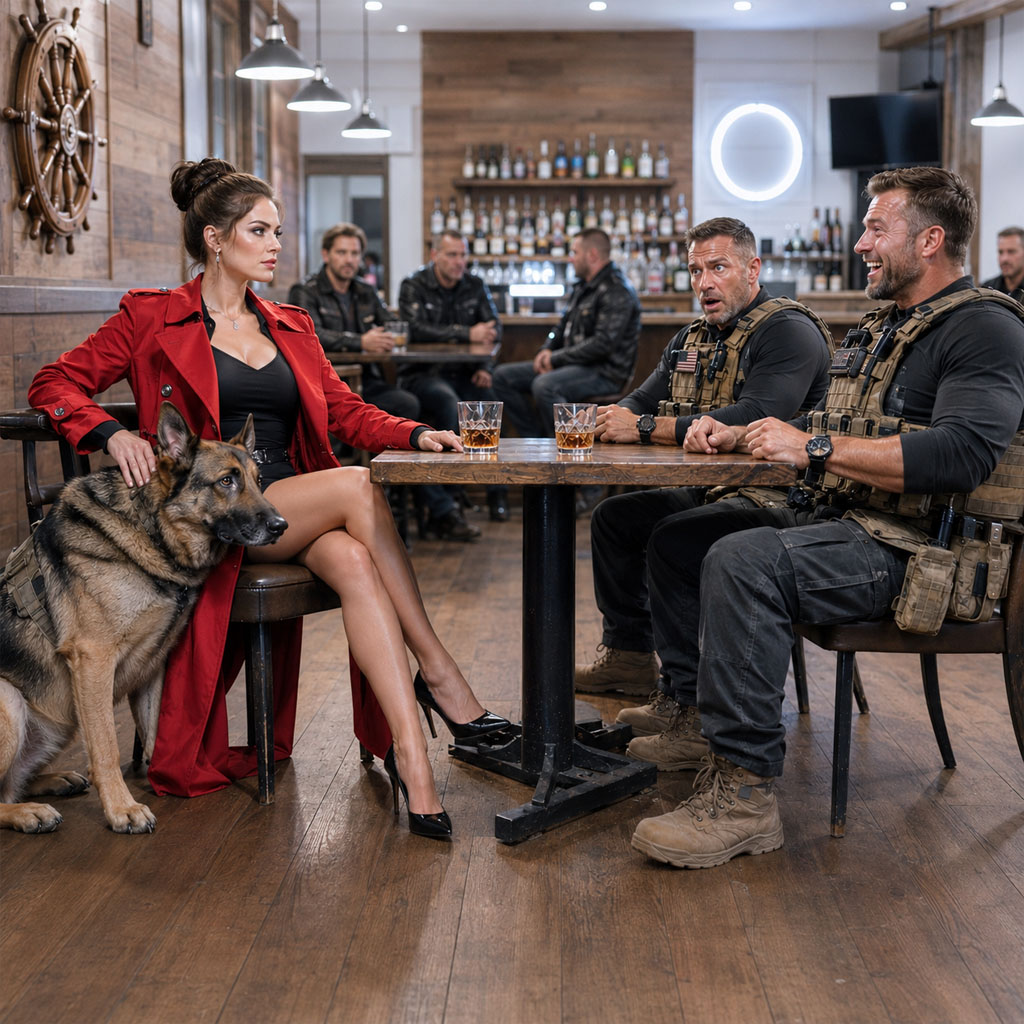
Kota was a hundred pounds of scarred German Shepherd, all muscle, teeth, and old war. His left flank still carried the white slash from the valley. His right ear had a notch from a bullet that should have killed him.
And one of his canines had a titanium cap because an insurgent in Kunar had learned the hard way that Kota did not negotiate.
Jackson lifted his shot glass and looked me over like I was a wrong delivery.
Red trench coat.
Black heels.
Designer bag.
Hair done.
Makeup clean.
Credit card wealth, or at least a very convincing imitation of it.
“Yacht club’s three miles that way,” Brody said, pointing with his beer bottle. “Unless you came in here looking for a guy named Kyle who sells crypto and disappointing cologne.”
A few men laughed.
I didn’t.
I kept my eyes on the dog.
Kota’s ears twitched first.
Then his nose lifted.
Jackson noticed.
His hand dropped to the leash wrapped around his wrist.
Good handler.
Not good enough.
“Lady,” Jackson said, voice changing fast, “do yourself a favor and don’t take another step.”
I took another step.
The bar went quieter.
That’s what men do when they sense a show.
They stop pretending they aren’t watching.
Kota’s head came up fully now. His dark eyes locked onto me. A low sound rolled out of his chest, deep enough to vibrate through the floorboards.
Brody stopped smiling.
“There it is,” he said. “Princess is about to become a lawsuit.”
Jackson stood.
“He’s not friendly,” he warned. “He’s not a rescue. He’s not one of those emotional support dogs you sneak into Whole Foods. Back up.”
I looked at Jackson for the first time.
“You always talk this much before you lose control of a situation?”
His mouth tightened.
Brody barked a laugh. “Oh, I like her. She’s suicidal, but I like her.”
Kota growled harder.
People shifted away from us.
The bartender reached under the counter, probably for the Louisville Slugger every dive bar keeps beside the register.
I moved closer.
Jackson’s fingers clenched around the leash until his knuckles went pale.
“Last warning,” he said.
I ignored him.
I lowered my voice.
“Kota.”
The dog froze.
Not slowed.
Not hesitated.
Froze.
Jackson’s face changed right there. That tiny shift no civilian would catch. The moment training stops matching reality.
I gave the second command.
“Faso.”
One word.
Soft.
Sharp.
Old.
Kota made a sound no one in that bar expected from a war dog.
He whined.
Not a bark.
Not a growl.
A broken, stunned, almost angry whine, like he was furious at the universe for taking too long.
Then he lunged.
Jackson shouted, “Titan, heel!”
Kota ripped the leash straight out of his hand.
Brody reached for the gun under his jacket.
Three men in the corner stood up.
The bartender cursed.
And Kota, the famous “volatile” Tier One K9, crossed the floor like a missile and collapsed at my feet.
On his back.
Belly exposed.
Paws curled.
Whining so hard his whole body shook.
For two full seconds, nobody moved.
Then I dropped to my knees on that disgusting floor, in a coat that cost more than every barstool in the room combined, and put both hands into his fur.
“Hey, buddy,” I said. “You kept the secret.”
Kota shoved his head into my chest so hard he almost knocked me backward.
I laughed once.
It came out rough.
His nose pressed against the inside of my wrist, exactly where the burn scar began under my sleeve.
He remembered the smell of smoke.
He remembered the blood.
He remembered the last order I gave him.
Play dead.
Survive.
Don’t come back for me.
Jackson moved first.
He stepped close, not stupid enough to grab the dog, but angry enough to consider it.
“Who the hell are you?”
I stood slowly.
Kota stood with me.
He leaned into my leg like if he stopped touching me, I might vanish again.
Brody stared at the dog, then at me, then at the dog again.
“That animal tried to bite a corpsman for sneezing near his food bowl,” he said. “Last week.”
“Sounds like the corpsman had bad timing.”
Jackson’s voice came out flat. “Answer the question.”
I looked at him.
“Your dog’s name is not Titan.”
Jackson didn’t blink.
I continued.
“His name is Kota. He was born at a black-site training kennel outside Fort Bragg. He failed his first obedience evaluation because he bit the instructor who tried to shock-collar him. He passed his second because I fired the instructor.”
Brody’s face lost color.
Jackson’s hand drifted toward his waistband.
Not drawing.
Thinking.
“You read a file,” he said.
“No,” I said. “I wrote the file.”
The room held its breath.
I reached into my bag.
Both SEALs moved half an inch.
Not much.
Enough.
I pulled out a black folder and tossed it onto the bar. It landed in a puddle of cheap whiskey.
The bartender looked at it like it might explode.
Jackson didn’t touch it.
Smart.
“Open it,” I said.
Brody did.
Inside were satellite images, old mission photos, encrypted communication transcripts, bank transfers routed through shell companies, and one picture that made Jackson stop breathing through his nose.
A younger version of Kota, sitting beside a burned-out compound wall, blood on his muzzle, one paw resting on a woman’s boot.
My boot.
The picture had been taken eighteen months ago in Corangal Valley.
Before the official report said Captain Gabriel Lawson died in an ambush.
Before the memorial.
Before the folded flag.
Before Commander Darien Morrison stood in front of a room full of grieving operators and lied with his hand over his heart.
Jackson lifted the photo.
His voice dropped.
“That mission is classified.”
“So is treason,” I said. “People still do it.”
Brody looked up at me slowly.
“Captain Lawson was a man.”
“Captain Lawson was a name on paper,” I said. “A profile. A cover. A ghost built by people with better printers than morals.”
Jackson studied my face.
I let him.
Facial reconstruction can change the map.
It can’t change the eyes if someone knows what to look for.
He didn’t know.
Kota did.
I rolled up my sleeve.
The burn scar twisted from wrist to elbow, ugly and raised, pale in some places, darker in others. Right through the center of it sat the faded black insignia no official unit admitted existed.
A sword through a wolf skull.
Brody whispered something that would have gotten him kicked out of church.
Jackson finally touched the folder.
“What do you want?”
I smiled.
Not because anything was funny.
Because men always ask that when they realize the joke has turned around and locked the door.
“I came for my dog,” I said.
Kota’s ears lifted.
“And I came to tell you that your commanding officer is sending you into a kill box tomorrow morning.”
Jackson stared.
Brody’s jaw worked once.
I leaned closer.
“Morrison sold my team out in Corangal. Now he’s going to sell yours.”
The jukebox clicked.
The sad country song ended.
Nobody put in another dollar.
PART 2 — THE FILE DIDN’T LIE. THEIR COMMANDER DID.
“You’re telling me Commander Morrison is dirty?” Jackson said.
“No,” I said. “I’m telling you he’s rich. Dirty is what happens when a kid steals a Snickers from a gas station.”
Brody flipped through the bank records with fast, angry hands.
“Cayman accounts. Dubai transfers. Defense contractors. This looks like a Wall Street guy threw up on a war crime.”
“Accurate,” I said.
Jackson didn’t look at the papers.
He watched me.
Men like him trust behavior before documents.
Good.
I gave him behavior.
“Morrison has been moving prototype drone-targeting software through Coronado,” I said. “He uses fake cartel raids as cover. Tomorrow morning, you and your team hit a warehouse in National City. You expect smugglers. Instead, you get contractors with suppressed rifles and enough C4 to turn your after-action report into a funeral program.”
Brody shut the folder.
“Why us?”
“Because you follow orders.”
That landed harder than an insult.
Jackson’s face went still.
“He chose you because you don’t leak, don’t complain, and don’t ask why the intel smells like microwaved fish.”
Brody looked toward the door.
“Tell me you didn’t bring this circus straight to us without a tail.”
Kota answered before I did.
His body stiffened.
His ears cut toward the back entrance.
The fur along his spine rose.
I reached under my coat and drew my suppressed Sig Sauer.
Brody stared at the pistol.
“Of course Princess brought a party favor.”
Glass exploded at the front of the bar.
Three men in black tactical gear came through the door without shouting.
No threats.
No badges.
No wasted movement.
Contractors.
Expensive ones.
Jackson flipped a table before the first shot hit the wall.
The bar became screaming, splintering wood, shattered bottles, and men learning that cheap beer does not make good cover.
Brody drew and fired twice.
The first contractor spun into a booth.
The second kept moving.
Kota looked at me.
Waiting.
Not for Jackson.
For me.
“Faso broken,” I said. “Go.”
He launched.
A hundred pounds of war slammed into the second man’s arm and drove him into the floor.
The third turned toward me.
Too slow.
I put two rounds into his vest and one into the gap above it.
He dropped between a stool and a spilled basket of fries.
The whole thing lasted eleven seconds.
Long enough to ruin the bar.
Short enough for Morrison to start worrying.
Jackson kicked a rifle away from the nearest contractor.
Brody stood over another, breathing hard.
“Well,” Brody said, “that felt super legal.”
Sirens started in the distance.
I grabbed the folder.
“We leave now.”
Jackson looked at the bodies, then at me.
“This is where you say you have a plan.”
“I do.”
“Is it sane?”
“No.”
Brody sighed.
“Finally. A woman with consistency.”
PART 3 — WE DIDN’T RUN FROM THE NAVY. WE BROKE BACK IN.
Jackson’s black Chevy Silverado smelled like gun oil, old coffee, and the kind of fast-food wrappers men pretend they’re going to throw away later.
Kota climbed into the cab first.
Not the back.
Not the floor.
He shoved his massive body between Jackson and me, dropped his chin on my thigh, and made one exhausted sound that nearly undid me.
I scratched behind his ear.
“You got heavy.”
Brody climbed into the back seat and slammed the door.
“You two can do the emotional reunion later. Preferably after we’re not national news.”
Jackson peeled out of the alley with the headlights off.
The Rusty Anchor disappeared behind us, neon sign flickering over three unconscious contractors, one terrified bartender, and a police report that would make no sense to anyone sober.
Rain dotted the windshield.
Coronado slid by in strips of yellow streetlights, closed taco shops, chain-link fences, Navy housing, and sleeping families who had no clue a corrupt commander was about to light a match under half the base.
Jackson drove with both hands tight on the wheel.
“You said tomorrow’s warehouse is a trap,” he said. “How do we prove it before Morrison brands us rogue?”
“We don’t prove the trap,” I said. “We prove the business.”
Brody leaned forward.
“Please say the business is somewhere outside a federal installation.”
“It’s inside Morrison’s private office.”
Jackson hit the brakes so hard Kota braced against the dashboard.
The truck stopped under an overpass, rain ticking over the roof.
Jackson turned to me.
“You want to break into Naval Amphibious Base Coronado.”
“Yes.”
“Into the office of our commanding officer.”
“Yes.”
“To steal classified evidence.”
“To expose classified treason,” I corrected.
Brody pointed at me from the back.
“That sounds exactly like stealing, but with a better LinkedIn caption.”
I reached into my bag and pulled out three encrypted earpieces, two cloned access cards, and a small matte-black drive.
Jackson stared at the gear.
“You carry that in a Prada bag?”
“It’s Celine.”
“Sorry. That changes the felony.”
I handed him an earpiece.
“Morrison keeps an offline ledger. Old habit. Men who betray their country don’t trust the cloud, which is honestly the only smart thing about them.”
Brody took the second earpiece.
“And you know this because?”
“Because I spent eighteen months being dead.”
That shut him up.
I looked through the windshield at the road ahead.
Eighteen months.
Five hundred and forty-seven days of hotel rooms under fake names.
Burner phones bought with cash.
Uber rides where I sat behind drivers named Kevin and Maria and pretended I was just another woman going to another meeting.
A storage unit in Chula Vista.
A gym membership in a name I hated.
Starbucks mobile orders I never picked up because I saw the same silver Toyota twice in one week.
I learned Morrison’s habits.
His offshore accounts.
His mistress in La Jolla who liked Cartier bracelets and posted too many brunch photos.
His son at USC with a tuition bill that magically paid itself through a nonprofit veteran foundation.
His wife, who had no idea the man beside her at Christmas dinner had sold American operators for weapons money.
And I learned one more thing.
Morrison was sloppy only when he felt untouchable.
Tonight, he felt untouchable.
That made him useful.
Jackson put the truck back in drive.
“Why didn’t you go to NCIS?”
“Morrison has a friend there.”
“FBI?”
“He has two.”
“Inspector General?”
“He has photos.”
Brody whistled.
“This man networks like a demon at a Pentagon golf tournament.”
I looked at Jackson.
“I didn’t come because you’re clean. I came because Kota trusted you enough to stay alive.”
Jackson glanced down at the dog.
Something in his expression shifted.
Not soft.
Less armed.
“We found him three days after Corangal,” he said. “He was half-starved and mean as hell. Wouldn’t let anyone near the wreckage.”
“He was guarding the wrong body,” I said.
Jackson looked back at the road.
“I know that now.”
The base checkpoint glowed ahead.
Bright floodlights.
Wet pavement.
Armed guards.
American flag snapping hard in the coastal wind.
The kind of place built to keep threats out.
We were the threat coming home.
I took off the red trench coat.
Under it, I wore black tactical pants, a fitted dark shirt, and a slim Kevlar panel hidden beneath a tailored vest.
Brody saw it and shook his head.
“Okay. The princess thing is aging badly.”
“Most of your first impressions probably do.”
Jackson pulled into the service lane.
“Cards better work.”
“They’ll work.”
“And if they don’t?”
I checked my pistol.
“Then your night gets more cardio.”
At the gate, a young sailor stepped out of the booth, rain dripping from the brim of his cover.
Jackson lowered the window.
The sailor leaned in.
“Evening, Petty Officer Cole.”
Jackson gave him a tired nod.
“Long night.”
The sailor glanced at Brody, then at me, then at Kota.
Kota stared forward, perfectly still.
I tilted my face just enough for the overhead light to catch the fake ID clipped to my vest.
Civilian contractor.
Defense systems audit.
High clearance.
Boring enough to be invisible.
The sailor scanned the card.
One beep.
Then another.
Green.
He handed it back.
“Drive safe.”
Jackson rolled forward.
Brody exhaled behind us.
“I just committed treason without even unbuckling.”
“You’ll get used to it,” I said.
We parked two blocks from the administrative building, behind a maintenance shed that smelled like wet grass and diesel.
I gave them the plan in ninety seconds.
Jackson and Brody would enter through the west corridor during shift rotation.
I would bypass the interior lock.
Kota would alert us to patrol movement.
We had four minutes inside Morrison’s office before the system logged an anomaly.
Seven minutes before base security noticed.
Nine before Morrison got the call.
Brody raised a hand.
“Love the optimism. What happens at ten?”
“We improvise.”
Jackson checked his weapon.
“She means we run.”
“No,” I said. “At ten, we start ruining lives.”
The rain helped.
People hate rain.
They look down.
They walk faster.
They make lazy assumptions about anyone moving with purpose.
We crossed the lot under the flagpole, past a row of government sedans, past a memorial wall with names engraved in black.
I did not look for mine.
Dead people shouldn’t be sentimental.
Inside, the hallway smelled like floor wax and old coffee.
A vending machine hummed beside a framed photo of Morrison shaking hands with a senator.
Brody glanced at it.
“Guy has the smile of a man who tips fifteen percent and calls it generous.”
We moved.
Kota stayed close to my left leg.
Every few feet, his ears flicked.
A turn.
A pause.
A hand signal.
Old rhythm.
Old team.
Jackson noticed.
“You two really did this before.”
I didn’t answer.
At Morrison’s office door, I knelt and opened the access panel.
Brody watched the corridor.
Jackson watched me.
“Facial reconstruction,” he said quietly. “New identity. Eighteen months underground. You gave up everything.”
I plugged in the bypass device.
“No. Morrison took it.”
The lock clicked.
I stood.
“So I’m taking interest.”
Morrison’s office was exactly what I expected.
Large desk.
Polished wood.
Framed medals.
Challenge coins arranged like little trophies.
A photo of his family at Lake Tahoe.
A Bible on the shelf that probably hadn’t been opened since the photographer left.
And behind the American flag in the corner, a wall safe.
Brody closed the door behind us.
“Of course it’s behind the flag,” he muttered. “Subtle as a monster truck.”
I moved to the safe.
Jackson stood near the desk.
Kota sniffed once, then stared at the bookcase.
I stopped.
Kota’s nose was never wrong.
“What?”
He gave a low rumble.
Not danger.
Detection.
I followed his line of sight to the Bible.
I pulled it down.
It was hollow.
Inside sat a keycard and a small burner phone.
Brody grinned.
“Wow. That’s tacky even for Satan.”
The phone had one unread message.
No name.
Just a number.
Bar team failed. Cole and Evans still mobile. Davenport confirmed alive. Initiate warehouse backup.
Jackson read it over my shoulder.
His face went cold.
“Davenport confirmed alive,” he repeated.
Brody’s voice dropped.
“He knows who you are.”
The base alarm did not start.
The hallway stayed quiet.
But something had changed.
The building felt awake now.
I turned to the safe.
“Then we move faster.”
The keycard opened the first lock.
My code cracked the second.
The third needed biometrics.
Morrison’s thumbprint.
Brody looked at me.
“Please tell me you have his thumb in that fancy purse.”
“No.”
“Honestly, that’s a relief and a disappointment.”
I pulled out a thin strip of polymer from my wallet.
“Morrison plays golf every Wednesday. Drinks iced coffee after. Leaves fingerprints on the plastic cup.”
Jackson stared.
“You lifted his print from Starbucks trash?”
“Venti cold brew. Two pumps vanilla. Coward drink.”
The safe opened.
Inside was a hard drive, three passports, stacks of cash, and a velvet jewelry box.
Brody opened the box.
Diamond bracelet.
Receipt from Cartier.
“To the wife?” he asked.
“Mistress.”
He put it back.
“Man’s going down for treason and bad taste.”
I plugged the drive into my device.
Files populated.
Weapons transfers.
Buyer lists.
Drone software packages.
Names.
Dates.
Payment trails.
And one folder labeled CORANGAL CLEANUP.
My hand stopped.
Jackson saw it.
“We don’t have time.”
“I know.”
I opened it anyway.
There they were.
My team.
Photos.
Body locations.
Edited radio transcripts.
A signed order authorizing the ambush route change.
Morrison’s digital signature sat at the bottom like a polished boot on a grave.
For a second, the room narrowed to the screen.
Then Kota pressed his head against my hip.
Not gentle.
A command.
Stay here.
Finish.
I copied everything.
Then I opened the broadcast protocol.
Brody looked over.
“What’s that?”
“Joint Chiefs encrypted channel.”
Jackson’s eyebrows lifted.
“You have access to that?”
“I used to brief them.”
The upload began.
Twelve percent.
Twenty.
Thirty-one.
Then the office phone rang.
All three of us froze.
Brody stared at it.
“Nope,” he whispered. “Absolutely not.”
It rang again.
Jackson picked it up.
Put it on speaker.
Morrison’s voice filled the room.
Calm.
Smooth.
Annoyed.
“Cole, you have ten seconds to tell me why you’re in my office before I authorize base security to shoot you on sight.”
Jackson looked at me.
I nodded once.
He smiled without warmth.
“Commander,” he said, “your filing system sucks.”
Silence.
Then Morrison laughed.
Not loud.
Not scared.
“You’re standing next to a dead woman and a stolen dog, Petty Officer. Think very carefully about who the Navy will believe by morning.”
I leaned close to the phone.
“Hi, Darien.”
The laughter stopped.
I could hear him breathing.
“Khloe,” he said softly. “Or should I say Gabriel?”
“Say whatever you want. You always were better at speeches than combat.”
His voice hardened.
“You should have stayed dead.”
“Your contractors were late.”
The upload hit sixty-four percent.
Morrison exhaled.
“You have no idea what you’re touching.”
“Your retirement plan?”
“Global stability.”
Brody mouthed, “Wow.”
Morrison kept going.
“You think wars run on flags and speeches? They run on men like me moving assets before idiots in suits understand the board.”
I smiled.
“Keep talking.”
A pause.
Then he understood.
The phone clicked dead.
The upload hit eighty-nine percent.
Alarms screamed.
PART 4 — MORRISON HAD POWER. I HAD PROOF.
Red lights washed the hallway.
Base-wide alarm.
Not a drill.
Not subtle.
Brody looked at the ceiling.
“There’s the cardio.”
The upload hit ninety-four percent.
Jackson moved to the door and cracked it open.
Boots thundered somewhere beyond the corridor.
Kota stood between me and the door, teeth bared, waiting for the world to make a bad choice.
Ninety-seven.
Ninety-eight.
The screen froze.
I stared at it.
“No.”
Brody turned.
“No what?”
“They’re cutting internal network access.”
Jackson shut the door.
“How long?”
“Thirty seconds.”
“Can you finish?”
I pulled the drive, snapped it into the second device, and shoved it at Brody.
“Roof access. Satellite uplink. Go.”
Brody stared at the device.
“I’m the IT guy now?”
“You’re the fast guy.”
“I hate when people notice that.”
Jackson tossed him a keycard.
“Move.”
Brody opened the door and slipped into the hallway.
Two seconds later, he yelled, “Contact!”
Gunfire cracked.
Not wild.
Controlled.
Inside an American military building.
That sound does something different to you.
It’s one thing to hear shots in a valley where everyone admits they’re at war.
It’s another to hear them beneath framed photos of charity 5Ks and official portraits.
Jackson pulled me behind Morrison’s desk as rounds punched through the door.
Kota snarled.
“Hold,” I ordered.
He hated it.
He held.
Jackson fired through the wall at an angle, not to kill, to push them back.
“We need out.”
“Not yet.”
“You got a death wish?”
“I already did death. Overrated.”
The office window faced the parking lot.
Second floor.
Not ideal.
Not impossible.
I grabbed Morrison’s chair and slammed it into the glass.
Nothing.
Bullet-resistant.
Of course.
“Rich traitor,” I muttered.
Jackson looked at the wall safe.
“Private exit?”
I scanned the room.
Men like Morrison always build an escape and call it security.
Kota moved to the bookcase again.
This time he pawed at the lower shelf.
I shoved books aside.
A recessed latch sat behind a framed Navy Cross citation.
I pulled it.
The bookcase clicked open three inches.
Jackson stared.
“Behind the medal. That’s poetic.”
We slipped into a narrow service passage as the office door blew inward behind us.
The passage smelled like dust and expensive cowardice.
It dropped us into a records room on the first floor.
My earpiece crackled.
Brody’s voice came through, breathless.
“Roof is popular tonight. I’ve got two guys and a locked access ladder.”
“Status on upload?” I asked.
“Device says searching for satellite. Also says I should update firmware. Is now a bad time?”
Jackson took point through the records room.
“We’re coming.”
A guard rounded the corner with his rifle raised.
Young.
Confused.
Scared.
Not one of Morrison’s contractors.
Base security.
Jackson didn’t shoot.
He stepped in, stripped the rifle, swept the kid’s legs, and pinned him to the floor.
“Listen,” Jackson snapped. “Your commander is dirty. Stay down and don’t become stupid for a man who won’t remember your name.”
The sailor stayed down.
Smart kid.
We moved toward the stairwell.
Halfway up, Morrison’s voice came over the base intercom.
“Attention all security personnel. Petty Officers Jackson Cole and Brody Evans are armed and compromised. Civilian female suspect is a hostile intelligence asset. Use necessary force.”
Brody came through the earpiece.
“Hostile intelligence asset? That’s kind of flattering.”
“He left out charming,” I said.
Jackson pushed open the roof door.
Wind slammed into us.
Rain cut sideways.
The roof was a mess of vents, antenna masts, puddles, and bad visibility.
Brody crouched behind an HVAC unit, exchanging fire with two contractors near the satellite array.
“About time!” he shouted. “I was running out of sarcasm and ammunition.”
Kota didn’t wait for permission.
He saw the nearest contractor shift position and launched low across the roof.
The man turned.
Too late.
Kota hit him behind the knee and dragged him down hard.
Jackson took the second with a controlled shot to the shoulder.
Brody sprinted to the uplink panel and jammed the device into the port.
“Come on, come on,” he said.
The screen lit.
Uploading.
Twelve percent.
Forty.
Sixty-three.
Then the roof door opened again.
Morrison stepped out with four armed men.
He wore a Navy jacket over civilian clothes, hair perfect despite the rain, face calm like he was arriving late to a fundraiser.
A pistol rested in his hand.
Not shaking.
That annoyed me most.
The arrogance of men who have never paid full price for their own sins.
“Killing you once was expensive,” he called. “Doing it twice feels wasteful.”
I stepped out from behind the vent.
Kota moved with me, blood on his muzzle, eyes locked on Morrison.
Morrison glanced at the dog.
“Hello, Titan.”
Kota growled.
I smiled.
“He prefers his real name.”
Morrison looked past me to Jackson.
“Cole, you can still walk away from this. Evans too. Say she manipulated you. Say the dog created confusion. I can fix paperwork.”
Jackson laughed once.
“You really think this is about paperwork?”
“It’s always about paperwork,” Morrison said. “That’s how adults survive scandals.”
Brody checked the upload.
“Eighty-one percent.”
Morrison’s eyes moved.
Tiny flicker.
There it was.
Fear.
He raised his pistol toward Brody.
Jackson raised his weapon toward Morrison.
The four contractors raised theirs toward us.
For one breath, everyone owned half a second of death.
Then floodlights exploded over the roof.
Not the red alarm lights.
White.
Hard.
Blinding.
Helicopter blades beat the rain flat.
A voice boomed from above.
“Commander Darien Morrison, drop your weapon.”
Morrison’s face changed in stages.
Confusion.
Calculation.
Rage.
A second helicopter swung into view, Coast Guard markings visible in the wash.
Then another team came through the opposite roof entrance.
NCIS.
But not Morrison’s friends.
These were older agents with tired faces and rifles pointed at the right people.
The upload hit one hundred percent.
Brody looked at the screen.
“Sent.”
My knees did not buckle.
My hands did not shake.
I simply looked at Morrison and watched the moment his future left his body.
His phone began ringing.
Then one of his contractors’ phones.
Then another.
That’s the thing about powerful men.
They don’t lose power with a scream.
They lose it with incoming calls they suddenly don’t want to answer.
An NCIS agent stepped forward.
“Commander Morrison, you are under arrest for conspiracy, treason, illegal arms trafficking, murder, and obstruction of a federal investigation.”
Morrison looked at me.
“You don’t understand what you’ve done.”
“I do,” I said. “I made you poor in public.”
Brody winced.
“That one hurt me and I’m not even the traitor.”
They cuffed Morrison with his own men watching.
No speech.
No dramatic last stand.
Just zip ties, wet concrete, and a Navy Cross recipient being walked past a dog who remembered what kind of man he really was.
Kota barked once.
Sharp.
Final.
Morrison flinched.
That was worth every scar.
By sunrise, the story hit every screen in America.
Not the classified parts.
Those would be buried under hearings, sealed indictments, and men in suits using phrases like “ongoing national security review.”
But enough got out.
A decorated Navy commander arrested on base.
Two SEALs cleared after exposing a weapons pipeline.
A dead operator revealed alive.
A K9 at the center of a betrayal case that made cable news anchors say “incredible” until the word got tired.
Morrison’s wife left their Coronado house with two suitcases and no wedding ring.
His mistress deleted her Instagram.
His son’s tuition fund froze.
Three defense contractors lost federal licenses before lunch.
A senator announced he was “shocked and disturbed,” which usually means his staff was shredding something.
Jackson and Brody were suspended for seventy-two hours, then quietly reinstated.
The Navy hates embarrassment.
It hates public heroes slightly less.
As for me, they offered a debriefing room, a lawyer, a new identity, and a chance to disappear again.
I declined the last part.
A week later, I walked back into The Rusty Anchor.
The front door had been replaced.
The bullet holes patched badly.
The bartender saw me and immediately reached for the top shelf.
“Please tell me you’re just here for a drink.”
“Coffee,” I said.
He stared.
“This is a bar.”
“I’ve seen your whiskey.”
He poured coffee.
It was terrible.
I paid with a black credit card just to annoy him.
Jackson and Brody sat in the same spots as before.
This time, nobody laughed when I walked in.
Brody lifted his beer.
“Wrong bar, princess?”
I looked down at Kota, sitting calmly beside me in a new tactical collar with his real name engraved on the tag.
Kota gave Brody one bored glance.
Brody lowered the beer.
“Right. Retiring that joke.”
Jackson slid a stool out for me.
No apology speech.
No awkward confession.
Just the stool.
That was better.
I sat.
He looked at Kota.
“He’s yours.”
I nodded.
“He always was.”
Jackson pushed a folder across the bar.
“What’s that?”
“Warehouse raid file,” he said. “The one Morrison planned for tomorrow. We found twelve more names connected to the buyers.”
Brody leaned in.
“Apparently treason is like cockroaches. You see one, there are fifty behind the fridge.”
I opened the file.
Inside was a photo of a man I hadn’t seen in eighteen months.
Not Morrison.
Worse.
The informant from Corangal.
The one whose body was supposed to be in my grave.
Alive.
Older.
Bearded.
Wearing a suit outside a federal courthouse in Virginia.
My fingers stayed flat on the paper.
Kota stood.
Jackson noticed.
Brody stopped smiling.
I closed the folder.
Then I finished the worst coffee in California and stood.
“Looks like Morrison wasn’t the top of the chain.”
Jackson reached for his jacket.
Brody tossed cash on the bar.
Kota moved to the door before any of us.
Outside, the Coronado morning was bright, clean, and loud with traffic.
Normal people drove to work.
A woman in yoga pants carried Starbucks.
A kid on a bike nearly hit a trash can.
America kept moving, because America is very good at pretending rot is only a smell from somebody else’s house.
I put on my sunglasses.
Jackson looked at me.
“You sure you want to do this?”
I smiled.
Not sweet.
Not safe.
“Wrong question.”
Brody sighed.
“What’s the right one?”
Kota barked once.
I stepped off the curb.
“The right question is how many powerful men are about to wish they’d never taught my dog my name.”
PART 5 — ENDING
Two months later, Morrison sat in federal court wearing a suit that didn’t fit the way power used to.
No uniform.
No medals.
No men standing when he entered.
Just cameras, prosecutors, and a judge who looked bored by expensive criminals.
His accounts were frozen.
His pension was gone.
His wife filed for divorce.
His son changed his last name online.
The Navy stripped his honors pending final conviction, which is a polite way of saying they took the shiny toys off the traitor before the public asked louder questions.
Jackson and Brody testified.
So did I.
When the prosecutor asked me to state my name for the record, Morrison looked at the table.
For the first time since Corangal, he couldn’t make anyone else carry his shame.
I leaned toward the microphone.
“Khloe Davenport,” I said. “Formerly Captain Gabriel Lawson.”
Kota sat beside the witness stand with federal approval and very little patience.
Morrison would not look at him.
Good.
Some ghosts deserve teeth.
When it was over, I walked out through the courthouse doors into hard Virginia sunlight.
Reporters shouted.
Cameras flashed.
Brody asked if I wanted a ride.
Jackson offered coffee.
I looked at Kota.
He looked at the open sidewalk.
For eighteen months, I had lived like a dead woman.
That morning, I walked like someone who had finally collected what she was owed.
Justice didn’t fix the valley.
It didn’t bring my team back.
But it put the right man in chains.
And for now, that was enough.