
vf-My Family Skipped My Courthouse Wedding For My Sister’s Birthday Party,

My name is Gwen Overton, and I was thirty-two years old when I learned that being easy to love is not the same thing as being loved.
I learned it under the fluorescent lights of a county courthouse, standing in a knee-length white dress I had ordered online for exactly eighty-nine dollars. I remember the price because the number stayed in my head all morning, sharp and ridiculous, attaching itself to every ordinary detail around me. Eighty-nine dollars for the dress. Twenty-seven dollars for the marriage certificate. Twelve dollars for the gold frame I would later buy at a drugstore. Four dollars and change for the breakfast tacos Julian and I ate afterward from a food truck parked near the courthouse steps.
Everything about that day had a price tag.
Everything except what it cost me.
The dress was not ugly. That would have made the story simpler. It was plain, with short lace sleeves and a skirt that fell just below my knees. It fit me better than I expected, though the hem scratched the skin above my calves whenever I walked. The synthetic lace felt stiff and cheap against my legs, and every tiny scrape reminded me of something I did not want to admit that morning: my family had spent more on the balloons at my sister’s birthday party than I had spent on the dress I wore to become someone’s wife.
The courthouse hallway smelled like industrial floor cleaner, old paper, and vending machine coffee that had been sitting too long on a burner. The walls were painted a tired beige. The linoleum floors had been polished to a dull shine. Somewhere nearby, a printer jammed and a clerk sighed loudly enough for everyone waiting outside Courtroom B to hear. A toddler in a puffy jacket cried into his father’s shoulder. Two men in work boots stood near the metal detector, whispering over a folded traffic citation. A woman with red-rimmed eyes clutched a manila envelope against her chest as if it contained her entire future.
There were no flowers waiting for me.
No music.
No mother touching my veil because there was no veil.
No sister telling me I looked beautiful.
No brother pretending not to cry.
No aunts crowding me with perfume and advice, no cousins leaning into the aisle with phones raised, no grandmother dabbing her eyes with a tissue she had saved from church.
There was Julian, tall and quiet in a navy suit he normally wore to investor meetings. There was Cassandra, my best friend from college, standing near the courthouse vending machines in a bright blue cocktail dress, holding a grocery-store bouquet wrapped in brown paper and crying so hard she kept apologizing to the clerk. And there was me, standing very straight beneath the yellow lights, trying not to look at the empty space where a family should have been.
I did not get married in that courthouse because Julian and I were broke.
That was what made it worse.
We could have afforded a real wedding. Not an absurd one, not the kind where doves are released and guests go home with engraved silver boxes, but something beautiful. A garden ceremony, maybe. A small dinner at a restaurant with linen napkins and candles on every table. A string trio. A photographer. A dress that did not arrive folded into a plastic mailer. Julian was the co-founder and chief technology officer of a software company that had been growing quietly for three years. His days were filled with investors, late-night engineering problems, regulatory filings, and phone calls that made him stand in the kitchen with one hand over his eyes. His company was weeks away from going public, though only a small circle of people knew the timeline.
We were standing at the edge of a life-altering shift.
But on my wedding morning, none of that mattered.
What mattered was this: on that same Saturday, all the people who shared my last name, my childhood, my holidays, my family photographs, and my bloodline were across town in a rented banquet hall celebrating my older sister Brooke’s thirtieth birthday.
They had chosen champagne over my vows.
A custom cake over my courthouse bouquet.
A golden balloon arch over the moment I took my husband’s hand and promised to build a life with him.
For years, I had told myself that when the important day finally came, they would show up. Maybe not perfectly. Maybe late, maybe distracted, maybe with Brooke making a speech about herself and Austin asking if there was an open bar. But they would come. They would sit in the chairs. They would see me. They would prove that some part of me, no matter how deeply buried under everyone else’s emergencies, still mattered.
I had been wrong.
To understand how a woman can stand in a courthouse on her wedding day with only one friend beside her while forty relatives attend a birthday party across town, you have to understand the Overton family.
My mother, Meline Overton, did not raise a family so much as direct a production.
Every holiday had a script. Every Sunday dinner had blocking. Every birthday had an approved emotional tone. Nobody was allowed to simply exist in our house. You had to play your role. My mother controlled the scene with the calm smile of a woman who could rearrange a room, a guest list, or a person’s self-worth without raising her voice.
Brooke was the star.
She had been the star since the day she was born, though she would have told you she simply had higher standards than everyone else. Brooke was beautiful in the way people notice quickly: thick blond hair, clear blue eyes, an easy command of space. When she entered a room, people turned before they knew why. She spoke loudly, laughed loudly, complained loudly, and somehow my mother had mistaken volume for confidence.
Brooke did not ask for attention.
She expected it.
My mother gave it freely.
Then there was Austin, my younger brother, the baby, the charmer, the boy who could crash through life and still be described as “finding his way.” When Austin failed a class, he needed encouragement. When Austin wrecked a car at nineteen, he needed support. When Austin borrowed money and forgot to repay it, he needed compassion. My mother could turn any mess he made into proof that he was sensitive, overwhelmed, or misunderstood.
And then there was me.
I was useful.
That was my role.
Not beloved. Not celebrated. Useful.
I was the one who showed up early to help set up tables. I was the one trusted to remember everyone’s dietary restrictions, drive relatives to appointments, proofread resumes, pick up prescriptions, and stay late washing dishes after everyone else had gone home. I was the calm one, the competent one, the girl who could handle disappointment without inconveniencing anyone.
My mother had a word for it.
Flexible.
“You are so flexible, Gwen,” she used to say, smiling as if she had given me a crown.
The first time I remember her saying it, I was eleven.
My parents’ divorce had already cracked the house open by then. My father, Garrison, had moved three states away with a woman my mother never referred to by name. For the first two years, he sent birthday cards with ten-dollar bills inside and the same careful note: Hope school is going well. Love, Dad. Then the cards stopped coming too.
The absence of my father made my mother more determined to polish the family we had left. She had no patience for grief unless it could be staged in a way that made her look noble. Brooke became her proof that everything was fine. Austin became her excuse to keep going. I became the place she put everything that did not fit.
When I was eleven, I placed second in the regional science fair. I had spent weeks building a circuitry project at the kitchen table after everyone went to bed. I stripped wires with a pair of old scissors because I didn’t have proper tools. I burned my thumb with a soldering iron borrowed from a neighbor and hid the blister so my mother wouldn’t tell me I was making a mess. I wrote the display board by hand because printing in color cost too much at the library.
My mother promised she would come.
She did not.
Brooke had a last-minute problem with a dress fitting for a middle school dance. She cried until my mother left work early and drove her to the mall.
I stood in the humid school gym holding a second-place certificate while other kids took pictures with their parents. I watched fathers kneel to adjust crooked ribbons and mothers smooth hair out of proud faces. I pretended to read the judge’s comments on my project so no one would see me staring.
Then I walked home alone in the rain.
When I got there, my mother was on the couch watching television while Brooke stood in front of the hallway mirror, turning side to side in her new dress.
I handed my mother the certificate.
She glanced down.
“Oh, honey, second place. That’s nice.”
Nice.
Then Brooke called from the hallway, “Mom, does the waist look weird?”
My mother looked away from the certificate.
“Coming.”
I stood there with rainwater dripping from my hair onto the carpet.
As she passed me, she patted my shoulder without looking at my face.
“You are so flexible, Gwen. Thank you for understanding.”
I did not understand.
But I learned.
I learned that being good at waiting meant people would make you wait longer. I learned that being quiet meant people assumed you had nothing to say. I learned that if you did not demand attention, the room would give it to someone who did.
By thirteen, I had stopped asking anyone to come to school events.
By sixteen, I kept my birthday expectations low enough that a grocery-store cupcake felt like luxury.
By eighteen, I left for college with two heavy suitcases, a partial academic scholarship, and a private promise that I would never again need my mother to choose me.
I worked two jobs all through school. On weekday evenings, I tutored advanced math in a campus study room that smelled like dry-erase markers and burnt coffee. On weekends, I stocked shelves at a grocery store until my hands cracked from cardboard and cold air. I graduated with a near-perfect GPA and no debt because I had learned, very early, that debt made you vulnerable to people who enjoyed holding favors over your head.
My mother called once during my freshman year.
Not to ask how I was.
Not to ask if I had made friends.
Not to ask if I was eating enough.
She called to ask if I could drive four hours home to help decorate for Brooke’s engagement-themed birthday dinner, even though Brooke was not engaged and had no boyfriend at the time.
“I have work,” I said.
My mother sighed.
“I thought you were more flexible than this, Gwen.”
I looked at the ceiling of my dorm room and felt something inside me go quiet.
Years passed like that.
I built my life the way other people build a shelter in bad weather: carefully, quietly, with an eye on every weak spot. I became a software engineer because code, unlike family, did not pretend. It either worked or it didn’t. It did not smile while undermining you. It did not call you selfish for refusing to collapse.
I got hired at a mid-sized software company right out of college and climbed steadily. Junior developer. Developer. Senior engineer. Technical lead. I became excellent at solving complex problems in silence, which was perhaps the only useful skill my family had ever taught me.
I met Julian at a tech conference in Chicago on a wet October afternoon.
He was giving a product demonstration on the main stage, explaining infrastructure scaling to a room full of people wearing lanyards and polite expressions. I was sitting in the back row, aggressively debugging a client issue on my laptop because the conference Wi-Fi was terrible and my team at work had no respect for the concept of paid time off.
After his talk, Julian walked to the back of the room, leaned slightly over my shoulder, and looked at my screen.
“Was my presentation so boring you had to work through it?” he asked.
I looked up.
He had dark hair, tired eyes, and the faintest smile, like he already knew he was interrupting someone dangerous.
“Your presentation was fine,” I said. “Your database architecture is going to fall apart under heavy traffic.”
For a second, he stared at me.
Then he laughed so genuinely that three people near us turned around.
“You’re the first person today who said something useful,” he said.
We got coffee at a small café around the corner where the windows fogged from the rain and everyone in line looked like they had missed lunch. He asked questions like he actually cared about the answers. He did not perform interest. He listened. When I spoke, he followed the thread instead of waiting for his turn.
On our fifth date, I told him about my mother forgetting my twenty-first birthday until a week later because Austin had gotten into trouble with rent.
Julian did not tell me family was complicated.
He did not tell me to be the bigger person.
He did not suggest that my mother probably loved me in her own way.
He set his fork down, looked at me across the restaurant table, and said, “They do not deserve you.”
He said it calmly. Factually. As if he had completed the equation and reached the only possible answer.
That was when I trusted him.
Julian proposed two years later on a cold evening by the river. The sky was clear, the city lights trembling in the water, and the wind kept blowing my hair across my face every time he tried to speak. He had designed the ring himself, delicate and simple, with a small diamond set low because he knew I hated jewelry that caught on sweaters.
“I had a speech,” he said, laughing nervously as he reached into his coat pocket. “But the wind is ruining the whole thing.”
“Skip the speech,” I said.
He blinked.
“Yes.”
“I didn’t ask yet.”
“I know. I’m being efficient.”
He laughed, and then he did ask, and I said yes again before he finished.
We chose March 15th at our kitchen table that night, sitting on our secondhand couch with our laptops open and takeout containers between us. Julian was careful to say we could do whatever I wanted. Courthouse, garden, backyard, restaurant, destination. He had no fantasy of his own except marrying me.
I wanted small.
Elegant.
Warm.
And despite every lesson life had handed me, I wanted my family there.
That was the humiliating truth.
I was thirty-two years old, financially independent, professionally successful, loved by a man who saw me clearly, and still some part of me wanted my mother to sit in the front row and cry for the right reasons. I wanted Brooke to hug me without making a joke about my dress. I wanted Austin to wear a suit and pretend, for one afternoon, to be the kind of brother who would stand up for me. I wanted my father to send a card, even if he did not come. I wanted my grandmother to hold my hands and say she was proud.
I wanted proof that I had not imagined belonging to them.
So I went to a stationery shop with brass bells on the door and shelves lined with paper thick enough to feel important. I bought cream-colored cardstock and matching envelopes. For three nights, I sat at the kitchen table writing addresses by hand. My mother. Brooke. Austin. My grandmother. Aunt Clara. Uncle Ben. Cousins I hadn’t seen since Thanksgiving. Relatives who knew me mostly as the girl who remembered to bring extra ice and fold the chairs after cookouts.
Forty-two save-the-date cards.
Forty-two small acts of hope.
When I dropped them into the blue mailbox outside the post office on a Tuesday morning, my hand lingered on the metal handle for a second longer than necessary.
“Please,” I whispered, though I did not know who I was asking.
Two weeks later, Brooke posted the birthday invitation.
I saw it while sitting on our couch in leggings and an old Northwestern sweatshirt, half-watching a cooking show while Julian answered emails at the kitchen island. The image loaded slowly, then flashed full brightness across my phone.
Gold lettering.
Dark background.
Champagne glasses.
Brooke’s Golden Era.
The words curved elegantly above a date printed at the bottom in bold metallic font.
March 15th.
For a moment, my brain refused to process the numbers.
Then it did.
I sat up so quickly Julian looked over.
“What happened?”
I did not answer. I clicked into the post, my thumb suddenly clumsy. The party was at a downtown banquet hall known for rooftop views and ridiculous rental fees. Live DJ. Open bar. Custom dessert table. Cocktail attire required. Brooke had already tagged a photographer, a balloon artist, and a bakery.
My phone felt hot in my hand.
I called my mother before I could talk myself out of it.
She answered on the second ring, cheerful and bright.
“Hi, honey.”
I did not ease into it.
“Why is Brooke having her birthday party on my wedding day?”
Silence.
Not surprised silence.
Annoyed silence.
Then my mother sighed.
“Oh, Gwen.”
I closed my eyes.
“No. Don’t ‘oh, Gwen’ me. You got the card. Brooke got the card. Everyone got the card.”
“Of course we got it.”
“Then why is her party on March 15th?”
“Brooke has been looking at that venue for months.”
“She announced it today.”
“That doesn’t mean she hasn’t been planning.”
“It is my wedding day.”
My mother’s voice softened into the tone she used when she wanted to make me feel unreasonable.
“Your wedding is small, sweetheart.”
I stared at Julian. He had closed his laptop and was watching me now, his expression unreadable but alert.
“What does that mean?” I asked.
“It means there is no reason to create unnecessary conflict. Brooke is turning thirty. It’s a very sensitive milestone for her. She has already put down deposits, and people are very excited. You and Julian can just move your ceremony a week or two.”
“No.”
The word came out before I could polish it.
My mother paused.
“Excuse me?”
“No. I’m not moving my wedding.”
“Gwen.”
“Mom.”
“You are making this harder than it needs to be. You have always been so flexible.”
There it was.
The old hook in the soft bait.
“You understand, right?” she added.
I hung up.
Not dramatically. Not with a final speech. I simply pulled the phone away from my ear and pressed the red button because if I stayed on that call one second longer, I would have begged her to choose me, and I refused to hear myself do it.
Julian came to sit beside me.
“She said flexible,” I said.
His jaw tightened.
“I’m sorry.”
“She wants me to move the wedding.”
“Do you want to?”
“No.”
“Then we won’t.”
I looked at him.
That was it. No negotiation. No lecture. No careful explanation of why my mother might feel pressured or why Brooke might be struggling with aging. Julian had a way of making my own desires sound allowed.
The first decline arrived three days later.
Then another.
Then another.
Every afternoon after work, I walked down to the apartment lobby and opened the little metal mailbox with a strange dread in my stomach. The stack grew slowly at first, then all at once. Cream envelopes returned with polite handwriting and short notes. Sorry, sweetie. Already committed to Brooke’s big night. Hope you understand. So sorry we can’t make it. We’ll celebrate you later. Heard things are shifting around. Let us know the new plan.
I kept them in a shoebox on the kitchen table.
Julian never touched it unless I asked him to.
By the end of the week, forty-two responses sat inside.
Forty-two.
Not one yes.
It is one thing to be disappointed by a person. It is another to watch an entire family become a closed door one envelope at a time.
The night I found Aunt Clara’s card, rain tapped gently against the kitchen window. Julian was still at the office. I had made chicken and forgotten to put it in the oven. The apartment smelled faintly of garlic, cold air, and paper.
Aunt Clara’s handwriting was round and careful.
Gwen, dear, your mother told us you were postponing the wedding due to scheduling conflicts. Let us know when the new date is.
I read it once.
Then again.
Then I opened the rest of the cards with shaking hands, tearing one envelope so badly the corner ripped off. Two more mentioned postponement. One cousin wrote that she hoped we found a new venue soon. Another said she was sure it was for the best since Brooke’s event had been planned so long.
My mother had not just chosen Brooke.
She had removed the choice from everyone else.
I called Aunt Clara.
She answered with the television loud in the background.
“Hello?”
“Clara, it’s Gwen.”
“Oh, honey, how are you?”
“Who told you my wedding was postponed?”
A pause.
The television kept playing. A game show host laughed.
“Well,” Clara said slowly, “your mother called. She said you and Julian were moving the date back a few months because of planning issues. Something about catering and budget, I think. She said not to worry about March 15th and to focus on Brooke, since Brooke couldn’t change her venue.”
I looked at the shoebox.
“She called you?”
“Yes.”
“Who else?”
Another pause.
“I think she called most of us, sweetheart.”
The word sweetheart made my stomach turn.
“Thank you,” I said.
“Gwen, is everything—”
“Have a good night, Clara.”
I ended the call and set the phone on the table.
For a long time, I sat in the dark kitchen staring at the shoebox.
I did not cry.
Not because I was strong.
Because the wound had gone past tears.
When Julian came home, he found me sitting exactly there. He took off his coat slowly, loosened his tie, and looked from my face to the box. He did not ask what happened. He sat beside me, opened the lid, and read until he understood.
His face changed.
Quietly.
That was Julian’s anger. It did not throw things. It sharpened.
“What do you want to do?” he asked.
I looked at the cards.
The lies.
The years.
The science fair certificate. The birthdays. The missed calls. The word flexible pressed into me like a thumbprint.
Something inside me that had bent for thirty-two years finally stopped bending.
“I want to marry you on March 15th,” I said. “I don’t care if it’s in a courthouse. I don’t care if Cassandra is the only witness. I don’t care if my mother throws a party on the moon. I am not moving my life out of their way again.”
Julian reached for my hand.
“Then we’re getting married on March 15th.”
Later that night, while we were eating cold sandwiches over the sink because neither of us had remembered dinner, Julian’s phone rang. He looked at the screen, then at me.
“It’s Marcus.”
Marcus was his business partner. Calls from Marcus were either very good or very bad and rarely anything in between.
Julian stepped into the bedroom. I heard his voice through the wall, low and careful. I rinsed plates we had barely used. I folded one dish towel, then unfolded it, then folded it again.
When Julian came back, his face looked different. Exhausted, but lit from behind.
“They filed the final paperwork,” he said.
“For the IPO?”
He nodded.
“The timeline is locked?”
“Six weeks, give or take.”
I leaned against the counter.
“Okay.”
He smiled faintly.
“Okay?”
“I don’t know what else to say.”
“Me neither.”
He crossed the kitchen and kissed my forehead.
“Let’s just get married first,” he said. “The rest can wait.”
The morning of March 15th, I woke up before the alarm.
The sky outside our bedroom window was still dark, bruised purple at the edges. The city had not fully woken, but I could already hear a garbage truck grinding somewhere in the alley and the hiss of tires on wet pavement. I lay still for a moment, listening to Julian breathe beside me, and waited for grief to arrive.
It came.
But not alone.
Peace came with it.
That surprised me.
I stood in the bathroom and put on the eighty-nine-dollar dress. I pinned my hair into a low bun, drew a careful line of eyeliner, and added lipstick I had bought the week before at the pharmacy. Julian knocked softly on the door.
“Can I come in?”
“Only if you’re ready to be emotionally devastated by my online shopping skills.”
He opened the door and stopped.
His eyes moved over me slowly, not in appraisal, but in recognition.
“Gwen,” he said.
The way he said my name made my throat tighten.
“What?”
“You look like yourself.”
I laughed before I could cry.
At exactly seven, Cassandra arrived.
She knocked twice, then let herself in because she had known me long enough to understand that wedding mornings did not need formalities. She wore a bright blue dress under a black wool coat and carried a bouquet of daisies and baby’s breath wrapped in brown paper.
“I know it’s not fancy,” she said immediately, already crying. “The flower shop wasn’t open, so I got these from the grocery store near the train, and the cashier gave me a discount because I told her my best friend was getting married, and then I started crying, and she started crying, and—”
“Cass.”
“What?”
“They’re perfect.”
She cried harder.
The courthouse ceremony lasted eight minutes.
The judge was an older man with silver hair and reading glasses perched low on his nose. He looked bored at first, then softened when Cassandra sniffled so loudly even the clerk turned around. Julian held my hand through the entire ceremony. His palm was warm and steady. When the judge asked if I took him as my husband, I looked at Julian and saw no performance there. No bargaining. No hierarchy. No one asking me to shrink so someone else could shine.
“I do,” I said.
Julian’s voice was quiet when he said it back.
Afterward, we walked outside into sharp morning air. Cassandra took pictures of us on the courthouse steps. A man walking a golden retriever stopped and offered to take one of all three of us. In the photo, I am holding the grocery-store bouquet, Julian is looking at me instead of the camera, and Cassandra’s cheeks are wet from crying.
It is still my favorite picture.
By eight-thirty, the three of us were sitting on the hood of Julian’s car in the courthouse parking lot eating breakfast tacos wrapped in foil. The salsa was too spicy. The coffee was terrible. My legs were cold. My dress scratched my skin every time I shifted.
I had never felt less abandoned.
That night, after Cassandra went home and Julian fell asleep on the couch with his tie still loosely around his neck, curiosity got the better of me.
I opened social media.
Brooke’s party was the first thing on my feed.
The banquet hall glowed gold. There were candles on every table, a massive balloon arch in the shape of a thirty, a three-tier cake with edible gold leaf, and people everywhere in cocktail dresses and suits. My mother stood at a microphone in the middle of the room, holding a glass of champagne.
I tapped the video.
Sound filled the apartment.
“To my beautiful firstborn,” my mother said, voice trembling with public emotion, “you are the light of this family. We would drop everything to celebrate you.”
The room cheered.
I saw Aunt Clara clapping.
My grandmother smiling.
Austin raising his glass.
Brooke standing under the lights like a bride.
Not a single one of them had texted me that day.
I closed the app.
The screen went black, reflecting my face back at me.
For three weeks, my family said nothing.
No congratulations.
No apology.
No awkward message from an aunt claiming confusion.
No card.
No call.
The family group chat, which had produced thirty-seven messages about Brooke’s cake flavor, remained perfectly silent about my marriage.
At first, I thought they were punishing me.
Then I realized something worse.
They had simply moved on.
My absence had not disturbed the shape of their world. The machine continued without me because, in truth, the machine had never required me except as labor.
So I used the silence.
Julian worked fourteen-hour days as his company prepared to go public. He left before sunrise, came home after midnight, and communicated with me mostly through tired kisses and texts that said things like, Eat dinner, please, and I love you, even if I am temporarily made of spreadsheets.
I worked my own job and built a different kind of preparation.
Cassandra gave me the name of a civil attorney named Jonathan Diaz. She described him as “the human version of a locked filing cabinet,” which turned out to be accurate. His office was downtown, all dark wood, glass walls, and framed degrees. He listened for forty-five minutes while I explained the Overton family without once interrupting to tell me I was being harsh.
When I finished, he set his pen down.
“You are not asking me how to punish them,” he said.
“No.”
“You are asking me how to make sure they cannot financially entangle you.”
“Yes.”
He nodded.
“That is much easier.”
Together, we drafted a formal written declaration. Jonathan was careful with the language, removing emotion from every line until what remained was clean, firm, and impossible to misread. I would not co-sign loans. I would not guarantee leases. I would not assume responsibility for debts. I would not provide large financial gifts. I would not act as a character reference for financial obligations. If anyone attempted to use my name, my husband’s name, or our household income without written consent, the response would come through counsel.
“It is not magic,” Jonathan warned me. “It will not stop people from asking. It will make your answer documented.”
“That’s all I need.”
He looked over his glasses.
“Are you sure you want your family to receive something this formal?”
I thought of forty-two cream envelopes returning to my mailbox.
“I’m sure.”
I signed four copies.
Meline.
Brooke.
Austin.
Garrison.
I put each one in a thick white envelope and placed them in the top drawer of my desk.
Then I waited.
The IPO happened on a Tuesday.
I was at my office when Julian texted me three words.
Look at news.
I opened a financial website and saw his company’s name at the top of the page. The stock had opened strong and climbed by the afternoon. Analysts were using phrases like impressive debut and strong market confidence. There was a photograph of Julian standing beside Marcus, looking tired, polished, and slightly uncomfortable in the way engineers often do when marketing people force them in front of cameras.
By the end of the day, the valuation everyone had whispered about privately was public enough for strangers to discuss over lunch.
Julian came home that night looking dazed.
He dropped his keys into the bowl near the door and leaned against the wall.
“It’s real,” he said.
I walked over.
“I saw.”
“I don’t feel different.”
“You look like you haven’t slept since February.”
“That part is accurate.”
We did not go to a steakhouse. We did not buy champagne. We ordered pad Thai from the place downstairs and ate it out of cardboard containers on our old couch while the financial news played on mute. Julian had a noodle hanging from his fork when he looked at me and said, “We should probably start looking at houses.”
“I already have a spreadsheet.”
He stared at me.
“Of course you do.”
“I have tabs.”
“I married a terrifying woman.”
“You married a prepared woman.”
The house we bought was not impulsive, though my mother would later act as if it had fallen out of the sky. Julian had arranged a portion of liquidity through a board-approved secondary transaction before the public offering, and we had spent months working quietly with a financial adviser who was not related to either of us, which immediately made him more trustworthy than almost everyone I had grown up with.
The house sat on two private acres twenty minutes outside the city. Modern farmhouse, five bedrooms, high ceilings, tall windows, a kitchen island big enough for a family that would never sit there unless invited. It was more house than two people needed, but after years in a cramped apartment and a lifetime of making myself small, I did not feel guilty walking through rooms that echoed.
On the day we got the keys, before furniture arrived, before movers, before rugs, before dishes, I brought one thing inside.
Our marriage certificate.
The frame cost twelve dollars. The certificate itself cost twenty-seven. I hung it near the entryway at eye level, where anyone entering the house would see it before they saw the open staircase, the wide living room, or the expensive fixtures.
March 15th.
The day they erased.
The day I stayed.
Two days later, Cassandra sent me a link.
Her message said: You need to see this now.
Cassandra was a data analyst by trade and a bloodhound by temperament. She did not pry without reason, which made the link worse before I clicked it.
It led to a public discussion thread on a betting forum. No real names. User handles, avatars, slang I barely understood. But Cassandra had recognized Austin’s username because he had used a version of the same handle on gaming accounts since high school.
I sat at the new marble island in a kitchen that still smelled faintly of paint and cardboard, and I read.
At first, I did not understand the scale.
Then I did.
Austin owed money. Not one mistake. Not one bad month. A pattern. Private loans. Online betting accounts. Money borrowed from my mother’s retirement savings. Money borrowed from Brooke. Money borrowed from our grandmother. Numbers stacked on numbers until they became a shape I could not ignore.
Forty-five thousand from my mother.
Twenty thousand from Brooke.
Fifteen from our grandmother.
More elsewhere.
And then I found the post that made my entire body go still.
It was dated the week of my wedding.
Austin had written about me.
Not by name. Not tenderly. Not even with embarrassment.
My sister just married some tech guy. Once the money hits, I’m golden.
I read it three times.
Once the money hits, I’m golden.
While I had been standing in a courthouse with scratchy lace against my legs, my brother had been calculating my marriage as a solution to his debt.
While my mother toasted Brooke as the light of the family, Austin had been waiting for Julian’s company to become public enough to use.
I printed the post.
Then I placed it in a folder beside the four white envelopes.
Four days later, the article made its way into the world.
A local business publication ran a feature on Julian’s company. His name. His title. A brief company history. Public valuation. Estimated equity. Nothing that private, nothing that anyone curious enough couldn’t find, but enough.
It took forty-eight hours.
Brooke found it first.
I knew because the family group chat lit up while I was at my desk.
The same group chat that had produced no congratulations.
The same group chat where my mother had posted endless photos from Brooke’s Golden Era.
Brooke sent the link.
Then: Is this Gwen’s husband?
Aunt Clara: Wait, seriously?
Austin sent three money emojis.
My mother: Oh my God. I’m calling her.
My phone rang.
I watched it until it stopped.
It rang again.
Then again.
On the fifth call, I answered.
“Gwen, honey.”
Honey.
She had not called me honey in years unless she wanted something.
“Hi, Mom.”
“How are you, sweetheart? How is married life? I’ve been meaning to call, but everything has been so busy with Brooke’s new job and Austin going through a hard time, and you know how life gets.”
She did not mention the wedding.
She did not mention the birthday party.
She did not mention forty-two cards, Aunt Clara, or the silence that followed.
She tried to step over all of it like it was a puddle on the sidewalk.
“What do you need?” I asked.
A pause.
Not surprised.
Calculated.
“Well,” she said, voice softening, “Austin has been dealing with some financial issues.”
“I see.”
“It’s nothing we can’t solve as a family.”
I almost smiled.
“As a family.”
“Yes. I think we should sit down together. Like adults.”
“Fine.”
She inhaled sharply, surprised by the ease of my answer.
“Really?”
“Saturday. One o’clock. I’ll text you the address.”
“Address? Are you moving?”
“Yes.”
“Where?”
“You’ll see.”
I hung up.
Saturday arrived bright and cold.
The house was fully furnished by then because I had planned the timing with a precision that would have impressed any project manager. A large sectional faced the living room fireplace. The dining table was solid oak, long enough to seat ten. Cream rugs softened the hardwood floors. Sunlight poured through the tall windows and made every surface look cleaner than it had any right to be.
I was not trying to impress them.
That was what I told myself.
But there was something deeply satisfying about refusing to hide what I had built.
At noon, I dressed carefully: navy blazer, white blouse, dark trousers, low heels. Not flashy. Not soft. The kind of outfit you wear when you intend to be heard the first time.
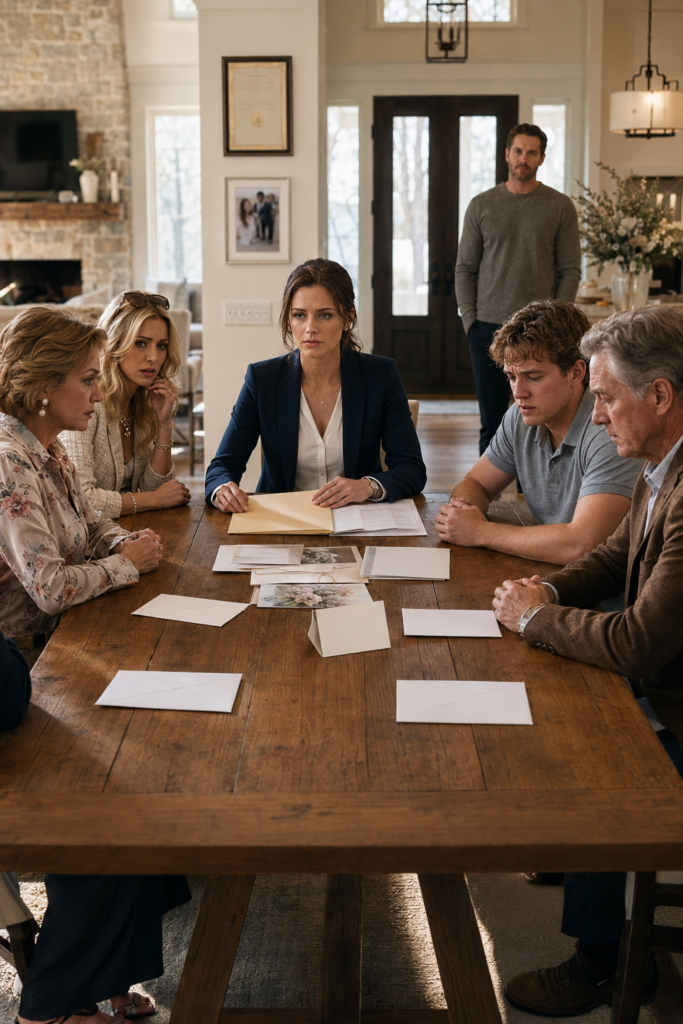
I placed the four white envelopes at the dining table.
One at each seat.
Then I placed the manila folder beside my own chair.
Inside were printed pages.
Austin’s posts.
The formal declaration.
A copy of my wedding save-the-date.
Aunt Clara’s card.
Evidence and boundary, side by side.
The doorbell rang at 1:07.
Of course they were late.
I opened the door.
My mother stood first, wearing a floral silk blouse and pearl earrings, the exact uniform of a woman prepared to appear reasonable. Brooke stood behind her in oversized sunglasses, her blond hair styled into soft waves. Austin lingered near the back in a wrinkled polo shirt, looking pale and restless. And finally, my father, Garrison, stood with his hands shoved into the pockets of a brown jacket, as if he had been dragged into a meeting he already regretted.
“Come in,” I said.
They crossed the threshold.
That was the first good moment.
My mother stopped walking.
Her eyes went up to the high ceiling, down to the stone floor, left toward the living room, right toward the kitchen. Her mouth opened, then closed.
Brooke said nothing, but her face tightened as she took in the windows, the marble, the view of the backyard. Austin looked around too quickly, the way people look when they are counting value rather than beauty.
My father saw the framed certificate first.
He stopped near the entryway.
His eyes fixed on the date.
March 15th.
Color rose slowly in his face.
He looked away.
My mother recovered first.
“Gwen,” she said brightly, “this is beautiful. Just beautiful. I always knew you and Julian would do well.”
“No, you didn’t.”
Her smile froze.
“Sit down,” I said. “Let’s talk about what you came here to talk about.”
The walk to the dining table was quiet.
They saw the envelopes immediately.
Nobody touched them.
I took the head of the table. My mother sat opposite me, arranging her face into concern. Brooke sat to her left. Austin sat beside Brooke, bouncing one knee under the table. My father sat last, keeping his eyes down.
For a few seconds, there was only the hum of the refrigerator and the faint sound of a lawn mower somewhere beyond the windows.
My mother folded her hands.
“Family helps family, Gwen.”
There it was.
The polished opening line.
The old door.
I waited.
She continued, encouraged by my silence.
“Austin has been going through a difficult season. He made some financial decisions that didn’t quite work out, and the numbers have gotten ahead of him.”
“Financial decisions,” I repeated.
“Yes. We have all tried to help. I gave from my retirement account. Brooke helped. Even your grandmother contributed what she could.”
Austin stared at the table.
Brooke looked bored, but her fingers were tight around the strap of her purse.
My mother leaned forward.
“The remaining amount is one hundred eighty thousand dollars.”
I wrote the number on the legal pad in front of me.
180,000.
My pen moved slowly, deliberately.
“And what exactly would this money go toward?”
“Clearing his obligations,” my mother said.
“To whom?”
She blinked.
“Various people.”
“Various people,” I repeated.
Austin shifted.
Brooke exhaled dramatically.
“Gwen, don’t do this,” she said.
I looked at her.
“Do what?”
“Act like we’re asking for something impossible. Look around. Look at this house. One hundred eighty thousand dollars is a lot to us, but to you? Come on.”
My mother’s eyes flicked toward Brooke, a silent warning to be careful.
Brooke ignored it.
“You married well,” she said. “Some of us aren’t that lucky.”
The room went still.
Even Austin looked up.
My father closed his eyes.
For one moment, I was back on the courthouse steps in an eighty-nine-dollar dress, holding a brown-paper bouquet while they drank champagne under gold lights.
You married well.
As if my degree, my career, my years of work, my discipline, my savings, my choices, my refusal to collapse had been nothing more than a lucky seat beside the right man.
I set the pen down.
“Brooke,” I said softly, “you should stop talking.”
Her face flushed.
“Excuse me?”
“You heard me.”
My mother lifted one hand.
“Let’s keep this calm.”
I turned to her.
“You don’t get to manage the tone in my house.”
That was when her mask slipped for the first time.
Not fully.
Just enough.
Her eyes narrowed, and for half a second I saw the woman who had called forty relatives behind my back, the woman who had taught me that compliance was love, the woman who could erase a wedding and still expect a seat at the table.
Then she softened again.
“Gwen,” she said, voice trembling now, “I know we have made mistakes.”
Mistakes.
Such a small word for years of being moved aside.
“I know your wedding day wasn’t handled perfectly.”
Brooke looked down at her nails.
Austin swallowed.
My father stared at the framed certificate visible through the entryway.
“But Austin is your brother,” my mother continued. “And he needs us. He needs you.”
I looked at Austin.
“Do you need me?”
He opened his mouth, then looked at my mother.
“Don’t look at her,” I said. “Look at me.”
His gaze snapped back.
“I’m in a bad spot,” he muttered.
“How long have you been counting on me to get you out of it?”
He went pale.
My mother stiffened.
Brooke frowned.
“What does that mean?” she asked.
I reached for the manila folder.
The movement was small, but everyone at the table noticed.
Austin’s knee stopped bouncing.
My mother’s hands tightened.
My father finally looked up.
The folder was plain, tan, ordinary. The kind you could buy in a pack of twenty at an office supply store. But in that room, on that table, it changed the air.
I rested my fingertips on the tab.
“Before we continue,” I said, “there is something all of you need to see.”
My mother’s smile disappeared.
Austin whispered, “Gwen…”
I opened the folder.
And the first page I pulled out was dated March 15th.