vf When my brother proudly announced that his wife was pregnant with baby number five,

When my brother proudly announced that his wife was pregnant with their fifth baby, my parents reacted as if heaven itself had leaned down and blessed the dining room.
My father stood first.
He pushed his chair back so quickly it scraped against the hardwood, crossed the room, and clapped Ryan on the shoulder with both hands.
“Great job, son,” he said, grinning like my brother had just secured the future of the Carter family name by doing something heroic.
My mother pressed a napkin beneath one eye.
“Oh, Madison,” she breathed. “Another blessing.”
Across the table, my sister-in-law placed one hand over her still-flat stomach and smiled like a queen accepting tribute from her court. She wore a cream sweater, pearl earrings, and the expression of a woman who had never once doubted that the entire room would reorganize itself around her needs.
Their four children were already reorganizing the house.
Lily, the oldest at seven, was shouting from the hallway because someone had stepped on her doll. Six-year-old Caleb was chasing three-year-old Noah with a plastic sword. Little Grace, barely two, had toddled into the living room and was trying to pull ornaments from my mother’s year-round decorative tree, which she insisted was “seasonal” because she changed the ribbons every month.
A crash came from the living room.
Everyone ignored it.
Everyone except me.
That was how it usually worked.
Ryan made announcements. Madison accepted praise. My parents glowed. The children ran wild through the house. And I, Olivia Carter, thirty-one years old, single, employed full time, and apparently born without the right to my own schedule, became the person expected to hear every crash, catch every spill, wipe every face, find every missing shoe, and somehow make sure no one blamed the parents who had produced the chaos.
I looked toward the living room.
“Something broke,” I said.
Madison waved one hand lightly.
“They’re fine.”
My mother gave me a look.
Not a grateful one.
A warning.
Do not spoil this moment by pointing out reality.
Then she turned back toward Madison and said, “Five children. I always knew Ryan would have a big family.”
Ryan puffed up with pride.
My father poured him more wine.
“To family,” Dad said.
Everyone raised a glass.
I did not.
I was still listening to Grace cry in the next room.
My mother noticed my hand resting beside my untouched water glass. Her smile cooled. Then, as if the thought had only just occurred to her, she looked straight at me.
“You’ll handle the kids,” she said.
Not asked.
Declared.
The room kept smiling for half a second longer, because everyone assumed I would do what I had always done.
Fold.
Adjust.
Sigh.
Give in.
I set down my fork carefully.
“Absolutely not.”
The silence came so fast I could hear the refrigerator buzzing in the kitchen.
Ryan frowned first.
“Don’t start, Olivia.”
“I’m not starting anything,” I said. “I’m ending something.”
My mother’s face tightened.
“Ending what?”
I looked around the table.
At my father, who had congratulated Ryan like fertility was a business promotion.
At Madison, whose smile was fading into something harder.
At Ryan, who had not once looked toward the living room where his children were still yelling.
At my mother, who had already assigned my life to a fifth child that was not even born yet.
“For eight years,” I said, “I have been the emergency babysitter, the weekend babysitter, the unpaid tutor, the school pickup, the sick-day backup, the birthday organizer, the person who remembers which child needs gluten-free snacks, which one hates loud bathrooms, which teacher needs a form signed, and which shoe belongs to which kid.”
Madison sighed.
“Oh my God.”
“I have used vacation days for your children’s fevers,” I continued. “I have missed dates, canceled work meetings, changed plans, and driven across town at midnight because someone forgot to tell me they needed childcare until they were already leaving.”
Ryan rolled his eyes.
“You act like we never say thank you.”
“You usually don’t.”
My father set his glass down.
“Olivia.”
That was all.
Just my name.
In his voice, my name had always been a warning before punishment.
When Ryan borrowed money and did not repay it, Dad said Olivia, be generous.
When Madison left the kids at my apartment with no notice, Dad said Olivia, they’re overwhelmed.
When Mom volunteered me for birthday parties, school runs, and emergency pickups, Dad said Olivia, don’t make everything difficult.
That night, my name did not work.
I looked at him and said, “No.”
Madison’s face changed.
She leaned back in her chair and folded her arms.
“You have no family,” she said. “This is your training.”
The words struck colder than I expected.
Not because they were clever.
Because no one corrected her.
My mother looked down at her plate.
My father stared at his wine.
Ryan only sighed, as if I had embarrassed him by being hurt.
You have no family.
This is your training.
As if motherhood were my future duty to Ryan’s children.
As if I were an empty apartment waiting for someone else’s furniture.
As if my life had no shape because it did not look like theirs.
I stood.
My chair legs made a soft sound against the floor.
Madison’s eyes flashed.
“Where are you going?”
“Home.”
Ryan scoffed.
“Classic.”
I placed my napkin beside my plate.
“Find childcare. Real childcare. Paid childcare. Confirmed childcare. I am done being assumed into the room.”
Mom followed me to the front door.
“Olivia, don’t be dramatic.”
I turned around.
Behind her, I could see Ryan standing near the dining table, irritated and offended. Madison sat with one hand on her stomach, glaring at me like I had attacked her unborn child by refusing to parent the four she already had. My father remained seated, silent in the way men are silent when they agree but want the women to do the dirty work.
“I’m not dramatic,” I said. “I’m done.”
I walked out without another word.
The cold evening air hit my face like relief.
I made it to my car before the tears came.
That made me angrier than anything.
I did not want to cry over Madison. I did not want to cry over Ryan. I did not want to cry over my parents, who had spent years turning me into a family utility and calling it love.
But my hands shook on the steering wheel.
Because the worst part of being used by family is not the exhaustion.
It is how long you spend wondering whether asking to be treated like a person makes you selfish.
I drove back to my apartment in Brookhaven, kicked off my shoes, and sat on the floor beside my bed with my coat still on. My phone buzzed three times.
Mom.
Ryan.
Madison.
I did not answer.
Then one text came through from Madison.
You’ll learn one way or another. Don’t think you can walk away from family.
I stared at it for a long time.
Then I took a screenshot.
I had been doing that for two years.
At first, I kept the folder because I thought someday, if I showed them everything, they would see. If they could just understand how often it happened, how casual the demands had become, how little warning I was given, surely they would apologize.
Surely Ryan would say, I didn’t realize.
Surely Madison would say, We took advantage.
Surely Mom would say, We leaned on you too much.
That was the hopeful version of me.
The folder outlived her.
By the time I went to bed, I had added Madison’s message to the others.
Thanksgiving last year: We’re leaving the kids with you for the weekend. Don’t make it weird.
March: You don’t have a husband or kids, so stop acting busy.
April voicemail from Mom: Family helps, Olivia. You should be grateful they need you.
June text from Ryan: I told the school you’d pick up Lily because Madison and I have plans. Don’t embarrass me.
August message from Madison: The kids are outside your apartment. We had to go. Open up.
There were dozens.
Hundreds, if I counted missed calls.
I slept badly.
At 7:42 the next morning, my phone rang.
I nearly let it go to voicemail, but the number was local and unfamiliar.
“Hello?”
A steady male voice answered.
“Ma’am, this is Officer Daniels with the Brookhaven Police Department. Am I speaking with Olivia Carter?”
My stomach clenched.
“Yes.”
“Ms. Carter, your brother and sister-in-law listed you as the responsible caregiver for four minor children this morning.”
I sat upright in bed.
“They what?”
There was a pause.
“The children are safe,” he said quickly. “A neighbor called after seeing the youngest child outside near the driveway without an adult. Officers responded to the residence. Your parents arrived shortly after. Your brother and sister-in-law are currently being contacted.”
My mouth went dry.
“I was not watching them.”
“That is why I’m calling,” he said. “Your name and number were written on a note left on the kitchen counter.”
I stared at my bedroom wall, still wearing the same sweatpants I had cried in the night before.
“What note?”
He cleared his throat.
“It said, ‘Olivia has the kids until noon. We’ll be at the clinic.’”
Of course.
Ryan and Madison had taken my refusal, erased it, and written my obedience onto paper.
“I never agreed to that,” I said. “I left my parents’ house last night before nine. I have not spoken to any of them since.”
“I understand,” Officer Daniels said. “We need that documented. Are you able to come to the station?”
“Yes.”
“Bring any relevant communication if you have it.”
I looked toward the closet where the folder sat in a file box.
“I have it.”
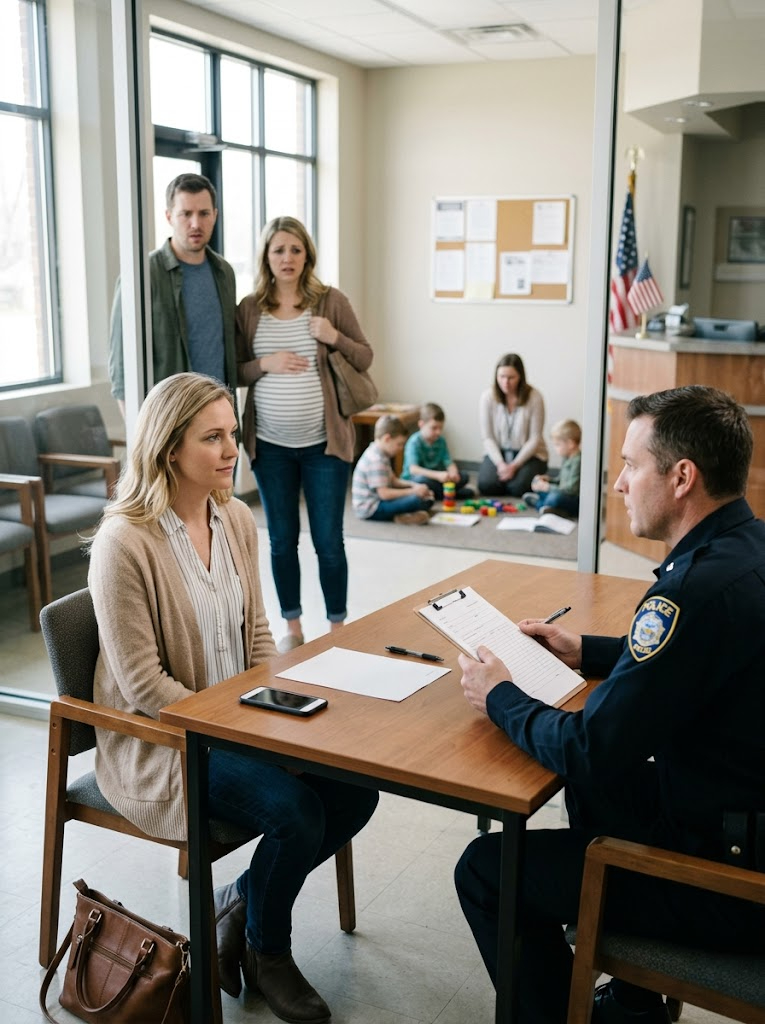
Thirty minutes later, I walked into the Brookhaven Police Department with trembling hands and a folder I had once been ashamed to keep.
The station was smaller than I expected. Fluorescent lights. Gray chairs. A coffee machine humming in the corner. A bulletin board with community notices and a faded flyer about bicycle safety. It smelled like paper, burnt coffee, and disinfectant.
Officer Daniels met me near the front desk.
He was younger than I had imagined, maybe late thirties, with gentle eyes and the worn-out face of a man who had learned too much about how often adults failed children before breakfast.
He led me to a small interview room.
“I need to ask you directly,” he said once we sat down. “Were you asked to watch the children today?”
“No.”
“Did you agree to watch them today?”
“No.”
“Did you have access to the house this morning?”
“No. I left my parents’ house last night. I slept at my apartment.”
He wrote carefully.
“Your mother told officers there may have been a misunderstanding.”
I almost laughed.
“My mother calls everything a misunderstanding when Ryan causes it.”
He looked up.
So I opened the folder.
The first page was Madison’s Thanksgiving text.
The next was Ryan’s message about my “empty life.”
Then the voicemail transcript from my mother.
Then calendar invites I had never accepted but had still been blamed for missing.
Then screenshots from times Ryan had left his children at my apartment lobby and texted me after the fact.
Officer Daniels read in silence.
With every page, his expression shifted.
Not shock exactly.
Recognition.
The kind that told me he had seen patterns like this before, even if my family had trained me to think I was overreacting.
When he reached the screenshot from the night before, he stopped.
You’ll learn one way or another. Don’t think you can walk away from family.
He looked at me.
“Ms. Carter,” he said, “this is no longer just a misunderstanding.”
For the first time in years, someone outside my family saw exactly what they had been doing to me.
My throat tightened.
I looked away because I did not want to cry in a police station.
“I don’t want the kids hurt,” I said.
“I understand.”
“They’re not bad kids. They’re little. They’re loud, but they’re little.”
“I understand,” he repeated. “This is about the adults who left them.”
That sentence settled into me like medicine.
The adults who left them.
Not me.
By noon, my parents were at the station.
Mom entered first, pale and furious, gripping her purse like it was a shield. Dad came behind her, red-faced, jaw tight, already angry at the inconvenience of consequences. Ryan arrived ten minutes later with Madison, who looked less like a radiant pregnant mother and more like someone who had expected sympathy and found paperwork instead.
The moment Madison saw me, her eyes narrowed.
“You called the police on us?”
Officer Daniels stepped between us before I could respond.
“No, ma’am. A neighbor called after finding your child outside unattended.”
Madison opened her mouth.
Then shut it.
Ryan pointed at me.
“She was supposed to be there.”
I stood slowly.
“No. You wanted me to be there. That is not the same thing.”
Mom turned toward me and whispered sharply, “Olivia, stop making this worse.”
I looked at her.
“Worse than four children being left alone?”
Her face tightened, but she said nothing.
Officer Daniels brought us into a conference room, not all together at first. He knew better than to let a family like mine turn a police matter into a guilt circle. Statements were taken separately. The children were with my parents temporarily, eating snacks in another room with a woman from child protective services who spoke gently and wrote everything down.
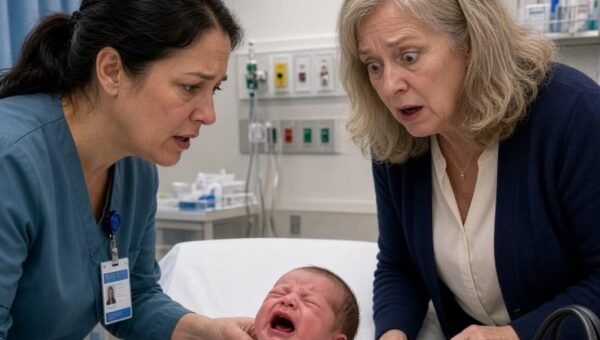
I heard Grace cry once.
The sound tore at me.
Not because I felt guilty.
Because she was two, and none of this was her fault.
When we were finally brought into the same room, Ryan began talking fast.
He said Madison had a morning appointment.
He said they thought I would “cool down” after dinner.
He said I always helped eventually.
He said family arrangements were casual and everyone understood that.
He said they had no reason to believe I would abandon the children over a disagreement.
Officer Daniels listened without interrupting.
That was worse for Ryan than being challenged.
Ryan was used to people interrupting. He could argue with interruption. He could call it drama. Calm silence made him explain himself until the explanation collapsed.
Then Officer Daniels placed the note on the table.
“Who wrote this?”
Madison looked away.
Ryan swallowed.
I knew right then.
Officer Daniels asked again.
“Who wrote the note saying Olivia had the children until noon?”
Madison’s voice came out thin.
“I did.”
“And did Olivia agree?”
Madison lifted her chin, anger returning because shame had not taken root.
“She should have.”
The room went completely still.
Officer Daniels leaned back slightly.
“That was not my question.”
Madison’s face flushed.
“No.”
One word.
Small.
Legal.
Devastating.
No, I had not agreed.
No, I was not responsible.
No, they could not keep using me and calling it love.
Mom whispered, “Madison.”
Madison turned on her.
“What? She always does it. Everyone knows she always does it.”
I looked at my mother.
There it was.
The whole family system, spoken plainly at last.
Not Olivia agreed.
Not Olivia offered.
Not Olivia wanted to help.
She always does it.
My father rubbed his forehead.
Ryan glared at me as if I had betrayed him by allowing the truth to become official.
Officer Daniels opened my folder and placed several printed screenshots beside the note.
“Ms. Carter has provided a record indicating repeated unplanned childcare demands, including communication from last night after she refused additional responsibility.”
Madison’s eyes darted toward the papers.
“You brought a folder?”
“Yes,” I said.
“That’s insane.”
“No,” I said. “It’s documented.”
Ryan scoffed.
“You’ve been collecting things against us?”
“I’ve been keeping proof of what you do.”
“Family doesn’t do that.”
“Family doesn’t abandon children and write my name on the counter.”
That shut him up.
The legal consequences were not cinematic.
No one was dragged away screaming. No dramatic handcuffs. No judge banging a gavel in real time. Real consequences are often quieter than people imagine.
Child protective services opened an inquiry.
Ryan and Madison were questioned, warned, and required to provide proof of confirmed childcare going forward. My parents had to admit they never actually checked whether I was coming before assuming I would. The neighbor gave a statement. Madison’s note became part of the file. Officer Daniels documented my refusal, my location, my communications, and the history of pressure.
But the real consequence happened inside that room.
For the first time, my family had to say aloud what they had always buried beneath guilt.
They had never asked me to help.
They had assigned me.
And once that truth entered the room, it could not be stuffed back into a casserole dish and served as family duty.
After the meeting, Mom followed me into the hallway.
“Olivia.”
I stopped but did not turn around right away.
When I did, her eyes were red.
“Your brother could get in real trouble.”
“Your grandchildren could have been hurt.”
She flinched.
“You know Madison. She’s overwhelmed.”
“No,” I said. “She’s entitled.”
Mom’s mouth tightened.
“Pregnancy is hard.”
“So is being treated like unpaid staff for eight years.”
Dad came up behind her.
“Olivia, this has gone far enough.”
I looked at him.
“For once, I agree.”
He seemed relieved for half a second.
Then I continued.
“I will no longer be on any school pickup forms. I will no longer be listed as emergency childcare. I will not babysit without a direct request, at least a week’s notice, and my written agreement. And even then, I reserve the right to say no.”
Mom stared at me.
“Written agreement? That’s ridiculous.”
“No. Ridiculous is waking up to a police call because someone wrote my name on a note and left four children alone.”
Dad’s face reddened.
“You are punishing the family.”
“No,” I said. “I am resigning from a job I never accepted.”
I walked out before they could answer.
Two weeks later, Madison sent a long text.
Stress made me say things I didn’t mean. Pregnancy hormones are awful. I hope you can understand that everyone was under pressure.
No apology.
No mention of the children.
No ownership.
Just stress wearing perfume.
Ryan sent one sentence.
We need to move forward.
I replied to both of them with the same answer.
I am moving forward. Without being your childcare plan.
Then I blocked their numbers for a month.
The silence was strange at first.
I had not realized how much of my life was built around anticipating interruption. I kept checking my phone at work, expecting a crisis. I woke early on Saturdays, tense, waiting for someone to text that a child was sick, a practice had changed, a birthday party needed supervision, Madison was exhausted, Ryan had a meeting, Mom had volunteered me for “just a few hours.”
No message came.
The quiet felt almost suspicious.
Then, slowly, it began to feel like mine.
I went grocery shopping on a Saturday afternoon and bought food only for myself.
I slept until nine on a Sunday.
I went to a movie alone and did not silence my phone out of fear that Madison would call me selfish for missing an “emergency.”
I took a pottery class I had wanted to take for three years.
At the first class, the instructor asked everyone why they had come.
People gave simple answers.
Stress relief.
Creative outlet.
Date night.
When it was my turn, I looked at the lump of clay in front of me and said, “I wanted to make something that no one could ask me to babysit.”
Everyone laughed.
I did too.
And for the first time in a long time, the laughter did not hurt.
My parents were more difficult.
Mom cried. Often. She said the family felt broken. She said Ryan was hurt. She said Madison was embarrassed. She said the children missed me. She said I was making holidays complicated.
I told her the same thing every time.
“I am available for relationships, not assignments.”
She hated that.
Probably because it was clear enough that she could not pretend to misunderstand.
Dad apologized in pieces.
At first, not really.
“I’m sorry things got out of hand.”
Then, after I ended the call immediately:
“I’m sorry you felt taken for granted.”
I ended that call too.
Finally, one evening, he came to my apartment and stood in the hallway holding a small box of tea because he had no idea what to bring a daughter he had never learned how to visit without needing something.
“I’m sorry we treated your time like it belonged to us,” he said.
I looked at him for a long time.
“That’s the first honest version.”
He nodded.
“I should have stopped it.”
“Yes.”
“I thought because you were single…”
He stopped himself.
Good.
Learning sometimes sounds like silence arriving before the old sentence gets out.
“Because I was single, what?” I asked.
He looked down.
“I thought you had more room.”
“I had a life.”
“I know that now.”
I leaned against the doorframe.
“Do you?”
He swallowed.
“I’m trying to.”
That was the best he had.
It was not enough to erase years.
But it was enough not to close the door in his face.
Baby number five arrived six months later.
A boy.
Mason.
I learned from my mother, who told me carefully, not asking for anything after she said it. Progress, maybe.
I sent a gift.
A soft blue blanket, a card, and nothing more.
No offer to babysit.
No emergency availability.
No silent permission.
The card said:
Welcome to the world, Mason. May you always be cared for by people who choose the responsibility with love.
I meant every word.
Madison did not thank me.
Ryan sent a thumbs-up emoji.
That was fine.
I had not sent the gift to purchase gratitude.
I sent it because Mason was a baby, and babies do not choose the rooms they are born into.
The older children adjusted in their own ways.
Lily sent me a drawing through Mom. It showed me standing beside a house with a purple sun overhead. On the back, in crooked handwriting, she wrote:
Aunt Olivia, I miss pancakes.
That one got me.
Because I had made pancakes for them almost every weekend for years. Chocolate chip for Caleb. Tiny ones for Noah. Plain for Lily because she hated “surprises in food.” Grace mostly just ate syrup.
I waited three days before answering.
Then I sent back a postcard.
I miss pancakes too. Maybe someday we can have them when the grown-ups plan properly.
Two months later, Ryan emailed.
Not texted.
Emailed.
Subject: Pancakes?
Olivia,
Lily keeps asking. I know things are still tense. Would you be willing to have the kids over for breakfast next month? We can drop off at 9 and pick up at 11. If not, I understand.
Ryan
I read it three times.
It was the first request that was actually a request.
Specific.
Limited.
Permission-based.
No guilt.
No assumption.
I waited until the next day to respond.
Yes. Saturday the 14th, 9 to 11. Confirm by Friday. If anyone is sick, we reschedule. This is breakfast, not childcare for the day.
He replied:
Understood. Thank you.
I stared at that word.
Understood.
Maybe people could learn after all.
The children came that Saturday.
Ryan walked them to my apartment door himself. Madison stayed in the car. That was probably best.
He handed me a small bag.
“Extra clothes for Grace. Allergy medicine for Noah. My phone will be on. I’ll be back at eleven.”
I took the bag.
“Good.”
He looked awkward.
“I know this should have been normal.”
“Yes.”
“I’m sorry.”
I nodded once.
Not forgiveness.
But acknowledgment.
The kids burst into my apartment like weather.
Lily hugged my waist. Caleb asked if I still had the pancake pan. Noah wanted to know whether my pottery bowl was “supposed to look like that.” Grace climbed onto my couch and announced that she was big now.
We made pancakes.
It was loud.
Sticky.
Chaotic.
But different.
Because I had chosen it.
Because it had a beginning and an end.
Because when Ryan knocked at eleven, he was there.
On time.
That mattered more than pancakes.
I did not become the old Aunt Olivia again.
I became someone better.
Someone present by choice.
Someone loving without being consumed.
Someone who could hold a child and still hand them back when the visit ended.
Family did not collapse because I stopped being available for exploitation.
It changed shape.
Some parts broke.
Some parts grew back stronger.
Some parts stayed gone.
Madison and I never became close. There are apologies that must be lived longer than they are spoken, and she had not yet learned either. She did eventually say, “I shouldn’t have said you had no family.”
I replied, “No, you shouldn’t have.”
That was all I could offer.
My mother still slips sometimes.
She will say, “Could you just—” and then stop.
I wait.
She starts over.
“Are you available to help?”
Sometimes I am.
Often I am not.
Both answers are accepted now, though not always gracefully.
That is fine.
Grace is not required for boundaries to hold.
And Ryan?
He is tired.
Five children will do that.
But tired is not a legal argument, a moral claim, or a childcare plan. He knows that now.
At least, he knows I know it.
One Saturday after midnight, my phone rang.
Ryan’s name flashed across the screen.
For one second, my whole body tightened with the old reflex.
Emergency.
Guilt.
Duty.
I watched the screen glow.
Then I remembered Officer Daniels saying my name.
Ms. Carter, this is no longer just a misunderstanding.
I let the call go unanswered.
A minute later, a text arrived.
Mason has a fever. We’re taking him to urgent care. Just wanted to let you know, not asking you to come.
I stared at the message.
Then I exhaled.
I wrote back:
I hope he feels better. Keep me updated.
No guilt followed.
No second call.
No demand.
Just information.
That was when I realized the lesson had not only been mine.
Some lessons arrive through tears.
Mine arrived through a police call at 7:42 in the morning, a folder full of proof, and Officer Daniels placing a handwritten note on a table where my family could no longer pretend assignment was the same as consent.
For years, they told me family meant showing up whenever they needed me.
Now I know better.
Family means asking.
Family means hearing no.
Family means protecting children without sacrificing the nearest woman who has been trained not to complain.
I am still Aunt Olivia.
I still love those children.
But I am no longer the unpaid village built from guilt.
I am no longer the empty space where everyone else stores responsibility.
I am no longer training for a family I do not have.
I have a family.
It begins with me.
And the life I finally stopped handing over.
THE END
Disclaimer : This content may be created by AI for entertainment purposes. Any resemblance to real persons, events, or places is coincidental.