
Wade Harland had not spoken a single word in three days.

But when he heard the auctioneer’s voice crack like a bullhip across the town square, when he turned and saw what they had put up on that platform, something inside him tore open all over again. If this story already has your heart, do me a favor right now. Subscribe to this channel, hit that follow button, and drop a comment telling me what city you’re watching from.
I want to know how far this story has traveled. Now, stay with me because what happens next will stay with you long after it’s over. The bidding had already started by the time Wade crossed the street.
He heard it before he saw it. The low, ugly murmur of a crowd that smelled blood in the water. Benton’s Crossing was not a cruel town by design.
It was a town that had simply stopped caring about the difference between mercy and convenience, the way a man stops noticing a scar once it’s healed over. And on that October morning, with the wind blowing cold from the north, and the dust curling up off the unpaved main street, convenience had dressed itself up in the shape of an auction. Wade pushed through the edge of the crowd and stopped.
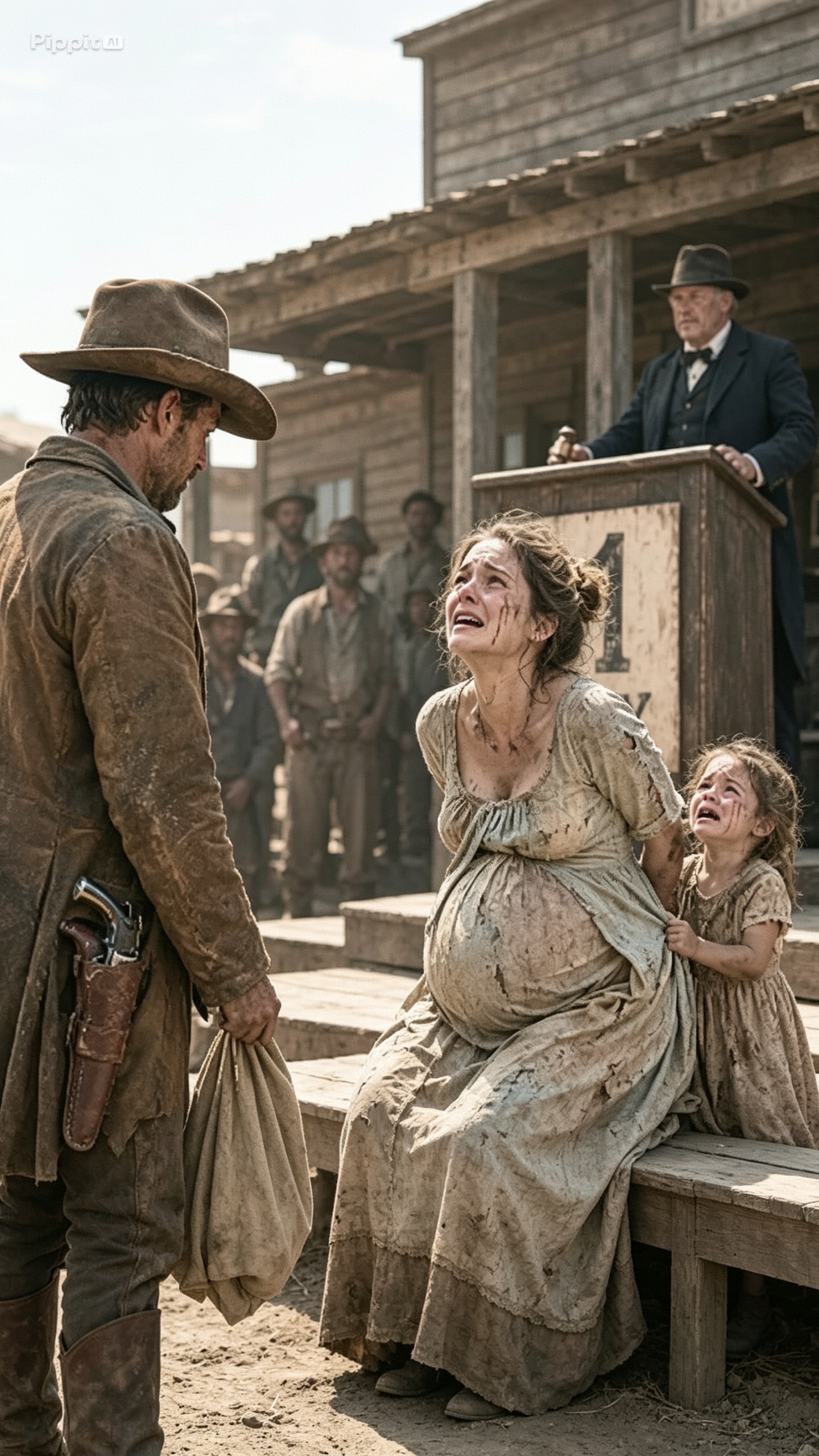
There were two of them on the platform. The woman stood on the left. She was young.
He could see that even from 20 ft away. And her dress was the color of old ash worn through at both elbows, the hem dragging against the wooden boards. Her hair was dark, pulled back without care, and her hands were clasped in front of her belly, which was swollen and low and unmistakably close to its time.
She wasn’t crying. That was the first thing Wade noticed. She wasn’t crying and she wasn’t looking at the crowd.
She was looking at something past the rooftops, past the ridge, past everything visible. The look of a woman who had already survived more than most men could name. The child stood on her right.
She was small, maybe five or 6 years old, with the same dark hair as her mother and eyes that hadn’t blinked once since Wade started watching. She wore a coat two sizes too large. The sleeves rolled back to free her hands, and she held her mother’s hand with a grip that said she had learned somewhere and sometime that letting go meant losing.
15 cents, someone in the crowd said it wasn’t a real bid. It was a joke, and the men around the man laughed. The auctioneer, a thin, red-faced man named Gruber, who ran the general store on weekdays and apparently sold human beings on Fridays, cleared his throat and raised his gavvel.
Now, gentlemen, let’s be reasonable. We’re talking about a capable woman due to deliver within the month and the child is quite healthy. Whoever takes them on gets a full season of labor once she’s recovered.
And the county gets this unfortunate matter settled before winter. Unfortunate matter. A woman in a bonnet near the front repeated to her companion, her voice ripe with satisfaction.
That’s a charitable way to put it. Her husband left debts. Another voice offered.
Can’t blame the county for needing to settle accounts. I heard it was her brother-in-law pushed for this. Said she had no legal standing after Thomas died.
Well, she don’t, does she? WDE stood very still and listened to all of it. He had grown up in a world where men talked like this matter of fact and comfortable about the disposing of other people’s difficulties.
He had watched it happen to others. He had once, to his everlasting shame, walked past a situation not unlike this one because he had told himself it wasn’t his business. That was 6 years ago, and the memory of it had clung to him like woods smoke ever since.
He was not going to walk past this one. Do I hear $2? Gruber called out.
Silence. $1, then. Someone give me $1 for a healthy woman and a quiet child.
More silence. A few men shuffled their feet. A few women looked away.
50 cents, said the man who had started with 15. He was grinning. Wade recognized him, Clyde Marsh, who ran freight wagons and treated his horses worse than most men treated their enemies.
50 Cents and I’ll take them both off the county’s hands before supper. The woman on the platform finally moved. She didn’t flinch.
Didn’t look at Clyde Marsh. She pulled her daughter an inch closer to her side and that single quiet gesture hit Wade somewhere behind his sternum like a closed fist. He stepped forward.
$15. The crowd turned. Wade Harland was not a large man, but he carried himself in the way of men who had worked hard ground their entire lives, straightbacked, unhurried, with hands that told the story before his mouth ever opened.
He was 34 years old, weathered 10 years past that, and he was wearing his good coat because he had planned to sell a horse today, not spend what the horse would have brought. Gruber stared at him. $15 from Mr.
Harland, Wade Harland, north of town off the Calvert Road. Mr. Harland bids $15.
Gruber looked around the crowd with obvious hope that someone would outbid him. No one moved. going once.
Clyde Marsh made a sound low in his throat. Harland, you planning to work that woman in her condition? Wade looked at him.
That’s your business, Marsh. I’m just asking. Then I’m just not answering.
Going twice, Gruber said with the tone of a man who wanted this concluded before it became more uncomfortable. Sold to Mr. Wade Harland of Calbertt Road for the sum of $15.
The gavl came down. The crowd dispersed the way crowds do when the spectacle is finished slowly in clusters already moving on to the next thing. Wade walked to the steps of the platform and took them one at a time.
Gruber was already counting the money Wade had pressed into his hand and he didn’t look up. The woman was watching Wade now. Up close, he could see that her eyes were gray and that the stillness in them was not peace.
It was the particular stillness of someone who has been afraid for so long that fear has become the only steady thing in their life. Ma’am, he said. He took off his hat.
She didn’t say anything. My name is Wade Harland. I have a ranch north of here about 7 mi out.
It’s not much to look at, but it’s warm and it’s mine and there’s room. He paused. He wasn’t a man who talked around things, but he found himself wanting to be careful.
I’m not buying you. I want to be plain about that. I paid that money to Gruber because the county was going to use it to settle your husband’s debts, and I’d rather the money go to that than watch Clyde Marsh drive off with you in a freight wagon.
The woman’s jaw tightened. You can come with me until after the baby comes, he continued. After that, whatever you want to do is your choosing.
If you want to go, I’ll give you what I can for supplies and a direction. If you want to stay and work for room and board, I won’t turn that down either, but it’s your choice. That’s what I’m offering.
The little girl, Lily, he would learn her name later was staring at him with those unblinking eyes. She hadn’t made a sound. The woman said, “Why?” It was the first word she had spoken.
Her voice was low and level and a little rough. The voice of someone who hadn’t had much reason to use it lately. Because no one else did, Wade said simply.
Something shifted behind her eyes. Not softness, not yet. Something more like the slight easing of a knot that has been pulled too tight for too long.
Clara Voss, she said. My name is Clara Voss, and this is my daughter, Lily. Pleased to meet you both.
He put his hat back on. My wagon’s around the side of the merkantile. It’s about half broke down, but it’ll get us there before dark if we leave in the next hour.
Clara looked down at Lily. The child looked up at her mother. Something passed between them, the private language of two people who have only had each other.
===== PART 2 =====
And then Clara looked back at Wade and gave a single careful nod. “All right,” she said. “We’ll come.
The wagon was in fact somewhat more than half broke down. One of the rear wheel spokes was cracked through and the canvas cover had a tear along the left side that let the wind in like an unwanted opinion. Wade had been meaning to fix both for 2 weeks and he stood looking at it now with the specific guilt of a man confronting a chore he has put off past the point of politeness.
I can fix the spoke, he said. Won’t take long. I’ll wait, Clara said.
Lily was already beside the wagon, running her fingers along the sideboard with the careful, methodical attention of a child cataloging something new. She touched the wood. She touched the iron bracket at the corner.
She did not touch the horse. She doesn’t talk much, Clara said quietly. She wasn’t explaining or apologizing, just stating.
That’s all right, Wade said. He was crouched beside the wheel with a mallet and a spare spoke he kept in the wagon bed. Quiet suits me fine.
Clara watched him work. You said your ranch is 7 mi north. About that, give or take.
You live alone out there. He drove the spoke into place with three clean blows. I do now.
She heard the weight in those two words and didn’t press them. That was something Wade noticed about her. Even then, she could hear what a person wasn’t saying, and she had the sense to leave it where it lay.
He got the wheel set right, checked the axle, and stood. He wiped his hands on the side of his trousers, and looked at the sky. The clouds were moving fast from the northwest, and they had the gray-bottomed look that meant weather before nightfall.
“We should go,” he said. He helped Clara up onto the wagon seat, moving slowly, giving her time and not making a thing of it. He lifted Lily up himself, and the child allowed it without stiffening, which he took as a good sign.
He climbed up, took the res, and clicked his tongue at the horse. A bay geling with one white sock named Sage, who had carried Wade through three bad winters, and earned every oat he’d ever eaten. They pulled out of Benton’s crossing without ceremony.
No one came to see them off. No one called out. The town simply closed behind them the way a wound closes slowly and without anyone’s permission.
For the first two miles, nobody said anything. The wind was picking up and Lily had pressed herself against her mother’s side and pulled the overlarge coat tighter. Clara sat straight backed on the wagon seat despite the cold and the rough road her hands folded across her belly with a stillness that seemed almost deliberate like she was keeping herself together through sheer will of posture.
===== PART 3 =====
Wade drove and kept his eyes on the trail. It was Lily who broke the silence not with words but by pointing. She lifted one small hand and pointed at Sage’s hindquarters with a look of absolute focus.
That’s Sage. WDE said. He’s been with me about 4 years.
Good horse. Stubborn sometimes, but honest. Lily’s finger stayed pointed.
You can pet him when we stop. Wade offered. He won’t mind.
Lily lowered her hand and looked up at her mother. Clara’s mouth moved slightly. The ghost of something that might in better times have been a smile.
“She likes horses,” Clara said. “Then she and Sage will get along fine.” Another stretch of quiet. The trail bent north and the trees closed in on both sides, bare limbmed and skeletal against the gray sky.