Waitress Got A Zero Tip, Then Found The Note Hidden Under The Plate-yilux

Maya Ortiz learned to carry two kinds of weight before most people finished their first cup of coffee.
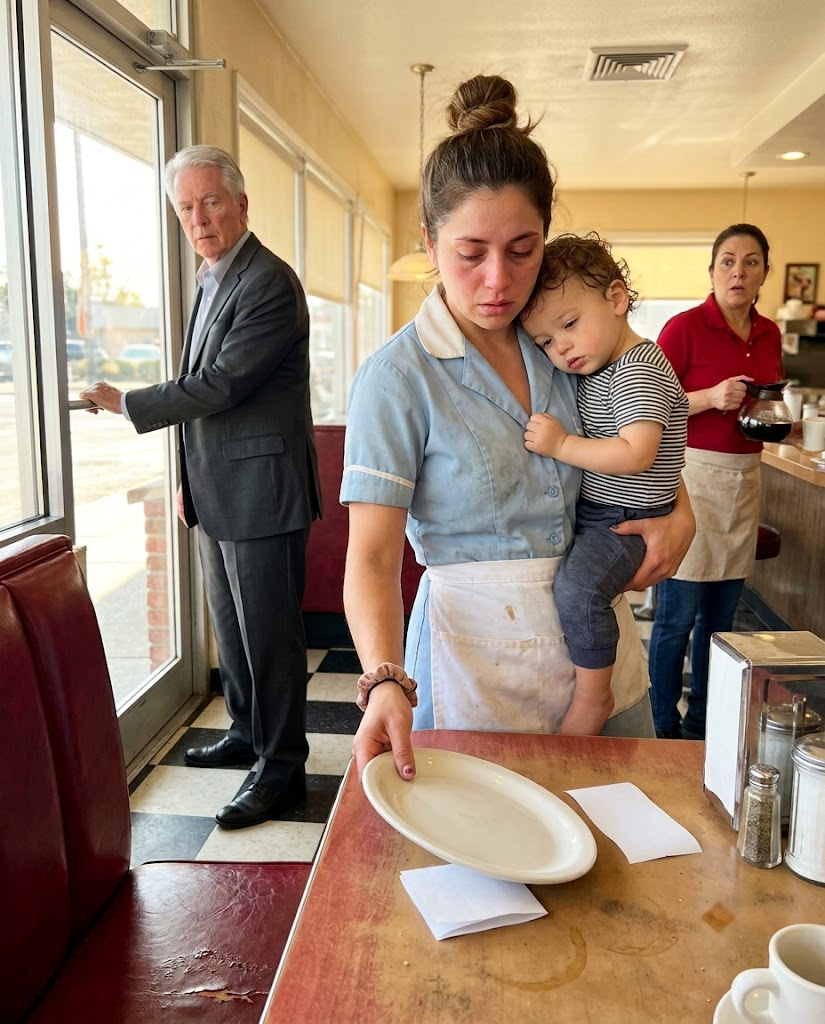
There was the real weight, Noah’s sleepy body tucked against her hip while she moved between booths at Cedar Ridge Diner.
Then there was the other kind, the invisible heaviness of rent, medicine, childcare, and smiling politely when people treated exhaustion like a personal flaw.
That Thursday morning, both kinds of weight had settled on her before sunrise.
Noah had woken hot and whimpering, his curls damp against his forehead, and the daycare director had used the gentle voice people use when they are about to say no.
Maya thanked her anyway, because anger did not pay bills.
She packed a diaper bag, two fever reducers, a stack of coloring pages, and the last clean dinosaur shirt Noah owned.
By six-thirty, she was unlocking the side door of the diner with one hand and balancing her son with the other.
The kitchen already smelled like onions, coffee, and old grease.
Carla, the morning cook’s sister and the only coworker who never made Maya feel small for being desperate, took one look at Noah and moved a crate behind the counter.
She did not ask why he was there.
She just put a towel over the crate and said he could sit near the register whenever Maya needed both hands.
Maya almost cried from that small mercy, which was how she knew the day was going to be harder than usual.
Maya moved through all of it with her apron pocket full of receipts and her mind full of arithmetic.
She knew the cost of Noah’s medicine.
She knew the exact number of hours she needed before Friday to cover daycare.
She knew the rent notice in her purse had a red stamp on the corner, and she knew red stamps were not patient.
At eleven-forty, the bell over the door rang once.
The diner did not go silent, but it changed.
People noticed the man before Maya did.
He was older, tall, silver-haired, and dressed in a charcoal suit that looked like it belonged in a boardroom instead of beside a pie case.
He paused near the hostess sign, glanced over the room, and chose the booth by the front window.
Carla leaned through the pass and whispered that he was Elliot Hale.
Maya knew the name in the way working people know rich names, from buildings, headlines, and charity plaques they pass without being invited inside.
None of that mattered to table seven needing coffee.
Maya set a menu in front of him, shifted Noah higher on her hip, and asked what he would like.
He ordered eggs, toast, and black coffee.
His voice was quiet.
His eyes were not.
They moved over the diner like he was memorizing evidence, lingering on the cracked vinyl, the handwritten pie board, the old photograph of the first owner above the register, and finally on Noah’s hand gripping Maya’s apron.
Maya waited for the look people gave her when they decided a child at work was unprofessional.
It did not come.
He only nodded toward the coffee pot.
She poured, apologized for Noah’s fussing, and moved on before the apology could turn into pleading.
When the rush thinned, she brought Hale his check.
He took it without looking at the total.
Maya went to wipe down the counter, settle Noah with crackers, and breathe for thirty seconds.
By the time she returned to table seven, the booth was empty.
The chair had been pushed in.
The coffee cup sat squarely on the saucer.
The receipt lay beneath the rim of the plate.
Maya pulled it free the way servers do, quickly, automatically, already moving on to the next task.
Then she saw the tip line.
Zero.
The number seemed too neat to be accidental.
For a second, Maya heard every sound in the diner at once: forks on plates, the dishwasher door, Noah’s small cough, Carla calling an order, a truck braking outside.
Then all of it dulled behind the heat rising into her face.
She had been stiffed before.
People forgot, people were cheap, people thought a smile came free with breakfast.
But this felt different because he had seen her.
He had seen the toddler, the shaking hands, the tired apologies, and still left nothing.
Maya pressed the receipt flat with her thumb.
She did not curse.
She did not chase him.
She did not let the college boys see her blink too fast.
She reached for the plate.
It stuck.
Not hard, not like old syrup, but with the small resistance of paper trapped underneath.
Maya lifted the dish slowly.
A folded note lay in the clean square of table beneath it.
It had been placed directly under the center of the plate, so carefully that nobody clearing fast would have missed it unless they were careless.
Maya’s first feeling was not hope.
It was fear.
Powerful people could turn anything into a test, and poor people were always the ones expected to be grateful for being examined.
Still, she picked up the note.
Noah stirred against her shoulder.
Carla saw Maya’s face and stepped closer, but she did not touch the paper.
Maya unfolded it.
The handwriting was blue, even, and old-fashioned.
It said he had watched her keep her dignity when the room offered her no help.
It said the zero was not the tip.
It said she should come to an office on Maple Street the next morning and ask for Grace Weller.
It said to bring her son.
At the bottom was Elliot Hale’s signature and a phone number.
Maya read the note until the words blurred.
Carla asked if she was all right.
Maya wanted to answer, but the only thing she could feel was the dangerous shape of possibility.
That night, she set the note on the kitchen table beside the rent notice and stared at both while Noah slept.
She almost threw the note away, then folded it into her wallet behind Noah’s insurance card.
At nine the next morning, Maya stood outside the Maple Street office wearing borrowed flats that pinched her heels.
The building was small and brick, not the glass tower she expected.
There was no marble lobby.
There was no receptionist looking her up and down like a mistake.
There was only a woman with gray curls, a navy cardigan, and a badge that read Grace Weller, Hale Family Foundation.
Grace did not ask Maya to sit in a waiting room.
She opened the door herself.
Noah hid behind Maya’s leg, then peeked at the wooden train set on the rug.
Grace knelt and pushed one little engine toward him.
That was the first sign this was not a performance.
Maya sat across from Grace’s desk with her purse clutched in both hands.
Grace placed the diner note between them and asked if Maya wanted the truth before the paperwork.
Maya nodded.
Grace explained that Elliot Hale’s mother had once worked at Cedar Ridge Diner.
Her name was Lillian.
She had been a waitress with a child, no husband, no safety net, and a boss who docked her pay whenever the baby cried.
One winter morning, Lillian served breakfast to a traveling salesman who left no money on the table.
Under his plate, she found a note and enough cash to keep her room for another month.
The note did not save her whole life.
No single note can do that.
But it gave her one week of breathing room, and that week gave her the courage to apply for night classes.
Years later, Lillian’s son became Elliot Hale.
Years after that, he built a foundation around the one belief his mother had repeated until she died: help should arrive before people break, not after.
Maya listened without moving.
Grace slid a photograph across the desk.
It showed the same red booth at Cedar Ridge, decades younger but unmistakable.
A tired waitress stood beside it, holding a little boy’s hand.
The boy’s shoe was untied.
The waitress’s apron was stained with coffee.
The resemblance was not physical, not really, but Maya felt it anyway, the echo of another woman trying to survive a morning with a child at her side.
Grace opened a folder.
Inside were three offers, all written plainly.
The first was an emergency grant paid directly to Maya’s landlord and daycare, not to her, so nobody could call it a handout she had misused.
The second was a childcare scholarship for Noah at a center near the community college.
The third was tuition support for Maya to finish the nursing prerequisites she had abandoned when Noah was born.
Maya put one hand over her mouth.
Grace waited.
Good help waits.
Bad help rushes you into gratitude before you have time to understand the cost.
Maya asked what Elliot wanted from her.
Grace said he wanted one honest answer.
If the zero tip had made Maya cruel to the next customer, the foundation would still have helped with emergency rent, because children should not pay for an adult’s test.
But the scholarship was reserved for people who kept their hands open when life tried to make fists of them.
Maya did not know whether to feel honored or angry.
Both feelings stood up inside her at the same time.
She thought of the heat in her face when she saw the zero.
She thought of the way she had apologized all day for needing to be a mother and a worker in the same body.
She thought of how close she had come to tearing the note in half.
Then she said the only sentence in her heart.
“Kindness shouldn’t have to pretend to be cruelty.”
Grace looked down.
Not ashamed enough to deny it.
Ashamed enough to hear it.
She told Maya she was right.
That answer, Grace said, would be included in her file exactly as she said it.
Maya signed nothing that day.
She took the folder home, read every page twice, called the community college, called Carla, and left Elliot a voicemail saying thank you, then saying she hoped the next woman would not have to be hurt first.
Two days later, Grace called back and told her the zero-tip test would end.
From then on, the program would work through referrals from diners, laundromats, clinics, libraries, and schools, places where people saw quiet strength every day without staging humiliation to prove it.
The grant cleared the rent notice before Friday, Noah started at a childcare center with bright windows, and Maya returned to Cedar Ridge long enough to leave on steady feet instead of panic.
On Monday evenings, she took biology in a classroom that smelled like dry erase markers and old carpet.
She was tired in every class.
She passed anyway.
Six months later, Grace invited Maya to a foundation meeting, and Elliot Hale stood when she entered a plain conference room with no cameras in it.
He thanked her, said his mother would have liked her, and opened a box on the table.
Inside were copies of old diner receipts, photographs, and Lillian Hale’s waitress badge.
At the bottom was the original note the traveling salesman had left under her plate.
Maya expected money words.
She expected a blessing, a promise, maybe some grand line about destiny.
Instead, the note was practical.
It listed a boardinghouse address, a school office, and the name of a woman who could watch children during evening classes.
The old act of kindness had not been magic.
It had been logistics.
That was why it worked.
Hope is beautiful, but childcare has hours.
Compassion sounds noble, but rent has a due date.
Elliot told Maya the foundation had spent years giving money from a distance because distance felt safer, and after her voicemail, he understood that distance had made him careless.
He asked if Maya would join a paid advisory board made up of workers who had actually lived the problems the foundation claimed to solve.
A year passed, and Maya finished two semesters while Noah learned to count to twenty and developed a fierce loyalty to blueberry pancakes.
Maya never became rich.
That was not the point.
She became steadier, harder to scare, and able to look at a folder, a bill, a syllabus, or a crying child and see a next step instead of a dead end.
The final twist came on a rainy Tuesday in October.
Maya was no longer working the lunch shift, but she stopped by Cedar Ridge after class to pick up soup for Noah.
A young man at the counter was counting coins beside a stroller.
His baby slept under a thin blanket.
The cashier looked irritated.
The man looked like he had already apologized too many times for existing.
Maya recognized the posture before she knew anything else about him.
It was the posture of someone bracing for the world to say no.
She paid for his meal quietly.
Then she took a napkin, wrote Grace Weller’s number on it, and placed it under his plate before she left.
No zero tip.
No test.
Only the address, the number, and a note that said help was available before pride had to bleed for it.
Outside, rain tapped against the awning.
Maya stood for a moment with the soup container warm in her hands and watched the young man lift the plate.
His face changed.
Not all at once.
Just enough.
That was how second chances often arrived, not as thunder, not as a miracle, but as one practical door opening while a person still had the strength to walk through it.
Maya never saw Elliot Hale in that diner again.
She did not need to.
His mother’s story had found hers, and hers had already begun moving toward someone else.
The receipt that once looked empty had never been the ending.
It was only the surface.
Underneath, there had been a note, a wound, a correction, and a future waiting for Maya to lift the plate.