
Advertisement

When a Silent Lieutenant Faced an Admiral, the Whole Base Froze…-haohao

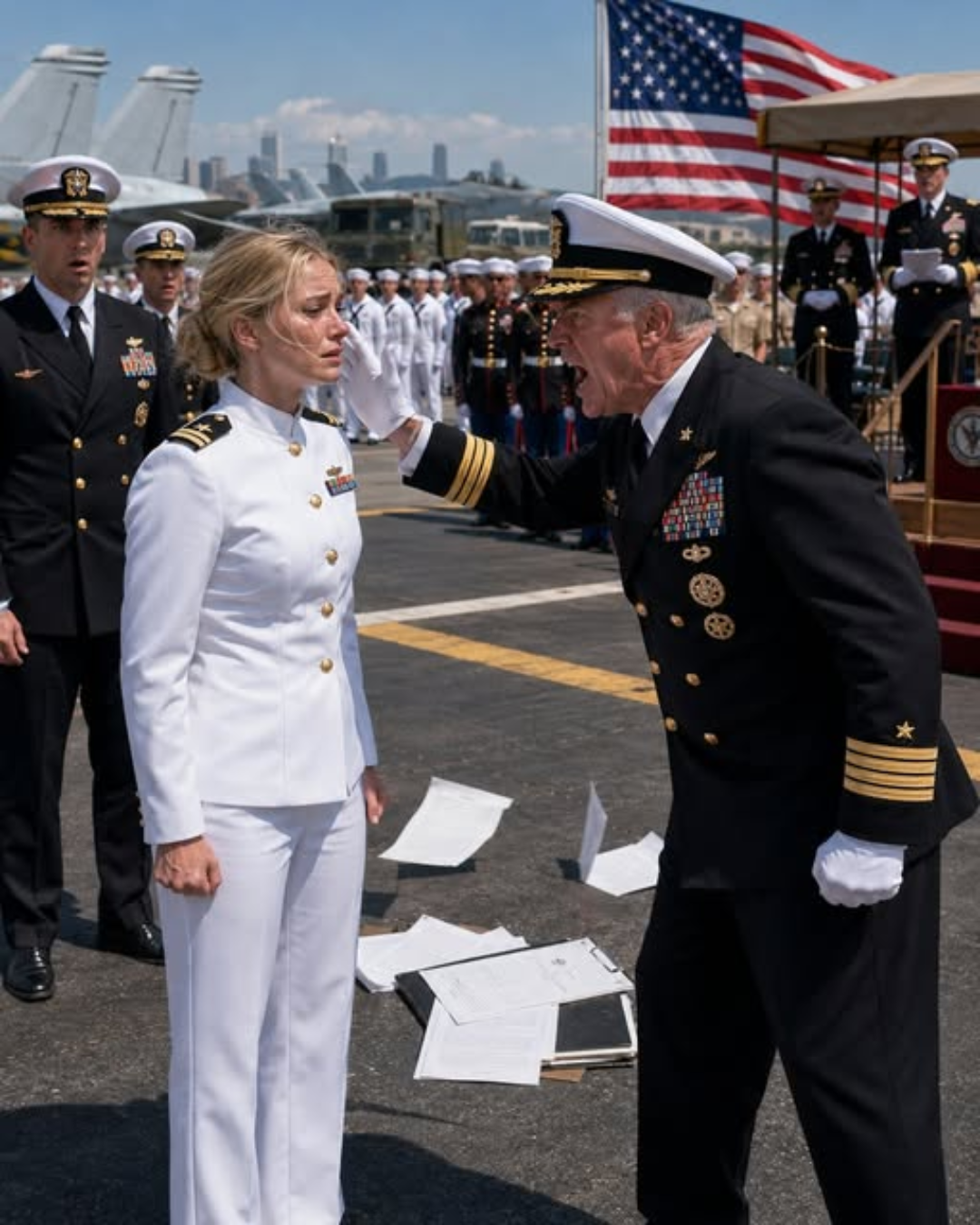
“Look at me, Lieutenant!” Admiral Victor Hale roared, and his white-gloved hand cracked across Evelyn Carter’s face in front of nearly the entire West Coast special warfare command.

The sound carried over the parade ground like something fired from a distance.

Advertisement
For one second, Naval Amphibious Base Coronado stopped feeling like a military installation and became something much smaller.

A room.

Advertisement

A witness stand.

A place where everyone had seen too much.

The California sun was brutal that afternoon, pressing heat up from the black asphalt until the air above the tarmac shimmered.

The wind brought salt from the Pacific, jet fuel from the flight line, and the dry metallic taste of tension.

Five thousand sailors, Marines, and special operators stood in dress formation, locked at attention in spotless uniforms, their faces trained forward because training was easier than reacting.

Lieutenant Evelyn Carter did not move.

Her cheek turned red beneath the glove mark.

A few strands of blonde hair slipped loose near her temple and stuck there in the heat.

She did not touch the bruise forming under her skin.

She did not blink.

That was what broke the admiral’s rhythm.

Hale had built a career on making rooms shrink around his anger.

He knew how to make captains lower their eyes.

He knew how to make commanders laugh too late at jokes that were not funny.

He knew how to make junior officers apologize for things he had done.

But Evelyn Carter did not give him the one thing he wanted most.

She did not look afraid.

The official reviewing order had been printed that morning and clipped to a plain black board near the platform.

Inspection start: 1400.

Presiding officer: Admiral Victor Hale.

Protocol liaison: Lieutenant Evelyn Carter.

Nobody had written anything about a slap.

Read More

Nobody had written that at 1426 hours, five thousand trained service members would watch a decorated admiral cross a line so clearly that even rank could not blur it.

At first there was only shock.

One commander near the reviewing platform dropped his clipboard.

It struck the pavement, bounced once, and scattered two sheets across the yellow formation line.

The sound was tiny.

It still felt deafening.

Somewhere behind the platform, a flag rope knocked against the pole in a steady metal clink.

A gull cried beyond the harbor.

The men and women in formation stayed still because nobody had been given permission to do anything else.

Evelyn slowly turned her face back to Hale.

Not sharply.

Not with theater.

Slowly.

The movement made people swallow.

It made a young ensign in the back row stare harder at the asphalt, as if the ground could become a wall between him and responsibility.

Hale’s medals flashed in the sun.

His face stayed red with anger, but something else appeared under it.

Annoyance at first.

Then confusion.

Then the smallest flash of uncertainty.

“You will answer when addressed,” he snapped.

Evelyn looked at him.

Her eyes were pale gray, and they were dry.

She had been assigned as protocol liaison for the review because she was careful, steady, and so precise that people joked she could find a typo in a weather report from across the room.

That morning, she had checked the order of speakers twice.

She had verified the positions of the color guard.

She had signed off on the ceremony packet at 1113 hours and logged the change to the formation schedule at 1202.

Those details mattered to her.

Details were how she survived powerful men who liked fog.

Hale hated details when they did not serve him.

He had already been angry before he reached her.

A microphone had gone live three seconds late.

One unit had shifted on command half a beat behind the others.

The printed folder on the reviewing stand had been placed to the left of the lectern instead of the right.

None of it justified what he did.

All of it gave him the excuse he wanted.

A petty man loves a public stage until the audience understands the scene better than he does.

Then the stage becomes evidence.

Evelyn’s right hand stayed at her seam.

The fingers did not curl.

The shoulders did not slump.

Her stillness was so disciplined that it became louder than Hale’s voice.

Behind the main formation, four DEVGRU operators shifted at the same time.

It was barely movement.

Half a step.

A change of weight.

A shadow of intent.

But the sailors near them felt it immediately.

The operators were not in the front row, and they were not part of the ceremony’s polished face.

They stood farther back, sun-darkened, broad-shouldered, and quiet, with thick beards and the exhausted posture of men who had spent too long in places where speeches meant nothing.

Old scars marked their hands.

One had a pale line near his throat.

Another clenched and unclenched his fingers once before forcing them still.

Their eyes stayed on Evelyn.

None of them looked at Hale until Hale noticed them.

The admiral took one step closer to Evelyn, as if proximity could restore authority.

The polished leather of his shoe scraped against the asphalt.

“You think silence makes you strong?” he asked.

Evelyn breathed in through her nose.

It was not loud.

It did not need to be.

By then, everyone was listening for anything she did.

A woman in the third formation block stared straight ahead while a bead of sweat moved from under her cover to her jawline.

A Marine captain looked at the scattered papers from the dropped clipboard and then looked away.

A senior chief tightened his jaw so hard a muscle jumped near his ear.

Nobody moved.

The parade ground had become a freeze beat.

Hands at seams.

Flags snapping.

Papers trembling in the wind.

The microphone standing on the platform, still live but unused.

The sun kept burning down as if the world had not just watched something irreversible happen.

Hale opened his mouth again.

This time the words did not come immediately.

The delay lasted less than a second.

It was enough.

Evelyn tilted her head slightly.

Not in challenge.

Not in submission.

In assessment.

The motion made Hale’s eyes narrow.

For the first time, he seemed to understand that he had not struck a frightened lieutenant in private.

He had created a record in public.

There are men who mistake obedience for loyalty because obedience makes less noise.

They forget that a silent witness is still a witness.

Evelyn’s fingers moved once at her side.

Behind the ranks, the four operators stepped forward together.

Not a charge.

Not a threat.

Only one disciplined half step.

The surrounding formation seemed to tighten around the sound of their boots.

Hale’s eyes cut past Evelyn.

“Stand down,” he barked.

The command came out too fast.

Too sharp.

It did not sound like control.

It sounded like panic wearing a uniform.

Evelyn did not turn around.

That was what made the moment colder.

She had not summoned them with her eyes.

She had not pleaded.

She had not performed distress for the crowd.

She had simply waited for Hale to finish exposing himself.

From the shaded edge of the reviewing platform, the base legal officer stepped forward with a thin blue folder in his hands.

He had been there from the beginning, tucked near the speaker stand, one of those people nobody noticed until paperwork mattered.

His uniform was neat.

His face was pale.

His hands were steady.

Across the top of the folder, in plain block letters, was INCIDENT WORKSHEET.

The commander who had dropped the clipboard saw it and whispered, “No.”

It was not a defense of Hale.

It was the sound of a man realizing the day had already become something he could not bury.

Evelyn finally spoke.

Her voice was calm enough to make the hair rise on the back of more than one neck.

“Read the time.”

The legal officer opened the folder.

Paper cracked softly in the wind.

He looked down at the first line, then up at the five thousand witnesses standing under the afternoon sun.

“At 1426 hours,” he began, “Admiral Victor Hale was observed making physical contact with Lieutenant Evelyn Carter in the presence of assembled personnel.”

Nobody breathed.

Hale’s face hardened.

“You will close that folder,” he said.

The legal officer did not close it.

That was the second rupture.

The first had been the slap.

The second was a man of lower rank refusing to make himself blind.

“Sir,” the legal officer said, “the observation has already been entered into the base operations log.”

A sound moved through the formation.

Not talking.

Not mutiny.

Only the tiny human shift that happens when an entire crowd realizes the truth has found a place to land.

Hale turned back to Evelyn.

“You planned this,” he said.

Evelyn’s cheek was still red.

Her eyes did not change.

“No, sir,” she said. “You did.”

The words were not loud, but the microphone on the reviewing platform caught them.

They went through the speakers with a thin, clean edge.

No one laughed.

No one cheered.

It was worse than that for Hale.

No one doubted her.

The four operators stopped where they were.

They did not touch anyone.

They did not need to.

Their presence made clear what everyone already understood: this was not a scene where Hale could invent a private version later.

The legal officer continued reading.

The worksheet was short.

Time.

Location.

Persons present.

Witness estimate.

Observed contact.

Immediate response.

Every line sounded less emotional than the last, which somehow made it more damning.

Paperwork can be cruel in its simplicity.

It does not care how powerful a man sounded when he made the mistake.

Hale tried to interrupt twice.

The legal officer paused each time, waited, and began again from the previous sentence.

By the third time, even the admiral seemed to understand that interruption only made him look smaller.

The commander who had dropped the clipboard finally bent down and gathered the loose pages.

His hands shook visibly.

One sheet kept slipping from his fingers.

He had served under Hale for years.

Everyone knew it.

His collapse was quiet, but it was complete.

He looked once at Evelyn’s cheek, then at the blue folder, and his face folded inward with the private shame of a man who had spent too long calling fear discipline.

“I saw it,” he said.

His voice was rough.

Hale turned on him.

The commander swallowed.

Then he said it again, louder.

“I saw it, sir.”

That was when the formation changed.

Not physically.

No one broke ranks.

No one stepped out.

But witness became weight.

One sailor in the second block lifted his chin.

A Marine major near the center stopped staring at the ground.

The young ensign who had been studying the yellow line looked up at Evelyn as if seeing, for the first time, what courage could look like without noise.

Hale’s authority remained on his shoulders.

Three stars.

A decorated uniform.

Decades of command.

But authority is not the same as permission.

And in that moment, permission left him.

The base command master chief moved toward the platform and spoke quietly into the open microphone.

“Formation will remain at attention pending instruction.”

His voice was level.

His face was unreadable.

It was the kind of sentence that meant nothing to a civilian and everything to everyone standing there.

The ceremony had stopped belonging to Hale.

Evelyn still had not touched her cheek.

Later, more than one witness would mention that.

In written statements.

In follow-up interviews.

In the review file that grew thicker by the hour.

They remembered the mark.

They remembered the silence.

They remembered the way she kept both hands down as if refusing to give him the satisfaction of seeing damage measured by her own fingers.

The legal officer stepped closer and lowered his voice.

“Lieutenant Carter, do you require medical attention?”

Hale gave a short, bitter laugh.

No one joined him.

Evelyn looked at the legal officer.

“I require the report to stay open,” she said.

The sentence traveled through the formation with the force of a verdict.

The legal officer nodded once.

“It will.”

That should have been the end of it.

For Hale, it was only the beginning.

Within thirty minutes, the first written witness statement was taken in a plain office off the parade field.

By 1548 hours, three more had been logged.

By 1631, the operations entry had been copied into a command review packet.

By 1710, the reviewing order, the incident worksheet, and the microphone audio notation had been secured together.

Nobody had to embellish anything.

The facts were enough.

Hale tried to frame it as a disciplinary correction gone misunderstood.

The phrase lasted less than an hour.

Too many people had heard the crack.

Too many people had seen Evelyn’s empty hands.

Too many people had watched him lean into her space with his anger already ahead of him.

The four operators gave statements separately.

They used plain language.

No drama.

No speeches.

One wrote that Lieutenant Carter displayed exceptional restraint under assault.

Another wrote that the admiral’s conduct compromised good order far more than any silence from the lieutenant.

The third statement was only six sentences.

The last line became the one people repeated quietly for weeks.

She did not escalate.

That was the truth Hale could not survive.

He had built his defense around the idea that Evelyn had provoked him.

But provocation requires movement.

A raised voice.

A step forward.

A threat.

Evelyn had offered him none of those things.

She had stood still, and he had struck her anyway.

By sundown, the parade ground was empty.

The painted lines on the asphalt were still there.

The flag still moved in the Pacific wind.

Evelyn sat in a small office with a paper cup of water in her hands.

Her cheek had darkened.

The medical corpsman wrote facial redness, swelling, no laceration on the intake form and asked again if she wanted ice.

This time, Evelyn took it.

Only then did her fingers tremble.

Not much.

Just enough for the legal officer to look away and give her the mercy of privacy.

One of the DEVGRU operators stood outside the door, not guarding her officially, not saying much of anything.

When she came out, he straightened.

“You good, Lieutenant?” he asked.

Evelyn gave him a look.

He corrected himself.

“Bad question.”

For the first time that day, her mouth almost moved into something like a smile.

“Accurate question,” she said. “Wrong day.”

He nodded.

That was all.

The review moved faster than anyone expected because the witnesses did not scatter into rumor.

They wrote.

They signed.

They confirmed.

A thing that happens in front of everyone can still disappear if everyone decides survival is safer than truth.

This time, enough people chose otherwise.

Hale was relieved from ceremony duties first.

Then from active oversight of the review chain connected to Evelyn.

Then from the temporary command authority he had been using like personal property.

None of it happened with shouting.

No dramatic arrest.

No movie ending on the parade ground.

Just doors closing.

Phones ringing.

Emails sent with careful subject lines.

Meetings where nobody raised their voice because the evidence already had.

Evelyn returned to duty three days later.

The mark had faded to yellow at the edge.

People tried not to stare.

Some failed.

A petty kind of apology followed her through the halls at first.

Not real apology from Hale.

That never came directly.

It was the apology of lowered eyes from people who had seen too much and done too little in the first second after it happened.

Evelyn accepted none of it out loud.

She did not punish them either.

She understood fear.

She only refused to let fear be renamed honor.

Weeks later, during a closed command review, Hale was asked one simple question.

Why did you strike Lieutenant Carter?

Witnesses said he looked older then.

Smaller.

He began with procedure.

Then with pressure.

Then with standards.

Each word sounded thinner than the one before it.

Finally, the room waited him out.

The silence that had saved him for years had turned against him.

He had no clean answer.

The finding did not call it passion.

It did not call it a misunderstanding.

It did not call it old-school leadership.

It called it misconduct.

It called it abuse of authority.

It called it a breach witnessed by assembled personnel.

Evelyn read the final summary in the same office where she had held the ice pack to her cheek.

The base legal officer slid the pages across the table.

She read them twice.

Not because she needed proof.

Because paper had finally caught up to what five thousand people already knew.

“What do you want entered into your final statement?” he asked.

Evelyn looked toward the window.

Outside, the afternoon light sat bright on the pavement.

Somewhere in the distance, boots crossed concrete in a steady rhythm.

She thought about the first crack of Hale’s glove.

She thought about the rope hitting the flagpole.

She thought about the four men stepping forward, the commander finally saying “I saw it,” and the five thousand people standing inside a moment none of them could pretend had not happened.

Then she wrote one sentence.

“Rank does not turn violence into leadership.”

She capped the pen and stood.

The legal officer read it, then nodded once.

The story moved through the base the way true stories do in places that prefer official language.

Carefully.

Quietly.

With details trimmed and then restored.

Some people made Hale the center of it because powerful men often remain the easiest subject even after they fall.

But others remembered the real center.

A young lieutenant with a red mark across her cheek.

Hands at her sides.

Eyes dry.

Body still.

They remembered that an entire parade ground had gone silent, and that silence had not belonged to the admiral forever.

It had belonged, in the end, to the witnesses who finally used it.

Months later, Evelyn walked past the same reviewing platform during another ceremony.

The flag snapped in the wind.

The sun hit the asphalt.

A new commander stood at the microphone.

Nobody mentioned Hale.

Nobody needed to.

A sailor near the back recognized Evelyn and straightened a little harder than necessary.

She noticed.

She kept walking.

Her cheek had healed long ago.

The lesson had not.

A person can understand pain.

A person can understand anger.

But quiet control after public humiliation makes people start asking what else they have failed to see.

That day, five thousand people saw it.

And this time, they did not look away.

Advertisement
info@teaytech

info@teaytech

81 articles published