
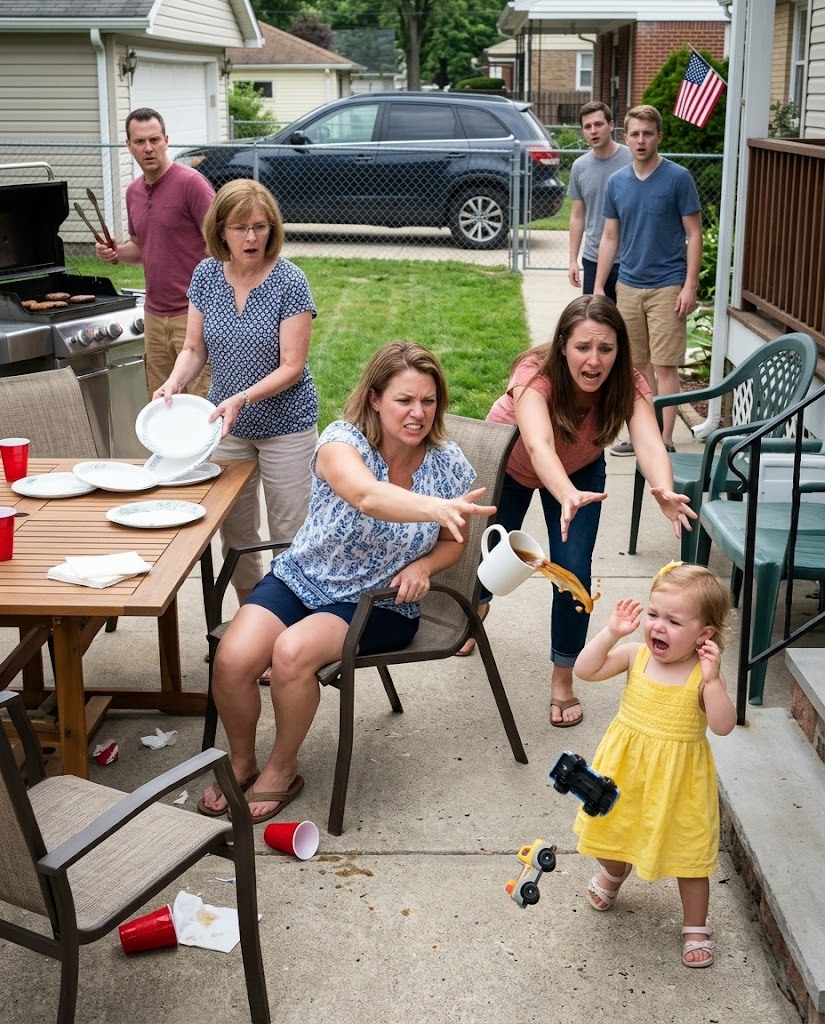
When Coffee Hit Her Toddler, One Neighbor Changed Everything- GALACY

My two-year-old only reached for her cousin’s toy, and that was all it took for my sister-in-law to show me who that family really was.
The day had started with the kind of summer normal that tricks you.
Charcoal smoke hung low over Ethan’s parents’ backyard.
Cut grass clung to the warm air.
Sunscreen made Lily’s cheeks shine while she kicked her little sandals against the back of my seat on the drive over.
Ethan had been called into a last-minute shift that afternoon, so I drove to his parents’ house alone.
He kept apologizing over the phone, telling me he would meet us there as soon as he could.
“It’s just a cookout,” I told him.
I said it like I believed it.
Lily was two years old, wearing a yellow sundress with tiny white flowers, and she had been carrying one of her stuffed rabbits since breakfast.
I had the diaper bag on one shoulder and a glass dish of pasta salad pressed against my hip when I pulled into the driveway.
The house looked the same as it always did.
Robert’s grill sat at the edge of the patio.
Diane’s planters lined the back steps.
A small American flag moved lazily near the porch railing.
It looked ordinary.
That is the thing about some families.
The dangerous parts do not always announce themselves.
They stand around a grill.
They ask if you brought enough food.
They smile with their teeth.
Ethan’s older brother Mark was already in the backyard with his wife Vanessa and their four-year-old son Caleb.
Diane, my mother-in-law, was setting out napkins and paper plates like the success of the afternoon depended on straight stacks.
Robert stood at the grill in sunglasses, flipping burgers and talking louder than necessary.
Vanessa saw me first.
Her smile did not reach her eyes.
It never did when Lily was around.
For years, I had tried to tell myself Vanessa was just insecure.
Maybe she was tired.
Maybe she felt like Diane favored Ethan.
I had made excuses for her because making excuses was easier than admitting my daughter had been born into a family where adults kept score with children.
I set down the pasta salad and kissed Diane on the cheek.
Diane barely turned her head.
“Ethan coming?” she asked.
“After work,” I said.
Robert made a sound from the grill.
“Always working.”
I ignored it.
Lily toddled beside me, happy and bright, watching Caleb blow bubbles near the fence.
Each time one popped, she clapped like the whole world had performed for her.
Caleb laughed at first.
Then he got bored and ran to the yard.
For almost twenty minutes, everything stayed peaceful enough for me to relax.
There were paper plates, warm soda, plastic forks, grill smoke, and Diane’s sharp little comments about how Lily needed more sunscreen.
I could handle that.
I had handled worse.
Then Caleb dropped his toy truck near the patio steps.
It was a small blue thing with scratched paint and oversized black wheels.
Lily saw it.
She waddled over with that careful toddler concentration that makes their whole body look serious.
She picked it up with both hands.
She turned one wheel with her thumb.
That was it.
She did not snatch it.
She did not throw it.
She did not break it.
She did not even walk away.
Before I could cross the patio, Vanessa’s chair scraped hard against the concrete.
“Tell your kid to stop touching my son’s things,” she snapped.
I raised both hands a little, already moving.
“I’m sorry, I’ll get it.”
Those were the last peaceful words I spoke that day.
Because Vanessa moved first.
There was a full ceramic mug on the side table beside her.
Diane had poured the coffee only minutes earlier.
I saw Vanessa’s hand close around it.
I saw her mouth tighten.
Then she threw it.
Not toward the ground.
Not near me.
Straight at Lily.
The mug spun once in the sunlight, and the coffee came out in a dark arc before it hit my daughter across the face and neck.
Lily screamed.
I have heard children cry from falls, shots, fevers, nightmares, and exhaustion.
This was different.
This was a sound that split the air open.
Her little hands flew to her face, and the toy truck hit the concrete at her feet.
I lunged so fast my knees slammed into the patio.
Pain shot up my legs, but I barely felt it.
I pulled Lily against me and tried to wipe the coffee away with my bare hands.
Her skin was hot.
Her body jerked and trembled against my chest.
I kept saying, “Mama’s here, Mama’s here, Mama’s here,” because I had no other words.
The backyard froze around us.
Robert’s grill tongs hung in one hand.
Mark stood pale and useless by the lawn.
Diane’s paper plates slid sideways under her fingers.
Caleb started crying because the adults were suddenly too still.
Vanessa was breathing hard.
She looked angry.
Not sorry.
Angry.
Then Diane started yelling.
At me.
“Get her out!” she shouted.
For one second, I did not understand.
My daughter was burned and screaming in my arms, and Diane was waving her hands like Lily had spilled something on her carpet.
Robert stepped away from the grill and pointed toward the side gate.
“Get that child out of our house right now!”
Something inside me went still.
Not calm.
Still.
There is a moment when panic becomes a tool because you cannot afford to waste it.
I looked at Mark.
He looked at the concrete.
I looked at Vanessa.
She looked at Lily like my child had caused all of this by existing too near her son’s toy.
I looked at Diane and Robert.
They were not horrified.
They were managing optics.
For one ugly heartbeat, I imagined putting Lily down safely, picking up that mug, and making Vanessa feel even one second of what my daughter was feeling.
I did not.
I grabbed the diaper bag with one hand and held Lily with the other.
Ethan called while I ran to the SUV.
I could not answer.
I buckled Lily into her car seat while she screamed herself hoarse.
Her little fingers kept clawing toward her face, and I had to gently pull them away while my own hands shook.
I drove straight to County Memorial.
Every red light felt like a personal cruelty.
Every car ahead of me felt like a wall.
When traffic stopped, I reached back and touched Lily’s foot so she would know I was there.
By the time we reached the emergency entrance, her screams had turned into broken gasps.
That frightened me more.
A triage nurse took one look at Lily and did not make us wait.
She opened the double doors and called for help over her shoulder.
Suddenly everything became bright lights, cool compresses, clipped questions, gloved hands, and medical words I had to force myself to understand.
Name.
Age.
Allergies.
What happened.
When did it happen.
How hot was the liquid.
Who threw it.
A hospital intake form was pushed toward me, and I signed it so badly my name looked like someone else’s.
A nurse kept speaking softly to Lily.
Another nurse photographed her injuries.
The pediatric burn specialist examined the redness along her cheek and the more serious patches under her chin and along her neck.
He told me some areas were first-degree burns.
Others were partial-thickness.
He said the pattern was consistent with hot liquid striking her at close range.
Those words stayed in me.
Consistent with hot liquid striking her at close range.
A social worker came in at 6:18 p.m.
She pulled a chair close, sat beside me instead of across from me, and lowered her voice.
“Can you tell me what happened?”
So I told her.
The toy truck.
Vanessa’s chair scraping.
The white mug.
The coffee.
Diane shouting at us to leave.
Robert pointing toward the gate while my daughter’s skin burned.
The social worker did not interrupt.
She did not look doubtful.
When I finished, she asked, “Would you like us to contact law enforcement from here?”
“Yes,” I said.
I did not hesitate.
Ethan arrived twenty minutes later.
He was still wearing his work badge.
His hair was damp with sweat, and his face had no color in it.
The moment he saw Lily in the hospital bed, wrapped in gauze and whimpering through sedation, he stopped in the doorway.
For a second he looked like he had forgotten how to move.
Then he came to her bed and put one shaking hand on the rail.
“What happened?” he whispered.
I told him.
At first, his expression was confusion.
Not disbelief in me.
Disbelief in the shape of what I was saying.
His family had always been cruel in manageable ways.
They guilted.
They complained.
They twisted stories.
They punished silence with more noise.
But this was different.
This had burned his child.
I told him what Vanessa did.
Then I told him what Diane and Robert said afterward.
Ethan sat down slowly beside me.
He covered his mouth with both hands.
Then he cried without making a sound.
That was the first time I saw him stop explaining his family’s intentions and start seeing their actions clearly.
Police arrived later that night.
They took my statement.
They took Ethan’s.
The doctor documented the injury pattern.
The nurse logged the photographs into Lily’s medical chart.
The social worker helped me preserve the messages that started coming in before Lily was even fully asleep.
Diane wrote first.
You’re making this worse than it was.
Robert followed.
Kids get hurt. Don’t ruin this family over an accident.
Then Vanessa sent hers.
Maybe if you controlled your daughter, none of this would have happened.
I stared at that message until the words blurred.
Not one of them asked if Lily was okay.
Not one.
That kind of absence tells its own story.
At 11:40 p.m., my father walked into the hospital.
Richard Bennett is not a loud man.
He spent thirty years as a litigation attorney, and he has never needed volume to make a room change temperature.
He came in wearing the same gray jacket he wore to client meetings, his tie loosened, his face controlled in a way that scared me more than rage would have.
He walked to Lily’s bed and looked down at her bandaged cheek.
Then he bent and kissed her forehead above the gauze.
When he straightened, his eyes had gone flat and cold.
“Step into the hall,” he said.
I thought he was going to comfort me.
He did, in his way.
He gave me structure.
He asked for exact times.
He asked for names.
He asked who stood where.
He asked about Robert’s grill, Diane’s side table, Vanessa’s chair, Mark’s position, the neighbor fences, the side gate, and whether any backyard cameras faced the patio.
He asked for screenshots of every message.
He asked for the police report number.
He asked which nurse took the photographs.
He asked if the hospital social worker had written her notes yet.
Ethan stood beside us, shaking with shame and anger.
My father looked at him for a long moment.
Then he said, “This is where you choose your wife and child, or you go stand with them.”
Ethan flinched.
Then he nodded.
“I choose Lily,” he said.
My father looked back at me.
“Tomorrow morning, we file in person. Police report. Protective order. Civil action. They are already rewriting this. We move first, and we move clean.”
He was right.
By breakfast, the rewrite had already started.
Vanessa told relatives I had burned Lily myself with my own coffee.
Diane repeated it to anyone who called.
Robert told Ethan that if we dragged them into court, he would cut him out of family property.
Mark sent one text that said, I don’t want to get involved.
Ethan read it and laughed once.
It was not a happy sound.
“You were there,” he texted back.
Mark did not answer.
At 8:07 a.m., my father received a voicemail from Mrs. Alvarez, the quiet neighbor who lived behind Robert and Diane’s fence.
She watered tomato plants every evening around six.
She was not close to the family.
She was not part of their group texts.
She had no inheritance to lose and no reason to protect Vanessa.
Her voice trembled on the recording, but her words were clear.
“I saw the woman throw the cup,” she said.
“I saw the baby fall.”
“I saw them make the mother leave.”
Ethan bent forward in the hospital chair like someone had knocked the air out of him.
Then my father opened the second thing she had sent after midnight.
It was a still frame from her backyard camera.
Time-stamped 4:36 p.m.
Vanessa’s arm was extended.
The white ceramic mug was already in the air.
Lily was standing near the patio steps in her yellow sundress, holding the toy truck.
My breath left me.
I had known what happened.
I had lived it.
But seeing it frozen like that made something in me sharpen.
They had counted on family noise to cover the truth.
They had forgotten that ordinary houses have windows, fences, cameras, and neighbors who still know right from wrong.
Ethan’s phone rang.
It was Mark.
He answered on speaker.
Mark’s voice came through low and shaky.
“Mom says if you file today, Dad is going to tell everyone you staged this.”
My father reached for the phone.
He did not raise his voice.
“Mark,” he said, “this is Richard Bennett. You are going to listen carefully. You witnessed an assault on a two-year-old child. If your parents are asking you to lie about that, you need your own attorney before you say another word.”
There was silence.
Then Mark whispered, “I didn’t know she was going to throw it.”
“No one said you did,” my father replied. “But you know what happened after.”
Mark started crying.
It was small at first, the kind of sound a grown man makes when he is trying to keep shame from becoming noise.
“Dad told me to shut up,” he said.
Ethan closed his eyes.
My father asked, “Will you give a statement?”
Mark did not answer right away.
Then he said, “Yes.”
That was the first crack.
We filed that morning.
My father walked us through the process with a precision that kept me upright.
The police report was updated with the hospital documentation.
The screenshots were printed and saved.
The neighbor’s camera still was preserved.
The social worker’s notes were added to the file.
The protective order petition listed Vanessa by name.
It also listed Diane and Robert’s conduct after the injury.
Not because they threw the coffee.
Because they tried to force an injured child out of the house instead of getting her help.
There are different kinds of cruelty.
Some act.
Some watch.
Some point at the door while a baby screams.
By noon, Robert called Ethan sixteen times.
Ethan did not answer.
Diane sent a message saying, Your father is making this worse.
Ethan typed back, My daughter is burned. Do not contact us again.
I watched him send it.
His hands shook afterward.
Breaking away from family does not always look brave while it is happening.
Sometimes it looks like a man staring at his phone, grieving people who are still alive.
Vanessa tried one more time.
She wrote, I panicked. I didn’t mean for it to hit her like that.
My father read the message and said, “Do not respond.”
So I did not.
The hardest part was not the paperwork.
It was sitting beside Lily while she slept and wondering how a family cookout had turned into hospital gauze, police statements, and a little girl flinching whenever a nurse moved too quickly.
When Lily woke, she asked for her rabbit.
Her voice was hoarse.
I put it beside her good cheek.
She touched one soft ear and whispered, “Hot.”
I turned my face away so she would not see me cry.
Ethan heard her.
Something in him changed again.
He stood up, walked into the hallway, and called Mark back.
“I need you to tell the truth,” he said.
Mark did.
His statement matched mine.
He said Vanessa threw the mug.
He said Lily had only been holding the toy truck.
He said Diane screamed for us to leave.
He said Robert pointed at the gate.
He said nobody called 911.
When Robert found out, he drove to the hospital.
Security stopped him before he reached the unit.
He shouted Ethan’s name across the hallway.
Ethan walked to the nurses’ station but did not go any closer.
For once, Robert was the one being told to leave.
He looked smaller on the other side of the glass doors.
Still loud.
Still angry.
But smaller.
Diane stood behind him with a purse clutched to her chest, crying like she was the injured one.
Vanessa did not come.
The protective order hearing came quickly.
I will not pretend it felt good.
Nothing about sitting in a family court hallway with hospital photos of your toddler feels good.
The walls were beige.
The chairs were hard.
There was an American flag near the clerk’s window and a vending machine humming by the elevators.
Ordinary things kept existing around us while our life felt split in two.
Vanessa arrived with Mark.
She looked smaller without the backyard and the family noise around her.
Diane and Robert came behind them.
Robert would not look at me.
Diane looked at Ethan like he had betrayed her.
That almost made me laugh.
The judge reviewed the medical records.
He reviewed the photographs.
He reviewed Vanessa’s message blaming Lily.
He reviewed Mrs. Alvarez’s camera still.
Vanessa’s attorney tried to call it an accident.
Then the judge asked why Vanessa had not called 911.
The room went quiet.
Then he asked why the grandparents ordered the injured child out of the house.
Diane started to cry harder.
Robert stared at the table.
Mark looked like he wanted to disappear.
Vanessa said, “I was upset.”
The judge looked at the photograph of Lily’s bandaged cheek.
Then he looked back at Vanessa.
“So was the child,” he said.
That was the moment her confidence finally drained out of her face.
The order was granted.
The civil case did not end that day, and the criminal process took its own time, but the most important thing happened before any final ruling.
The story stopped belonging to them.
It belonged to records.
It belonged to timestamps.
It belonged to a nurse’s photographs, a doctor’s words, a neighbor’s camera, and a father who understood that truth needs protection before liars organize.
Lily healed slowly.
The doctors were careful.
The dressings changed.
The redness faded.
For a while, she hated mugs.
She would push them away from the table with both hands and say, “No hot.”
So we changed how we lived for a while.
No hot drinks near her.
No crowded family rooms.
No backyard gatherings with people who thought children were props in adult grudges.
Ethan changed too.
He blocked Vanessa.
He blocked his parents.
He kept Mark at a distance until Mark proved, over time, that truth had not been a one-day performance.
Some people told us we were destroying the family.
I learned to answer calmly.
“No,” I would say. “We are protecting the child they hurt.”
There is a difference.
Months later, Lily saw a toy truck in a store aisle.
She stopped walking.
For a second, I thought she would cry.
Instead, she picked it up, turned the wheel gently with her thumb, and looked at me.
“Mine?” she asked.
Ethan crouched beside her.
“If you want it,” he said.
We bought the truck.
It was blue.
Just like Caleb’s.
She carried it to the car with both hands, serious and careful, like it was something precious.
I watched her in the rearview mirror on the drive home, turning the wheels one by one.
That was when I understood what we had really fought for.
Not revenge.
Not punishment.
Not even being believed, though we deserved that too.
We fought so my daughter would not grow up thinking pain was the price of touching something she was curious about.
We fought so an entire patio of adults could not teach her that silence was normal when she was hurting.
They forgot hospitals keep records.
They forgot phones save messages.
They forgot neighbors sometimes see more than families want them to see.
Most of all, they forgot that a quiet mother with a burned child in her arms is not weak.
She is memorizing everything.