When My Son Collapsed At School, One Whisper Exposed Them All-myhoa

The school called me in the middle of a work meeting with a question that did not sound real.
“Why did we find your son unconscious in the bathroom?”
I stood up so fast my chair hit the wall.
Ryan was ten.
Ten years old, missing one front tooth, obsessed with space facts, still sleeping with the same stuffed bear he swore he did not care about anymore.
He was supposed to be in math.
Instead, the secretary was telling me his lips were turning blue.
I asked why he was not already on his way to the hospital, and that was when the first lie opened under my feet. The ambulance was there. The paramedics were there. But the emergency permission form in his school file had never been signed by Isabella, my wife, and the staff were scared to authorize treatment without a parent.
I ran to my car with my phone pressed to my ear.
Isabella answered like I had interrupted her lunch.
When I asked why she had refused emergency care, she said, “Because I don’t trust the medicine.”
Then she added the sentence that split my life in half.
“That’s why I didn’t vaccinate him either.”
For years, I had believed we were doing what every careful parent does. Pediatric visits. School forms. Little vaccine cards tucked into folders. Isabella handled the paperwork, and I thanked her for it.
I had thanked her for lying to me.
By the time I pulled into the school parking lot, my hands were numb on the wheel. The ambulance sat near the entrance with its lights off. Two paramedics stood outside with the helpless anger of people who knew exactly what should be happening and were being blocked by signatures.
The principal led me inside.
Ryan was on a cot in the nurse’s office.
He looked smaller than he had that morning.
His skin had a gray cast. His breathing came shallow and uneven. The nurse kept saying his name, but his eyes stayed closed.
I did not wait for another argument.
I lifted him into my arms and carried him out.
One paramedic tried to stop me long enough to explain the risk. I told him he could explain it while following my car to the ER, because my son was not spending one more minute as a paperwork problem.
The hospital took him immediately.
People moved around him so fast I could barely track their hands. Oxygen. Monitors. Blood draw. Questions. I answered what I could.
Then they pushed me into the hallway.
I called Isabella.
Once.
Twice.
Six times.
No answer.
The next sound from my phone was not her ringtone.
It was a Ring alert from our driveway.
I opened it because panic makes you grab at anything that looks like information.
The video showed Isabella’s car pulling in.
Pastor Kent climbed out of the passenger side.
He was the pastor from the church she had started attending more often over the last year. The man who had shaken my hand at a barbecue while my son threw a football in the yard.
In the video, he looked around like he knew he should not be there.
Then he kissed my wife.
They went inside our house while Ryan was fighting for breath at the hospital.
I sat down on the hallway floor.
For a few minutes, I did not feel angry.
I felt empty.
Then a nurse came out and said Ryan was awake.
I ran.
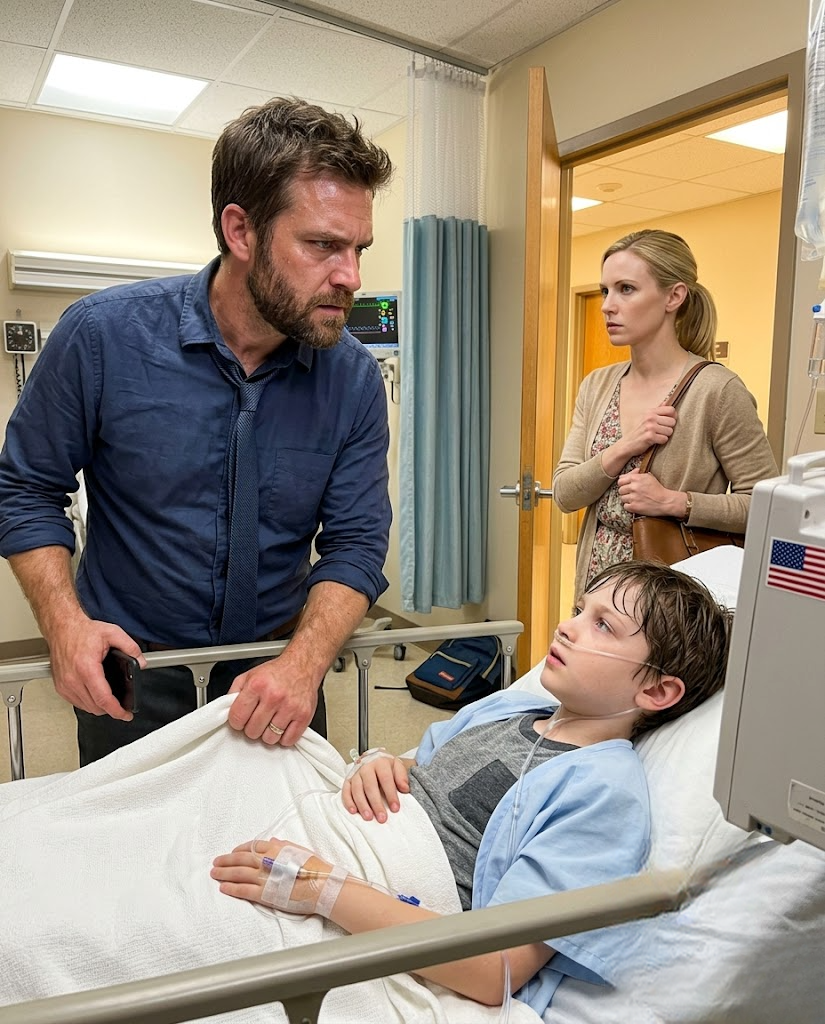
He was pale, but his eyes were open. He looked confused, like he had been dropped into the middle of a story he did not understand. I held his hand carefully because of the IV tape and asked him what happened.
His voice was barely there.
“Ms. Wellington gave me too much galaxy gas.”
I thought I had misheard him.
He said it again.
Galaxy gas.
He said Ms. Wellington called it brain boost time. She gave balloons to a few kids after lunch and told them it helped their brains wake up. He said the room got fuzzy, one girl got sick, and when he told her his chest felt weird, she told him to breathe slower.
The nurse stopped writing.
The doctor ordered more tests.
When the first results came back, his face changed in a way I hope no parent ever sees. Ryan’s blood showed signs consistent with nitrous oxide exposure. The doctor said Ryan needed monitoring, more blood work, and a neurological check to make sure there was no lasting damage.
I heard the words.
I understood each one.
Together, they felt impossible.
A teacher had given my child gas from balloons at school.
His mother had blocked emergency treatment.
And the person who was supposed to be my wife had been at my house with another man.
I called the principal.
He answered on the second ring. I told him exactly what Ryan said.
There was a long silence.
Then he said he was going to the classroom himself.
Isabella arrived twenty minutes later with Pastor Kent beside her.
She did not run to Ryan.
She looked first at the IV bag.
“We need to take him home,” she said. “Hospitals overreact. His body can heal naturally.”
I had never wanted to scream at someone more in my life.
The doctor did it for me, only colder.
He told her Ryan could have died.
He told her oxygen levels were not a lifestyle debate.
He told her that refusing emergency care for a child in that condition was not a parenting preference.
It was neglect.
That was when my attorney friend Sarah walked in.
I had sent her one message from the hallway: Ryan in hospital. Isabella refused care. Need emergency custody.
Sarah took one look at Ryan, one look at Isabella, and became the calmest person in the room. I showed her the Ring video. She watched Isabella and Pastor Kent kiss in my driveway, then handed the phone back without changing expression.
“We start with Ryan’s safety,” she said.
The principal called back right then.
His voice shook.
They had found nitrous oxide canisters in Ms. Wellington’s desk drawer.
There were balloons too.
Behind spelling worksheets.
A handwritten note said “brain boost group.”
I remember looking at Ryan’s small hand inside mine and feeling something in me go still. Not calm. Not gentle. Still in the way a storm goes still before it tears the roof off.
Police came to the hospital.
A child interview specialist sat with Ryan and asked questions softly, giving him time to answer. He told her about the balloons. He told her which kids had taken turns. He told her Ms. Wellington smiled and said they were going to be her smartest group yet.
Other parents were called.
Stories started pouring in.
A girl had thrown up after school twice.
A boy had headaches for a week.
Another child told his dad that learning hard made the air “sparkly.”
Every weird sentence suddenly had a shape.
Child Protective Services arrived for Isabella.
Mrs. Garcia was polite, professional, and absolutely unmoved by Isabella’s tears. She asked why Isabella had refused ambulance care. Isabella talked about toxins, natural immunity, and government lies. Mrs. Garcia wrote it all down.
Then Sarah handed Isabella the emergency custody papers she had filed from her laptop in the hospital waiting room.
Temporary sole custody went to me within twenty-four hours.
Medical decisions went to me.
Isabella got supervised contact only while CPS investigated.
She cried like she was the injured one.
Pastor Kent disappeared before the paperwork was done.
He mumbled something about a church meeting and left so quickly the elevator doors nearly closed on his jacket.
He did not get far from consequences.
The next afternoon, his wife walked into the hospital and asked for him.
Isabella saw her and locked herself in the bathroom.
I showed Mrs. Kent the Ring video.
She watched it twice.
Then she thanked me for telling the truth and left without raising her voice.
That quiet scared Isabella more than yelling would have.
Ms. Wellington was arrested that evening.
The detective told me she seemed genuinely confused. She kept saying she had read about focus boosters online. She thought it was safe because nitrous oxide had normal uses in controlled settings. She said she only wanted the children to perform better.
Good intentions do not put oxygen back in a child’s body.
The district moved fast after that because parents were furious.
The school board held an emergency meeting. Teachers were told no substance, device, supplement, scent, or classroom experiment could be used with students without written approval and documentation.
Ryan came home physically stable after five days, but the hospital did not stay at the hospital.
It came home with us.
The first night, he woke up gasping, clutching at his chest and saying the room was closing. I held him while he shook. A psychiatrist later explained trauma in words that sounded too small for what I had seen.
Ryan started therapy twice a week.
At first, he barely spoke. Then he used action figures to show kids standing in a line, taking balloons from a smiling teacher.
He told the therapist he was scared of sleeping because dreams made him breathe wrong. He asked why his mom did not want doctors to help him. He asked if he had done something bad by telling the truth.
That question broke me in a new place.
I told him the truth had saved him.
We started catch-up vaccines once his doctor cleared it. The nurse explained every shot before she gave it. Ryan squeezed my hand, flinched, then looked almost proud when she put superhero stickers on his arm.
I kept every record, printed, scanned, and filed with the court.
Because Isabella had built a whole secret life out of missing records.
When I searched her home office for medical paperwork, I found anti-vaccine books, conspiracy printouts, essential oils labeled like antibiotics, and receipts for supplements she had been giving Ryan instead of real care. Sarah added every photo to the custody file.
The divorce petition followed.
Adultery. Medical neglect. Endangerment. Eight years of marriage reduced to words on legal paper, and the strangest part was that I felt relief.
Isabella fought for joint custody at first.
Her attorney said she was Ryan’s mother and deserved equal rights.
The judge said parenting rights do not outweigh a child’s safety.
The emergency custody order was extended.
Visits stayed supervised.
Isabella had to complete parenting classes, follow all medical recommendations, and stop discussing medical conspiracy theories around Ryan.
She attended the classes, but she did not magically change. The reports said she participated while still talking about natural immunity and medical overreach. The judge gave her another ninety days of supervised visits.
Ryan did not complain.
He just got quiet on the drives there.
In the visitation room, Isabella brought board games and snacks. A social worker sat in the corner taking notes. Sometimes Ryan smiled. Sometimes he watched the clock.
Healing was not a straight line.
It was a child laughing at breakfast and sobbing at bedtime. It was a good school day followed by a panic attack because someone opened a balloon at a birthday party. It was me learning that protection could become a cage if I let fear make every decision.
His therapist helped me see that.
So when Ryan asked to sleep over at a friend’s house months later, every part of me wanted to say no. Instead, I called the friend’s mom, explained enough, packed his inhaler even though he did not need one, and sat in my car outside their house for ten minutes after drop-off.
He called at nine to say good night.
He sounded happy.
That sound became my proof that we were moving forward.
Ms. Wellington took a plea deal.
Five counts of child endangerment. Probation. Community service. Permanent loss of her teaching license. Some parents wanted jail. Some pitied her confusion. I did not have room for either argument.
I only cared that she would never stand in front of children again.
The district settled Ryan’s medical bills and paid additional compensation for trauma. We put most of it into his college fund. The rest helped us move into a townhouse near his school, where Ryan chose blue paint for his bedroom and said it felt safer than the old house.
That was the first time he used the word safe without me saying it first.
Pastor Kent lost his church position.
His wife filed for divorce.
Isabella found a different church months later, one where the pastor was a woman who did not feed her paranoia. Her parents moved closer and, to their credit, they did not defend what she had done. Her mother called me crying one night and said she should have challenged Isabella years earlier.
I did not know what to say.
Everyone had regrets.
Only Ryan had paid for them with his body.
A year passed.
Ryan’s nightmares slowed.
His grades climbed.
He joined soccer, then track, then basketball. He did a science fair project about lungs and oxygen, building a model from balloons and tubing. I almost cried when he asked to use balloons, then watched him handle them with steady hands.
He won first place in life sciences.
He told the judges he wanted to become a doctor who helped kids breathe.
That was when I understood the final twist of all this.
The thing that almost took his breath had given him a voice.
Two years after the hospital, Isabella and I sat three rows apart at Ryan’s spring concert. He played trumpet in the sixth-grade band, missed one note, recovered, and grinned like the world had not once tried to swallow him whole.
Afterward, we stood in the hallway and talked about orthodontist appointments and soccer tryouts without lawyers between us.
Isabella had changed slowly.
Not perfectly.
Not in a way that erased the past.
But enough that Ryan no longer came home confused by her visits. Enough that she followed the doctor’s rules. Enough that one Tuesday she emailed me three sentences I never expected to read.
She wrote that she was sorry.
She wrote that she had been wrong about medical care.
She wrote that she understood why I fought so hard.
Ryan saw the email later while using my laptop for homework. He asked if I believed her.
I told him people can learn from mistakes, even big ones, but trust grows slowly and health comes first.
He nodded like that made sense.
Then he went back to his math.
Life became wonderfully boring after that.
Homework.
Sports practice.
Dentist appointments.
Sleepovers.
Science projects.
Arguments about screen time.
Ordinary things I used to rush through before I knew how sacred ordinary could be.
Sometimes I still wake up at night and listen for Ryan breathing in the next room. I probably always will. But now, when I open his door, I usually find a lanky kid sprawled across the bed, one sock on, one sock lost, trumpet music on the floor, homework half-finished, chest rising and falling like a promise.
And every time I see that, I remember the call from the school.
I remember the blue around his lips.
I remember the hallway, the report, the video, the lies.
Then I remember what came after.
My son lived.
My son healed.
And the people who treated his life like an experiment lost the right to make decisions for him.