Advertisement

Widower Hid £600,000 From His Son—Then Came The Lock Change-Teptep

After Diane died, the house did not become peaceful.

Advertisement

It became watchful.

Advertisement

Every room seemed to hold its breath when I walked through it.

The kitchen still smelt faintly of her lavender hand cream and the strong tea she always forgot to finish.

Her cardigan hung on the back of the chair by the window.

Her reading glasses were still beside the biscuit tin.

The kettle clicked off each morning, and for a second I would turn, expecting her to ask why I had filled it so full for only two cups.

Then I would remember.

One cup now.

One plate.

One voice in a house built around two people.

My name is Walter Bennett, and I had been married to Diane for thirty-eight years.

We had raised our only son, Cameron, in that house.

I had paid it off with plumbing work, overtime, emergency callouts in the rain, and knees that no longer forgave me for crawling beneath sinks.

Diane had made the place warm.

Not expensive.

Warm.

She chose the curtains, rescued the old sideboard from a clearance shop, and insisted the dining table would last us a lifetime if we saved properly and did not buy cheap rubbish twice.

She was right about most things.

In the end, she was right about Cameron too.

Read More

A father can forgive a son for almost anything when he is still picturing the boy who once fell asleep in the back of the van clutching a packet of crisps.

A mother sees the man earlier.

Diane saw what Cameron had become before I allowed myself to say it.

She saw how his visits became shorter when there was no paperwork involved.

She saw how Brooke, his wife, asked questions that were too neat to be casual.

Insurance.

Savings.

The house.

What would happen later.

Diane would smile politely, make tea, and answer nothing.

After they left, she would stand at the sink with her hands resting in the washing-up bowl and stare out at the small back garden.

“He’s not asking because he’s worried,” she said once.

I told her not to think the worst.

She did not argue.

That was Diane’s way when she knew time would prove her point.

During her final weeks, when pain had made her body small but had not touched the sharpness of her mind, she asked me to promise her something.

We were in the bedroom.

Rain tapped against the window.

A mug of tea sat untouched on the bedside table beside a blister pack of tablets and a folded hospital form.

She held my hand so tightly I could feel how much strength it cost her.

“Walter,” she whispered, “don’t let Cameron turn you into one of his errands.”

I tried to smile.

“He’s our son.”

Her eyes filled, but she did not look away.

“He is also a man now,” she said. “And he has started counting what isn’t his.”

I promised because she needed me to.

I promised because part of me already knew.

What Cameron did not know was that Diane had also left me two things he would have taken if he had known they existed.

One was a fifty-acre ranch in Wyoming, inherited through her grandmother’s side of the family.

The other was a £600,000 cashier’s cheque, sealed in a plain envelope and placed in my solicitor’s safe.

Diane had written my name on it herself.

No decoration.

No explanation.

Just Walter, in that careful handwriting she used when something mattered.

I did not tell Cameron.

Grief can make a man quiet.

It does not have to make him foolish.

Two weeks after Diane’s funeral, I was sitting at the kitchen island with my hands wrapped around a mug I had no intention of drinking.

The old clock above the cooker ticked too loudly.

The fridge hummed.

Somewhere upstairs, a floorboard gave its usual creak as the house settled into the grey afternoon.

Then the front lock clicked.

Cameron had stopped knocking months before his mother died.

At first, I told myself it was because he felt at home.

Later, I understood it was because he had begun to think of the house as future property.

He entered first, wearing a dark suit and a watch he checked more often than he checked on me.

Brooke followed behind him, neat and polished, carrying a designer handbag and a stack of bright yellow sticky notes.

Neither of them looked as though they had come to comfort a widower.

They looked as though they had come to manage an inconvenience.

“Dad,” Cameron said, not warmly.

Brooke gave me a small smile that never reached her eyes.

No one asked whether I had eaten.

No one asked whether I had slept.

No one said Diane’s name.

Cameron walked straight to the island and dropped a roll of black bin bags beside my mug.

The sound was dull and heavy.

Then he reached into his jacket and slid a glossy brochure across the counter.

It stopped under my fingers.

On the front was an elderly man in a wheelchair, smiling at a garden that looked as if no real person had ever dropped a leaf on it.

Silver Pines Assisted Living.

I looked at the brochure.

Then I looked at my son.

“We met with a developer this morning,” he said. “The house is in a profitable spot. They’re prepared to offer above market if we move quickly.”

We.

There are words that reveal more than people intend.

That one did.

“This house is paid for,” I said.

“I know,” Cameron replied. “That’s why this makes sense.”

He said it gently, which somehow made it worse.

“You don’t need all this space anymore. You’re alone. It’s too much upkeep, and frankly, it isn’t safe.”

I let the words sit between us.

Brooke had already moved into the sitting room.

Through the archway, I watched her place a sticky note on Diane’s cherrywood dining table.

Then one on the sideboard.

Then one on the old clock Diane had inherited from her father.

She moved quickly, without hesitation.

Not cruelly in the loud way.

Efficiently.

That was almost harder to stomach.

She was not smashing memories.

She was pricing them.

“The developer wants clearance started soon,” Cameron said. “You’ve got until Sunday evening to pack whatever personal junk you want to keep.”

Personal junk.

The phrase landed harder than the bin bags.

Diane’s handwritten recipes were in the drawer by the cooker.

Our wedding photograph was on the mantel.

My work boots were by the back door.

Her quilts were in the airing cupboard.

The rocking chair where she had held Cameron through fever and nightmares still stood in the corner.

He had reduced it all to junk because he wanted speed.

Brooke came back into the kitchen with another sticky note half peeled from the pad.

“The sofa is very dated,” she said. “We probably won’t get much for it.”

She did not quite say from him.

She did not need to.

My chest tightened.

I wanted to stand.

I wanted to throw the bin bags into the hall and tell both of them to leave before I forgot they were family.

But Diane’s voice was there, steady as a hand on my shoulder.

If people show you greed, do not interrupt too soon.

Let them speak.

Let them act.

Let them leave fingerprints.

So I smiled.

It was small.

Calm.

Not happy.

Cameron noticed at once.

His expression changed by a fraction.

He had expected confusion, grief, perhaps a plea for time.

He had not expected me to look as though I had been waiting for him.

“Silver Pines is nice,” he said, recovering. “Brooke looked into it. Meals, activities, staff on site. You’ll be comfortable.”

“I see.”

He frowned.

“Don’t make this difficult, Dad.”

“I’m not.”

Brooke laughed softly.

“Honestly, Walter, you should be grateful we’re taking care of all this. Old houses are exhausting, and you’ve been through enough.”

I set my mug down.

The tea inside had gone cold.

“Sunday is fine,” I said.

Relief crossed Cameron’s face before he could hide it.

That told me everything.

He had thought it would take more effort.

He had prepared for resistance and found obedience.

At least, he thought he had.

“I only need to clear my plumbing tools from the garage,” I added. “Those are the only things I care about keeping.”

Cameron laughed.

It was a short, sharp sound.

“Take all the rusty wrenches you want,” he said. “I don’t know how much room you’ll have at Silver Pines, but maybe they’ll let you keep a box under the bed.”

Brooke smirked.

I looked down at my hands because if I looked at them much longer, I might have forgotten the plan.

Three days earlier, I had already packed what mattered.

Two holdalls.

Medication.

Clothes.

Family photographs.

Bank records.

Diane’s wedding ring.

The ceramic bird she kept on her bedside table.

The house documents Cameron believed he would need.

A small brass key.

A solicitor’s appointment card.

And the copy of Diane’s final statement that she had made me promise to use only if Cameron proved her right.

Those bags were no longer in the wardrobe.

They were no longer in the attic crawl space where I had first hidden them.

By the time Cameron arrived with his bin bags, they had already been moved.

So had I, in every way that mattered.

Cameron checked his watch.

“We’ll be back this weekend to change the locks,” he said. “Don’t drag your feet.”

Brooke gathered her sticky notes and gave the sitting room one last appraising glance.

Then they left.

The front door slammed hard enough to rattle the glass.

The house fell silent again.

But it was different now.

Not empty.

Ready.

On Saturday morning, I made one last cup of tea in Diane’s kitchen.

I stood by the counter while the kettle boiled, listening to the old house breathe around me.

I touched the sideboard.

I folded the tea towel properly because Diane would have noticed.

Then I took my coat from the peg in the hall and walked out through the back door.

I did not lock myself inside my grief.

I had done enough of that.

The neighbour across the road, Mrs Lane, was trimming a plant beneath her front window.

She had brought casseroles after the funeral and never once asked what anything was worth.

When she saw me carrying the last small bag, her face softened.

“Are you all right, Walter?” she asked.

People ask that question all the time.

Very few are ready for the answer.

“I will be,” I said.

She looked at the house, then at me.

“Your son’s been round a lot.”

“Yes.”

She hesitated.

Then she lowered her voice.

“I saw his wife putting notes on things through the window.”

I nodded.

“Would you do me one favour?” I asked.

Her eyes sharpened.

“If they come back to change the locks, don’t argue. Just watch.”

She did not ask why.

She simply said, “Of course.”

That is the thing about decent people.

They do not need a full explanation to recognise indecency.

By Sunday afternoon, the rain had come in thin and steady.

The sort of rain that makes the pavement shine and gets under a collar before a person admits they are wet.

Cameron arrived just after two.

Brooke was with him.

So was a locksmith, a quiet man in a dark jacket carrying a tool case and the careful expression of someone who would rather not be involved in family business.

Cameron had two empty suitcases in the boot of his car.

Brooke had more sticky notes.

They expected me to open the door.

I did not.

Cameron knocked once.

Then, as usual, he tried the handle.

It held.

He knocked again, harder.

“Dad?”

No answer.

Brooke peered through the narrow glass panel beside the door.

Inside, the hallway was tidy.

The kitchen light was on.

My mug sat on the counter.

Beside it lay a brown envelope.

Cameron saw it after Brooke did.

His shoulders tightened.

“What is that?” she asked.

He did not answer.

The locksmith cleared his throat.

“Sir, before I start, I do need to confirm you have authority to change the lock.”

Cameron snapped his head round.

“It’s my father’s house.”

“That isn’t quite the same thing,” the locksmith said carefully.

Brooke folded her arms.

“For goodness’ sake, he’s elderly. We’re moving him somewhere safer.”

That word again.

Safer.

People love dressing control in sensible clothes.

From across the road, Mrs Lane stepped out beneath a black umbrella.

She was holding her phone at chest height.

“Sorry,” she called, in that very British way that means no apology is coming. “I wouldn’t be too sure about forcing anything.”

Brooke turned pale with irritation.

Cameron stared at the phone.

“Are you recording us?”

“I’m watching,” Mrs Lane said.

The locksmith shifted his weight and closed his tool case halfway.

Cameron swore under his breath.

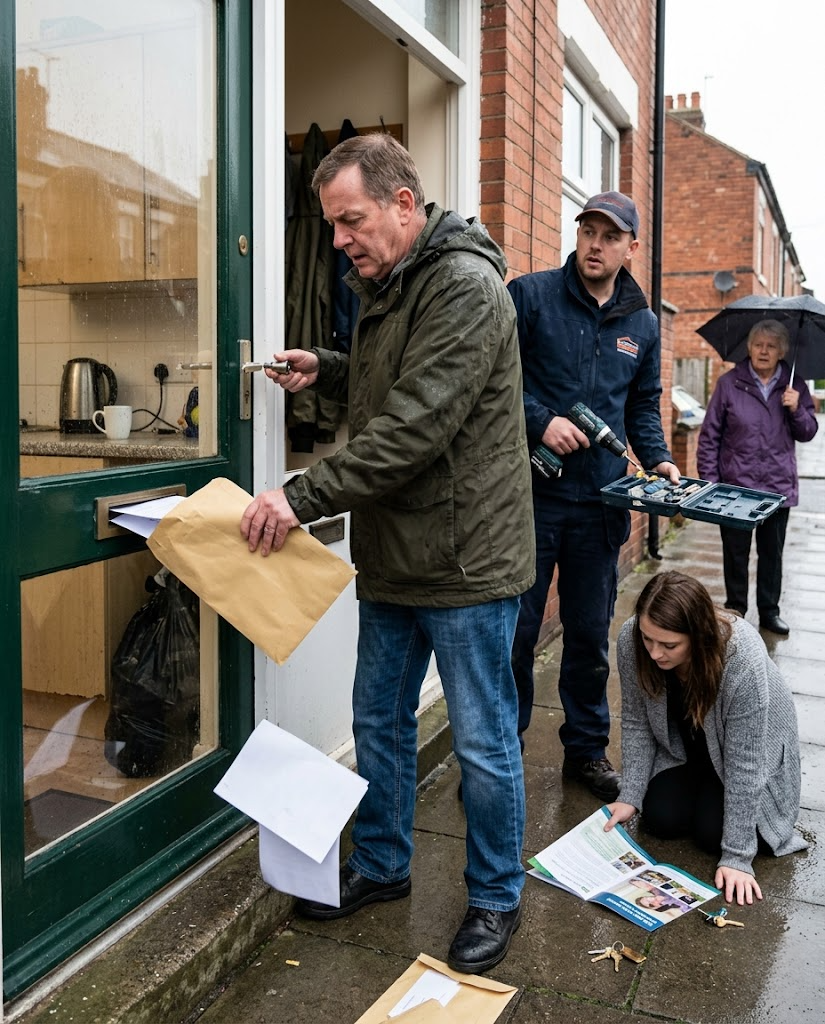
Then he crouched and forced two fingers through the letterbox flap.

It took him three attempts to hook the envelope.

Brooke hissed at him to stop making a scene.

But he kept pulling until the corner bent and the flap tore.

Finally, the envelope came through.

It was addressed to him.

In Diane’s handwriting.

For the first time since he arrived, my son looked less like a man in control and more like a boy caught where he should not be.

He opened it with a shaking thumb.

The first sheet slid out.

It was not the deed.

It was not a will.

It was not permission.

It was Diane’s signed statement, witnessed before her death, describing the questions Cameron and Brooke had asked, the pressure she feared they would put on me, and the exact instruction she had given my solicitor if either of them attempted to remove me from my home.

Cameron read the first paragraph.

Then the second.

His face lost colour.

Brooke reached for the page, but he pulled it back.

“What does it say?” she demanded.

He did not answer.

The locksmith stepped away from the door.

Mrs Lane lowered her umbrella slightly but kept the phone up.

Rain ran down the glass beside Cameron’s reflection.

Inside the house, my mug remained on the kitchen counter like a quiet witness.

Cameron turned the page.

At the bottom was one line in Diane’s hand.

The same hand that had packed his school lunches.

The same hand that had smoothed his hair before photographs.

The same hand he had thought too weak, at the end, to protect me.

Walter is not to be moved, managed, pressured, or stripped of his home by our son.

Brooke sat down on the wet front step as if her knees had forgotten their job.

The sticky notes slipped from her hand and scattered across the pavement.

Bright yellow squares stuck to the rain-dark stone.

The locksmith quietly lifted his case.

“I’m sorry,” he said, and this time it sounded like he meant it. “I can’t help you.”

Cameron looked up then, straight at the empty house.

For one moment, I think he understood.

Not everything left behind is abandoned.

Sometimes it is bait.

Sometimes it is proof.

Sometimes it is a mother’s final way of standing in the doorway when she can no longer be there herself.

He reached into the envelope again.

There was a second page.

This one was from my solicitor.

Cameron unfolded it slowly.

Brooke whispered his name.

Mrs Lane stopped moving.

Even the rain seemed to quiet against the glass.

And then my son saw the sentence that told him the house was no longer the prize he thought it was.

Because I had already moved.

And what Diane left me was never going to pass through his hands.

Advertisement
info@teaytech

info@teaytech

1058 articles published