
“You Are Just My Wife On Paper”—Said The Mafia Boss Coldly, Until The First Night Broke His Control

The Billionaire Forced Her Into A Marriage Contract To Save Her Father — But When His Enemies Came For Them, The “Paper Wife” Became The One Person He Could Not Afford To Lose
The rain hit the hospital window like a warning.
My father was unconscious in the bed behind me, machines breathing in soft, mechanical rhythm around him.
And across the table, the most feared man in the city slid a marriage contract toward me as if he were offering a business card.
“You are just my wife on paper,” Vincent Moretti said.
His voice was calm.
That was what made it terrifying.
Not the contract. Not the sterile smell of disinfectant burning my nose. Not the storm outside turning the hospital glass into a trembling silver wall. It was the way he said those words with no hesitation, no apology, no warmth, as if my entire life had been reduced to a clause he had already approved.
I looked down at the papers.
Marriage to Vincent Moretti.
In exchange, my father’s medical bills would be paid in full. My family would be protected from the men who had come to collect debts my father never should have owed. No more threatening calls. No more strangers parked outside our apartment. No more nurses whispering about transferring him because the insurance had run out.
The terms were simple.
That was what made them cruel.
My father’s life for my freedom.
My mother’s safety for my name.
A future I had not chosen in exchange for saving the only people who had ever truly belonged to me.
Vincent stood by the window, immaculate in a charcoal suit that looked custom-made for power. His dark hair was damp from the rain, combed back neatly. His jaw was sharp, his expression unreadable. The stormlight flashed across his face, and for one second, he looked less like a man and more like a judgment.
“You don’t have to pretend this is kindness,” I said.
He turned his head slightly.
“I never pretend.”
That was the first honest thing he gave me.
I should have hated him for it.
Maybe I did.
But hatred did not pay hospital bills. Hatred did not keep men with broken noses and quiet voices from cornering my mother outside the grocery store. Hatred did not cancel the debt my father had taken after the accident that destroyed his back, then his job, then our savings, then whatever pride he still had left.
Vincent Moretti could do all of that with one signature.
And he knew it.
“Why marriage?” I asked, my voice smaller than I wanted.
“Because money can be challenged. Contracts can be ignored. Protection can be negotiated.” He stepped closer, his shoes soundless against the hospital floor. “My name cannot.”
“Your name is the danger.”
His eyes held mine.
“My name is the only reason more dangerous men will step back.”
There was no comfort in that.
Only truth.
The pen felt heavy when I picked it up. My fingers were cold. My father’s monitor beeped behind me. I could hear my mother crying quietly in the hallway, trying not to let me hear her.
I signed.
My name looked wrong on the paper.
Like it belonged to someone braver.
Or someone already gone.
The courthouse ceremony lasted twelve minutes.
No flowers.
No music.
No guests.
No vows anyone believed.
The judge was an older man with tired eyes who kept glancing at Vincent and then away again, as if even the law felt uncomfortable standing too close to him. I wore a navy dress from the back of my closet. Vincent wore the same suit from the hospital, only now his tie was perfect and his expression even colder.
“Do you take this man…”
The words floated around me without landing.
Marriage, I had once thought, would happen with warmth. Maybe not wealth. Not fairy-tale extravagance. But with choice. With trembling laughter. With someone holding my hands because they loved me enough to be nervous too.
Instead, I stood beside a man who did not touch me.
When the judge pronounced us married, Vincent nodded once, like a deal had closed.
No ring was exchanged.
No kiss.
Just signatures.
Legal ink pretending to be intimacy.
Outside the courthouse, rain slicked the pavement black. A car waited at the curb, long and dark, with tinted windows that reflected nothing. The driver opened the door for me without looking directly at my face.
That became familiar very quickly.
Men around Vincent Moretti were trained not to stare.
Maybe because staring revealed fear.
Maybe because curiosity was punished.
The ride to the Archer Building took twenty minutes, though it felt longer. The car moved through the city with silent authority, stopping at lights beside taxis, buses, delivery trucks, ordinary people going home to ordinary lives.
I pressed my forehead to the cool window.
My phone buzzed once.
A message from my mother.
Your father is stable. I love you. I’m sorry.
I stared at the words until they blurred.
There was nothing to forgive.
That was the worst part.
Everyone had been trapped in different rooms of the same burning house, and I was simply the one who had been handed the key at the highest price.
The Archer Building rose sixty floors above the city like a blade.
Glass. Steel. Marble. Security so discreet it felt more threatening than obvious guards. The lobby smelled of polished stone, expensive flowers, and air conditioning cold enough to preserve secrets.
The elevator required Vincent’s palm print.
He did not speak on the way up.
Neither did I.
At the top floor, the doors opened into a penthouse that did not feel like a home.
It felt like an exhibit of wealth.
Marble floors pale enough to reflect the city lights. Floor-to-ceiling windows overlooking a thousand glittering windows below. Low furniture in expensive gray fabrics. Sculptures I did not understand. A fireplace with no warmth in it. Everything chosen, curated, controlled.
My suitcase looked humiliatingly small near the entrance.
I stood there, unsure where to go.
That was another kind of cruelty. Not being told the rules, but being expected to know when you had broken one.
Vincent appeared at the end of the hallway, tie loosened now, sleeves rolled to his forearms. I noticed scars near his wrist and one pale line disappearing beneath his cuff.
“The east wing is yours,” he said, gesturing to the right. “My quarters are in the west. You are not to enter without explicit permission.”
I almost laughed.
The man had bought my life and was now concerned about boundaries.
“The staff arrives at six,” he continued. “Breakfast is at seven. You will join me. Appearances must be maintained.”
“Even in private?”
His gaze moved over me once.
Not with desire.
With assessment.
“Yes.”
I found my voice. “How long do you expect this arrangement to last?”
Something flickered in his eyes.
Amusement, maybe.
Or irritation.
“Until it no longer serves its purpose.”
There it was.
My marriage.
A purpose.
A function.
A shield made of my name.
“The master bedroom has been prepared for you,” he said. “I sleep elsewhere.”
Then he turned and walked away.
The dismissal was complete.
That night, I lay awake in a bed built for two and occupied by one.
Lightning flashed beyond the glass, briefly illuminating a room too beautiful to comfort anyone. I stared at the ceiling and thought of my father’s hands, once strong enough to lift beams at construction sites, now weak against hospital sheets. I thought of my mother’s face when I told her it was handled. I thought of the judge who could not look at me.
I did not cry.
Tears seemed too small for that kind of loss.
Instead, I listened to the storm and wondered how long it would take before lightning found me too.
The first weeks of marriage were a choreography of distance.
Breakfast at seven.
Always.
Vincent sat at the head of the table with an Italian newspaper folded beside his plate and financial reports stacked neatly near his espresso. I sat at the opposite end, picking at fruit sliced so perfectly it looked unreal. The food was exquisite. I tasted almost none of it.
He rarely spoke.
When he did, it was practical.
“There is an event next month.”
“Maria will arrange your wardrobe.”
“Do not answer unknown calls.”
“If anyone asks, your father is recovering well.”
The staff moved through the penthouse like ghosts. Efficient. Quiet. Careful. Maria, the housekeeper, was the only one who sometimes met my eyes. A flicker of sympathy, quickly hidden. In Vincent’s world, even kindness looked over its shoulder before entering a room.
The library saved me.
I found it on the third day after opening the wrong door near the second-floor corridor. The room rose two stories high, walls lined with leather-bound books, a rolling ladder attached to brass rails, deep chairs near the windows, and the first real warmth I had felt in the penthouse.
It smelled of paper, old wood, and dust.
Human things.
Forgotten things.
I began spending hours there.
At first, I read only to avoid thinking. Then I began choosing books carefully. History. Italian grammar. Poetry. Legal essays. Business memoirs. Anything that might help me understand the world I had been forced into.
Vincent disappeared often.
Sometimes for a day.
Sometimes three.
He never explained.
When he returned, there were signs.
A bruise at his jaw he pretended I did not see.
A cut near his eyebrow.
The way he held one shoulder slightly higher when he was in pain.
I learned him the way powerless people learn dangerous rooms: quietly, precisely, without permission.
When his mouth tightened at breakfast, someone had failed him.
When he drank scotch before noon, something had gone wrong.
When he spoke Italian too softly over the phone, the problem was serious.
When he said nothing at all, everyone in the penthouse became careful.
Our paths crossed in hallways like strangers in a hotel.
Yet I always felt his awareness of me.
Not tenderness.
Not exactly.
Attention.
As if some part of his mind tracked my location without effort. Like the owner of a dangerous house knowing which rooms held fragile things.
One morning, I found a book of Italian poetry on my nightstand.
I had not placed it there.
At breakfast, I set it beside my plate.
“Is this yours?”
Vincent did not look up from his paper.
“It is yours now.”
“I didn’t ask for it.”
“Your Italian is poor. Practice would benefit you in this household.”
I stared at him.
“Was that an insult or a gift?”
His eyes lifted.
“Yes.”
It should not have made me smile.
It did.
Only for a second.
I hated that he saw it.
His gaze dropped back to the paper, but there was the faintest shift near his mouth.
Victory, perhaps.
Or surprise.
I began finding pieces of him after that.
Not deliberately.
A cufflink beneath a sofa cushion.
A handwritten note in the margin of a political biography.
A watch left ticking on a windowsill.
A half-finished glass of scotch beside the piano.
Each object worked against my anger. Not enough to erase it, but enough to complicate it. It is easier to hate a monster than a man who forgets cufflinks, annotates books, and walks the penthouse at two in the morning like sleep is a country he has been exiled from.
The most surprising discovery came one month into our paper marriage.
Vincent played piano.
I found him late one night in the music room, a space I had assumed was decorative. Moonlight crossed the floor in silver rectangles. He sat at the grand piano with his jacket off, shirtsleeves rolled, head slightly bowed, fingers moving over the keys with unexpected tenderness.
Chopin.
My mother had played Chopin when she still believed we would have better years.
I stood in the doorway, unable to move.
This was not the man from breakfast.
Not the one who issued rules like verdicts.
Not the man whose name made judges look away.
This man seemed alone.
Not powerful.
Not feared.
Alone.
I stepped back to leave, but the floorboard betrayed me.
A soft creak.
His hands stopped mid-phrase.
The silence after the music was almost painful.
He turned.
For one unguarded second, our eyes met without armor.
Then his face closed.
“Tomorrow,” he said, lowering the piano lid with careful precision. “We have an event.”
I swallowed.
“What kind of event?”
“A gala. My associates need to see that my marriage is solid.”
“Our marriage is paper.”
“Paper burns easily,” he said. “Appearances prevent fire.”
“Wear something appropriate,” he added, rising. “Be ready at eight.”
And just like that, the wall returned.
The gala was not a party.
It was a battlefield with champagne.
The ballroom glowed under chandeliers, all gold light, black tuxedos, silk gowns, diamond necklaces, expensive perfume, and eyes that never stopped calculating. Men smiled with mouths trained by lawyers. Women kissed both cheeks while measuring each other’s weaknesses. Waiters moved between them with trays like ghosts carrying evidence.
Vincent kept me close.
His hand rested at the small of my back, warm and heavy through the silk gown Maria had chosen. Not affectionate. Not exactly possessive either.
Strategic.
“Smile,” he murmured near my ear.
I did.
“These people look for cracks,” he said. “Do not give them one.”
I kept smiling.
I counted exits.
I memorized faces.
I noticed who looked at Vincent with respect, who looked with fear, and who looked at me as if trying to decide whether I was decoration or leverage.
One woman with diamonds like ice touched my arm and said, “You are much prettier than expected.”
I smiled. “How unfortunate for your expectations.”
Vincent’s fingers pressed once against my back.
Warning or approval, I could not tell.
The woman blinked, then laughed too late.
A man named Soren Bell approached near midnight. Silver hair, red pocket square, smile too smooth.
“Vincent,” he said. “Marriage suits you. Softens the edges.”
Vincent’s face did not change.
“Does it?”
Soren looked at me.
“And you, Mrs. Moretti. Are you enjoying the view from the tower?”
A smaller woman might have looked down.
I had been sold, yes. Trapped, yes. But I was not furniture.
“The view is revealing,” I said. “People look different from this height.”
Soren’s eyes sharpened.
Vincent moved slightly closer.
“Enjoy your evening, Soren.”
The dismissal was polite.
Absolute.
As we walked away, Vincent said under his breath, “You should be careful with men like him.”
“I am careful with men like you.”
He looked at me then.
For one second, something like respect moved across his face.
Then it vanished.
At midnight, Vincent guided me not to the car waiting outside, but to the hotel rooftop.
Wind hit us the moment the door opened. My hair whipped across my face. A helicopter waited on the landing pad, blades beginning to turn.
“What is this?”
“Change of plans.”
“Vincent.”
He handed me a headset.
“We are leaving the city.”
That was all.
No explanation.
No request.
Just urgency wrapped in control.
The helicopter rose into the night, carrying us away from the glittering skyline. Vincent sat across from me, speaking rapidly into a satellite phone in Italian. I caught only fragments.
Pericolo.
Traditore.
Sicurezza.
Danger.
Traitor.
Security.
My stomach tightened.
We landed at a private airstrip where a jet was already waiting, engines alive. Men moved around us quickly. Vincent’s body stayed between mine and the darkness beyond the runway.
Only once we were airborne did I ask, “Where are we going?”
His jaw was tight.
“Somewhere safe.”
“Safe from what?”
He looked at me for a long moment.
“Someone made a move against me tonight.”
A pause.
“Against us.”
Us.
The word lingered in the cabin longer than it should have.
I told myself it meant the legal arrangement.
The appearance.
The Moretti name.
But when I woke hours later from a shallow, restless sleep, Vincent was watching me.
Not clinically.
Not strategically.
Simply watching.
When our eyes met, he did not look away.
Dawn broke over the island like another world.
Emerald hills. Sapphire water. White sand. A villa perched above the coast among palms and flowering trees. The air smelled of salt, sun-warmed stone, and hibiscus.
“My private estate,” Vincent said as a car drove us up from the small airstrip. “No one knows about this place except my most trusted people.”
He looked at me.
“And now you.”
The villa was nothing like the penthouse.
Open. Bright. Full of air. White stone, blue shutters, wide terraces, windows facing the sea. It should have felt free.
But isolation can be beautiful and still be isolation.
“One week,” Vincent said. “Until my people handle the situation in the city. No phones. No outside contact.”
“Complete isolation,” I said.
His eyes flicked to mine.
“Yes.”
The first day was awkward.
Without staff moving constantly through rooms, without business calls filling the air, without the city pressing against the windows, we had too much silence and nowhere to hide inside it.
We bumped into each other in hallways.
Reached for the same coffee pot.
Sat too far apart at lunch on the terrace while the ocean glittered beyond us with obscene indifference.
Vincent checked the satellite phone every few minutes. I pretended not to notice.
By the second day, I discovered the infinity pool.
The water was warm, impossibly blue, vanishing at the edge into the sea beyond. I floated on my back, eyes closed against the sun, letting my body become weightless for the first time in weeks.
When I opened my eyes, Vincent stood at the edge.
White shirt. Dark trousers. Sleeves rolled.
Watching.
“You never mentioned you could swim,” he said.
I sat upright, suddenly aware of how little the swimsuit covered.
“You never asked.”
“I should have.”
The answer was so unexpected I had no response.
He crouched near the edge, trailing his fingers once through the water.
“My mother insisted I learn when I was five. She said men who cannot swim should never own boats.”
“Practical woman.”
“Terrifying woman.”
That made me laugh.
A real laugh.
Vincent looked at me as if the sound had caught him off guard.
Then he stood.
“Lunch in thirty minutes.”
And walked away before either of us could acknowledge the softness that had entered the air.
That night, a storm rolled in from the sea.
It came fast and violent, wind bending the palms, rain lashing against glass doors, thunder shaking the villa like something alive outside wanted in.
The power went out just after dinner.
Darkness fell.
Then candlelight.
Vincent appeared with more candles, setting them around the living room where I had been reading. In the flickering light, the sharp lines of his face seemed older. Less invincible.
“The generator should engage soon,” he said.
It did not.
We sat across from each other while the storm raged beyond the glass.
Without electricity, without staff, without the city, the silence between us changed.
It was no longer empty.
It was charged.
“Why did you marry me?” I asked.
The question escaped before I could stop it.
Vincent’s fingers tightened around his whiskey glass.
“You know why.”
“No. I know what the contract said. I know what you told me. But you could have paid my father’s debts without marrying me.”
A branch slammed against the terrace doors.
I startled.
Without thinking, my hand reached out and touched his arm.
He went still.
The contact lasted only a second.
Maybe two.
But it was the first time I had touched him by choice.
When he looked at me, something in his eyes had changed. The careful distance cracked, revealing heat beneath the ice.
“Your father owed men who do not respect payments unless they fear the person making them,” he said. “Marriage gave you my name. It made you untouchable.”
“Did it?”
“Yes.”
“Or did it make me yours?”
The question landed.
Vincent looked toward the candles.
“I told myself there was no difference.”
“And now?”
His gaze returned to me.
“Now I know there is.”
He rose abruptly.
“I should check the generator.”
At the doorway, he stopped.
“You should know something,” he said without turning fully back. “This marriage may have begun on paper, but my protection of you is real.”
Then he left.
Sleep did not come easily.
Past midnight, a crash from downstairs jolted me upright.
Glass breaking.
A muffled curse.
I slipped from bed, grabbed a heavy vase as an improvised weapon, and crept toward the sound.
I found Vincent in the kitchen.
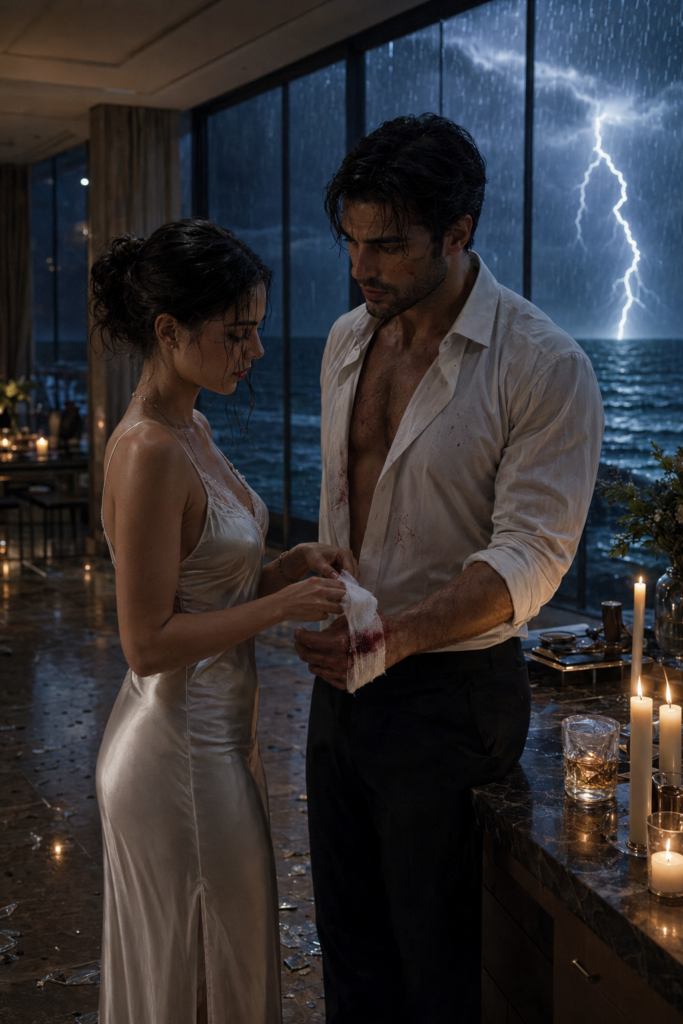
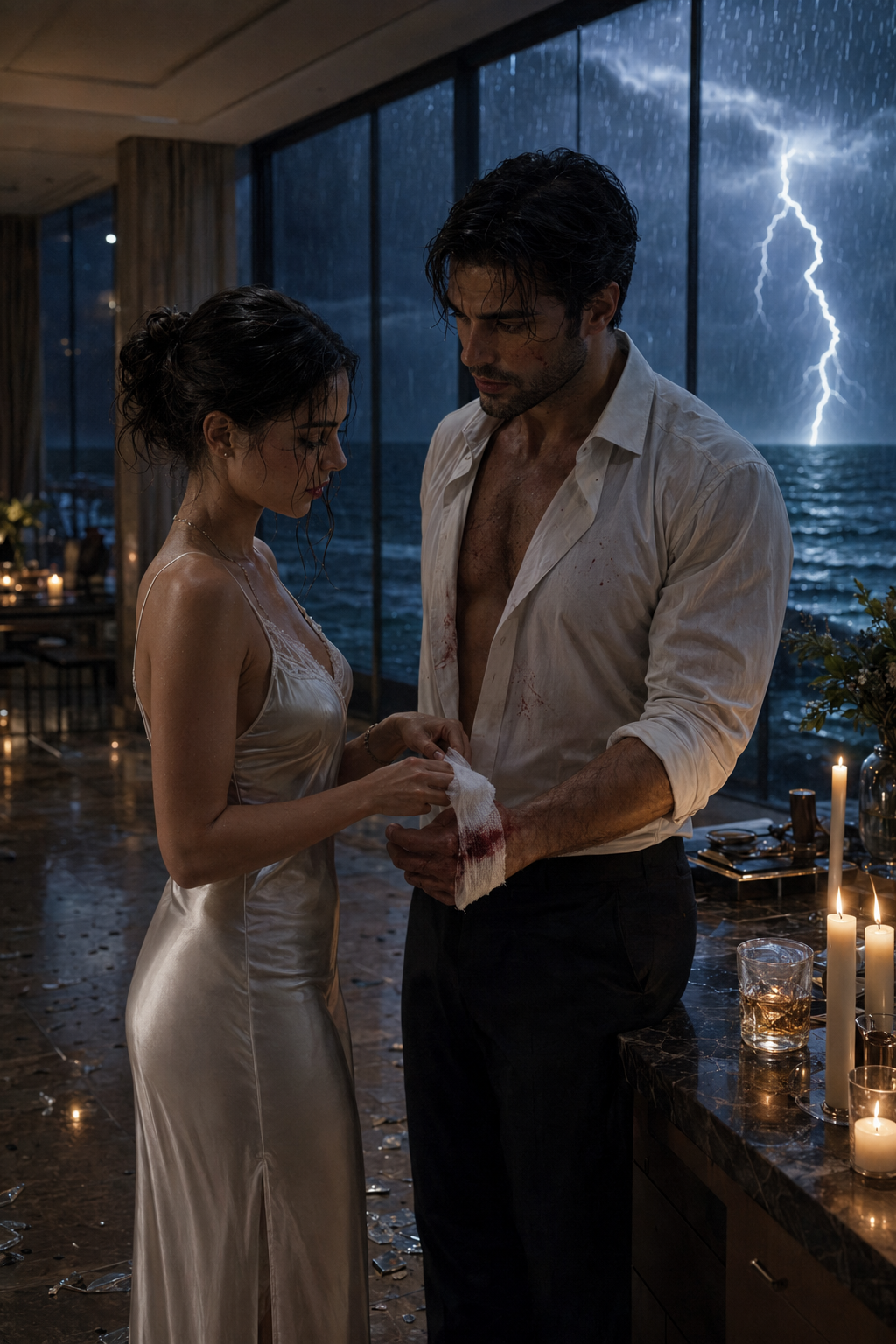
Blood dripped from his palm onto the broken remains of a water glass. A flashlight lay on the counter, throwing harsh light across his face. For once, his control was absent. He looked angry at the injury, the storm, perhaps himself.
“You’re bleeding,” I said.
He looked up.
“I noticed.”
I set down the vase.
His eyes moved to it.
“You were going to attack someone with that?”
“I was considering it.”
“Good choice. Heavy base.”
Despite everything, I almost smiled.
I found the first-aid kit under the sink and guided him to a chair. He allowed it, which surprised me more than the blood. His hand was large in mine, warm, cut across the palm.
“You have experience,” he said as I cleaned the wound.
“My father worked construction before his accident. Cuts and scrapes were normal.”
“And now?”
“Now hospitals are normal.”
His face changed slightly.
I kept wrapping the gauze.
“I’m sorry,” he said.
My hands paused.
“For what?”
“Your father.”
“Be careful,” I said. “You almost sounded human.”
His mouth moved.
Not quite a smile.
His uninjured hand came up, slow enough that I could move away if I wanted. I did not. His fingers brushed a strand of hair behind my ear. His touch lingered against my cheek.
“You continue to surprise me,” he murmured.
The kitchen seemed to shrink around us.
Storm outside.
Candlelight from the hall.
Blood beneath gauze.
His eyes asking a question his mouth would not risk.
I leaned into his touch.
Just slightly.
That was enough.
The kiss came softly.
Not demanding.
Not claiming.
Almost reverent.
As if he were touching something he had no right to and knew it.
When we separated, his forehead rested against mine.
“This was not part of our arrangement,” he said, voice rough.
“No.”
“I tried to keep my distance.”
“I noticed.”
“I failed.”
“Obviously.”
This time, he did smile.
Then I kissed him again.
The walls between us did not disappear all at once. Walls built from fear never do. But that night, in the storm-dark villa, they cracked enough for both of us to see light through them.
Dawn found us tangled in his sheets.
Sunlight spilled across the room. The storm had passed. The ocean beyond the windows was calm, glittering as if the night had never happened.
Vincent traced lazy patterns over my shoulder, his face more open than I had ever seen it.
“I saw you before the contract,” he admitted.
I turned toward him.
“What?”
“At the hospital. I watched you with your father. The way you spoke to doctors. The way you signed forms with hands that shook but never stopped moving. The way you stood between your mother and the men who came to collect.”
My heart beat harder.
“You chose me.”
“I chose to protect you.”
“That isn’t the same thing.”
“No,” he said quietly. “It isn’t.”
The satellite phone rang.
The sound cut through the room like a blade.
Vincent answered with one word.
“Moretti.”
As he listened, the man beside me vanished into the man the city feared. His body tightened. His jaw locked. His eyes went cold.
When he ended the call, he was already moving.
“Get dressed. Pack only what you need.”
“What happened?”
“Someone betrayed our location.”
The tenderness of the morning did not vanish.
It was packed away instantly, like something valuable before an earthquake.
I dressed quickly, heart pounding. From the hallway, I heard Vincent speaking Italian into the phone.
One word came clearly.
Traditore.
Traitor.
We were in the car within fifteen minutes, not heading toward the airstrip, but deeper into the island’s interior. Vincent drove himself, one hand on the wheel, the other resting near a gun on his thigh as casually as another man might rest a phone there.
“There is only one person who knew we were here,” he said.
“Someone close.”
“Yes.”
The road narrowed, then disappeared into dense green foliage. We emerged at an abandoned fishing village near a hidden cove where a speedboat waited.
Vincent pulled a waterproof bag from beneath a loose floorboard in one shack. Inside were passports, cash in multiple currencies, and a satellite tracker.
“Always have contingencies,” he said.
The words were practical.
But I noticed something else.
He was afraid.
Not for himself.
Every time leaves moved near the tree line, his body shifted between me and danger.
A distant sound of vehicles reached us.
He handed me a small pistol.
It was heavy in my palm.
“Do you know how to use this?”
I nodded.
His eyebrow lifted.
“My father took me to the range on weekends,” I said. “He believed daughters should know how not to be helpless.”
“Smart man.”
The first shots came before the helicopter appeared.
Wood splintered near us. The boat captain ducked behind the cabin. Vincent returned fire with cold precision, his face empty of everything except focus.
I crouched behind cover, gun steady despite the fear rushing through my blood.
A man emerged near our flank.
Time narrowed.
I fired.
The recoil shocked my wrists. The man dropped his weapon and fell back behind the crates. I did not know if I hit him badly. I did not let myself think about it.
Vincent glanced at me.
Not horrified.
Not patronizing.
Respect.
“Three minutes,” he said. “Helicopter is almost here.”
His shoulder pressed against mine as we held the line.
“You continue to surprise me, wife.”
This time, the word wife did not sound like paperwork.
It sounded like recognition.
The helicopter roared overhead, sending sand and leaves whipping through the air. Ropes dropped. A pilot shouted orders we could barely hear. Vincent grabbed my hand and pushed me toward the line.
“Go!”
“I’m not leaving you.”
“Go!”
A bullet grazed his arm, blood blooming against his shirt.
I climbed because refusing would get us both killed, but I kept the gun in one hand, firing toward the tree line as Vincent covered me from below. When I reached the helicopter, the pilot shouted that another aircraft was approaching.
“We can’t wait, Mrs. Moretti!”
Mrs. Moretti.
Not the paper wife.
Not the woman acquired in a hospital room.
Someone with authority.
Someone they expected to survive.
Vincent fought his way to the remaining rope as the helicopter began to rise. He leapt, caught it with one hand, and I grabbed his wrist with both of mine.
For one terrible second, he hung between ocean and sky.
Then I pulled.
He rolled into the helicopter, blood on his shirt, breath harsh, eyes bright with something wild and alive.
“You should have gone when I told you,” he said.
“I don’t follow bad instructions.”
He stared at me.
Then laughed once.
A short, stunned sound.
I realized in that moment that something irreversible had happened. I had seen his world at its worst. He had seen me inside it.
And neither of us could return to the lie of being strangers under the same contract.
We flew to another island, larger and busier, where Vincent owned a medical clinic above a restaurant that served fishermen by day and men with secrets by night. The doctor who treated his arm asked no questions.
In the safe house apartment upstairs, Vincent tried to return immediately to strategy. Calls. Names. Orders. Maps. Security routes. Betrayal charts.
I watched him for twenty minutes.
Then I took the phone from his hand and ended the call.
His eyes narrowed.
“The empire will survive if you sleep for four hours,” I said.
“You do not know that.”
“I know blood loss when I see it.”
He looked like he wanted to argue.
Then sat down heavily on the bed.
When I turned to leave, he caught my wrist.
Not hard.
Carefully.
“Stay.”
Not a command.
A request.
That difference mattered.
I lay beside him, fully clothed, and felt his arm curve around me as if it had always known the shape of my body.
“When this is over,” he murmured against my hair, “we need to renegotiate the arrangement.”
“What terms would you propose?”
“No more separate wings.”
“Bold opening.”
“No more pretense.”
“Reasonable.”
“No more paper marriage.”
I turned to look at him.
His face was serious, tired, unguarded.
“I want a real marriage,” he said. “With a wife who knows exactly who I am and chooses to stay anyway.”
The words should have frightened me.
They did.
But not enough to make me move away.
The following week became a study in consequences.
Vincent’s people traced the betrayal to a former associate who believed marriage had made him weak. That love had given enemies leverage. That the man who built an empire from nothing had become distracted by a wife who had not even been meant to matter.
When they found him, Vincent did not respond with theatrical cruelty.
That surprised me.
I had expected violence. The kind stories attach to men like him because stories enjoy simplicity.
Instead, Vincent used information.
Accounts frozen.
Allies turned.
Routes exposed.
Debts called in.
Phone records released to the right people at the right hour.
The traitor’s network collapsed under the weight of its own paperwork.
One evening, while we reviewed documents spread across the safe house table, Vincent told me about his childhood.
Not all of it.
Enough.
Poverty. Hunger. A mother who worked until her hands cracked. A father who vanished before Vincent was old enough to hate him properly. A boy who taught himself economics in public libraries and learned five languages because language was access, and access was survival.
“Everything I built,” he said, “was a wall between me and where I came from.”
“And then you moved inside the wall and locked the door.”
He looked at me.
Then nodded.
“Yes.”
That was Vincent’s gift when he was being honest.
He did not waste time defending what was true.
We returned to the city a month later.
Not to the penthouse.
To a brownstone in a quieter neighborhood, with trees along the street and neighbors who walked dogs in the morning. Vincent called it a fresh start. I called it a better negotiating position because it had fewer cameras inside.
On our first night there, he gave me a small velvet box.
Inside was a ring.
Not the cold legal absence of the courthouse.
A diamond encircled by sapphires the color of the ocean near the villa. Beautiful, yes, but not arrogant. Chosen. Thoughtful.
Vincent held it but did not take my hand.
“I should have asked before,” he said.
“Yes.”
“I should have given you choice before protection.”
“Yes.”
“I cannot undo the way this began.”
“No.”
“But I can ask what I should have asked at the beginning.”
The room felt very still.
“Will you stay married to me,” he said, “not because your father needed saving, not because my name protects you, not because paper says you belong beside me, but because you choose it?”
My throat tightened.
I thought of the hospital room. The rain. The judge. The empty courthouse. The east wing. The piano. The storm. The kitchen. The helicopter. The way he had asked me to stay, not ordered. The way I had seen his darkness and his discipline, his fear and his tenderness, the walls and the boy who built them.
“I will not be owned,” I said.
“No.”
“I will not be decorative.”
“No.”
“I will not be protected into silence.”
“Never.”
“And if I say yes, it is not forgiveness for everything.”
His eyes held mine.
“I know.”
I gave him my hand.
“Yes,” I said.
He slid the ring onto my finger with a care that made the memory of the courthouse feel like something from another lifetime.
Then he kissed my knuckles.
Not like ownership.
Like gratitude.
In the months that followed, people said many things.
That Vincent Moretti had been softened by marriage.
That his paper wife had become real.
That enemies miscalculated by underestimating the woman beside him.
Some of that was true.
Most of it was too simple.
Love did not make Vincent harmless.
It made him accountable.
It did not turn me into a queen overnight.
It forced me to decide what kind of woman I would become when survival no longer required silence.
I began working inside his legitimate businesses, not as a pretty symbol, but as a strategist. Restaurants. Properties. Investments. Charitable trusts that had existed mostly for tax reasons until I insisted they serve actual people. Vincent argued with me often.
I argued back.
At first, his men looked startled.
Then amused.
Then careful.
One of them once said, “Mrs. Moretti has opinions.”
Vincent looked up from his papers.
“My wife has judgment. Learn the difference.”
That sentence traveled through the organization faster than any memo.
The first time I returned to the hospital where my father had lain, I went with my mother, not with Vincent. My father was walking again with a cane. Slowly. Stubbornly. Cursing every third step.
He cried when he saw the ring.
Not from joy.
From guilt.
“I sold you,” he whispered.
I took his face in my hands.
“No,” I said. “You were drowning. I made a bargain. Then I changed the terms.”
That was the truth.
Not neat.
Not innocent.
But mine.
The brownstone filled with life slowly. Books in rooms that had been too polished. My father’s terrible jokes at Sunday dinner. Maria visiting with food Vincent pretended not to need. Vincent playing piano after midnight, not hiding when I entered anymore.
One night, years later, storm rain struck the windows hard enough to wake me.
Vincent was already awake beside me.
The scar on his arm from the island had faded but never disappeared. My ring caught a flash of lightning. For a moment, the room brightened silver, and I remembered the hospital window, the contract, the woman I had been when I signed away a life I thought was over.
Vincent turned his head.
“What are you thinking?”
“That paper burns.”
He studied me.
Then smiled faintly.
“Yes.”
I looked at the ring.
“But some things survive fire because they were never paper to begin with.”
His hand found mine beneath the blanket.
Quietly.
Without command.
Outside, the storm raged over the city.
Inside, I no longer felt like lightning was coming for me.
Because I had learned the difference between being taken and being chosen.
Between protection and possession.
Between a man who builds walls around you and a man willing to hand you the key.
Our marriage began as a contract.
Cold ink.
Debt.
Fear.
A judge who would not meet my eyes.
But it became something else because I refused to remain the woman on the page.
And Vincent, dangerous as he was, learned that the strongest vow was not spoken in a courthouse.
It was not written in a contract.
It was made every time power stepped back and allowed love to choose freely.
That was how our real marriage began.
Not with “I do.”
But with the first moment I was finally free to say yes.