
A $14 Baby Blanket Exposed the Husband Everyone Thought They Knew

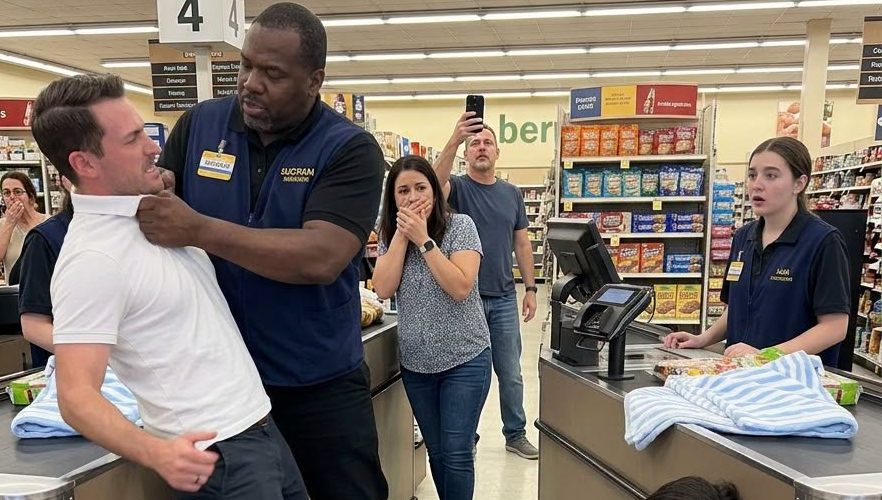
My husband slammed my eight-month-pregnant belly into a checkout counter over a $14 baby blanket.
As I collapsed clutching my stomach, he snarled, “You greedy bitch! We’re not wasting my money on useless baby junk!”
His smile vanished when the store manager stepped forward, grabbed him, and moments later, secrets far worse than anyone imagined began to surface.
The cold metal edge of the checkout counter struck just beneath my ribs, hard enough to force the breath from my lungs.
For one stunned second, I tasted pennies and blood.
Then a white flash burst behind my eyes, followed by a deep pulling pain across my eight-month-pregnant belly.
I did not immediately understand that I was falling.
I only knew that the fluorescent lights above me had tilted, the floor was rushing closer, and the small blue baby blanket I had placed beside the scanner was still sitting there with its price tag facing up.
Fourteen dollars.
That was all it had taken for David to stop pretending.
“You stupid, selfish bitch,” he hissed, keeping his voice low enough to sound controlled to anyone who had not seen what he had just done.
His face was inches from mine as he added, “You are spending my money.”
My knees hit the floor first.
One hand pressed beneath my stomach while the other clawed at the edge of the counter, trying to keep me from collapsing completely.
The side seam of my maternity dress had torn near my hip, and the fabric twisted painfully around my legs as I slid down.
Everything around me looked too bright and too sharp.
The checkout belt had stopped moving.
The card reader still displayed the total.
A pack of diapers sat behind the blanket, along with a bottle of prenatal vitamins and two cans of soup I had added because they were on sale.
David stood over me in a spotless polo shirt, breathing hard through his nose.
He looked less like a husband who had just hurt his pregnant wife than a customer annoyed by an unexpected delay.
“Get up,” he said.
When I did not move quickly enough, his voice hardened.
“Stop making a scene.”
The words should not have surprised me.
David had spent years teaching me that whatever he did was private, while whatever reaction I had was embarrassing.
If he yelled, I was provoking him.
If he broke something, I had made him lose control.
If I cried, I was manipulating him.
And if anyone noticed, the problem was never what he had done.
The problem was that I had failed to hide it.
I looked around the checkout lane, desperate for someone to say something.
A woman near the next register had one hand over her mouth.
The cashier stared down at the scanner as though the red beam might tell her what to do.
A man farther back in line had raised his phone, but he lowered it when David turned his head toward him.
No one moved close enough to touch me.
No one seemed certain whether helping would make things worse.
David noticed their hesitation, and some of the tension left his shoulders.
He understood hesitation better than anyone.
He built his entire life around it.
He was a regional director with an easy handshake, an expensive watch, and a polished smile that made strangers trust him before he had earned it.
He remembered names, tipped well when people were watching, and brought expensive bottles of scotch to men whose approval mattered to him.
He knew exactly when to lower his voice so cruelty sounded like patience.
At church gatherings, he carried folding chairs without being asked.
At company dinners, he thanked servers by name.
When neighbors saw him unloading groceries from our SUV, he made sure they noticed the heavy bags in his hands and not the way he checked every receipt afterward.
People called him generous.
They called me lucky.
He liked both words because they made it harder for me to explain the truth.
At home, every purchase became a test I could fail.
A carton of strawberries was wasteful if they spoiled before he ate them.
A maternity bra was unnecessary because, according to him, I already owned clothes.
Gas was questioned by the mile.
Groceries were sorted into things he considered necessary and things he accused me of buying for attention.
The money was always “ours” when he wanted praise for providing it.
It became “his” the moment I needed anything.
The blanket had been the first thing I had chosen for the baby without asking him.
It was soft, plain, and small enough to fold into one hand.
There were no designer labels, matching accessories, or embroidered initials.
It was simply a blanket I had imagined wrapping around our child on the drive home.
I had stood in the baby aisle for nearly ten minutes before placing it in the cart.
Even then, I had checked the price twice.
David had not objected until the cashier scanned it.
The beep sounded, the price appeared, and something in his expression tightened.
“What is that?” he asked.
“A blanket,” I said.
“We already have towels.”
“It’s for the baby.”
His smile remained in place because the cashier was watching.
“Put it back.”
I looked at the blanket, then at the total on the screen.
“It’s fourteen dollars.”
That sentence changed everything.
It was not loud.
It was not disrespectful.
It was the smallest argument I had made in months, but David heard something else inside it.
He heard resistance.
He leaned closer and told me to remove it.
I said I wanted to buy it.
His hand closed around my upper arm.
The cashier froze.
I tried to pull away without drawing attention, which was the instinct David had trained into me.
He squeezed harder and steered me toward the end of the counter as though guiding an uncooperative child.
“David,” I whispered, “you’re hurting me.”
He smiled at the cashier.
Then he drove me into the metal edge.
Now, on the floor, I waited for the baby to move.
A few seconds earlier, there had been a faint rolling pressure under my palm.
Now I felt only the tightness spreading across my stomach.
Panic rose so quickly that it made the store seem distant.
The voices around me blurred into fragments.
Someone asked whether I could hear them.
Someone else said they should call an ambulance.
David answered before I could.
“She’s fine,” he said.
The confidence in his voice frightened me more than the pain.
He had decided what had happened, and he expected the rest of us to accept it.
“She slipped,” he continued. “She’s emotional. Pregnancy hormones.”
The woman near the next register stared at him.
“I saw you shove her,” she said.
David turned toward her with the patient expression he used when he wanted someone to feel unreasonable.
“No, you saw my wife lose her balance while she was having one of her episodes.”
I had never had an episode.
The word landed with the smoothness of something practiced.
He did not need the accusation to be proven.
He only needed it to create doubt.
The cashier finally looked at me.
Her face was pale, and her hands were shaking beside the register.
“Ma’am, should I call 911?”
“Yes,” I tried to say.
The word came out as a breath.
David stepped between us.
“No,” he said firmly. “I’m taking her home.”
Home.
The place where no strangers would be watching.
The place where he controlled the doors, the keys, the accounts, and the explanation.
I pressed both hands around my belly and tried again.
“Call.”
David looked down at me.
The public mask slipped for half a second.
I saw the same expression I had seen behind closed doors whenever I made a choice he had not approved.
It was not rage alone.
It was disbelief that I still thought I was allowed to decide anything.
He bent toward me as if he meant to help me stand.
“Get up,” he said through his teeth. “Now.”
I jerked away before his hands reached me.
The movement sent another line of pain across my stomach, and I cried out.
Several customers stepped backward.
David’s jaw tightened.
His open hand came up.
I knew that hand.
I knew the speed of it, the sound it could make, and the apologies that would follow if it left a mark someone might see.
I squeezed my eyes shut and curled around my stomach.
The blow never came.
A broad shadow crossed the tile beside me.
Then came the heavy thud of work boots stopping between David and my body.
“Let go of her.”
The voice was deep, steady, and close enough to make David freeze.
I opened my eyes.
Wyatt, the store manager, stood behind him.
He was nearly seven feet tall, with a wild red beard and a store vest stretched tight across his shoulders.
There was no confusion in his expression about what he had seen.
One of his hands was held slightly forward, ready to block David if he moved toward me again.
The other was clenched beside his leg.
David turned slowly and reached for the version of himself that usually worked.
“This is a private family matter,” he said.
Wyatt did not move.
David straightened his shirt and lifted his chin.
“You need to step back before I have your job.”
His voice carried farther now, polished and authoritative.
He introduced himself by title, as if his job made him more credible than the woman bleeding on the floor.
He said I was emotional.
He said I had slipped.
He said the scene looked worse than it was.
He even gave Wyatt a tight, understanding smile, the kind one man might offer another when discussing an unreasonable wife.
Wyatt did not return it.
“Move away from her,” he said.
David laughed once.
It was a short, disbelieving sound.
“You have no idea who you’re talking to.”
“I know exactly who I’m talking to.”
Something in Wyatt’s answer made David’s expression shift.
It was subtle, but I saw it.
His eyes narrowed, and the confidence in his posture became calculation.
He looked at Wyatt’s face more carefully.
For the first time since I had hit the counter, he seemed to recognize that the situation might not belong to him anymore.
The woman beside the next register stepped closer to me.
She crouched several feet away, careful not to touch me without permission.
“My name is Karen,” she said softly. “I’m staying right here with you.”
The ordinary kindness of that sentence almost broke me.
I nodded because I could not speak.
The cashier’s hand hovered over the store phone.
Wyatt looked at her without taking his attention fully off David.
“Call 911,” he said. “Tell them we have an injured pregnant woman and an assault witnessed by multiple customers.”
David’s polished expression cracked.
Not because he was worried about me.
Because Wyatt had called it an assault.
“Don’t use that word,” David snapped.
Wyatt’s eyes stayed fixed on him.
“That is what I saw.”
“You saw my wife stumble.”
“I saw you drive her into the counter.”
“That is not what happened.”
“It happened six feet from me.”
David glanced around, searching the faces of the customers for someone willing to accept his explanation.
Minutes earlier, most of them had been afraid to meet his eyes.
Now the woman beside me was holding her ground.
The cashier was speaking into the phone.
The customer who had lowered his cell phone raised it again and began recording openly.
David could frighten one person at a time.
He could not intimidate everyone at once.
His attention snapped back to me.
“This is your fault,” he said.
Wyatt stepped farther between us.
“Do not speak to her.”
David’s face flushed.
“You don’t tell me whether I can speak to my wife.”
“She asked for help.”
“She is confused.”
“I’m not confused,” I said.
The words were weak, but the checkout lane had become so quiet that everyone heard them.
David stared at me.
For years, I had measured safety by the look in his eyes.
I knew when to change the subject, when to apologize, and when to pretend a cruel joke had been funny.
That look now told me I would pay for those three words if he managed to take me home.
Wyatt must have seen something in my face because his stance changed.
He shifted his weight, placing himself more firmly in David’s path.
The woman beside me reached for the folded blanket still lying near the scanner.
She lifted it carefully and placed it beneath my elbow so I would not have to brace myself against the hard floor.
The blanket David had called useless became the first soft thing between my body and the tile.
He noticed.
“Don’t touch our stuff,” he barked.
Karen’s eyes moved from the blanket to him.
Then she turned away from him completely and asked me, “Is this okay?”
“Yes,” I whispered.
It was such a small question.
It was also the first time anyone had asked what I wanted since we entered the store.
David took one step toward us.
Wyatt raised an arm.
“Stay back.”
David stopped, but only for a moment.
Then he made the mistake that ended any chance of passing the scene off as a misunderstanding.
He pulled his arm back toward me again.
Maybe he intended to grab me.
Maybe he intended to strike me.
I never found out.
Wyatt moved before David could finish the motion.
His hand closed high around David’s collar, catching the fabric beneath his throat.
My 190-pound husband came off his heels before he could complete the threat.
Wyatt forced him backward and turned him away from me, keeping the movement controlled but absolute.
David cursed and grabbed at Wyatt’s wrist.
“Take your hands off me!”
“Stop fighting.”
“I’ll sue this store into the ground!”
Wyatt kept him pinned away from the checkout lane.
“You can explain that after she gets medical help.”
The cashier continued speaking into the phone, giving the store’s location and repeating that I was eight months pregnant.
Karen stayed near me, one hand hovering beside my shoulder while she watched my face.
The man recording moved closer, careful to keep both Wyatt and David in frame.
The entire balance of the room had changed.
David still had money, status, and the voice he used in meetings.
But Wyatt had named what happened.
The cashier had called for help.
The customers had stopped looking away.
And I had said I was not confused.
David twisted in Wyatt’s grip and shouted that I had attacked him first.
No one believed him.
He claimed the blanket had caused an argument because I was irresponsible with money.
No one asked why irresponsibility justified violence.
He said he was under pressure.
No one treated pressure as permission.
Finally, he tried the explanation he had used on me more times than I could count.
“You don’t know what she’s like at home.”
Wyatt’s expression changed then, not into surprise but into something colder.
“I know what you’re like when you think no one will stop you.”
David stared at him.
The shouting stopped.
For the first time, I saw genuine uncertainty enter my husband’s face.
He looked again at Wyatt’s red beard, his name badge, and the steady recognition in his eyes.
Then David said his name.
Not “manager.”
Not “you.”
“Wyatt.”
He said it quietly, like a man realizing he had walked into a room where his reputation had arrived before him.
Wyatt’s grip tightened just enough to keep him still.
“Yes,” he said.
David went pale.
I had never seen them together before.
I did not know how Wyatt knew him, why David suddenly looked frightened, or what connection could make a man who threatened everyone around him stop speaking.
But the silence between them was not the silence of strangers.
Karen noticed it too.
So did the cashier.
Even the man recording lowered his phone slightly, waiting for one of them to explain.
I pressed my palm against my stomach again.
A faint movement answered from beneath my hand.
Relief hit me so sharply that tears filled my eyes.
The baby had moved.
Once.
Then again.
I held on to that movement while the pain continued tightening across my belly.
Outside, the distant sound of sirens began to rise.
David heard them and started struggling again.
“Let me go,” he said. “This can still be handled privately.”
Wyatt looked at him with an expression I could not read.
“No,” he said. “It can’t.”
David lowered his voice.
The anger disappeared from his tone, replaced by something almost pleading.
“You don’t understand what this will do.”
Wyatt’s answer came without hesitation.
“I understand exactly what it will do.”
That was when I realized David was not afraid only of being arrested for what everyone had just witnessed.
He was afraid of Wyatt.
More precisely, he was afraid of what Wyatt already knew.
The store manager had recognized my husband before David ever touched me.
And whatever history stood between them was serious enough to strip away the confidence David had spent years building.
The $14 blanket was no longer the real reason his face had changed.
It was only the object that had exposed him in public.
The deeper secret was still sitting behind Wyatt’s eyes, waiting for the sirens to reach the door.