A Boy’s Terrifying Call Revealed Why His Mother Never Came Home-jeslyn_
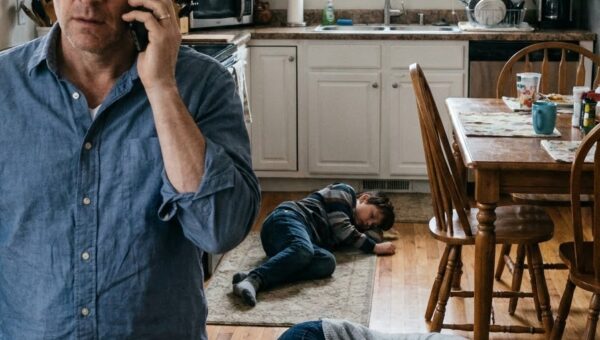
“Dad… Emma won’t wake up, and there’s nothing left to eat.”
Ethan’s voice was so quiet that for one confused second, I thought the call had failed.
I was sitting inside a glass-walled conference room with a paper coffee cup cooling beside my laptop and twelve people waiting for me to approve a seven-figure campaign.
The air conditioner hummed above us.
A presentation glowed on the wall.
Someone was explaining projected growth.
Then my six-year-old son said his little sister had not eaten in three days, and every other sound disappeared.
“Ethan, where are you?”
He did not answer immediately.
I heard him breathe, then swallow.
“Mom’s apartment.”
“Why are you calling from another number?”
“A lady downstairs let me use hers.”
My chair struck the wall when I stood.
“Where is your mother?”
“I don’t know.”
His voice dropped even lower.
“Emma is really hot. I tried to give her crackers, but she can’t chew.”
I left my laptop open on the conference table, grabbed my keys, and ran.
No one tried to stop me.
Eight months earlier, Laura and I had signed a shared-custody agreement that looked reasonable on paper.
She kept the children most school nights because her apartment was close to their elementary school.
I had Ethan and Emma every other weekend, two afternoons during the week, and any extra time Laura said she needed.
We were not friends anymore.
We had spent too many months turning old disappointments into legal language for that.
But I believed we still shared one unbreakable rule: whatever happened between us, the children would remain safe.
That belief made everything else possible.
It allowed me to leave Ethan’s school jacket at Laura’s door without starting an argument.
It allowed her to call when Emma needed medicine and know I would bring it.
It allowed both of us to pretend the divorce had damaged only the marriage, not the structure holding our children up.
Three days before Ethan called me, Laura sent a text at 7:18 p.m. on Friday.
She said she was taking the kids to stay with a friend near the lake.
“Cell service is bad,” she wrote. “I’ll check in Sunday.”
I replied with a thumbs-up.
That tiny response would bother me for a long time.
There had been warning signs before that message.
Laura missed two school pickups in one month and blamed work.
She canceled one of my afternoons with the kids because she said Emma had a stomach bug, but when I spoke to Ethan later, he said they had not gone anywhere.
He had also started eating differently at my house.
He no longer asked whether he could have seconds.
He simply ate fast, shoulders rounded over the plate, with one forearm guarding his food.
The first time I noticed, I asked whether someone at school had been taking things from his lunch tray.
He shook his head and said he was just hungry.
I believed that answer because I wanted the problem to be small.
Trust does not always break in one huge moment.
Sometimes it disappears quietly through ordinary things until your child calls from a stranger’s phone and tells you his sister will not wake up.
I called Laura while racing through the parking garage.
The call went directly to voicemail.
I called again.
Voicemail.
The drive to her apartment took twenty-two minutes, but I remember almost none of it.
I remember gripping the steering wheel.
I remember running one red light after stopping long enough to see the intersection was clear.
I remember saying Ethan’s name aloud, as if repeating it could keep him safe until I arrived.
The apartment complex sat behind a row of low stores and a wide parking lot washed in hard afternoon heat.
When I reached the building, the upstairs door was partly open.
The hallway carpet felt sticky beneath my shoes.
Hot air pressed against my face.
“Ethan!”
The smell inside reached me before the children did.
Old dishes.
Dirty laundry.
Sour juice.
The thick, trapped heat of an apartment that had been closed too long.
Ethan sat on the living room floor holding a couch pillow against his chest.
His hair was damp and stuck to his forehead.
A gray streak of dust crossed one cheek.
He did not run toward me.
He looked up and said, “I thought you weren’t coming.”
I dropped to my knees and pulled him against me.
“I’m here.”
He held on without speaking.
“I’m here now.”
Then he pointed toward the couch.
Emma lay beneath a heavy blanket even though the room felt like an oven.
Her cheeks were red with fever.
Her lips were cracked.
When I touched her forehead, fear moved through me with a coldness that did not belong in that room.
She barely reacted when I lifted her.
In the kitchen, an empty cereal box lay beside a ketchup bottle.
Half a sleeve of stale crackers sat open on the counter.
A sippy cup held a dried ring of orange juice at the bottom.
The refrigerator contained mustard, an old container of takeout sauce, and nothing a child could eat.
“When did you eat last?” I asked.
Ethan looked down at the floor.
“I don’t know.”
“What did you give Emma?”
“Bread.”
His mouth trembled.
“But it ran out.”
Anger arrived before thought.
For one ugly second, I imagined Laura walking through the door and hearing every accusation I had stored during the divorce.
I imagined demanding how a mother could leave a six-year-old in charge of a sick three-year-old.
I imagined telling her she would never see them again.
Then Emma made a weak sound against my chest, and Ethan watched me with the careful expression of a child trying to judge whether the adult in front of him was about to become another problem.
So I swallowed the rage.
I carried Emma downstairs, buckled Ethan into the family SUV, and drove toward the children’s hospital.
Halfway there, Ethan asked, “Is Mom mad at me?”
My vision blurred for a second.
“No, son.”
“Because I used the lady’s phone.”
“You did exactly the right thing.”
“I took care of Emma.”
I gripped the wheel harder.
“You saved her life.”
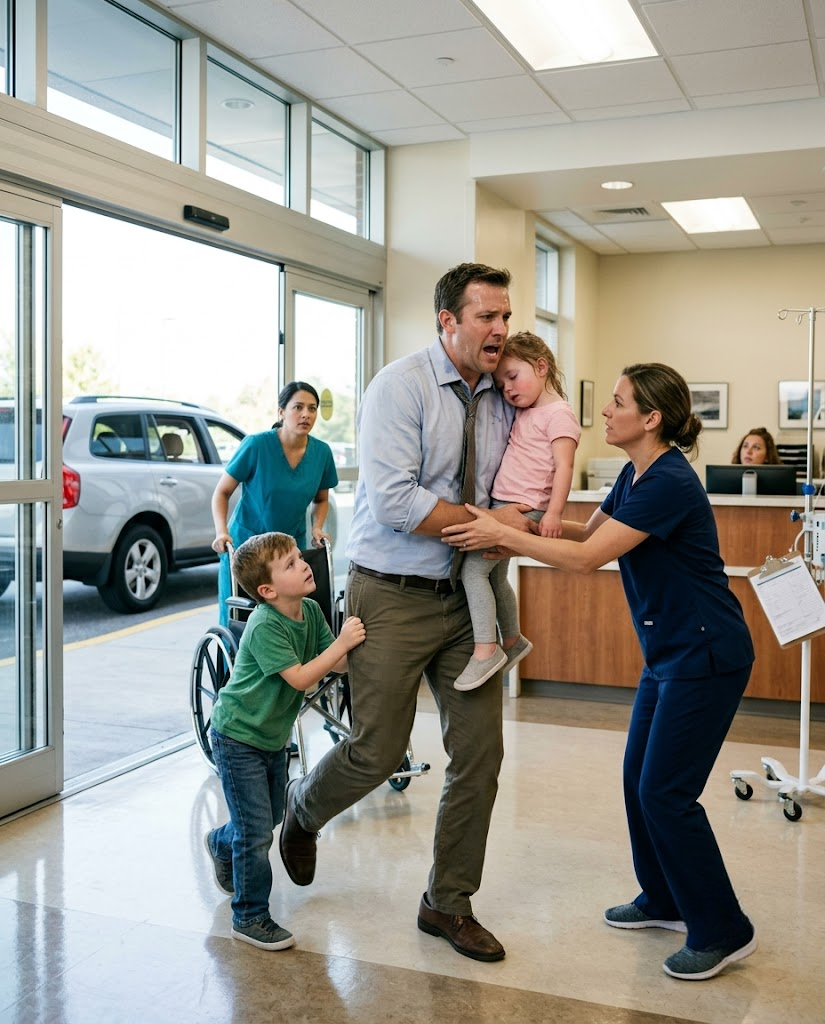
At 4:42 p.m., I ran through the emergency entrance carrying my daughter.
“Help me,” I shouted. “My daughter isn’t responding.”
Two nurses rushed forward.
One took Emma from my arms.
Another guided Ethan toward a chair, but he kept one fist twisted in the fabric of my pants.
The intake clerk asked for names, birth dates, insurance information, custody details, known allergies, and the last time either child had eaten.
Each answer sounded more terrible when spoken aloud.
Emma Carter.
Age three.
Fever.
No food for three days.
By 5:09 p.m., Ethan had a hospital wristband too.
By 5:37 p.m., a social worker was documenting the apartment condition on a tablet.
She asked about the empty kitchen, Laura’s Friday text, our custody schedule, and the stranger’s phone Ethan had borrowed.
By 6:11 p.m., a neglect report had been opened.
The social worker explained that the apartment photographs, medical notes, and timeline would be added to the county family court file.
“Mr. Carter, do you know where the children’s mother is?”
“I don’t.”
I looked through the glass toward the room where a nurse had taken Emma.
“But when I find her, she will never get near them again.”
The social worker did not challenge me.
She simply typed my words into the record.
Two hours later, Ethan slept across two plastic chairs beneath my jacket.
The hallway smelled like antiseptic and vending-machine coffee.
A pediatrician had told me Emma was severely dehydrated and fighting an infection, but she had begun responding to fluids.
Ethan was exhausted and hungry, but stable.
Those facts should have calmed me.
They did not.
I kept seeing the empty cereal box.
I kept hearing Ethan say the bread had run out.
Then a nurse approached with a clipboard held close to her chest.
Her expression was different from the expression she had worn earlier.
“Mr. Carter, we found a record under your ex-wife’s name at another hospital.”
I stood so quickly the chair legs scraped across the floor.
“What does that mean?”
“Laura wasn’t out of town.”
“Then where was she?”
The nurse looked at Ethan before lowering her voice.
“She was admitted Friday night.”
The other hospital had logged Laura’s arrival at 7:46 p.m.
Her text about the lake had been sent twenty-eight minutes earlier.
She had been brought in unconscious after collapsing in a grocery store parking lot.
Her phone had shattered when she fell.
The screen would not turn on, and the emergency contact in her old hospital record was no longer valid.
For nearly three days, one hospital had been treating Laura while another was treating the children waiting for her to come home.
The nurse showed me the property inventory attached to Laura’s chart.
A grocery receipt was stapled to the page.
It was time-stamped 7:31 p.m. Friday.
Bread.
Crackers.
Children’s fever reducer.
Juice.
The shopping bag had been found beside her.
Ethan woke while I was staring at the receipt.
He pushed my jacket away and rubbed his eyes.
“Mom was coming back?”
I tried to answer, but my throat closed.
The social worker sat beside him.
“Yes,” she said gently. “It looks like she was trying to come back.”
That did not erase what had happened.
Laura had still left two young children alone.
She had still lied to me.
She had still allowed hunger and fear to become normal enough that Ethan knew how to hide both.
But the story was no longer simple.
Anger feels clean when you think you understand everything.
The truth is usually messier, and mess does not give you the comfort of one person to hate.
A doctor from the other hospital called a few minutes later.
He explained that Laura’s fall had not caused the bleeding in her brain.
A ruptured aneurysm had.
The collapse had happened quickly, but the severe headaches she had apparently been experiencing for weeks were warning signs she had ignored.
Emergency surgery had stopped the bleeding.
She was alive, but unconscious in intensive care.
The doctor could not promise what recovery would look like.
I sat down because my knees would no longer hold me.
Ethan watched my face.
“Is Mom dead?”
“No.”
The word came out too sharply, and he flinched.
I lowered my voice.
“No, buddy. She’s very sick, but she’s alive.”
“Can she hear me?”
“I don’t know.”
He thought about that.
Then he asked, “Can I tell her I gave Emma the last bread?”
That question broke something in me the hospital had not reached.
I turned away and covered my mouth.
The social worker placed one hand between Ethan’s shoulder blades.
“You can tell her,” she said. “But you should also tell her that feeding everyone was never supposed to be your job.”
Emma remained in the hospital overnight.
Her fever began to drop after fluids and medication.
The next morning, she woke long enough to ask for Ethan.
He climbed carefully onto the edge of the bed and held her hand.
Neither child asked for me.
They asked for each other.
On Monday morning, I appeared in a family court hallway with the hospital intake forms, the neglect report, Laura’s admission timeline, and photographs of the apartment.
The emergency hearing lasted less than an hour.
The judge granted me temporary physical custody while the county reviewed the circumstances and Laura remained hospitalized.
The order did not declare Laura a monster.
It did not pretend the children had been safe.
It simply placed responsibility where it had to go until the adults could understand what had happened.
The social worker later helped reconstruct the months before the collapse.
Laura had lost her job six weeks earlier.
She had not told me.
She had fallen behind on rent and utilities.
She had sold a few pieces of jewelry, canceled appointments, and stretched food farther than food should ever be stretched.
She had also become convinced that if I knew how bad things were, I would use the information to take the children permanently.
That fear did not come from anything I had said directly.
It came from every hostile exchange we had allowed to gather between us.
We had turned communication into evidence.
We had made honesty feel like surrender.
The lie about the lake was meant to buy her one weekend.
She planned to leave the children alone for less than half an hour, buy food and fever medicine, and return before anyone knew the pantry had been empty.
It was a reckless decision.
It was also not abandonment in the way I had imagined while sitting outside Emma’s hospital room.
Both things were true.
Laura woke nine days after surgery.
Her speech was slow, and one side of her body was weak.
The first clear question she asked was about the children.
I was standing beside her bed when she whispered, “Ethan?”
“He’s safe.”
“Emma?”
“She’s safe too.”
Her eyes closed.
Tears slipped toward her ears.
“I was coming back.”
“I know.”
The words surprised both of us.
For days, I had rehearsed what I would say when she woke.
I had planned to tell her about the apartment, the empty refrigerator, and the way Ethan guarded his plate.
I had planned to make her face every detail.
Instead, I pulled the grocery receipt from my pocket and placed it on the table beside her bed.
“I know you were coming back,” I said. “But they never should have been alone.”
Laura stared at the receipt.
“I was ashamed.”
“That almost killed them.”
“I know.”
Her voice cracked.
“I thought you’d take them.”
“I did take them.”
She looked at me then.
There was no anger in her face.
Only exhaustion.
“I know.”
That was the beginning of the hardest part, because survival did not solve anything.
Laura needed rehabilitation.
The children needed stability.
I needed to stop treating every frightening fact as proof of the worst possible motive.
And all of us had to accept that love does not cancel accountability.
When Laura was strong enough, the social worker arranged a supervised visit at the rehabilitation hospital.
Ethan stood near the doorway at first.
He had drawn a picture of four people beside a house, but he kept the paper folded against his chest.
Laura lifted her good hand.
“Hi, buddy.”
He walked toward her slowly.
“I gave Emma the last bread.”
Laura began crying before he reached the bed.
“You took care of her.”
He nodded.
Then Laura said the sentence he needed more than praise.
“But you never should have had to.”
Ethan unfolded the picture and placed it on her blanket.
Emma climbed onto the chair beside the bed and touched the hospital wristband around Laura’s arm.
For a few minutes, no one spoke.
The machines continued beeping.
A cart rolled past in the hallway.
Sunlight moved across the floor.
Ordinary things kept happening around a family trying to understand how close it had come to losing itself.
Laura did not return to unsupervised custody when she left rehabilitation.
The temporary order remained in place while she rebuilt her health and housing.
I adjusted my work schedule, accepted help I would once have called inconvenient, and stopped pretending that providing money was the same as noticing everything.
The school office arranged regular check-ins for Ethan.
His teacher kept snacks available without making him ask in front of the other children.
At home, I filled the pantry and left the cabinet doors open the first few nights.
Ethan still counted slices of bread.
He still asked whether the milk would last until morning.
Once, I found three granola bars hidden beneath his pillow.
I did not scold him.
I sat on the edge of the bed and showed him the grocery list for the next day.
“We will buy more,” I said.
“You promise?”
“I promise.”
Months later, Laura was able to walk with a cane.
Her speech improved.
She moved into a smaller apartment closer to her rehabilitation clinic and began seeing the children for longer supervised visits.
The family court file did not disappear.
Neither did the neglect report.
Facts do not become false because the reason behind them changes.
But the records also contained the other truth: the 7:31 p.m. grocery receipt, the 7:46 p.m. hospital admission, the shattered phone, the ruptured aneurysm, and the bag of food found beside a mother who had been trying to get home.
I once believed the worst thing Laura had done was leave our children.
In the end, the worst thing we had both done was let pride make honest help feel more dangerous than silence.
Trust does not always break with one huge moment.
Sometimes it disappears quietly through missed pickups, guarded plates, and unanswered calls.
And sometimes rebuilding it begins just as quietly—with an open pantry, a documented plan, a hospital visit, and a six-year-old finally hearing that he is allowed to be a child again.