I adopted the son my best friend abandoned when he was four. Fourteen years later,

PART 1
The call came at 2:07 in the morning on a Tuesday in November.
I still remember the cold tile of the kitchen floor beneath my bare feet when I answered the phone and heard David’s voice break before he could even finish his first sentence.
“Leo… Sarah’s gone.”
I stood completely still.
Sarah was thirty-one. She was my best friend’s wife and one of those rare people who seemed built to survive anything. But a sudden brain aneurysm gave her no chance to fight.
No warning.
No goodbye.
Nothing.
Their son, Mason, was barely four years old.
“I can’t do this, Leo,” David repeated over the line, his breathing erratic. “I can’t raise a kid on my own.”
I thought he was speaking from raw fear.
From grief.
From the sheer shock of losing his wife just hours earlier.
“I’m coming over right now,” I told him. “Don’t do anything. Just stay with Mason.”
At seven that morning, I arrived at his house holding two coffees, a bag of pastries, and absolutely no idea how to comfort a man who had just lost his partner.
I knocked.
No answer.
The front door was unlocked. I stepped inside.
The television was playing on low volume in the living room. Mason was sitting on the rug in his pajamas, eating dry cereal straight out of a plastic bowl.
“Uncle Leo,” he asked, looking up with big eyes. “Where’s my daddy?”
A tight knot formed in my chest.
I walked through the house. David wasn’t there. His car was gone from the driveway.
On the kitchen counter rested a piece of notebook paper torn from a pad. He had written only five words:
I wasn’t built for this.
I walked back into the living room and looked down at Mason. He was four years old. His mother had died hours ago, and his father had walked out before the boy even woke up.
I was twenty-eight, single, and working as an auto mechanic in a local garage, making barely thirty-five thousand dollars a year. I lived in a cramped one-bedroom apartment, knew how to cook maybe five basic meals, had zero savings, and had never changed a diaper in my life.
But as Mason looked up at me and asked again when his dad was coming back, I made a choice that reshaped the next fourteen years of my life.
I knelt down in front of him. “I don’t know when your daddy is coming back, pal. But I am not going to leave you.”
The first few months were chaotic.
Sarah had no close relatives who could take Mason in, and David’s family refused to assume legal responsibility. Child Protective Services intervened immediately.
A family law attorney named Patricia took my case pro bono.
“Leo, this is an uphill battle,” she warned me gently in her office. “You aren’t a blood relative. You’re single. Your income is modest.”
“Then tell me what I need to do,” I replied.
“Are you completely sure about this?”
I looked through the glass window at Mason, who was fast asleep on a reception chair, clutching a dinosaur backpack.
“Yes.”
The legal process took eleven exhausting months.
I sold my motorcycle to cover processing fees. Mason slept in my bedroom while I took the worn-out sofa that wrecked my back every night.
I learned how to pack school lunches before my six-thirty morning shifts.
I learned how to comb his hair for elementary school picture days.
I learned that whenever he ran a fever, he wanted a small nightlight left on by the door.
I learned the names of his teachers, his classmates, and every kid on the playground who ever made him cry.
When he turned six, he called me Dad for the first time.
It happened without any grand announcement. We were sitting at the small kitchen table eating waffles.
“Dad, can you pass the milk?”
I froze, the carton suspended in midair. Mason didn’t even notice what he’d said; he was focused on his breakfast. I walked into the bathroom right after, turned on the faucet, and cried quietly for five minutes.
David never called.
Not on birthdays.
Not on holidays.
Not when Mason broke his arm playing youth soccer.
Not when he won his first middle school athletic award.
Nothing.
Fourteen years passed.
That scared four-year-old boy grew into a six-foot-two young man—fast on his feet, holding a lethal left foot on the soccer field that had begun attracting serious interest from Division I college recruiters.
His high school team made it to the state championship game. Mason was the varsity captain.
I had attended virtually every single match he had played since he was seven years old. But during the three months leading up to the championship, I noticed a subtle shift in his behavior.
Mason was constantly checking his phone.
When I walked into the living room, he’d flip the screen face-down.
He became unusually quiet.
I assumed he was talking to a girl.
Until the morning before the championship game, when he knocked gently on my bedroom door.
“Dad,” he said, taking a seat on the chair across from my bed. “I need to tell you something. But promise me you’ll let me finish first.”
My stomach tightened. “Go ahead, Mason.”
He rubbed his palms together, looking down. “I invited David to the game tomorrow.”
The room went dead silent.
My brain struggled to process the name. David’s name hadn’t been spoken inside our home in nearly a decade.
“Who?” I asked softly.
“My biological father,” Mason said. “He found me on Instagram three months ago. He messaged me.”
I sat up slowly. “You’ve been talking to him for three months?”
“Yeah.”
“And you didn’t tell me?”
“I tried to,” Mason murmured. “A dozen times.”
“It didn’t look like it.”
Mason lowered his head. “I was afraid.”
“Of what?”
He looked up, his eyes wide and vulnerable. “That you’d think I was choosing him over you.”
That sentence cut deeper than I cared to admit. I stayed silent, staring at the floorboards.
Mason swallowed hard. “He says he’s changed, Dad. He’s married now. He runs a successful commercial real estate firm in Chicago. He’s doing really well.”
I let out a dry, hollow laugh. “Good for him.”
“Dad…”
“Did he happen to mention how he changed after leaving a four-year-old alone in an empty house?”
“I know what he did.”
“No, Mason, you know the story,” my voice rose slightly before I could check it. “I was there. I walked into that house at seven in the morning and found you sitting on the floor eating dry cereal by yourself. Your mother was dead, and he was already gone.”
“I know, Dad.”
“Then you know what kind of man walks away from his own kid.”
Tears glistened in Mason’s eyes, but he didn’t pull back. “I’m not asking you to forgive him.”
“Then what do you want from me?”
“I want you to trust me.”
I stared at him. Every protective instinct in my body urged me to tell him that David had no right to show up after fourteen years of radio silence just to snap a picture at the biggest game of his high school career.
I wanted to forbid it.
I wanted to shield him.
Then I remembered the core principle I had lived by since the day I brought him home: being his father had never been about controlling his choices. It was about teaching him how to make them.
“Okay,” I said quietly.
Mason blinked, caught off guard. “What?”
“If you invited him, he can come.”
“Are you serious?”
“I won’t make a scene,” I promised.
Mason stood up, walked to the doorway, and turned back to look at me. “I love you, Dad.”
“I love you too, son.”
I didn’t sleep a wink that night. As he rested up for the state final, I lay awake reviewing fourteen years of memories, wondering if I was about to lose the boy I had raised as my own.
PART 2
The high school stadium was packed to capacity.
Parents, students, teachers, and local scouts filled the aluminum bleachers an hour before kickoff. I recognized almost every face in our section—we had shared years of carpools, rain-drenched tournaments, late-night ER visits for sprained ankles, and greasy diner dinners after away games.
Then I saw him.
David.
Custom dark navy suit. Polished leather shoes. A wristwatch that cost more than my pickup truck.
It took me a moment to reconcile the prosperous executive walking up the bleacher steps with the broken, cowardly man who had left a sticky note on a kitchen counter fourteen years ago.
He recognized me instantly. He walked up the aisle and stopped right beside the single empty seat next to mine.
“Leo.”
I kept my eyes fixed on the field. “David.”
“It’s been a long time.”
“Fourteen years.”
He adjusted his tailored jacket and sat down carefully. “Mason left a ticket for me at the box office.”
I didn’t reply.
“He asked me to sit here, next to you,” he added softly.
That made me turn my head. David looked visibly uncomfortable under my gaze.
“I’ve built a good life now, Leo,” he said, keeping his voice low. “I run a firm. I remarried six years ago. My wife helped me get back on my feet.”
“I’m glad to hear it.”
“I know I made mistakes.”
“Abandoning your four-year-old son isn’t a mistake, David. It’s a choice.”
David’s jaw tightened. “I was destroyed after Sarah died. I was out of my mind.”
“So was Mason.”
Before he could respond, a hand clapped down on my shoulder. It was Marcus, my lead mechanic from the shop. For over a decade, Marcus had covered my shifts whenever Mason had a fever, a parent-teacher conference, or a mid-week away game.
“Who’s the suit, Leo?” Marcus whispered, glancing over.
“Mason’s biological father,” I said quietly.
Marcus looked David up and down, offering a cold, dismissive grunt. “Unbelievable. Shows up for the victory lap, does he?”
The referee blew the opening whistle, cutting off any further conversation.
Mason played like he had lightning in his veins. In the thirty-first minute, he controlled a cross on his chest, beat two defenders, and drove a fierce left-footed shot into the top corner of the net.
The stadium erupted. David leaped to his feet, cheering his name at the top of his lungs.
I stayed seated.
Not because I wasn’t thrilled—my heart was pounding with pride—but because watching David celebrate triggered a quiet, dark anger I couldn’t entirely suppress.
He was cheering like a proud father.
But he hadn’t been there when Mason learned to tie his cleats.
He hadn’t paid for those cleats.
He hadn’t spent late nights wrapping ice packs around his swollen ankles.
He hadn’t driven three hours through snowstorms to watch him play twenty minutes in a middle-school scrimmage.
He simply hadn’t been there.
The match ended 4–1. State champions. Mason finished the night with two goals and an assist.
When the final whistle blew, his teammates hoisted him onto their shoulders in the center of the pitch. Tears spilled over my eyes. I noticed David wiping tears from his face, too.
A quiet, uncomfortable thought crossed my mind: Maybe Mason needed this. Maybe I have to learn how to share a place in his life that has belonged exclusively to me for fourteen years.
After the trophy presentation, the head coach stepped up to the PA system microphone on the field.
“Before we wrap up tonight, we have one final honor to present,” the coach announced. “The State Tournament Most Valuable Player award goes to our captain, Mason Sterling.”
The crowd roared. Mason walked to midfield, accepted the glass trophy, and shook the athletic director’s hand.
Then he held up a hand, asking for the microphone.
“I want to say something,” Mason said into the mic, his voice echoing over the stadium speakers.
The crowd quieted down. Mason looked directly up into our section of the bleachers.
“Tonight, my real father is sitting in these stands.”
I felt my stomach drop straight through the floor.
David straightened his posture in the seat beside me, buttoning his jacket, a subtle, proud smile touching his lips.
The noise of the stadium faded into static in my ears.
For fourteen years, I had quietly feared a hundred different things. I worried about making rent, about being an inadequate parent, about Mason getting sick, about the day he might ask why he was being raised by a man who shared none of his DNA.
But I had never felt a fear as sharp and terrifying as the one gripping my chest right then.
Mason continued speaking over the microphone, his voice echoing across the turf.
“We haven’t seen each other in fourteen years. A few months ago, he reached out to me. He told me he wanted a chance to rebuild our relationship.”
David raised a hand slightly toward the crowd, preparing to be acknowledged.
Mason paused. Then his eyes locked straight onto mine.
PART 3
The entire stadium followed his gaze down to the first row of bleachers.
I was standing there in my faded denim jacket, my fingernails still bearing faint traces of motor oil from the shop floor where I’d worked until four o’clock that afternoon.
Mason raised his hand, pointing directly at our row.
“David is the man who gave me life.”
David’s smile widened slightly. But Mason wasn’t finished.
“My dad is the man standing right beside him.”
My knees felt weak.
“My dad is the guy who walked into an empty house when I was four years old and decided to stay, even though nobody forced him to,” Mason said, his voice echoing clear and strong across the PA system.
The stadium went completely silent.
“He’s the man who sold his motorcycle to pay legal fees so I wouldn’t end up in a state foster home.”
I raised a hand to my mouth. Mason had discovered that story years later; I had never brought it up to him.
“He’s the man who learned how to cook because I needed breakfast before school. The man who took unpaid leave from his job when I was sick. The man who sat outside my elementary school in his truck during lunch breaks just to make sure I was doing okay. The man who bought my very first pair of soccer cleats and pretended he wasn’t hungry at dinner so I wouldn’t realize money was tight.”
Beside me, Marcus lowered his head, wiping his eyes.
David’s smile vanished completely.
Mason lifted the MVP trophy high into the night air.
“For a long time, I thought a father was just the guy you inherited your eyes or your last name from,” Mason said, taking a deep breath. “Now I know that a father is the man who stays when staying costs him everything.”
Tears streamed down my face, uncontrolled and unashamed.
“David gave me life,” Mason concluded, looking right at me. “But Leo taught me how to live it.”
The bleachers erupted into a deafening wall of applause. A few people started clapping, then dozens, then the entire home side stood up, cheering.
I wanted to melt into the floorboards—not from embarrassment, but because my heart felt too full for my chest to hold.
Mason stepped off the podium on the field and walked straight toward the sideline gates.
David stood up in the bleachers, extending his hand as Mason approached the railing.
Mason walked past him. Not with malice. Not with anger. He simply walked past.
He stopped directly in front of me and reached over the fence, pressing the heavy MVP trophy into my hands.
“This belongs to you, Dad.”
I shook my head, my voice cracking. “No, son. You earned this on the field.”
“I won the game,” Mason said softly, leaning over the railing to push the glass trophy firmly against my chest. “You won everything else.”
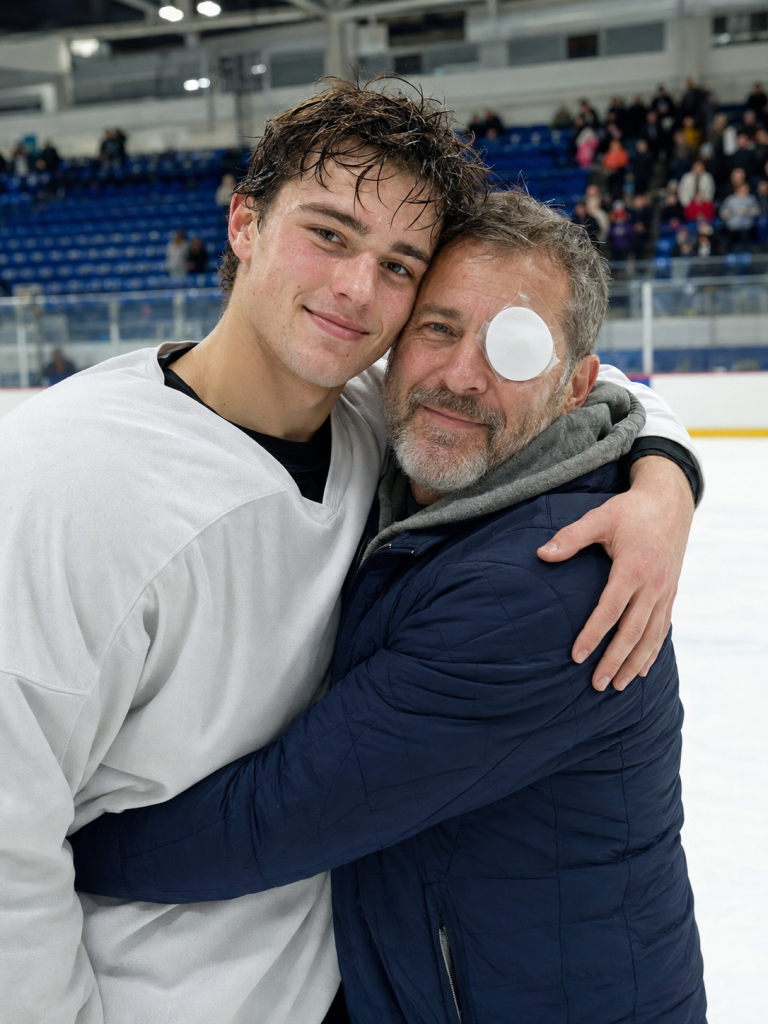
I pulled him into a tight, desperate hug over the chain-link fence, ignoring the crowd around us. I felt the four-year-old boy who had once clung to my shirt in an empty living room asking when his dad was coming home. Only now, that boy was an eighteen-year-old man standing on his own two feet.
When I finally pulled back and looked up, David was already walking quietly down the bleacher stairs toward the exit gates. Nobody followed him.
Mason called out over the noise: “David.”
David stopped and turned around.
Mason walked over to the fence gate and stepped out onto the concourse. I couldn’t hear their entire conversation over the noise of the crowd, but I saw David nod slowly several times. Then they shared a brief, polite handshake.
I’ll admit that seeing them touch sent a small pang through my chest. It would be a lie to pretend it didn’t.
On the drive home, the truck was quiet. The heavy championship trophy rested on the back seat between our sports bags.
“Are you going to keep in touch with him?” I asked quietly, keeping my eyes on the highway.
“Yeah,” Mason replied.
I tightened my grip on the steering wheel.
Mason noticed immediately. “I’m not trying to replace you, Dad.”
“I know you’re not.”
“You’re thinking it, though.”
I let out a slow sigh. “Maybe a little.”
Mason looked out the passenger window at the passing streetlights. “I want to get to know him, Dad. I want to understand why he left. But understanding his choices doesn’t mean I excuse them.”
His words settled heavily in the quiet cab.
“And I don’t need to hate him to prove how much I love you,” Mason added softly.
That hit me right where I needed it.
For fourteen years, I had assumed that protecting Mason meant keeping David out of his world entirely. But Mason wasn’t four years old anymore. He possessed a maturity I hadn’t given him enough credit for. He could seek answers without losing his way. He could offer forgiveness without forgetting where he came from.
“You’re right,” I said.
Mason grinned, turning toward me. “Wait, can you repeat that? I need to record you saying I’m right.”
“Don’t push your luck, kid.”
He laughed, and for the first time since David had reentered our lives, I felt like I could finally take a full, deep breath.
Over the next few weeks, Mason met David for lunch twice. He never kept secrets from me about their meetings.
David admitted that after Sarah’s death, he had spiraled into severe depression and alcohol abuse, fleeing to Chicago and spending years feeling too ashamed and cowardly to face what he’d walked away from. None of that erased the damage he had done, but it stripped away the myth. He was no longer a haunting ghost in Mason’s mind—just a flawed, foolish man who had made a catastrophic mistake and realized too late what he had lost.
A month later, Mason signed a partial athletic scholarship to play Division I soccer at a university three hours away.
On the morning he packed up to leave, his suitcases were lined up by the front door. His official enrollment forms sat on the kitchen counter.
I made scrambled eggs and toasted bagels, just as I had done thousands of mornings before.
“Got your wallet?” I asked.
“Yes, Dad.”
“Phone charger?”
“Yes.”
“Social Security card?”
“Dad,” Mason laughed gently. “I’ve got everything.”
I looked over at the living room shelf. The state championship MVP trophy sat right beside the framed, official adoption decree from fourteen years ago. Two completely different documents that meant the exact same thing to me.
“I have one question for you,” I said, setting the spatula down.
“Go ahead.”
“Did you rehearse that speech at the stadium?”
Mason paused, then grinned sheepishly. “I worked on it for three weeks.”
“And that’s why you invited David?”
“Partly.”
“You nearly gave me a heart attack on the bleachers.”
“I’m sorry,” he chuckled. “I had to build the suspense.”
“You’re terrible.”
“I learned from the best.”
He picked up his duffel bag, zipped his jacket, and walked toward the front door. Before stepping out into the morning air, he stopped and turned around.
For a split second, I didn’t see an eighteen-year-old college athlete with a beard and a muscular frame. I saw the little boy in oversized pajamas standing in a sunlit living room holding a bowl of dry cereal.
“Dad,” he said softly.
“Yeah?”
“Thanks for choosing me.”
A lump formed in my throat, but I managed a steady smile. “I didn’t just choose you once, Mason.”
He waited in the doorway.
“I chose you every single day.”
Mason dropped his bag, walked back across the room, and pulled me into a fierce embrace. “I love you, Dad.”
“I love you too, son.”
When the door finally clicked shut behind him, I stood alone in the quiet kitchen.
I looked at the framed adoption papers on the shelf, then out the window as his truck pulled out of the driveway into the bright morning sun.
For fourteen years, I believed I was the one who had saved a little boy from being left behind.
Standing in that quiet room, I finally understood the truth: he had given me a life, a purpose, and a home just as much as I had given him one.
Blood might explain where you start in this world, but it’s the people who stand by you through the storm who show you where you truly belong.