
A Shaved Head, A Pediatrician, And The Text That Changed Everything

He had barely opened the thread when a fresh text from his mother slid into view at the bottom.
His thumb stopped above the screen.
A moment earlier, he had been insisting that the first message was being misunderstood. He had grabbed his phone quickly, unlocked it, and opened the conversation as though scrolling backward would prove that everyone else in the exam room had gotten the wrong idea.
Then another message arrived.
The pediatrician was still there. I was still there. Our eight-year-old daughter was still beside me, wrapped in the same blanket she had been using to hide what had happened to her hair.
And my husband was holding the phone.
That mattered.
Because this had never really been about whether a haircut could grow back.
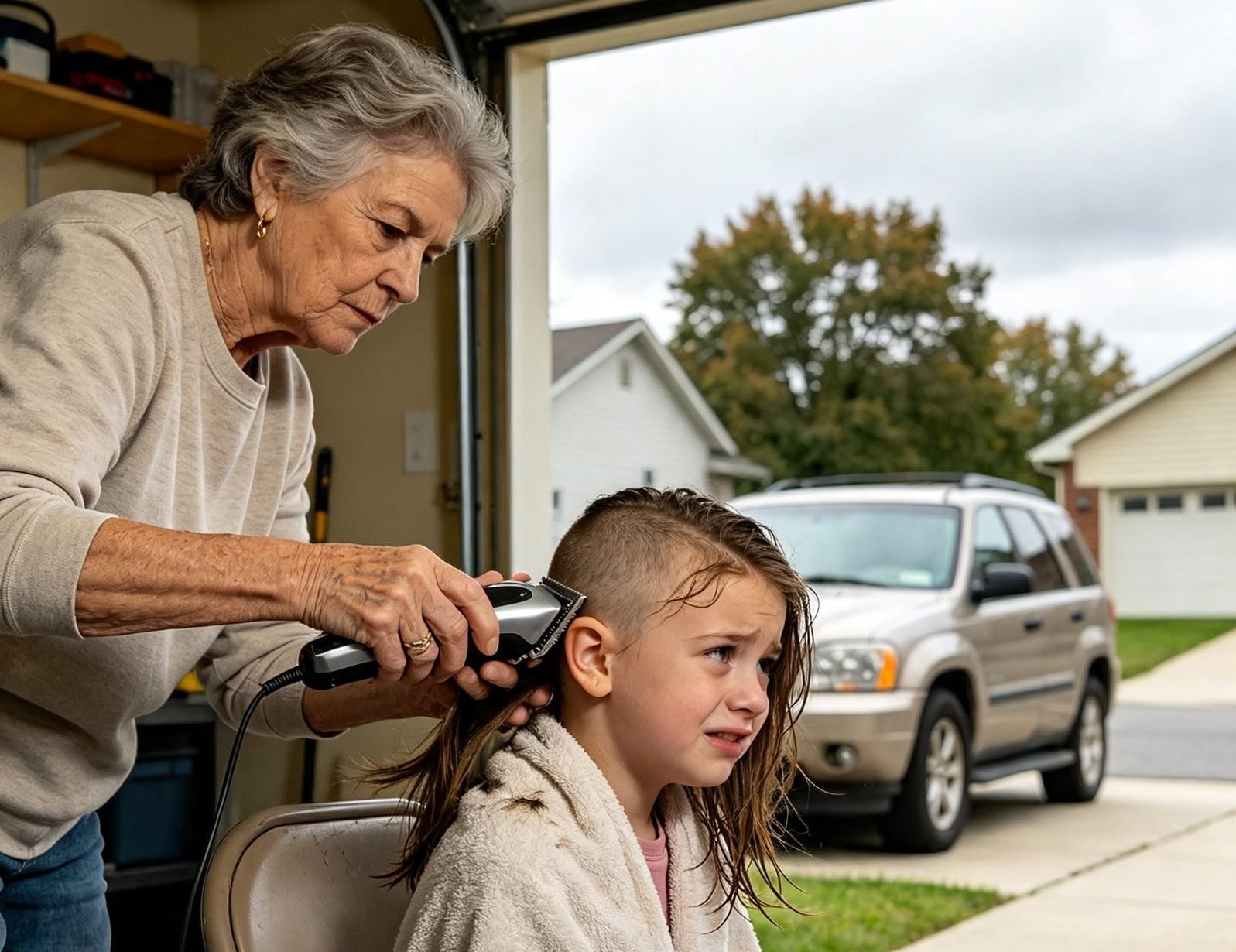
It had started the day before, when my mother-in-law decided our daughter had taken too long brushing her hair before school. She did not shorten it. She did not trim a difficult section. She shaved her head.
When I picked my daughter up afterward, she would not look into a mirror.
She would not talk.
She kept a blanket pulled over her head even though the house was warm, as if hiding under fabric was easier than letting anyone see what had been done to her.
I expected my husband to see that and understand why I was alarmed.
Instead, he looked at the situation as if I were creating the problem by reacting to it.
“Hair grows back. Stop making this bigger than it is,” he told me.
I had argued at first.
Then I stopped.
There are moments when continuing an argument only gives the other person more chances to shrink what happened into something easier to dismiss. My daughter was sitting there under a blanket, refusing to look at herself. I did not need another debate about whether I was being dramatic.
I needed someone to look at her.
So the next morning, I took her to her pediatrician.
The appointment changed almost immediately.
The pediatrician examined my daughter’s scalp. Then she noticed something else: the way my daughter reacted when her grandmother’s name came up.
She flinched.
The pediatrician did not make a speech about it. She did not announce a conclusion. She simply pulled her stool closer to the exam table and asked my daughter if she wanted me to stay beside her.
My daughter nodded.
The blanket stayed on.
That small choice set the tone for everything that followed. The pediatrician did not demand eye contact. She did not push my daughter to tell the story quickly. She asked plain questions and allowed the answers to come at the pace an eight-year-old could manage.
Who had been there?
What happened before the clippers came out?
Had anyone told her that she could get up and leave the chair?
At first, my daughter did not answer with words.
She squeezed my fingers.
That was enough to tell me she was listening.
The pediatrician waited.
Eventually, my daughter whispered that Grandma had said she was making everyone late.
The pediatrician wrote it down.
Then my daughter explained what came next. Her grandmother had told her that if she wanted to act like a baby about her hair, then she did not need long hair.
Another note went onto the page.
My stomach tightened.
I wanted to speak. I wanted to tell the pediatrician what I thought those words meant. I wanted to explain how my daughter had behaved when I picked her up and how my husband had dismissed everything when we got home.
But I kept quiet.
This part belonged to my daughter.
She needed to answer without me filling in the spaces.
Then the pediatrician asked whether anyone else had heard Grandma threaten to cut her hair before that morning.
For the first time, my daughter looked up.
“Dad did,” she said.
I thought I had heard her wrong.
She repeated it.
“Dad did.”
Those two words rearranged the entire story for me.
Until then, I had believed my husband had encountered the aftermath. I thought he had seen his daughter upset, decided his mother had made one bad decision, and reacted by minimizing it.
That would have been painful enough.
But my daughter described something earlier.
According to her, the night before the haircut, Grandma had complained that brushing her hair took too long. She said that if it happened again, she would “take care of the hair problem herself.”
My daughter had been close enough to hear my husband’s response.
The pediatrician asked what he had said.
My daughter pulled the blanket more tightly around herself.
Then she answered.
“He said, ‘Good.’”
One word.
That was all.
But it meant my husband’s later defense of his mother could no longer be separated from what he had apparently heard the night before.
He had known she was angry about the hair.
He had heard the threat.
And when our daughter came home unable to face a mirror, he still told me I was making too much of it.
I did not know yet what he would admit. I did not know whether he would claim he had misunderstood his mother’s words. I only knew what our daughter had just told the pediatrician.
The pediatrician kept documenting.
I sent my husband a single text telling him that we were still at the pediatrician’s office.
His phone calls started almost immediately.
I did not pick up.
He called again.
Then again.
About twenty minutes later, his voice carried down the hallway outside the exam room.
He had come in person.
When he entered, he was carrying our daughter’s school backpack in one hand. Frustration was already written across his face.
His first question was not whether she was okay.
It was why I had brought her there “over a haircut.”
The pediatrician did not argue about the wording.
She had the reporting forms beside her, and she asked him directly whether he had heard his mother threaten to cut our daughter’s hair the previous night.
He looked at me instead of answering her.
“This is what you do,” he said. “You turn everything into a crisis.”
The pediatrician asked again.
This time, he acknowledged that he remembered his mother complaining. But he offered a different explanation for what he believed she had meant. He said he thought “take care of it” meant putting our daughter’s hair into a ponytail.
Our daughter made a tiny sound beside me.
He heard her.
His voice changed when he turned toward her.
“Sweetheart, Grandma didn’t mean to scare you.”
But our daughter’s body answered before she did.
Her shoulders lifted almost to her ears.
He stepped closer.
She moved away.
He stopped.
The reporting forms were still there.
So was the pediatrician.
My husband shifted to another argument. He said we should go home and discuss everything “as a family.” He reminded me that his mother had helped us plenty of times. He said one bad decision should not be allowed to tear everyone apart.
Then he returned to the same explanation he had used from the beginning: our daughter was upset because I was treating the haircut as something terrifying.
I could have answered every sentence.
I did not.
Instead, I turned to my daughter.
“Where do you want to go with me right now?”
My husband started to speak before she could respond.
The pediatrician lifted one hand.
It was not aggressive. It was not dramatic. It was simply enough to prevent him from answering for her.
Our daughter stared at the backpack he was holding.
Then she climbed down from the exam table.
She walked across the room.
She took the backpack from her father.
And she placed it into my hands.
She never needed to announce a side.
The movement said enough.
The backpack hit my palms with more emotional weight than the school supplies inside it could possibly explain. My husband stared at our daughter as though she had violated a rule he had not known she was allowed to reject.
Then he blamed me again.
He said she was scared because I was making her scared.
I stayed quiet.
So did she.
Then his phone buzzed on the counter beside the exam table.
He had put it there when he came into the room.
The screen lit up.
His mother’s name appeared.
So did enough of the message for the adults in the room to see what she had written.
She told him not to let me turn the situation into abuse.
Then came the part that changed his posture.
She wrote that he had told her to handle the hair problem.
That sentence did something his arguments had not been able to undo.
Until that moment, my husband had room to keep presenting himself as the person caught between two women who interpreted one unfortunate haircut differently.
His mother had just described him as someone who had given her direction.
He grabbed the phone so fast that the charging cord attached around his car keys tangled against his fingers.
“That’s not what she means,” he said.
The pediatrician looked at him.
Then she looked at the phone.
I watched his thumb hover above the screen.
For the first time since he had entered the exam room, he was not telling me I was overreacting.
He was explaining the message.
That distinction was impossible to miss.
He unlocked the phone and opened the conversation, apparently intending to show that his mother’s words had been taken out of context.
The room had narrowed around that little glowing screen.
But the phone was not the beginning of the story.
The beginning was an eight-year-old spending too long brushing her hair.
The beginning was an adult deciding that delay deserved humiliation.
The beginning was a child learning that something attached to her own body could be changed as punishment because a grown-up was irritated.
Everything after that was about what the adults around her did with the truth.
My mother-in-law had chosen the clippers.
My husband had chosen minimization.
I had chosen the pediatrician’s office.
And the pediatrician had chosen to ask the child herself.
Those choices kept colliding in the same room.
The blanket mattered because my daughter had wrapped herself in it before anyone started asking formal questions.
The backpack mattered because she had taken it from her father and handed it to me without being prompted to make a speech.
The reporting forms mattered because the pediatrician reached for them after observing both the physical result and my daughter’s reaction.
And now the phone mattered because my mother-in-law’s own words were appearing while my husband was trying to explain what she had meant.
None of those objects needed interpretation from me to exist.
They were simply there.
That was what made the morning so different from the argument at home.
At home, my husband could say I was making things bigger.
In the exam room, our daughter had her own voice.
The pediatrician had her own observations.
His mother’s message had its own wording.
I no longer had to carry every fact into the conversation myself.
For hours, I had felt as though I were being pushed into an impossible role: either stay calm enough to prove I was reasonable or react strongly enough to protect my daughter. Anything I said could be reframed as evidence that I was the source of the fear.
So I stopped trying to win that argument.
I watched my child instead.
She had already shown us what she wanted when she kept the blanket around her head.
She showed us again when Grandma’s name made her flinch.
Again when she said her father had heard the threat.
Again when she repeated his one-word answer.
Again when she pulled away as he approached.
Again when she removed her backpack from his hand and gave it to me.
The pattern was not coming from a speech I had coached.
It was coming from her behavior and her words.
My husband still seemed to want a version of events in which intent could erase impact. Grandma had not meant to scare her. He had not meant “handle the hair problem” the way the message sounded. I was supposedly amplifying everything by treating our daughter’s reaction as serious.
But intent could not make her look into a mirror.
It could not make the blanket fall from her shoulders.
It could not make her stop flinching.
It could not change what she had already told the pediatrician.
And it could not erase his mother’s text from the screen.
The pediatrician remained remarkably controlled through all of it.
She did not accuse him for me.
She did not turn the exam room into a family courtroom.
She kept asking narrow questions.
That restraint made his answers more noticeable, not less.
When asked whether he had heard the threat, he first redirected his frustration toward me.
When asked again, he said he thought his mother was talking about a ponytail.
When his daughter recoiled from him, he said she was scared because of my reaction.
When his mother’s message suggested he had told her to handle the problem, he said the message did not mean what it appeared to mean.
Every new piece of information seemed to produce another explanation.
The explanations kept changing.
My daughter’s account did not.
She had taken too long brushing her hair.
Grandma had complained.
Grandma had threatened to deal with the hair herself.
Dad had heard her.
Dad had said, “Good.”
The next day, Grandma shaved the child’s head.
Those were the facts my daughter had offered.
Then came the aftermath everyone could see.
No mirror.
No conversation.
A blanket over her head.
A flinch at Grandma’s name.
A retreat when Dad came closer.
I kept thinking about the sentence my husband had used the night before: “Hair grows back.”
Technically, of course, hair does grow.
But that had never answered the real question.
The question was what an eight-year-old had learned in that chair when an adult decided she did not get to control what happened to her own hair.
The question was what she learned afterward when her father treated her distress as an inconvenience created by someone else’s reaction.
The question was whether the adults around her would listen once she finally spoke.
That was why the pediatrician’s first meaningful choice had been so simple.
She asked whether my daughter wanted me beside her.
She gave her control over one small thing before asking about a morning when control had been taken away.
That small act did not undo anything.
But my daughter nodded.
And then, slowly, she talked.
By the time my husband arrived, the room was no longer built around his interpretation of what had happened.
Our daughter had already described it herself.
His mother’s message only added another layer.
The first visible text did not tell us everything. It did not explain every conversation between them. It did not prove what he had meant by every word he had ever said to his mother.
But it directly challenged the picture he had been presenting in the exam room.
That was enough to make him open the conversation.
He wanted context.
Maybe he believed context would save him.
Maybe he believed there was an earlier message that would make his mother’s wording sound harmless.
I could not know what he expected to find.
I only knew what I saw.
His hand tightened around the phone.
Our daughter stayed close to me.
The pediatrician watched without interrupting.
And my husband’s thumb moved toward the conversation he had been so certain would prove everyone else wrong.
He had barely opened the thread when the next message arrived.
It appeared at the bottom of the screen before he could start scrolling.
And this time, none of us had asked his mother a question first.