
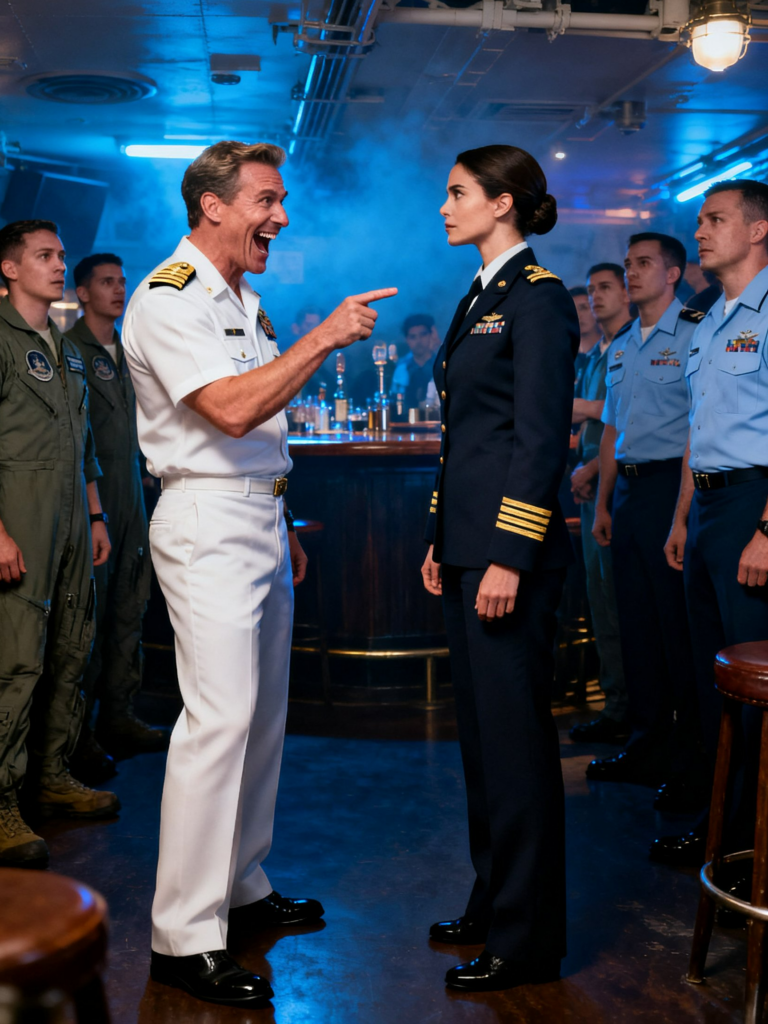
A Navy SEAL Captain Laughed at My Call Sign in a Bar—Until Two Words Made Every Veteran in the Room Go Silent

The SEAL captain asked for my call sign like he was asking a child to spell her own name.
Then he laughed before I even answered.
By the time I said, “Hunter Six,” his beer slipped out of his hand and shattered on the floor between us.
Nobody moved.
Not the bartender.
Not the Marines by the jukebox.
Not the two old Vietnam vets playing pool in the back under the neon Budweiser sign.
Even the birthday girl in the corner stopped clapping with frosting still on her fingers.
Captain Ryan Cole stood across from me in his pressed civilian polo, his gold watch catching the bar light, his smile dying one inch at a time.
Five seconds earlier, he had been the loudest man in the room.
Five seconds later, he looked like he had seen a ghost wearing my face.
I didn’t raise my voice.
I didn’t smile.
I just set my glass down on the bar and watched him understand exactly what he had just done.
The place was called The Brass Rail, a military bar tucked between a pawn shop and a tattoo parlor outside Norfolk, Virginia. It smelled like fried wings, old wood, cheap cologne, and men who had mistaken survival for personality.
I had gone there for one quiet drink.
One.
That was all I wanted.
A bourbon.
A corner stool.
A little silence before the memorial ceremony the next morning.
But silence has a way of avoiding women like me.
Especially when men like Ryan Cole decide a room belongs to them.
He was holding court near the bar with half a dozen junior sailors around him, laughing too hard at everything he said. He had that special kind of confidence men get when rank has carried them farther than character ever could.
Broad shoulders.
Perfect haircut.
White teeth.
A voice trained to cut through noise.
He wore no uniform, but he didn’t need one.
Every movement announced it.
I am command.
I am decorated.
I am dangerous.
I had seen the type before.
I had also zipped the body bags of better men than him.
I sat three stools away in jeans, black boots, and a leather jacket that had seen three continents and one helicopter fire. My hair was pinned back. My hands were bare. No ring. No watch. No patches. Nothing that begged for a question.
That should have been enough.
It wasn’t.
“Hey,” Ryan said, turning toward me after one of his men nudged him. “You lost, sweetheart?”
I looked at him in the mirror behind the bar.
The bartender, a thick-armed woman named Marcy, stiffened.
She knew me.
Not well.
Enough.
“I’m where I meant to be,” I said.
The younger sailors laughed, not because it was funny, but because their captain had started something and they wanted permission to enjoy it.
Ryan tilted his head.
“Military bar,” he said. “Not exactly wine night.”
I lifted my bourbon.
“Good thing this isn’t wine.”
One of the sailors muttered, “Damn.”
Ryan’s eyes narrowed, but he kept smiling.
That smile had probably saved him more than once.
It wouldn’t save him from me.
“You serve?” he asked.
I took a sip.
“Once.”
“Once.” He repeated it like he had caught me stealing valor from a donation jar. “Army? Air Force? Coast Guard?”
There it was.
The hook.
The little trap men like him set when they want a woman to prove she has the right to occupy space.
I could have ignored him.
I should have ignored him.
But then I saw the black memorial bracelet on his wrist.
The name engraved there stopped me cold.
M. HARRIS.
My throat went dry.
Marcus Harris had been my radio operator.
Twenty-seven years old.
Atlanta smile.
Two daughters.
He used to chew cinnamon gum before every mission because he said fear tasted better with flavor.
He died with one hand pressed to my side, trying to stop me from bleeding out after the convoy hit the second device.
And Captain Ryan Cole was wearing his name like jewelry.
That changed things.
“Why are you wearing that bracelet?” I asked.
Ryan glanced down at it.
His smile turned theatrical.
“This?” He held up his wrist for his audience. “For a fallen brother.”
My fingers tightened around the glass.
“A fallen brother,” I repeated.
“Yeah,” he said. “Marcus Harris. Good man. Served under a legend, apparently. Some ghost unit nobody will talk about.”
A laugh moved through the group.
“Hunter team,” one of the sailors said. “Right, sir?”
Ryan chuckled.
“That’s what the old guys call it. You know how stories grow after enough whiskey.”
I set my glass down.
The ice clicked once.
“Did you know him?” I asked.
Ryan’s eyes flicked over me again.
Boots.
Jacket.
Hands.
No insignia.
No invitation.
“I know enough.”
“No,” I said quietly. “You don’t.”
The room heard it.
Not because I was loud.
Because I wasn’t.
Ryan turned fully now.
He was taller than me by several inches, broad enough to cast a shadow over my stool.
“Careful,” he said, still smiling for the boys. “You have no idea who you’re talking to.”
I looked at the bracelet again.
“I know exactly who I’m talking to.”
His jaw shifted.
There it was.
The first crack.
Small.
Clean.
Promising.
“Then enlighten me,” he said. “Who are you?”
I reached into my jacket pocket and pulled out a folded twenty for my drink.
“I’m leaving.”
That should have ended it.
It almost did.
Then one of the younger sailors, drunk on secondhand courage, said, “Ask her call sign, sir.”
Ryan laughed.
“Yeah.” He stepped closer. “That’s fair. Everybody who served has a story, right?”
Marcy put both hands on the bar.
“Captain,” she warned.
He ignored her.
“Come on, sweetheart,” he said. “What was your call sign?”
I stood.
The legs of the barstool scraped the floor.
A few people turned.
Ryan spread his arms like a man inviting applause.
“Was it Princess? Cupcake? Whiskey Barbie?”
The sailors burst out laughing.
Marcy said, “That’s enough.”
But Ryan was enjoying himself now.
He had the room.
He had rank.
He had a woman standing in front of him who looked, to his eyes, like a soft target.
I looked at the bracelet again.
Marcus.
Then I looked at Ryan.
“My call sign was Hunter Six.”
The beer bottle fell from his hand.
Glass exploded across the floor.
The sound was small compared to the silence after it.
Ryan’s face drained so fast I could see the red line at his collar where the blood stopped.
One of the old Vietnam vets in the back stood up.
Slowly.
His pool cue stayed in his hand.
The Marine by the jukebox whispered, “Oh, hell.”
Ryan’s mouth opened.
Closed.
Opened again.
“Say that again,” he said.
I leaned closer.
Not much.
Just enough that only he and the boys nearest him could hear me clearly.
“Hunter Six.”
His eyes dropped to my left side.
He knew where to look.
Most people didn’t.
My jacket covered it, but muscle remembers what shame tries to hide. His gaze went right to the old injury under my ribs.
Then to my throat.
Then to my hands.
Then back to my face.
“You’re dead,” he said.
Not loud.
Not for the room.
For himself.
I held his stare.
“A lot of people were told that.”
Behind him, the youngest sailor swallowed so hard I heard it.
Ryan took one step back.
That one step told me everything.
Fear is a language.
So is guilt.
Men can fake grief.
Men can fake honor.
Men can fake loyalty.
Men can even fake courage when the room is bright and everyone is watching.
But nobody fakes the first step backward.
Not like that.
Not unless the past has just walked through the door wearing boots.
I picked up my twenty and slid it toward Marcy.
“Keep the change.”
Ryan’s hand shot out and caught my wrist.
The room changed temperature.
Not metaphorically.
Actually.
The air turned colder.
Every chair leg, every breath, every old grief in that bar seemed to angle toward his fingers on my skin.
I looked down at his hand.
Then up at him.
“Remove it.”
Ryan’s face hardened. A captain again. A man remembering he had witnesses.
“We need to talk.”
“No,” I said. “You need to remove your hand.”
His grip tightened.
The two sailors behind him shifted, unsure whether to help him or pretend they didn’t see.
Marcy reached under the bar.
I knew there was a shotgun there.
I also knew she wouldn’t need it.
Ryan said, “Where have you been?”
I let one beat pass.
Then another.
Enough for him to understand I was giving him a chance.
He didn’t take it.
So I turned my wrist inward, stepped across his balance, and pinned his thumb against the bar with the kind of pressure that makes the nervous system forget rank.
Ryan dropped to one knee so fast the boys jumped back.
I didn’t shove him.
I didn’t twist hard.
I didn’t need to.
I just placed him exactly where he belonged.
Below eye level.
“Captain Cole,” I said, “the next time you touch me without permission, I’ll make you explain your broken hand to every admiral you know.”
His breathing went sharp.
I released him.
He snatched his hand back and stood, humiliated but trying not to show pain.
The old vet in the back chuckled once.
It sounded like gravel in a coffee can.
Ryan heard it.
That hurt him more than his thumb.
“You don’t know what you’re walking into,” he said.
I picked up my jacket from the stool.
“Neither did Marcus.”
The name hit him hard.
Good.
I turned to leave.
“Major Vale.”
I stopped.
Nobody had used that name in public in five years.
Not like that.
Not with the rank attached.
Ryan’s voice was low now.
Careful.
Almost pleading.
“There are people who still think you’re dead.”
I looked back.
“They should have checked better.”
Then I walked out of The Brass Rail into the Virginia night, leaving behind broken glass, a silent bar, and a Navy SEAL captain who had just learned ghosts can drink bourbon.
The motel was six blocks away.
I walked.
Norfolk air carried salt, diesel, and rain that hadn’t fallen yet. The streetlights smeared gold across wet pavement. Somewhere near the shipyard, metal groaned in the dark like an old animal refusing to sleep.
My phone buzzed before I reached the second corner.
Unknown number.
I let it ring.
It stopped.
Buzzed again.
Stopped.
Then a message came through.
DO NOT ATTEND THE MEMORIAL TOMORROW.
I stood under a streetlamp and read it twice.
No punctuation.
No signature.
Just the order.
I deleted it.
Then I crossed the street.
The motel was the kind that charged by the night and apologized with vending machines. My room was on the second floor, last door before the ice machine. I had chosen it because I could see both stairwells from the window and the parking lot from the bathroom mirror.
Old habits are only paranoia when nobody is hunting you.
I unlocked the door.
Paused.
Listened.
The room hummed with cheap electricity.
No movement.
No breath.
No wrong shadow.
I stepped inside and closed the door with my left hand while my right stayed near my jacket pocket.
The lamp beside the bed was on.
I had left it off.
On the pillow sat a black memorial bracelet.
M. HARRIS.
Not Ryan’s.
This one was older.
Scratched.
Real.
My pulse slowed.
That’s the thing people misunderstand about danger.
It doesn’t always make your heart race.
Sometimes it makes your heart kneel.
I picked up the bracelet.
Under it was a photograph.
Four people in desert dust, standing beside a burned-out truck under a sky too bright to forgive anything.
Marcus Harris on the left, grinning.
Eli Monroe beside him, holding up two fingers behind Marcus’s head.
Tommy Briggs squinting into the sun.
And me.
Captain Katherine Vale.
Hunter Six.
Alive.
The photo had been taken three days before the convoy.
Three days before the ambush.
Three days before the official report said I made a bad call that got my team killed.
Three days before the same report said my body was never recovered.
I turned the photograph over.
One sentence had been written in black ink.
COLE WASN’T THE ONE WHO SOLD US.
For a long moment, I stood very still.
Then I laughed.
Not because it was funny.
Because after five years of living with a hole where justice should have been, the universe had finally decided to be rude enough to knock.
I swept the room.
Bathroom clear.
Closet clear.
Under bed clear.
Window locked but recently opened.
The intruder was gone.
But they had left something else.
A small flash drive taped under the nightstand.
I found it by touch.
Too obvious to be accidental.
Too careful to be careless.
I sat on the edge of the bed and held it in my palm.
Five years.
Five years of fake names.
Five years of cheap apartments and cash jobs.
Five years of watching my own funeral online from a library computer in Idaho.
Five years of not calling Marcus’s widow.
Five years of not telling Eli’s mother her son died laughing at a terrible joke.
Five years of letting men in pressed uniforms stand on stages and say “tragic mistake” when they meant “useful lie.”
Five years of swallowing my name like a blade.
Five years of waking with my hand on a weapon because the dead are not the only ones who get buried.
I plugged the flash drive into the burner laptop I kept in the false bottom of my duffel.
One file.
Audio.
No title.
I pressed play.
Static hissed.
Then a voice I recognized crawled out of the speaker.
Not Ryan Cole.
Older.
Smoother.
Rear Admiral Daniel Whitaker.
The man giving the keynote speech at tomorrow’s memorial.
The man whose signature sat at the bottom of the report that erased my team.
The man who had called me “a brave officer who made one fatal mistake” while standing beside my empty casket.
His voice filled the motel room.
“Hunter convoy is moving early. Route changed to Black Finch. Confirm receipt.”
Another voice answered.
Distorted.
Low.
“Confirmed.”
Whitaker again.
“Leave the woman if possible. We need her blamed, not questioned.”
The audio ended.
I stared at the screen.
My reflection hovered in the black border.
Calm face.
Still eyes.
A woman who looked less shocked than she should have.
That was because part of me had always known.
Not the name.
Not the proof.
But the shape.
Betrayal has a shape.
You feel it before you can draw it.
A knock came at my door.
Three taps.
Pause.
Two taps.
My hand was already around the pistol under my pillow.
“Kate,” Ryan Cole said through the door. “Open up.”
I didn’t answer.
“I know you’re in there.”
I moved to the wall beside the door.
Not behind it.
Never behind it.
“Go away, Captain.”
“We don’t have time.”
“You had five years.”
“I thought you were dead.”
“That seems to be popular.”
He lowered his voice.
“Whitaker knows you’re here.”
There it was.
The second name in the room.
I looked at the flash drive.
Then at the door.
“How?”
“Because I told him.”
My grip on the pistol tightened.
Outside, Ryan exhaled.
“Not tonight. Years ago.”
I said nothing.
“I was the one who found your blood trail after the blast. I was the one who argued the report was wrong. I was the one who got ordered to shut up before my career disappeared.”
“Touching story.”
“I wore Marcus’s bracelet because his wife gave it to me.”
That hit differently.
I hated that it did.
“Why would Tasha give you his bracelet?”
“Because I brought her the recording he left behind.”
My world narrowed.
Marcus.
A recording.
Another one.
I opened the door with the chain still fastened.
Ryan stood in the hallway under a flickering light, one hand wrapped in ice from the bar, no swagger left in him.
His face looked older now.
Not old.
Just stripped.
Some men need darkness before they become honest.
Behind him, the motel walkway was empty.
For now.
“What recording?” I asked.
Ryan’s eyes dropped to the chain.
“I’m not saying this through a door.”
I lifted the pistol just enough for him to see the edge of it.
“I’m not inviting you in.”
He nodded once.
Fair.
“Marcus knew something was wrong before the convoy moved. He left a message for Tasha. Said if he didn’t come home, she should find me. He said the route change came from above your clearance.”
I watched him closely.
His pupils.
His mouth.
His shoulders.
Truth has rhythm.
So does performance.
Ryan was sweating, but not in the right places for a liar.
“Why didn’t you find me?” I asked.
“Because every source I had said you were dead.”
“And now?”
“And now you said Hunter Six in a bar full of veterans twelve hours before Whitaker dedicates a memorial stone with your name on it.”
A siren wailed somewhere far off.
Then faded.
Ryan looked toward the parking lot.
“We need to move.”
I almost laughed again.
“Captain Cole, you mocked me in public, grabbed my wrist, and admitted you reported my presence to a man whose voice I just heard ordering my team into an ambush. Give me one reason I shouldn’t drop you where you stand.”
His jaw worked.
Then he reached into his jacket.
Slowly.
Very slowly.
He pulled out a folded envelope and held it up.
“Because Marcus’s widow told me to give you this if I ever found you.”
I didn’t move.
He slid it through the gap above the chain.
The envelope fell to the carpet at my feet.
My name was written on the front.
Not Katherine.
Not Major Vale.
Kate.
In Marcus’s handwriting.
My hand went cold.
Ryan saw my face change.
He didn’t use it.
That earned him half a point.
I picked up the envelope but didn’t open it.
Not yet.
Some doors don’t get opened in hallways.
“Who left the drive?” I asked.
Ryan frowned.
“What drive?”
That was enough.
He didn’t know.
Which meant we had a third player.
Good.
Terrible.
But good.
A black SUV rolled into the motel parking lot with its headlights off.
Ryan saw it in the reflection of my window.
So did I.
Two doors opened.
Then a third.
Men stepped out in rain jackets too clean for the weather.
Not cops.
Not military police.
Private.
Expensive.
The kind of men who don’t ask questions because their invoices already answered them.
Ryan whispered, “Kate.”
I shut the door, slid off the chain, opened it again, and pulled him inside by the collar.
The first bullet punched through the hallway window before the door clicked shut.
Glass sprayed across the carpet.
Ryan hit the floor.
I killed the lamp.
The room went black except for neon bleeding through the curtains.
“Bathroom,” I said.
He crawled.
Another round cracked through the door.
Then another.
Measured shots.
Center mass height.
Professional, but not careful enough.
They thought they were shooting at a woman in shock and a captain in panic.
They were half right.
Ryan was breathing hard behind me.
“Do you have a weapon?” I asked.
“Ankle.”
“Good. Try not to shoot me.”
“Same to you.”
I moved low across the room, grabbed my duffel, and pulled the fire alarm wedge from the side pocket.
Not a weapon.
Better.
I jammed it under the door.
Then I crossed to the bathroom, climbed onto the toilet, and popped the narrow window latch.
Ryan stared.
“You’re not serious.”
“Your shoulders won’t fit.”
“Neither will yours.”
I looked at him.
His gaze dropped to my ribs again.
He remembered too late.
I had learned to make my body smaller than pain.
The bathroom window opened onto the flat roof above the vending machines. I shoved the duffel through first, then the laptop, then myself.
The first kick hit the motel door as my boots scraped the roof.
Ryan followed with less grace and more swearing.
The door inside split under the second kick.
I grabbed him by the shirt and hauled him through the window just as gunfire shredded the bathroom mirror.
We landed behind the ice machine.
Rain started.
Soft at first.
Then harder.
Like the sky had been waiting for permission.
We moved along the roofline, dropped behind a dumpster, and crossed into the alley between the motel and a closed laundromat.
Ryan limped.
“Ankle gun,” I said.
“I landed on it.”
“Try landing better next time.”
He almost smiled.
Almost.
Behind us, the men found the window.
One shouted.
No names.
No commands.
That told me they had comms.
I pulled Ryan behind a delivery van and pointed toward the street.
“My truck is two blocks east.”
“You drove here?”
“No, Captain. I floated in on betrayal.”
He deserved that.
He accepted it.
We ran.
Rain soaked my jacket, flattened my hair, and turned the world into headlights and hard surfaces. My side burned by the second block. Old shrapnel had opinions about sprinting.
Ryan noticed.
He slowed.
I grabbed his sleeve.
“Do not pity me.”
“I wasn’t.”
“You were thinking about it.”
“I was thinking you’re still faster than most men I know.”
“Better.”
My truck was parked behind a closed seafood market.
Old Ford.
Dull green.
Rust along the wheel wells.
Cash purchase.
Fake registration.
Reliable engine.
I unlocked it manually.
No fob.
No signal.
Ryan climbed in, wet and bleeding from a shallow cut over his eyebrow.
I started the engine and pulled out without headlights until the corner.
In the mirror, a black SUV turned onto the street behind us.
Ryan looked back.
“Friends of yours?”
“Your admiral has expensive taste.”
“Whitaker isn’t my admiral.”
“He was when it mattered.”
That shut him up.
For three minutes, we drove through Norfolk back roads in rain so thick the traffic lights looked like bruises. The SUV stayed two cars back.
Patient.
Too patient.
“They don’t want a scene,” Ryan said.
“No,” I said. “They want an accident.”
He glanced at me.
I turned right instead of left.
He braced.
“What are you doing?”
“Creating options.”
We crossed under the overpass toward the old shipyard access road.
Industrial lots.
Chain-link fences.
Flooded potholes.
No pedestrians.
No witnesses.
Perfect place to die.
Perfect place not to.
The SUV followed.
“Kate,” Ryan said, “this road dead-ends.”
“I know.”
“It dead-ends at the water.”
“I know.”
He gripped the dashboard.
“You have a plan?”
“No.”
“That’s comforting.”
“I have a habit.”
“What habit?”
I downshifted.
“Surviving.”
At the end of the access road, a gate blocked the pier entrance.
I accelerated.
Ryan shouted something extremely Navy.
The truck hit the gate.
The chain snapped.
Metal screamed across the hood.
We burst onto the pier, tires skidding on wet concrete, the black water opening wide ahead.
The SUV followed through the broken gate.
Too fast.
Too confident.
I cut the wheel hard behind a stack of shipping containers.
The truck fishtailed.
Ryan slammed into the door.
The SUV shot past us, unable to turn, and plowed through a row of empty barrels before stopping sideways near the pier edge.
Two men got out.
One with a rifle.
One with a handgun.
I killed the engine.
Rain hammered the roof.
Ryan drew his ankle gun.
I opened the glove box and took out a flare.
He blinked.
“That’s your weapon?”
“No.”
I struck it.
Red fire hissed alive in my hand.
“This is my invitation.”
I threw the flare under the SUV.
The men shouted and scattered.
Not because the SUV would explode.
Real life isn’t that generous.
They scattered because light makes cowards visible.
Ryan and I moved in the red glow.
He covered left.
I went right.
The rifleman raised his weapon toward me, but I was already inside his reach. I drove my elbow into his throat, stripped the rifle, and used the sling to pull him face-first into the wet concrete.
Ryan fired once.
The handgun flew from the second man’s hand.
The shot echoed over the water.
Then silence.
Rain.
Breathing.
Metal ticking.
I knelt beside the rifleman and pulled his wallet.
No ID.
Of course.
But his phone buzzed in his pocket.
One message on the lock screen.
STATUS?
The sender was saved as D.W.
Ryan saw it.
His face hardened.
I tossed him the phone.
“Still not your admiral?”
He didn’t answer.
The second man groaned.
Ryan moved toward him.
“Who sent you?” he demanded.
The man spat blood and laughed.
That laugh was too calm.
I knew before I saw his hand move.
“Ryan,” I said.
Too late.
The man bit down.
His body jerked once.
Then again.
Foam touched his lips.
Ryan stumbled back.
“What the hell?”
I crouched.
Checked pulse.
Gone.
“Suicide cap,” I said.
Ryan stared at the body.
“This is American soil.”
I looked at him.
“That was true at the motel too.”
His face changed again.
Not fear this time.
Understanding.
The kind that arrives late and costs too much.
I searched the dead man’s jacket.
Nothing.
No tags.
No receipt.
No human life beyond the job he failed.
The rifleman was still breathing but unconscious.
Sirens sounded in the distance.
Someone had heard the shot.
Good.
Bad.
Both.
I grabbed Ryan’s arm.
“We leave.”
“We can’t just—”
“We can.”
“My prints are on—”
“Then wipe faster.”
We wiped what mattered, took the phone, and disappeared into the rain before the first police cruiser reached the broken gate.
By 2:17 a.m., we were in the back room of a closed bait shop owned by a man named Earl who owed me a favor from a night in Tampa involving his nephew, a stolen Mustang, and three very confused federal agents.
Earl didn’t ask questions.
Men who owe real favors rarely do.
He handed me towels, coffee, and a first-aid kit.
Then he looked Ryan up and down.
“Do I need to shoot him?”
“Not tonight,” I said.
Earl nodded.
“Shame.”
Ryan sat on a crate while I cleaned the cut above his eyebrow.
He flinched.
“For a SEAL, you’re delicate.”
“For a dead woman, you’re judgmental.”
I pressed the antiseptic harder.
He hissed.
Earl laughed from the front room.
The burner laptop sat open on a fish-cleaning table between us. The audio file had copied safely. The dead man’s phone lay beside it inside a Faraday pouch I’d made from foil, tape, and spite.
Ryan watched me work.
“You really have been alive all this time.”
“No. I’m a very organized hallucination.”
“I mean it.”
I stopped typing and looked at him.
“Yes. I have been alive.”
“Why didn’t you come forward?”
I stared at him for one long second.
Then I turned the laptop so he could see the casualty report.
My report.
The one with Whitaker’s signature.
The one that said I deviated from approved route.
The one that said I ignored intelligence warnings.
The one that said my team died because I led them into a predictable kill zone.
Ryan read it silently.
His face tightened with every line.
When he finished, he said nothing.
Smart.
“After the blast,” I said, “I woke up under half a truck and two dead men. I couldn’t hear. Couldn’t stand. Couldn’t radio. I crawled into a drainage cut before the second team came through.”
“The second team?”
“Not rescue.”
Ryan’s eyes lifted.
I nodded.
“They checked bodies. Took drives. Shot anyone moving.”
His mouth went pale.
“I watched one of them step over Marcus.”
Ryan swallowed.
“I’m sorry.”
“Don’t spend that too fast.”
He nodded.
I continued.
“By the time I reached a village, my name was already on the report. By the time I got medical help, my death had already been announced. By the time I could contact anyone, two people I trusted had died in separate accidents.”
Ryan closed his eyes.
“You stayed dead.”
“I stayed useful.”
He looked at the laptop.
“Useful for what?”
I clicked open a folder I had carried for five years.
Bank records.
Shell companies.
Photos.
Flight logs.
Names connected by thin red lines that had grown thicker with every year.
“For this.”
Ryan leaned in.
At first, he looked confused.
Then he saw Whitaker.
Then defense contractors.
Then private security firms.
Then aid convoys that disappeared.
Then weapons seizures that never made it into evidence.
Then a name that made his hand curl into a fist.
Cole Strategic Maritime.
His family’s company.
Ryan stood so fast the crate tipped behind him.
“No.”
I watched him.
“Sit down.”
“No. My father’s company has nothing to do with this.”
“Sit down.”
He pointed at the screen.
“My father builds shipboard systems. Navigation support. Training software. That’s it.”
“Then someone used his company to move money.”
“No.”
I tilted my head.
“Captain.”
He stopped.
His breathing changed.
He looked at the name again.
Not angry now.
Scared.
Not of me.
Of inheritance.
That’s a different kind of ambush.
“When?” he asked.
“First transfer was six days before my convoy.”
He sat slowly.
Rain ticked against the bait shop roof.
Earl’s radio played old country through static in the front.
Ryan stared at the screen like it might apologize.
“It could be forged,” he said.
“Yes.”
“Could be another company with a similar name.”
“No.”
He looked at me.
I clicked the file.
Articles of incorporation.
Signatures.
Tax ID.
Board members.
Cole Strategic Maritime.
Founder: Admiral Thomas Cole, retired.
Ryan’s father.
Ryan put a hand over his mouth.
For the first time that night, he looked young.
Not weak.
Young.
Like a son who had just found blood under the family portrait.
“My father knew Whitaker,” he said.
“I assumed.”
“No. Not knew. They were close. He was at my commissioning. He gave a speech at my mother’s funeral.”
“Convenient.”
Ryan shot me a look.
I didn’t soften.
I had run out of softness in a ditch full of smoke.
“My father is many things,” he said. “Cold. Ambitious. Ruthless in business. But selling out American personnel?”
“Men don’t start with treason,” I said. “They start with exceptions.”
That landed.
He looked away.
I opened Marcus’s envelope.
My hands did not shake.
That was a lie.
They shook once.
I made them stop.
Inside was a single sheet of paper and a small memory card.
The note was short.
Kate,
If you’re reading this, I was right and I hate that.
Do not trust the first man who says he’s sorry.
Do not trust the report.
Do not trust the memorial.
And if Ryan Cole finds you, listen before you decide whether to break his face. He’s arrogant, but I don’t think he’s dirty.
Tell Tasha I kept my promise.
Harris
I read it twice.
Then I handed it to Ryan.
His eyes moved across the page.
At the line about breaking his face, his mouth twitched.
Barely.
At the line about not being dirty, he looked down.
Maybe shame.
Maybe relief.
Maybe both.
“What promise?” he asked.
I took the memory card between two fingers.
“Let’s find out.”
The card held a video.
Bad lighting.
Shaky frame.
Marcus’s face filled the screen, close and sweaty, sitting in what looked like a supply room.
He was whispering.
“Kate, if this gets to you, I need you to understand something. The route change didn’t come through normal channels. Briggs pulled the packet and it had a ghost authorization. Somebody cloned command credentials.”
He looked toward the door.
Then back.
“And there’s a name in the metadata. Not Whitaker. Not Cole. Somebody tagged the file before they wiped it.”
Ryan leaned closer.
Marcus swallowed.
“I don’t know who it is yet, but the tag says ORCHID.”
The video cut.
The bait shop seemed to tilt.
Ryan frowned.
“Orchid?”
I felt cold move across my shoulders.
Not fear.
Recognition.
Five years ago, when I woke under that broken truck, there had been a smell in the air under the smoke and fuel.
Sweet.
Floral.
Impossible.
I had told myself it was concussion.
Blood loss.
Shock.
But two weeks later, hiding in a clinic with stitches done by a woman who asked no questions, I found a white orchid pressed inside the pocket of my shredded uniform jacket.
No note.
No explanation.
Just a flower that should not have survived fire.
I never told anyone.
Not one person.
Ryan saw my face.
“What?”
Before I could answer, Earl walked in from the front room with a shotgun in his hands.
Not casual now.
Business.
“Company outside,” he said.
Ryan stood.
I closed the laptop.
“How many?”
Earl spit into an empty cup.
“Two cars. Maybe six people.”
Ryan reached for his ankle gun.
I packed the drive, card, and bracelet.
Earl looked at me.
“Back door still sticks.”
“It opens?”
“With motivation.”
A voice called from outside.
“Katherine Vale.”
Not Whitaker.
Female.
Clear.
Amplified by the rain.
Ryan looked at me.
I didn’t move.
The voice came again.
“You have something that belongs to us.”
Us.
Not me.
Not him.
Us.
I walked to the side window and lifted the blind one inch.
Two black sedans sat in the gravel lot.
Four armed men.
One woman standing between them under a clear umbrella.
Tall.
Blonde.
Camel coat.
Still as a knife.
I didn’t know her face.
But I knew the white orchid pinned to her lapel.
Ryan whispered, “Who is she?”
My phone buzzed.
Unknown number.
A photo appeared.
Not of me.
Not of Ryan.
Of Marcus’s widow, Tasha Harris, standing in her kitchen in Atlanta.
A red laser dot rested on her chest.
Below it, one message.
COME OUT, HUNTER SIX, OR THE WIDOW DIES FIRST.
I looked through the rain at the woman with the orchid.
She smiled like she could see me seeing her.
Then she lifted one hand and gave a small, delicate wave.
And behind her, stepping out of the second sedan with a memorial program tucked under his arm, was Admiral Daniel Whitaker.
Alive.
Smiling.
Ready to give my eulogy.