The Passenger in 13F Had a Call Sign That Stopped Two F-22 Pilots-iwachan
The Boeing 757 cut across the afternoon sky at 35,000 feet, steady enough that most people had forgotten they were moving through the air at all.
Sarah Martinez had not forgotten.
She felt every small correction in the wings, every quiet shift of pressure under the floor, every change in the engine note that most passengers would have mistaken for nothing.
Old habits did not leave just because a general signed a leave order.
She sat in seat 13F with her forehead near the cool oval window and watched the farmland below Kansas spread out in squares and circles.
Wheat fields.
Irrigation rings.
Thin roads like pencil lines.
The view looked peaceful in a way that made her chest ache.
For the first time in 18 months, Sarah was not wearing a uniform.
The jeans felt wrong.
The navy sweater felt too soft.
Her sister Elena had mailed it to her for Christmas with a note that said, Wear something that does not have rank on it for once.
Sarah had laughed when she opened it, then hung it in the back of her closet and returned to the reports waiting on her desk.
Now the sweater sat against her skin like proof that somebody had been trying to pull her back into ordinary life before she knew she needed saving.
General Patricia Hayes had done the rest.
At 4:18 p.m. on a Tuesday, Hayes had leaned back in her office chair and looked at Sarah over a stack of mission reports.
“Martinez, you have been running on caffeine and determination for two years straight,” she had said.
Sarah had started to answer.
The general lifted one hand.
“Your squadron is home safe. Your reports are filed. If I see you in my office before May 1, I will personally have the MPs escort you to the nearest beach.”
Sarah had smiled because Hayes rarely wasted humor.
It was an order dressed like kindness.
So Sarah took leave.
She booked a commercial flight from San Francisco to Washington, D.C., because her mother in Arlington had started pretending the stairs were not a problem.
Her mother had always been proud, but lately Sarah could hear the pause before she said, “I’m fine.”
That pause was why Sarah was in 13F with a paper cup of coffee and no insignia on her shoulder.
Just Sarah Martinez.
Not Colonel Martinez.
Not Phoenix.
Not the woman other officers spoke about in lowered voices when they thought she could not hear.
She wanted, for one flight, to disappear.
The cabin gave her every chance.
A businessman in 13D typed as if his keyboard had personally offended him.
His headset blinked blue while he muttered about quarterly projections.
Across the aisle, Maria Santis tried to keep twin toddlers from turning the tray tables into drums.
Her husband slept beside her with his head tipped back and exhaustion written plainly across his face.
A teenager two rows ahead watched a movie with one earbud in.
Someone behind Sarah opened a bag of pretzels with a loud crackle.
The ordinary world was noisy.
Messy.
Alive.
Sarah had spent so long inside rooms where every sound meant something that civilian noise felt almost luxurious.
A flight attendant stopped beside her row with a coffee pot in one hand.
Her name tag read Jennifer Walsh.
She had kind brown eyes, gray at the temples, and the efficient balance of a woman who could pour hot coffee during turbulence and still ask a child whether he wanted extra cookies.
“First time flying commercial in a while?” Jennifer asked.
Sarah looked up.
It was not an accusation.
It was recognition.
“Something like that,” Sarah said.
Jennifer refilled the cup carefully.
The coffee smelled burnt and bitter, but the steam warmed Sarah’s face.
Jennifer glanced once at the way Sarah sat.
Back straight.
Feet flat.
Carry-on stowed tight and square.
Eyes already aware of the nearest exits.
“Military?” Jennifer asked quietly.
Sarah hesitated.
She had not lied about her service in years, but she had learned how to step around it.
Some people thanked her too loudly.
Some people asked questions they did not really want answered.
Some people looked disappointed when she did not give them a story that sounded like a movie.
“Air Force,” Sarah said.
Jennifer’s face softened.
“My husband was Navy,” she said. “Twenty-two years. Three deployments. Retired last year as a senior chief.”
Sarah nodded once.
That was enough.
Military families spoke whole paragraphs in nods.
Jennifer leaned slightly closer.
“I can always tell,” she said. “It is something in the way you carry yourselves.”
Then, after a pause, she added, “Thank you for your service, ma’am. Whatever you did over there, thank you.”
Sarah looked down at her coffee.
Gratitude was hard to receive when you were still carrying the names of people who had not come home.
“Thank your husband too,” she said.
Jennifer smiled and moved on.
The flight settled into its rhythm.
Sarah let herself watch the clouds.
For almost twenty minutes, she did nothing useful.
It felt unnatural.
At 2:41 p.m. Eastern, the seat belt sign chimed.
Sarah looked up before she knew why.
The aircraft gave a small shudder.
Not severe.
Not enough to panic anyone.
But it had an edge to it, a hard little correction that moved through the frame of the plane and into the bones of the passengers.
Robert Kim stopped typing.
One of Maria’s twins went silent with a pretzel in his hand.
Sarah’s coffee trembled on the tray table, the surface rippling in tight brown circles.
Then the captain came on.
His voice was calm.
Too calm.
“Ladies and gentlemen, this is your captain speaking. We are experiencing a minor systems issue and have requested routine assistance from air traffic control. Please remain seated with your seat belts fastened.”
The cabin accepted the words because most people wanted to accept them.
Routine assistance sounded harmless.
Systems issue sounded fixable.
Sarah heard what lived between those phrases.
A good officer learns the difference between calm and normal.
They are not the same thing.
Jennifer came down the aisle checking seat belts.
Her smile remained in place, but the color had shifted under her skin.
When she reached Sarah, she rested one hand on the seatback.
“Colonel,” Jennifer whispered.
Sarah’s eyes moved to hers.
Jennifer did not ask how she knew.
The word had come from somewhere forward.
“The cockpit is asking if there is any military pilot on board,” Jennifer said.
Sarah’s first instinct was refusal.
She was on leave.
She was not crew.
She had no rank here, no authority over a commercial aircraft carrying families, business travelers, tired parents, and children who only knew the plane had started to feel different.
Then Maria pulled both toddlers closer to her chest.
The movement was small.
It decided for Sarah.
She unbuckled.
Jennifer stepped back to let her into the aisle.
Rows of passengers watched as Sarah moved forward.
No one knew who she was.
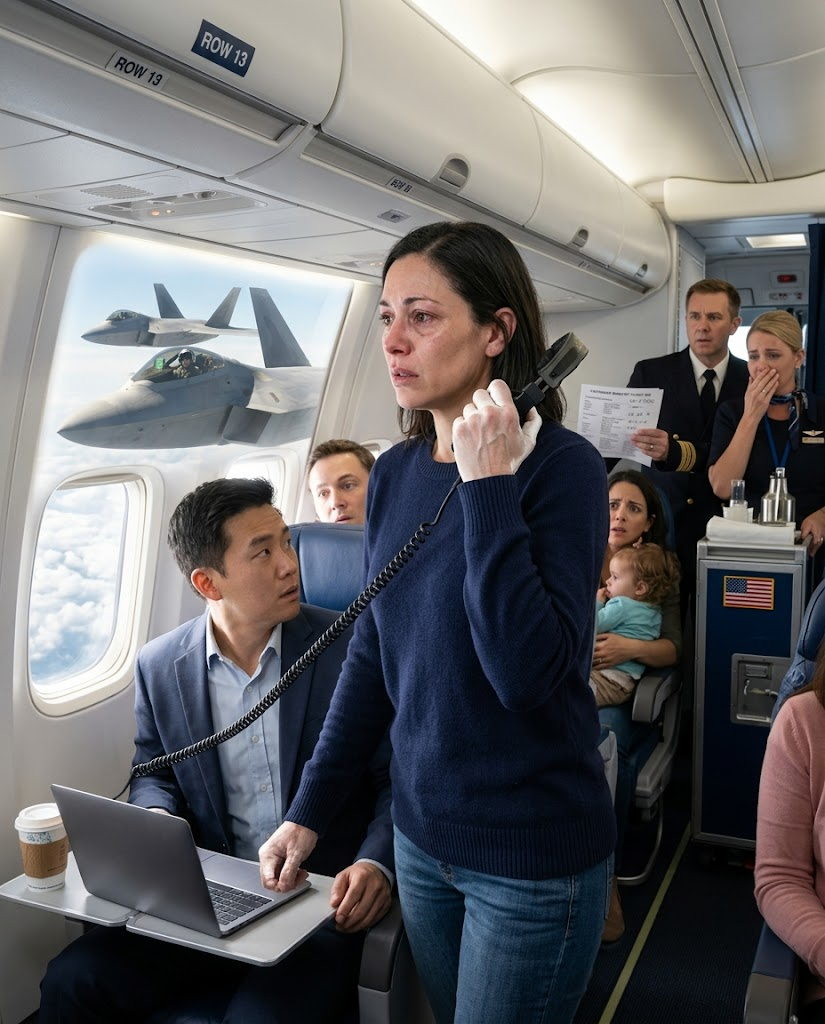
They only saw a woman in jeans and a sweater walking toward the cockpit with the flight attendant beside her.
Robert Kim pulled his headset off.
The teenager paused his movie.
A woman near the back began praying under her breath.
The cockpit doorway opened just enough to admit Sarah.
Inside, the air felt different.
Tighter.
The captain had one hand on a checklist clipped near the yoke.
The first officer wore a headset pressed hard to his ear and repeated numbers with careful precision.
A printed emergency procedure lay open.
The captain glanced back.
“Colonel Martinez?”
Sarah nodded.
“Yes.”
The captain did not waste time.
“We have military traffic off our right side. They intercepted after a transponder irregularity and a communication relay issue. Air traffic control is coordinating. They asked whether a Colonel Sarah Martinez is aboard.”
Sarah went still.
“They asked by name?”
The first officer turned slightly.
“They used a call sign.”
The cockpit seemed to shrink around her.
“What call sign?” Sarah asked.
The first officer swallowed.
Then he lifted a spare headset and handed it to her.
Static filled one ear.
Beneath it came a voice, crisp and controlled.
“United 847, this is Raptor Two-One. Request confirmation that Phoenix is on board. Repeat, request confirmation that Phoenix is on board.”
Sarah closed her eyes.
Phoenix.
She had not heard it spoken like that since Bagram.
Not in a report.
Not in a formal debrief.
In the open air.
Alive.
The name carried heat, dust, sirens, radio traffic, and the terrible clarity of a night when every decision had arrived with a cost.
The captain watched her carefully.
“Colonel?”
Sarah opened her eyes.
“Confirm,” she said. “Phoenix is on board.”
The first officer relayed it.
For a moment, only static answered.
Then Raptor Two-One came back.
“United 847, Raptor Two-One copies. Please advise Phoenix we are honored to escort.”
The captain’s jaw tightened.
The first officer looked at Sarah as if the sweater and jeans had suddenly become a disguise he had failed to see through.
Sarah said nothing.
She had learned long ago that some moments got smaller if you talked over them.
The captain guided her back toward the cabin.
Jennifer stood just outside the doorway, eyes searching Sarah’s face for information she knew Sarah might not be allowed to give.
“Are we safe?” Jennifer asked.
Sarah looked past her at the passengers.
Maria’s toddlers were quiet now.
Robert Kim held his laptop half-closed.
Every face waited for a story simple enough to survive fear.
“Yes,” Sarah said.
It was the only word that mattered.
Then she looked out the right-side windows.
The first F-22 slid into view like a blade made of gray light.
A second held farther back, steady and watchful.
The cabin reacted in pieces.
One gasp.
Then another.
A child said, “Mommy, is that ours?”
Maria did not answer.
Robert Kim stood halfway, then remembered he was on a plane and sat down again.
Jennifer pressed her fingers to her lips.
Sarah stepped into the aisle near row 13.
The lead jet moved closer, not dangerously close, but close enough that the people by the windows could see the helmeted pilot turn his head.
Close enough that Sarah could see his hand rise.
He saluted.
Not the aircraft.
Not the airline.
Her.
Sarah felt the whole cabin understand at once that the woman in 13F had not been only a passenger.
She raised her hand slowly and returned the salute.
It was the first time she had saluted in a navy sweater.
It nearly broke her.
Jennifer looked away, blinking hard.
Robert Kim whispered, “Who is she?”
Nobody answered him.
The captain came over the intercom again, and this time his voice carried something different.
Respect, maybe.
Or astonishment.
“Ladies and gentlemen,” he said, “we remain under escort and are continuing safely toward Washington. Please remain seated.”
He paused.
That pause told Sarah he had decided to say more.
“We also have the honor of carrying a distinguished Air Force officer aboard today.”
Sarah’s shoulders tensed.
She did not want applause.
She did not want a cabin full of strangers turning her grief into a performance.
But the captain did not give her medals or missions.
He kept it simple.
“Colonel Sarah Martinez is traveling with us. Some of our friends outside appear to know her by another name.”
Every head turned toward Sarah.
Not rudely.
Not like people watching entertainment.
Like people realizing they had been sitting beside a whole life they knew nothing about.
The radio crackled again in the cockpit.
The first officer stepped out with a notepad in his hand.
“Colonel,” he said softly. “Raptor Two-One has a message from Bagram relay. Personal priority.”
Sarah forgot the cabin.
She forgot the passengers.
She forgot even the jet holding formation outside the window.
“Read it,” she said.
The first officer looked down at the paper.
His hand was not steady.
“Phoenix,” he read. “Your last bird made it home.”
Sarah did not move.
For 18 months, she had carried that last aircraft in a part of her mind she refused to enter unless necessary.
A damaged jet.
A young pilot with fear hidden under training.
A night full of bad options.
She had gotten him pointed toward safety, but communications had fractured before she heard the final confirmation.
Reports later said he survived.
Reports were paper.
This was a voice coming through the sky.
Your last bird made it home.
The words took something out of her that exhaustion never had.
Her hand dropped from the seatback.
Jennifer stepped closer as if she might catch her, though Sarah did not fall.
“Ma’am?” Jennifer whispered.
Sarah nodded once, but tears had already blurred the F-22 outside the window.
The lead pilot still held position.
Then he saluted again.
This time, Sarah returned it without trying to hide the tears.
The cabin remained silent.
Even the toddlers were quiet.
Robert Kim lowered his head.
Maria Santis pressed a hand over her heart.
The teenager with the phone had tears in his eyes and, to his credit, was not recording.
The captain stepped into the aisle holding the printed manifest.
He looked at Sarah, then at the passengers.
“For those wondering,” he said, “sometimes the person beside you is carrying more than a boarding pass.”
Sarah let out a breath that almost became a laugh.
It was the kind of line that would have embarrassed her on any other day.
On that day, it landed gently.
The escort stayed with United 847 for several minutes.
Long enough for fear to drain out of the cabin.
Long enough for people to stop whispering and start breathing normally.
Long enough for Sarah to sit back down in 13F and hold the coffee cup with both hands because they were shaking.
Jennifer brought her a fresh one.
She did not ask questions.
She only set the cup down, then placed two packets of sugar beside it even though Sarah had not used sugar before.
Care often arrives disguised as a small correction.
A fresh cup.
A quiet seat.
A stranger letting you keep the parts of the story you cannot say out loud.
Sarah looked up.
“Thank you,” she said.
Jennifer’s eyes were wet.
“No, ma’am,” she said. “Thank you.”
The rest of the flight changed after that.
Not dramatically.
No one crowded Sarah.
No one demanded details.
But the cabin softened around her.
Robert Kim closed his laptop for good.
Maria’s twins fell asleep against her shoulders.
A man from two rows back asked Jennifer to send his drink voucher to Sarah, and Jennifer told him quietly that Sarah did not need to be turned into a collection plate.
Sarah heard that and almost smiled.
When the plane began its descent toward Washington, clouds gathered below them in soft white banks.
The F-22s had already peeled away, one after the other, their work complete.
The salute stayed.
Not in the window.
In the cabin.
In the way people held themselves afterward.
At the gate, passengers stood slowly, as people do when a flight ends and everyone suddenly remembers luggage.
But row 13 did not rush.
Robert Kim waited until Sarah had her carry-on down.
Maria adjusted one sleeping toddler and whispered, “My boys will hear about this someday. Not all of it. Just enough.”
Sarah looked at the children.
“Tell them pilots look out for each other,” she said.
Maria nodded.
Jennifer stood at the aircraft door saying goodbye to every passenger.
When Sarah reached her, Jennifer did not offer another speech.
She handed Sarah the folded notepaper from the cockpit.
The timestamp was still written at the top.
2:52 p.m. Eastern.
Phoenix—your last bird made it home.
Sarah folded it once and slipped it into her sweater pocket.
Outside the jet bridge, the airport sounded like America always sounds when nobody is paying attention.
Rolling suitcases.
Children complaining.
Coffee machines steaming.
Families calling names across crowded walkways.
Sarah stood still for one moment and let it all reach her.
She had spent 18 months getting other people home.
Now she was home too.
When she finally called her mother from the terminal, the older woman answered on the second ring.
“Sarah? Did you land?”
Sarah looked through the tall airport windows at a small American flag moving in the wind outside the terminal.
“Yes, Mom,” she said, her voice rougher than she expected. “I landed.”
Her mother heard it.
Mothers always heard it.
“Good,” she said softly. “Then come home.”
Sarah closed her eyes.
For the first time in a long time, the word home did not feel like an assignment.
It felt like permission.
And somewhere above Washington, two pilots who had known her only as Phoenix had already turned back into the sky, leaving behind a cabin full of strangers who would never again believe a quiet woman in 13F was only a passenger.