
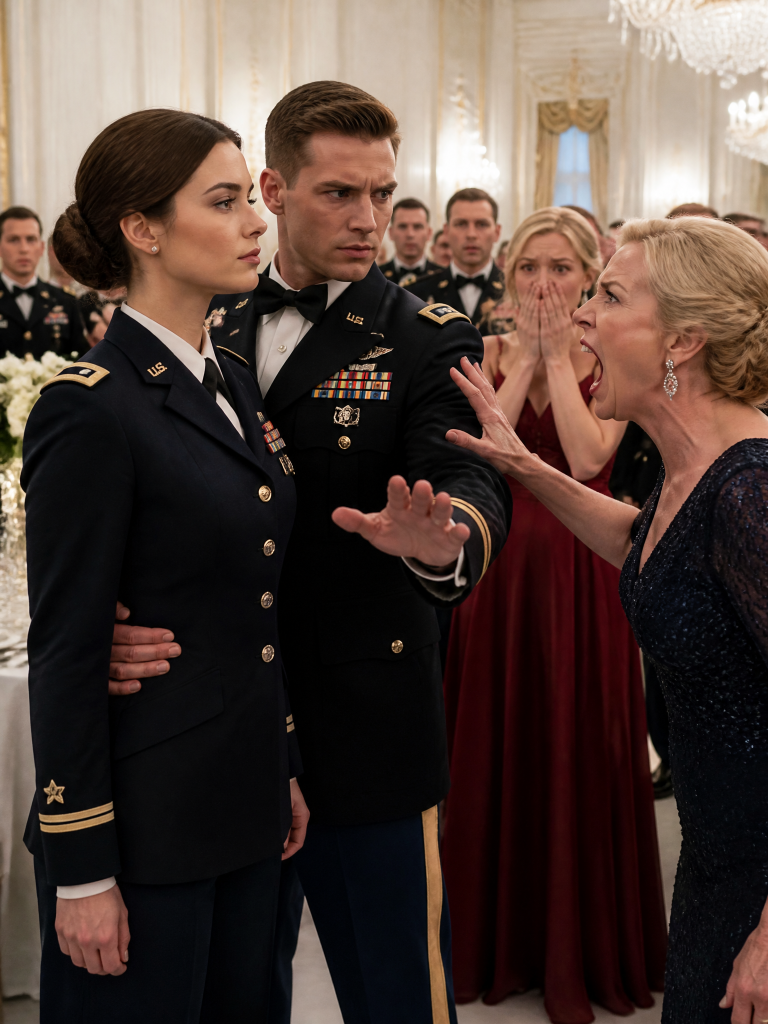
After I refused to give my late father’s military compensation to my irresponsible sister,

- Part 2: The Letter My Father Left
- Part 3: The Man Behind the Money
- Part 4: The Photograph
- Part 5: The Cedar Chest
- Part 6: Trust No One Close
After I refused to give my late father’s military compensation to my irresponsible sister, my mother publicly slapped me in front of my fiancé and dozens of senior military officers. Smiling through the sting, I looked right at her and quietly warned that she was about to lose everything. She thought she had broken my spirit, but she had actually just destroyed herself.
My name is Olivia Bennett, and my engagement party was meant to be the happiest night of my life.
The champagne had only just been poured when my mother stepped beside me with the same perfect smile she had worn my entire childhood whenever she wanted control.
“Olivia,” she whispered, linking her arm through mine, “we need to discuss your father’s fund.”
My chest tightened immediately.
That money was not a normal inheritance. It was the military compensation our family received after my father, a decorated four-star Army general, died while serving his country. I had never spent a dollar of it. I had promised myself it would help build the future Mason and I were planning together.
My mother squeezed my arm.
“Your sister needs it more than you do,” she said. “Sienna has nothing left. You have Mason. You’ll be fine.”
I looked across the ballroom.
Sienna was laughing with a glass of champagne in one hand and a designer purse in the other, showing off luxuries she could not afford. Somehow, every reckless choice she made always became mine to repair.
“I’m not giving her Dad’s money.”
My mother’s smile stayed perfectly in place.
“Don’t embarrass me tonight.”
I tried to walk away.
She followed.
“You owe this family,” she hissed, still smiling for the guests. “Transfer the money on Monday, or I’ll tell everyone what you’ve been hiding.”
I stopped.
“What exactly am I hiding?”
Her gaze moved toward Mason, who was speaking with several senior military officers invited to our celebration.
“That you’re selfish,” she said. “Ungrateful. Cold-hearted.”
I almost laughed.
If only she knew the truth.
For years, she believed I had an ordinary government job.
She did not know I was an active-duty Army officer assigned to a classified command.
She did not know my rank, my record, or my clearance.
And she definitely did not know that Mason, the man she dismissed as just a wealthy businessman, was actually one of the Army’s youngest senior commanders.
Our work required absolute secrecy.
Even our families did not know who we really were.
“Please stop,” I said quietly.
Instead, she raised her voice.
“Olivia! Do the right thing and help your sister!”
The conversations around us faded.
One by one, every guest in the ballroom turned to look.
I felt the old weight pressing down on me.
The guilt.
The pressure.
The expectation that I would always give in.
Not this time.
“No.”
My voice carried clearly across the room.
“I’m done.”
For one second, my mother looked shocked.
Then her hand struck my face.
The sound cracked through the ballroom.
My cheek burned.
The room froze.
Several uniformed officers instinctively looked toward Mason, whose expression changed the moment he saw what she had done.
I slowly touched my cheek, then looked straight into my mother’s eyes.
She smiled as if she had won.
I straightened my shoulders.
“Now it’s your turn to lose everything.”
Her face twisted with rage.
Then she slapped me again.
Harder.
This time, I smiled.
Because neither she nor Sienna understood that Mason had already seen everything.
And the military officers standing only a few feet away were no longer acting like guests.
They were quietly reaching for their phones.
Part 2: The Letter My Father Left
For one long second, the ballroom went silent.
My mother’s hand still hovered in the air, trembling as though even she could not believe she had struck me twice. The chandeliers glowed above us, but the room had turned cold. Every conversation stopped. Every guest stared.
Mason moved first.
He crossed the room toward me with quiet control, the kind that made people step aside without being told.
“Olivia,” he said softly.
His eyes searched my face, steady and concerned. His hand hovered near my cheek, asking permission without words.
“I’m all right,” I whispered.
He did not believe me, but he nodded.
My mother, Evelyn, gave a brittle laugh.
“Don’t be dramatic,” she said to the room. “Families argue. Olivia has always been sensitive.”
No one answered.
Then Colonel Reeves, one of my father’s oldest friends, stepped forward.
“Evelyn,” he said quietly, “you need to leave.”
She blinked. “Excuse me?”
“You heard me.”
“This is my daughter’s engagement party. I am her mother.”
“And you just assaulted her in front of witnesses.”
A low murmur moved through the ballroom.
My sister, Sienna, hurried from the dessert table, panic bright in her eyes.
“Mom, stop. Please.”
Evelyn shook her off.
“I will not be humiliated by my own child.”
I looked at Sienna then, really looked at her. Beneath the perfect dress and expensive makeup, she seemed frightened. Not innocent, but far smaller than usual.
Mason touched my shoulder.
“We can end the evening now.”
I looked around the ballroom. My friends stood frozen. Mason’s family watched from near the entrance. Officers who had known my father stared at my mother as though seeing her clearly for the first time.
Then I noticed Mr. Langley, the attorney who managed my father’s compensation fund, standing near the far wall.
He had not been invited.
“Why is Mr. Langley here?” I asked Mason quietly.
Mason followed my gaze.
“He asked to attend. He said your father left instructions tied to tonight.”
My father.
The word felt like a door opening inside an empty house.
My mother heard enough to turn sharply.
“What did you say?”
Mr. Langley approached with a leather case held against his chest.
“Olivia,” he said gently, “I’m sorry this is happening tonight.”
“What instructions?” I asked.
Evelyn straightened. “This is a private family matter.”
“No,” Mr. Langley said. “It stopped being private when you brought the fund into a public room and tried to pressure its beneficiary.”
Her mouth opened, then closed.
Sienna looked confused.
“Beneficiary?”
My mother snapped, “Be quiet.”
Something in Sienna cracked.
“No,” she whispered. “I don’t think I will.”
The room became even stiller.
My sister had defied our mother before in careless ways, but never like this. Never standing still, trembling, and saying no with witnesses watching.
Mr. Langley looked at me.
“May we speak somewhere quieter?”
I wanted to leave the room.
But I knew my mother. If I disappeared behind closed doors, she would fill the silence with her version.
I took a breath.
“Here is fine.”
Mason’s hand tightened gently on my shoulder, not stopping me, only reminding me I was not alone.
Mr. Langley opened his case.
“Your father placed several protective conditions around the compensation fund,” he said. “Most were standard. Some were personal. He knew you might face pressure after his passing.”
My throat tightened.
“He knew?”
Mr. Langley’s expression softened.
“General Bennett knew more than he allowed people to believe.”
My mother snapped, “This is absurd.”
Mr. Langley continued.
“He specified that if any family member tried to pressure, threaten, or manipulate you into transferring control of the fund, the matter must be reviewed immediately. He also left a sealed letter to be opened if that happened.”
My mother’s eyes widened.
“No.”
The word was small, but it carried fear I had never heard from her before.
Mr. Langley removed an envelope.
My father’s handwriting was on the front.
For Olivia, when she finally stops carrying what was never hers.
The room blurred.
I had spent years trying not to miss him in public. But seeing his handwriting again opened something raw.
Mason leaned closer.
“Do you want me to read it?”
I shook my head.
My fingers were steadier than I felt as I opened the envelope.
Inside was a letter.
My father wrote that love should never require surrender. He said I had learned too young to keep peace in rooms full of storms. He admitted he should have done more while he was alive.
He warned me that sacrifice freely given was love, but sacrifice demanded through fear was control.
He said the fund was protection, not a prize.
Then I reached the line that changed everything.
And if Evelyn ever tells you she has nothing, remember this: she has already been given more than you know.
I stopped reading.
“What does that mean?” I asked.
My mother said nothing.
Sienna’s voice shook.
“Mom?”
Evelyn hardened her face again, but the old confidence was gone.
“Your father was ill when he wrote that.”
“He was not ill,” Colonel Reeves said.
Evelyn glared at him.
“You have no right.”
“I served with him for twenty-three years,” he replied. “He knew exactly what he was doing.”
Mr. Langley spoke gently.
“Olivia, your father created a separate trust before his final deployment. It was not part of the military compensation. It was funded through personal savings, investments, and insurance planning.”
“For whom?” I asked.
“For your mother and Sienna.”
For a moment, I did not understand.
Sienna stepped back.
“What trust?”
Mr. Langley continued.
“It provided monthly support, educational funds, and emergency assistance. It was substantial. Enough that neither Evelyn nor Sienna should ever have needed your fund.”
I stared at my mother.
Every desperate bill.
Every crisis.
Every call about family loyalty.
Every time Sienna’s mistakes became my responsibility.
“You had money,” I said.
Evelyn looked away.
Sienna’s face crumpled.
“Mom, you told me Dad left everything to Olivia.”
“The military fund, yes,” Evelyn said quickly.
“But you had a trust?”
“It wasn’t that simple.”
Mr. Langley’s expression cooled.
“It was simple enough when annual statements were sent to you.”
Sienna stared at her.
“Annual statements?”
My mother finally cracked.
“You don’t understand what it costs to maintain a life after someone like your father dies.”
“A life?” I asked. “Or an image?”
She flinched.
That silence was the answer.
Part 3: The Man Behind the Money
Mr. Langley looked uncomfortable.
“There is more.”
My mother whispered, “Don’t.”
“The trust was depleted eighteen months ago,” he said.
Sienna covered her mouth.
“How?” I asked.
“That remains under review.”
Evelyn straightened, insulted now that fear had nowhere to hide.
“I did what I had to do.”
“For what?” Sienna demanded.
“For us.”
“No,” Sienna said, her voice breaking. “You told me Olivia was selfish. You told me Dad forgot us. You told me every time I needed help, Olivia could fix it but refused.”
“Because she could!” Evelyn snapped.
“No,” I said. “Because you wanted me to.”
The room felt too public again.
I folded my father’s letter and pressed it to my chest.
“I’m not discussing this here anymore.”
This time, my mother did not stop me.
Mason guided me toward a side corridor. Mr. Langley followed, then Sienna after a moment. Behind us, Colonel Reeves calmly handled the officers and guests.
Inside a small sitting room, the music from the ballroom sounded distant and wrong.
I sat with the letter in my hands.
Sienna stayed near the door, arms wrapped around herself.
My mother did not come in.
For once, she chose not to follow.
Mr. Langley set his case on the table.
“I’m sorry it came out this way.”
“Did Mason know?” I asked.
Mason answered immediately.
“Only that Langley had concerns about the fund. Not the details.”
I believed him.
Mr. Langley removed another folder.
“Your father asked me to monitor unusual requests connected to your compensation account. Two weeks ago, Evelyn called asking what documents would be needed for you to transfer control.”
My stomach dropped.
“She planned this.”
“Yes. And yesterday, someone attempted to start preliminary paperwork using your personal information.”
Mason’s expression sharpened.
Sienna whispered, “Someone?”
Mr. Langley looked at her.
Her face went pale.
“No. I didn’t.”
I studied her. For years, I expected the worst from Sienna because expecting better was exhausting. But now her fear seemed too raw to be fake.
“You didn’t know?” I asked.
She shook her head, tears streaking her makeup.
“I asked Mom for help. That’s all. I’m in trouble, Nat. I made mistakes, but I didn’t ask her to steal from you.”
The word steal hung in the room.
Mason leaned forward.
“What kind of trouble?”
Sienna swallowed.
“I signed a lease for a boutique with two friends. One disappeared with inventory money, and the other backed out. Now I owe more than I can pay.”
It sounded like Sienna.
Reckless.
Naive.
But not malicious.
“Why didn’t you tell me?” I asked.
She gave a broken laugh.
“Because you always look at me like you’re waiting for me to disappoint you.”
The truth hurt because it was partly fair.
“I was tired,” I said quietly. “I still am.”
“I know.”
For the first time in years, we sounded like sisters instead of enemies.
Mr. Langley slid the folder toward me.
“The attempted paperwork failed. Your safeguards held. But the identity verification used information only a close family member would know.”
“My mother,” I said.
“Possibly.”
Mason leaned forward.
“Possibly?”
“There is one inconsistency,” Mr. Langley said. “The digital request came from a device registered to another address.”
Sienna wiped her face.
“Whose?”
“A man named Daniel Price.”
The name meant nothing to me at first.
Then Sienna gasped.
“You know him?” I asked.
She nodded slowly.
“He was one of Mom’s financial advisers. Or her boyfriend. She never admitted which.”
Mason’s jaw tightened.
“Where is he now?”
“I don’t know. I haven’t seen him in months.”
Mr. Langley looked grim.
“That is troubling. Daniel Price contacted my office this morning asking whether your engagement party was still happening tonight.”
A chill moved through me.
“He knew about tonight?” Mason asked.
“He knew enough.”
Sienna sank into a chair.
“Mom said he was helping her reorganize everything.”
“The trust depletion may not have been solely your mother’s doing,” Mr. Langley said.
No one spoke.
This was supposed to be my engagement night.
There should have been speeches, laughter, and my father’s memory held gently.
Instead, I was discovering that my mother’s control might be tangled with someone else’s scheme.
Mason seemed to read my face.
“We can stop. Tonight can end. Tomorrow can handle the rest.”
I looked at him.
“I don’t want to run from this.”
“You’re not running by resting.”
His tenderness nearly undid me.
Sienna looked at me.
“Nat, I’m sorry.”
“For what?”
“For believing her so easily. For letting you be the bad one because it was convenient. For acting like Dad’s death only hurt me and Mom.”
I swallowed.
“It hurt all of us.”
“I know. I just didn’t know what to do with it.”
I unfolded my father’s letter again and read the final lines silently.
He wrote that truth was not revenge. It was light entering a room that had been dark too long. He hoped I would choose peace, but not the kind bought with silence. And he hoped that when I married, I would let joy stand beside grief without apologizing for either.
My vision blurred.
Mason took my hand.
This time, I let him.
Part 4: The Photograph
A knock sounded.
Colonel Reeves entered carefully.
“The guests are leaving quietly,” he said. “Mason’s parents are handling the venue. No one is making a scene.”
I almost laughed.
The scene had already happened.
“Where is my mother?” I asked.
Reeves hesitated.
“She left.”
Sienna stood. “Left?”
“With her purse and coat. A driver picked her up at the south entrance.”
Mr. Langley stiffened.
“Did anyone see who was driving?”
“One valet recognized him. Middle-aged man, dark hair, gray suit.”
Sienna whispered, “Daniel.”
The room changed again.
Mason reached for his phone, then paused.
I understood the hesitation. There were lines in our world that could not be crossed casually, even for family.
I placed my hand over his.
“Don’t make it official unless it has to be.”
His eyes met mine.
“It may have to be.”
“I know.”
Sienna looked between us, confused.
“What does that mean?”
The old instinct rose in me: protect the secret, say nothing, keep the line.
But tonight had already stripped away too many illusions.
“It means,” I said carefully, “Mason has resources most people don’t.”
“Business resources?”
Mason gave a faint smile that did not reach his eyes.
“Not exactly.”
Before she could ask more, Mr. Langley’s phone buzzed.
He checked the screen, and his face went pale.
“What is it?” I asked.
He turned the phone toward me.
An email had arrived from an unknown address.
Subject line:
General Bennett did not die the way they told you.
There was one attachment.
A photograph.
I leaned closer, and my breath caught.
It showed my father standing beside Daniel Price.
The date stamp was three days before my father’s final deployment.
And in the background, half-hidden in shadow, stood my mother.
The photograph looked too small to hold so much impossible weight.
For a moment, no one moved.
My father looked lighter than I remembered from his final week home. His jacket was off, sleeves rolled, posture relaxed beside Daniel Price. My mother stood near a window, turned slightly as though she had just looked away.
Three days before his deployment.
Three days before the official version of our family history began.
Sienna whispered, “That can’t be real.”
No one answered.
Mason studied the image carefully.
“Where was this taken?”
Mr. Langley swallowed.
“I don’t know.”
The sender was random. No name. No signature.
Just that sentence.
General Bennett did not die the way they told you.
A chill spread through me.
“My father died overseas,” I said slowly. “His convoy was attacked during a classified mission. That’s what we were told.”
Colonel Reeves stood very still.
Mason noticed too.
“Colonel?”
Reeves looked older than he had minutes earlier.
“Olivia,” he said, “there were things about your father’s final assignment that were never shared with the family.”
The sentence did not shock me as much as it should have.
Military families learn that truth often comes in layers.
The record.
The version told in living rooms.
And the version carried silently by those who came home.
“But Daniel Price?” I asked. “Why would he know him?”
Reeves looked at the photo.
“I don’t know.”
It was the first honest answer of the night that truly frightened me.
Sienna sank into the chair.
“Mom knew him before Dad died.”
Her voice trembled, but she was thinking now, assembling the pieces of our childhood.
“She told me she met Daniel at a charity event two years ago,” I said.
“So did I,” Sienna replied. “She said he helped widows with financial planning.”
Mr. Langley lowered himself into a chair.
“Daniel Price has never been a licensed adviser in any database my office checked.”
Sienna looked sick.
“Then what was he?”
Mason handed the phone back.
“Someone who knew enough about your family to get close.”
Part 5: The Cedar Chest
I crossed to the window, needing air.
Outside, the venue gardens glowed under white lights. Guests moved toward their cars like quiet shadows.
Hours ago, I had laughed with Mason in that same garden.
Now that version of me felt far away.
Behind me, Sienna said, “Olivia, there’s something else.”
The room tightened around her words.
“A few weeks ago, Mom asked me to find Dad’s old storage box.”
“What storage box?”
“The cedar one from the attic. The one with his medals and letters.”
I remembered it immediately.
A long cedar chest with brass handles, kept beneath a white sheet in our childhood home. After Dad died, our mother forbade us from opening it. She said grief needed dignity.
At twelve, I believed her.
At thirty, I understood that locked things often protect more than sorrow.
“Why did she want it?” Mr. Langley asked.
“She said she wanted to organize keepsakes before the engagement party,” Sienna said. “But when I went to the attic, it was gone.”
“Gone?”
“She said she moved it to storage years ago. But she looked scared when I asked.”
Mason stepped closer.
“Olivia, did your father ever mention Daniel Price?”
“No.”
“Any consultants? Old friends? Anyone connected to finances?”
I closed my eyes, searching through old memories.
My father at the kitchen table with maps.
My mother speaking low in the hallway.
Coffee at midnight.
An unfamiliar man’s laugh from the study.
Then one memory surfaced.
“There was a name,” I said. “Not Daniel. Price.”
Everyone looked at me.
“I was little. Maybe ten. Dad was on the phone in his study. I heard him say, ‘Price doesn’t get near my family.’ Then he closed the door.”
Sienna stared.
“You never told me.”
“I forgot.”
Or maybe I had buried it because children bury things adults call imagination.
Mr. Langley exhaled.
“General Bennett added extra identity protections to your fund shortly after that deployment cycle.”
“When was that?” Mason asked.
“Twelve years ago.”
I turned sharply.
“That’s when I heard the call.”
Mason’s eyes darkened with focus.
“Then Daniel Price may have been circling your family long before tonight.”
Colonel Reeves rubbed his face.
“I should have asked more questions back then.”
I looked at him.
“What do you know?”
He hesitated.
“Please,” I said. “No more protecting me with silence.”
That reached him.
“Your father came to me before his final deployment,” Reeves said. “He asked me to look after you girls if anything happened. Not just in the usual way. He seemed worried pressure would be placed on Olivia later.”
“By Mom?” Sienna asked.
“He didn’t say.”
“But he knew,” I whispered.
Reeves nodded.
“He knew something.”
Then Mason’s mother, Grace, entered softly. She explained that most guests had left and the venue was being handled.
Then she looked at me.
“Oh, Olivia.”
That was all she said.
Two words, and they reached past every wall I had built.
She hugged me gently, careful of my cheek.
For one second, I stood stiff.
Then I folded into her.
The tears came quietly.
“I wanted tonight to be beautiful,” I whispered.
“It still had beauty,” she said. “It had truth. Sometimes truth arrives badly dressed, but it clears the room.”
A broken laugh escaped me.
When I stepped back, Sienna was crying too.
Grace opened one arm.
Sienna froze.
Then she crossed the room and let herself be held.
It did not fix us.
But it gave us something fragile.
The possibility of standing on the same side.
Then Mr. Langley’s phone buzzed again.
Another email.
Same sender.
No photograph this time.
Only one line:
Ask Evelyn what was hidden in the cedar chest.
Sienna went pale.
The cedar chest.
Mason said, “We need to find your mother.”
“She’ll go home,” Sienna said. “When Mom is scared, she goes where she feels in control.”
Our childhood house.
The place where Dad’s boots once sat by the back door. Where our mother hosted memorial luncheons and taught us which emotions were acceptable in public.
Mason looked at me.
“Are you sure you want to go tonight?”
“No,” I said honestly. “But I need to.”
Grace squeezed my hand.
“Then you won’t go alone.”
Part 6: Trust No One Close
Twenty minutes later, I changed out of my engagement dress and into a cream sweater and dark trousers I had packed for the quiet weekend Mason and I were supposed to take after the party.
That weekend was gone now.
In its place was a road back into everything I had avoided.
Sienna stood near the mirror, holding my father’s letter like something sacred.
“You always packed practical clothes,” she said.
“You always mocked me for it.”
“I still might,” she said, and a faint smile touched her face.
It mattered.
Mason waited in the hallway with his coat over one arm.
“You ready?”
“No.”
He offered his hand.
“Me neither.”
We drove in two cars through light rain toward the neighborhood where Sienna and I grew up.
The city lights thinned.
Familiar places passed by.
The corner where Dad taught me to ride a bike.
The park where Sienna fell from the monkey bars and refused to cry until Dad promised not to tell Mom.
The bakery where he bought cinnamon rolls every Sunday.
“He was so alive here,” I said.
Mason glanced at me.
“He still is, in the way you remember him.”
“I’m afraid of learning something that changes him.”
“Truth can change a story,” Mason said. “It doesn’t have to erase the person.”
I held onto that.
My mother’s house appeared at the end of the block, white columns glowing under porch lights. A black sedan sat by the curb.
Sienna whispered, “That’s Daniel’s car.”
The front door was unlocked.
That alone felt wrong.
Our mother locked everything.
Mason stepped in first, not as a commander, but as a man protecting someone he loved while respecting that this was still my threshold to cross.
The house smelled the same: lemon polish, old wood, faint perfume.
Family portraits lined the foyer.
Dad in uniform.
Mom smiling beside him.
Sienna and me in matching holiday dresses, my hand gripping hers.
“Mom?” Sienna called.
No answer.
In the living room, papers covered the coffee table.
Bank statements.
Old envelopes.
Photocopies.
A storage receipt.
Mr. Langley picked it up.
“This is for a private storage facility outside the city.”
“Is the cedar chest there?” I asked.
“It lists one cedar trunk.”
Sienna exhaled sharply.
Mason crouched near the fireplace.
“Someone left in a hurry.”
A framed photograph had fallen face down on the rug.
I picked it up.
Dad holding Sienna on his shoulders while I stood beside him saluting badly, all missing teeth and crooked confidence.
For years, I remembered myself as the responsible child.
But in the photo, I looked happy.
Then my mother’s voice came from the hallway.
“I didn’t want you to find out this way.”
We turned.
She stood near the dining room, coat still on, hair no longer perfect.
Daniel Price was gone.
Sienna stepped forward.
“Where is he?”
“Gone.”
“Where?”
“I don’t know.”
Mason’s voice stayed calm.
“Was Daniel Price in this house tonight?”
She looked at him as though finally wondering who he really was.
“Who are you?”
“The man marrying your daughter.”
“That doesn’t answer my question.”
“No,” Mason said. “It answers the only part that matters.”
I held up the photo from the email.
“Did you know Daniel before Dad died?”
Her eyes closed.
“Yes.”
The answer landed softly, but its echo filled the house.
“How?”
“He worked with people your father was investigating.”
Colonel Reeves stepped forward.
“Investigating?”
My mother looked at him with old resentment.
“You worshiped him so much you forgot he kept secrets too.”
“He served his country,” Reeves said.
“He also brought danger into our home,” she snapped. “He thought he could control everything.”
I had never heard her speak of Dad with anything but polished admiration or controlled grief. This was messier, more human, and somehow more painful.
“What danger?” I asked.
She stared at me.
“Your father discovered money moving through charities connected to military families. Widows. Scholarships. Relief funds. Daniel was involved. So were others. Your father started collecting evidence.”
Mr. Langley went still.
“The cedar chest.”
My mother nodded.
Sienna whispered, “You hid it?”
“I protected it.”
“From who?” I asked.
“From Daniel. From the people behind him. And from you.”
“Why from me?”
“Because your father believed you would grow up just like him,” she said. “Brave. Stubborn. Impossible to stop once you believed something was right.”
Mason looked at me gently, as if to say she was not wrong.
My mother’s shoulders sagged.
“After he died, Daniel came back. He said the evidence was dangerous. He said if I gave him access to certain accounts, he could keep our family out of it. At first, I thought I was buying safety.”
“And later?” Sienna asked.
“Later I was ashamed. Then trapped. Then angry. And it became easier to blame Olivia than admit fear had made me cruel.”
No one spoke.
There it was.
Not an excuse.
Not enough.
But truth, trembling in the open.
Sienna stepped away from her.
“You made us hate each other.”
“I know.”
“You let me think Dad forgot me.”
“I know.”
“You hit Olivia.”
My mother looked at me with no defense left.
“I know.”
I waited for triumph to come.
It didn’t.
Only grief for the years we could not get back.
“I can’t forgive you tonight,” I said.
She nodded as tears fell.
“But I won’t carry your choices anymore.”
“That is fair,” she whispered.
Sienna moved beside me.
Not behind our mother.
Not across the room.
Beside me.
It was the first answer to a question I had not dared ask.
Mason touched my back.
“The storage facility. We should go before Daniel does.”
My mother startled.
“He doesn’t know which unit.”
Mr. Langley held up the receipt.
“He may now.”
The black sedan outside was gone.
We reached the storage facility just before midnight.
Rain glazed the rows of metal doors under harsh lights. The manager, guided by Mr. Langley’s authority and my mother’s trembling signature, led us to Unit 118.
The lock had been cut.
Sienna grabbed my hand.
Inside, the unit smelled of dust and cedar.
At the center sat my father’s chest.
Its lid was open.
Some items were missing.
“No,” my mother whispered.
I stepped closer.
Dad’s medals were still there. A folded flag. Letters tied with string.
But the false bottom had been lifted, revealing a hidden compartment beneath.
Inside lay one thing Daniel had missed.
A small leather journal.
My father’s initials were pressed into the cover.
With shaking hands, I opened it.
The pages held notes, dates, names, and careful observations.
Near the end, a folded photograph slipped free.
Mason picked it up.
His expression changed completely.
“What?” I asked.
He turned the photograph toward us.
My father stood beside Daniel Price again.
But this time, another man stood with them.
A man I recognized from every formal dinner Mason and I had attended in the past year.
Mason’s father.
And beneath the photograph, in my father’s handwriting, were four words:
Trust no one close.