
At my daughter’s birthday dinner, my arrogant son-in-law…..

part 2
Then she said, “Let’s just do everyone. Keep it simple.”
Simple is one of the most dangerous lies families tell themselves.
I made a reservation at a steakhouse in Marietta because Emily liked their mashed potatoes and because it had been Diane’s favorite place for anniversaries when we wanted to feel fancy without pretending to be something we were not. White tablecloths, dark wood walls, old black-and-white photographs of Atlanta in frames, waiters who wore black aprons and knew how to disappear at the right time.
I arrived ten minutes early.
Ryan and Linda were already there.
That irritated me immediately. I had made the reservation. I had invited them. I was paying. Men like Ryan enjoyed tiny territorial wins. Arriving first was a way of claiming the room.
Emily came in three minutes later, and the first thing I noticed was not the dress she wore or the smile she tried to arrange when she saw me.
It was the bruise.
Small.
Yellowing.
Almost hidden near the inside of her wrist.
A fading bruise is one of those things ex-cops see even when they do not want to.
I hugged her.
She smelled like vanilla shampoo and rain.
“Happy birthday, kiddo.”
“Thanks, Dad.”
I held her a second longer than usual.
She pulled away gently.
That, too, I noticed.
We sat.
Menus opened.
Drinks came.
For the first twenty minutes, dinner passed the way bad weather starts—quiet enough that you could still fool yourself into calling it a nice evening if you did not look too closely at the sky.
Ryan talked about supply chain delays and a possible promotion.
Linda complained about licensing paperwork for the daycare and said parents were becoming “too sensitive” about discipline.
Emily smiled when spoken to and went still when ignored.
I asked about work. She gave me short answers. Too short.
Then I mentioned the weekend before, when Emily had come to my house to help me sort Diane’s things in the attic. Old lesson plans. Coat boxes. The cedar chest where my wife kept Christmas linens and letters from people she loved. Emily and I had spent four hours there. We laughed some. Cried some. It was the first time the house had felt warm in months.
Ryan set down his fork.
“Yeah,” he said lightly. “That was a long visit.”
Emily’s hand tightened on her water glass.
“It was Mom’s stuff.”
“I know what it was.”
His tone was quiet enough that no one at another table would have flinched. But I watched Emily’s shoulders curve inward exactly one inch.
A detective’s life trains you to watch for the body telling on the mouth.
I said, “She was helping me.”
Ryan smiled without warmth.
“You get a lot of help from Emily.”
Linda sipped her wine and watched him the way people watch a dog they know might bite.
“I’m his daughter,” Emily said.
Ryan cut into his steak.
“And my wife.”
There are men who say the word wife like it means partner.
And there are men who say it like it means possession.
Ryan belonged to the second group.
I kept my voice level.
“She can be both.”
He looked up at me.
“Sure. If priorities are clear.”
Emily spoke quickly then, trying to smooth the air.
“Dad, how’s the garage sale pile coming?”
Classic deflection.
Diane used to do that when Emily was little and we started heading toward one of our father-daughter standoffs over curfew or grades or why exactly she needed boots that looked like they’d been hit by a truck.
But this was not that.
This was fear doing housework.
I let the subject move.
Dinner came.
The waitress brought Emily a tiny chocolate dessert with a candle because I had requested it earlier. She smiled, and for a moment I saw my daughter as she used to be. Open-faced. Relaxed. The room softened.
Then Linda said, “Maybe make a wish for more obedience this year.”
The word landed wrong.
Emily gave a confused half-laugh.
“What?”
Linda smiled at her over the rim of her wineglass.
“I’m just saying marriage works better when the wife remembers not every weekend has to revolve around her father’s emotions.”
I set down my knife.
Ryan did not correct her.
That told me plenty.
Emily said, “Helping Dad go through Mom’s things isn’t revolving around his emotions.”
Ryan leaned back.
“There’s that tone.”
“What tone?”
“The one that starts trouble.”
She looked at him like she had already stepped onto familiar ground.
Dangerously familiar ground.
“I’m not starting trouble.”
“No,” he said. “You’re just always pushing.”
Linda chuckled.
I watched Emily’s face change—not dramatically, just enough that I knew she had been here before. This was a script. Not those exact words, perhaps, but the rhythm of it. The trap. Say something normal. Get accused of disrespect. Defend yourself. Become the problem.
That is how control often works. Not with a constant scream. With a constant rearranging of blame.
I said, “Ryan, it’s her birthday.”
He looked at me.
“That doesn’t make her right.”
Emily whispered, “Can we not do this here?”
And then he did it.
Fast enough to shock the room, slow enough to prove it was deliberate.
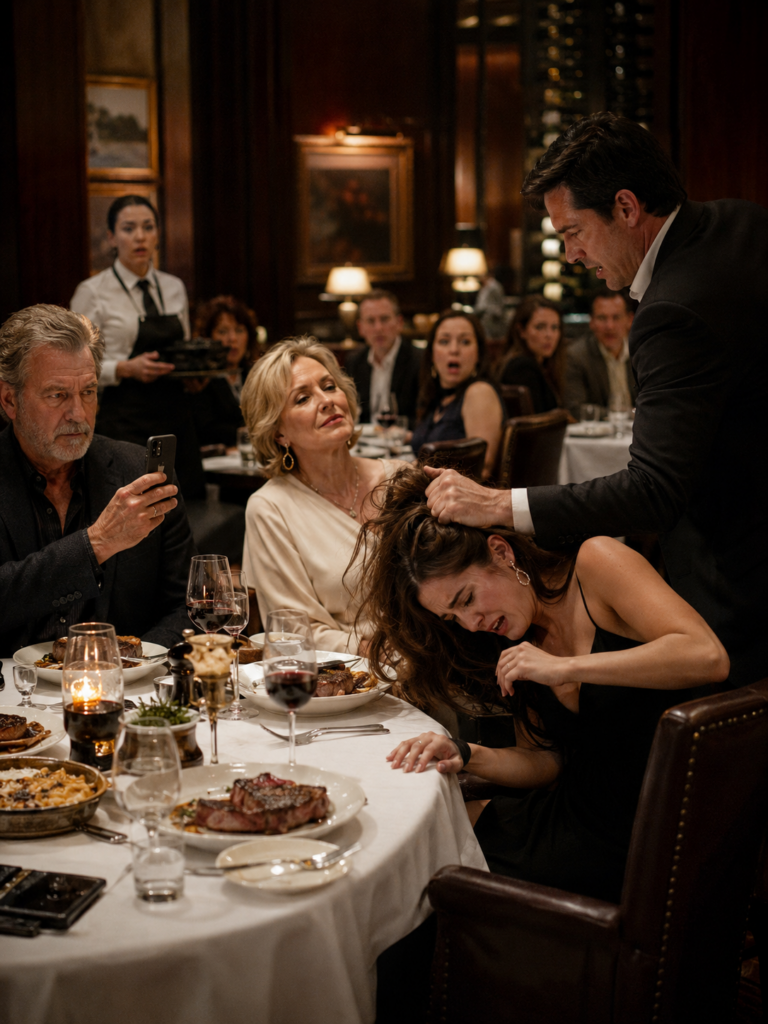
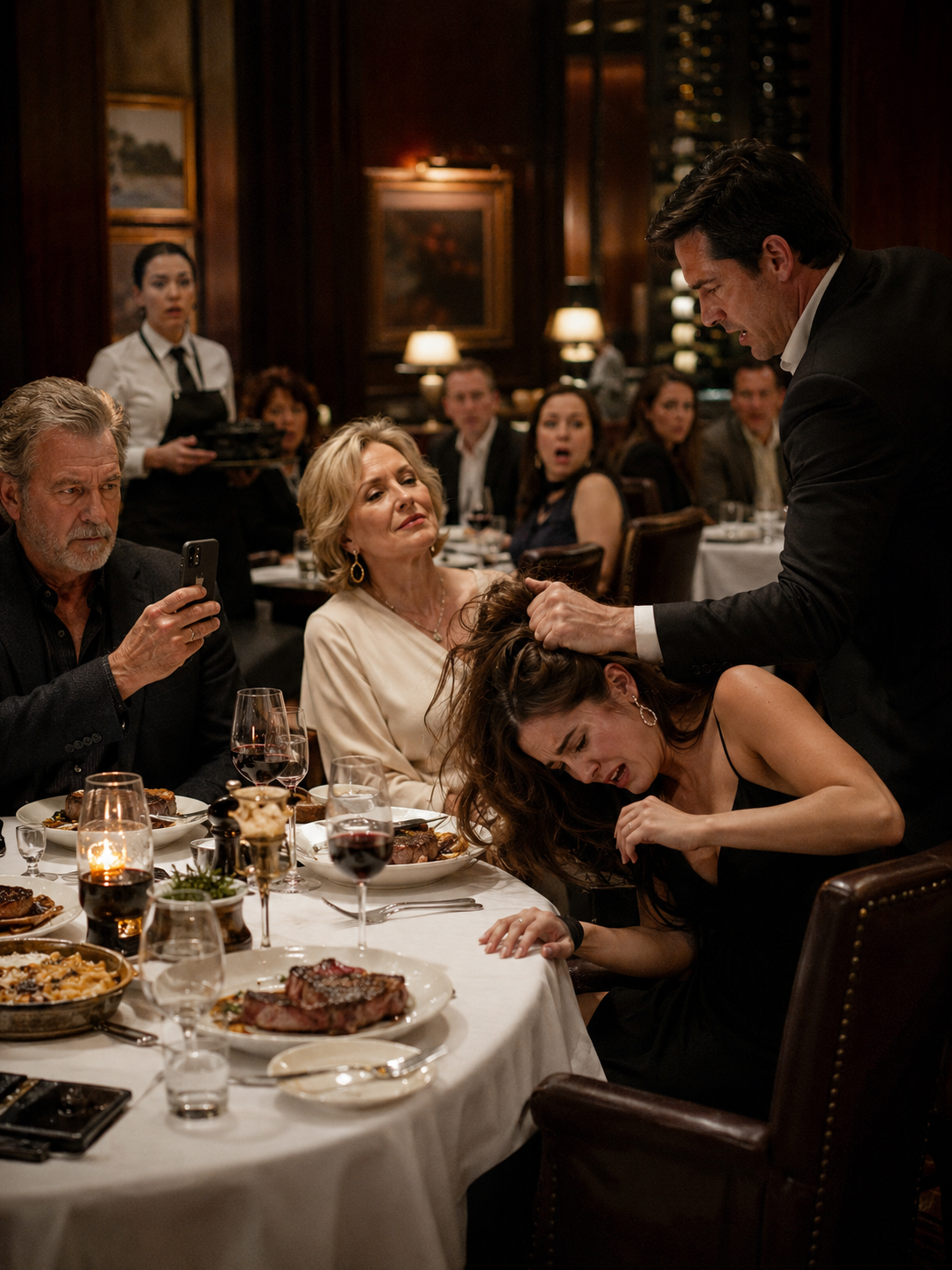
Ryan pushed back from his chair slightly, leaned across the table, and grabbed a fistful of Emily’s hair at the base of her neck.
Not from the top.
Not wild, like a bar fight.
From underneath, tight and efficient, where a man who has done it before knows he can control a head with one hand.
He yanked.
Emily’s chin lifted sharply. Her eyes watered instantly. The candle on her dessert flickered with the sudden movement.
Everything in me surged to my feet internally before my body moved at all.
The restaurant fell into that horrible public hush, when everyone hears something ugly and pretends they need one more second to identify it.
What held me still was not weakness.
It was recognition.
If I exploded, this would become a loud family scene.
If I stayed steady, it would become evidence.
That was the hardest decision I have ever made.
Harder than drawing my weapon.
Harder than knocking on doors at 3:00 a.m. to tell mothers their sons were dead.
Because every instinct in me wanted to put Ryan Collins through the window.
Emily froze in the exact way many victims freeze—not fighting, not speaking, body still as if survival depended on minimizing movement until the danger passed.
And then Linda crossed her arms, leaned back, and said, clear as day, “That’s right. Some women only learn when it costs them something. Emily needs to understand her place.”
I looked at her.
Of all the ugliness in that moment, that sentence remains the coldest.
A mother applauding her son for hurting a woman.
Not in a metaphorical sense.
Not after the fact.
In real time.
With my daughter’s eyes full of tears three feet away.
I slipped my phone from inside my jacket and started recording.
I angled it low at first, then raised it enough to catch all three faces.
Ryan still gripping hair.
Emily trembling.
Linda smirking.
No one at the table noticed immediately.
That helped.
Years in homicide teach you the value of letting people underestimate stillness.
The camera picked up Ryan saying, “Maybe now you’ll stop talking back.”
Emily whispered, “Please let go.”
Linda said, “He’s trying to help you.”
I recorded every second.
Every word.
My hands were steady because I had trained them to stay steady in rooms far worse than that one.
My heart was not steady.
A younger version of me would have confused those two things.
At sixty-four, I knew better.
The waitress approached halfway, saw what was happening, and stopped dead. A man at the next table stood halfway from his chair, then sat when he saw me looking directly at him—not because I threatened him, but because he understood from my face that the situation was being handled in a way he did not yet understand.
After maybe six seconds—though it felt much longer—Ryan released Emily’s hair.
She sat there breathing shallowly, one hand near her neck, tears slipping down in total silence.
I ended the recording.
Flagged the time.
Set the phone face down.
Then I raised my hand for the waiter.
“Check,” I said.
My voice sounded almost normal.
That scared Ryan more than yelling would have.
He straightened, smoothed his cuff, and gave a little laugh like the room had overreacted.
“You’re making a scene, Daniel.”
“No,” I said. “You did.”
Linda clicked her tongue.
“She’s his wife. People these days run to the law for every little correction.”
The waiter brought the check with shaking hands.
I handed him my card without looking down.
Ryan said, “Emily, we’re leaving.”
I turned to my daughter.
“Get your coat.”
It was the first direct order I had given her in years.
She looked at Ryan.
Then Linda.
Then me.
I do not know what she saw on my face, but something in it bypassed all the fear and confusion and habit.
She stood.
Ryan half-rose from his chair.
“She’s coming home with me.”
I looked at him.
“No, she isn’t.”
He laughed again, but there was uncertainty in it now.
“You don’t get to decide that.”
I signed the receipt, folded it, and stood.
“No,” I said. “You already made the decisions tonight. Now I make the report.”
The silence after that was clean and sharp.
Emily grabbed her coat with trembling hands.
Ryan glanced around the restaurant, suddenly aware of the eyes on him.
That is another thing abusers often hate more than consequences: witnesses.
Linda said, “You’re overreacting.”
I picked up my keys.
“Ma’am, in my professional experience, the phrase overreacting usually means someone has gotten too close to the truth.”
Then I turned and walked toward the door.
Emily followed.
I did not look back.
The parking lot air hit cold and damp. It had rained earlier, and the asphalt still held the shine of it under the restaurant lights. Emily got into the passenger seat of my truck and shut the door softly, like she did not want to startle the world.
Once inside, she began to shake.
Not cry.
Shake.
That kind of shaking often comes after the danger has passed just enough for the body to notice it survived.
I let the engine run and kept my hands on the wheel.
“I’m sorry,” she whispered.
There are sentences that can split a man open.
That was one of them.
I turned to her.
“Don’t ever apologize to me for what he did.”
She looked out the windshield.
“Please don’t do anything.”
I thought about that for a second.
Then I said, “I already did.”
She looked at me.
“What does that mean?”
I pulled out the phone and showed her the video thumbnail.
Her face changed.
Not relief.
Not fear alone either.
Something deeper.
The awful realization that what she had worked so hard to normalize now existed outside her private explanations.
“You recorded it,” she said.
“Yes.”
She went silent.
I waited.
Then I asked the only question that mattered.
“Has he done this before?”
People sometimes imagine victims answer that question dramatically. A breakdown. A confession. A flood.
Often, they do not.
Often, they answer the way Emily did.
A long silence.
A swallow.
Then: “Not exactly like this.”
That was enough.
I asked again, softer.
“Has he hurt you before?”
She closed her eyes.
“Yes.”
The word sat between us like a body.
I took one breath.
Then another.
Control is not the absence of rage.
It is choosing where to put it.
“How long?”
“About a year.”
I stared straight ahead because if I looked at her too fast, she might shut down.
“A year?”
She nodded.
“Maybe a little more.”
“Why didn’t you tell me?”
That was a selfish question, and I knew it the second it came out.
She answered anyway.
“Because Mom died. Because you were barely sleeping. Because every time I almost told you, I could hear Ryan saying you’d go after him, and then it would be my fault if something happened. Because it started small. Because every time I thought, That was too far, he’d cry or apologize or buy flowers or say I made him feel disrespected. Because Linda kept telling me marriage is hard and women who run at the first sign of conflict never build anything. Because after a while…” She pressed the heel of her hand to her mouth. “After a while, I started trying to be easier.”
I closed my eyes for one second.
There it was.
The whole architecture of abuse in a single sentence.
After a while, I started trying to be easier.
Not safer.
Not freer.
Easier.
For him.
I drove her to my house in Atlanta because I knew Ryan would go to her place first, and I did not want him finding her alone. My home had felt too big since Diane died, too quiet, as if the walls themselves were waiting for her voice to return and did not know what to do with the silence in the meantime.
That night, for the first time in months, the house did not feel empty.
It felt occupied by urgency.
Emily showered and changed into one of Diane’s old flannel robes. She curled up on the couch under the blue knitted blanket her mother used during winter, and within twenty minutes sheer exhaustion pulled her under. Even asleep, her jaw remained tight.
I sat at the kitchen table with a legal pad, a notepad app, my phone, and twenty-two years of instincts waking up inside a retired body.
I watched the video once.
Then again.
Frame by frame the third time.
Clear view of Ryan’s hand.
Clear audio.
Clear shot of Linda’s face while she endorsed it.
Good lighting.
No obstructions.
I wrote down time, location, names of staff I’d seen nearby, approximate table positions, and every word I could remember before memory had time to soften edges.
Then I started making calls.
The first call was to Caroline Webb, a former assistant district attorney I’d worked with on domestic violence cases fifteen years earlier. She had more iron in her spine than most men I arrested and a memory for case law that bordered on witchcraft.
She answered on the second ring.
“Daniel?”
“Sorry for the hour.”
“It’s midnight. This better be a body.”
“It’s my daughter.”
Silence.
Then: “Talk.”
I did.
I gave her the clean version first, the one detectives give when they are trying not to sound personal.
By the end, my voice had changed.
Caroline heard it.
“Bring me the video at eight,” she said. “Do not alert him. Do not threaten him. Do not answer if he calls unless we decide you should. Get your daughter somewhere safe, and Daniel?”
“Yes?”
“You did the right thing.”
I hung up and stared at the dark kitchen window over the sink.
Diane’s reflection should have been there.
That is what grief does. It teaches you impossible expectations and then punishes you when the world behaves normally instead.
The next call was to Sergeant Luis Ortega, still active at APD, younger than me by ten years and smart enough to know that domestic violence cases live or die on documentation, not outrage.
By 8:30 the next morning, the machine had started.
Not a metaphorical machine.
A real one.
Forms.
Statements.
Preservation requests.
Protocol.
We filed a police report. Caroline coordinated with a family law attorney named Sharon Feld, who specialized in protective orders and had the kind of polite voice that made destructive legal filings sound like invitations to brunch. Emily gave a full statement, voice shaking in places, steady in others. She handed over screenshots of old messages Ryan had sent after fights.
Where are you?
You don’t leave in the middle of a conversation with your husband.
If you make me come looking for you, that’s on you.
Mom says you provoke things and then play victim.
Wear the blue dress tonight. The green one makes you look broad.
Nothing explosive by itself.
That is another truth people miss.
Abuse often looks ordinary when separated into pieces. Control by clothing. By timing. By guilt. By threat implied rather than stated. No single text would have made a jury gasp. Together, lined up over months, they told the story.
Emily also showed me photos she had never sent anyone.
A bruise along her upper arm from where Ryan “stopped” her from leaving a bedroom during an argument.
A cracked phone screen from when he “knocked” it off the counter.
A hole in drywall from where he punched beside her head and later told her she was lucky he had better control than other men.
I sat through all of it without interrupting because she needed facts, not my rage.
Inside, I was not calm.
I was inventorying every chance I had missed to ask better questions.
By noon, Sharon had filed for an emergency temporary protective order in Cobb County based on the restaurant incident, the documented pattern, and the risk factors Caroline flagged from experience: escalating control, interference with movement, public humiliation, involvement of a family enabler, and the victim’s fear of retaliation.
We also contacted the steakhouse manager.
He had already reviewed part of the security footage because his staff were upset. He cooperated immediately. By late afternoon, we had formal preservation of the restaurant’s interior cameras and two witness names: the waitress and a couple seated at the next table who told management they were willing to speak if needed.
That was the point Ryan finally realized silence wasn’t going to save him.
He began calling Emily around two o’clock.
First apologetic.
Then confused.
Then angry.
Then desperate.
She didn’t answer. Sharon told her not to.
His messages came in waves.
Baby, last night got out of hand. Let’s not destroy our marriage over one moment.
Your dad is poisoning you against me.
You know I barely touched you.
If you go legal, I promise this gets ugly.
You’re humiliating me at work.
Call me now.
Emily.
Emily.
Emily.
Linda texted too.
This is exactly why men stop trying with modern women.
You’re letting your father make a criminal out of your husband.
What happened last night was discipline, not abuse.
A woman who runs home to Daddy over a marital correction is not mature enough to be married.
That one I printed out and handed straight to Caroline.
“People like her,” she said, “always think the text message is safer than the microphone.”
By the next morning, the temporary protective order was granted.
A deputy served Ryan at his office.
He was formally charged with misdemeanor battery under Georgia law initially, though Caroline believed the case could grow once the full pattern was documented and once prosecutors reviewed the footage. Sometimes the first charge is only the doorway.
Ryan was placed on administrative leave by his employer pending investigation.
Not because I threatened anyone.
Because companies dislike headlines containing the words assault, employee, and video.
Linda’s unraveling took a different shape.
I did not go after her vindictively.
I dealt in facts.
The footage showed her endorsing violence against my daughter in public. Several parents at her daycare already had concerns about how “strict” she was. Once the incident became known—first through witness conversation, then through licensing notification and the reality that a woman who approves public assault may not be the ideal person supervising toddlers—questions multiplied quickly.
Licensing authorities reviewed her program.
Parents withdrew children.
Within a week, her holy little kingdom of judgment and fold-out nap mats had cracks running through it.
If you spend enough years in law enforcement, you learn something simple: many bullies are not destroyed by force.
They are destroyed by visibility.
Meanwhile, Emily stayed with me.
That part mattered most.
The legal work was important. Necessary. Clean. Efficient.
But the house work—the human work—was slower.
She slept a lot at first. Then badly. Then not much at all.
She apologized whenever she used too many dishes or cried in the laundry room or forgot to buy coffee filters. She flinched the first time I knocked too loudly on her bedroom door. She asked me three separate times if I was disappointed in her.
That question did more damage than Ryan’s messages ever could.
“No,” I told her every time. “I’m angry at what happened to you. I am not disappointed in you.”
But shame is stubborn.
It settles into good people because good people keep trying to find the choice that would have changed everything, as if responsibility can be reverse-engineered from pain.
One night, about a week after the restaurant, she sat at the kitchen table across from me in one of Diane’s old sweatshirts and said, “I think I knew something was wrong long before I admitted it. But every time I got close to calling it abuse, I could hear a hundred other voices saying I was dramatic.”
I nodded.
“Abuse doesn’t become less real because it isn’t constant.”
She looked at the table.
“He wasn’t always awful.”
“They rarely are.”
That’s another truth nobody likes because it complicates neat morality.
Monsters are easier to leave if they are monstrous all the time.
But real abusers often alternate pressure and tenderness. Fear and repair. Humiliation and gifts. Control and affection.
Not because they are conflicted.
Because intermittent mercy is efficient.
Emily and I built a timeline together over several evenings.
First warning sign: Ryan getting angry if she visited me too often after Diane’s funeral.
Then criticizing clothes.
Then checking her phone “as a joke.”
Then insulting her driving.
Then saying her friends were immature.
Then pressuring her to hand over parts of her paycheck for “joint planning” while keeping his accounts largely separate.
Then a shove in the kitchen when she interrupted him during a football game and he later claimed he was just turning around too fast.
Then the first hair grab.
Not as violent as the restaurant.
Private.
Quick.
After she “mouth-offended” Linda.
The human mind can adapt to almost anything if trained slowly enough.
That is why patterns matter.
Once we laid everything out, Emily cried hard for the first time.
Not from fear.
From recognition.
“I wasn’t crazy,” she said.
“No,” I answered. “You were being trained.”
She closed her eyes.
“I hate that.”
“I know.”
The divorce process moved faster than Ryan expected because men like him often count on confusion. Once a pattern is documented, once counsel is involved, once a victim has a safe place to think, the abuser’s favorite terrain disappears.
Ryan tried several tactics.
Through his lawyer, he first denied wrongdoing and framed the restaurant incident as “a regrettable misunderstanding in a heated marital exchange.” Sharon sent over the video. That language changed.
Then he pushed for private settlement, hoping to keep the footage out of any formal hearing. Emily refused.
Then he tried remorse.
A letter arrived by certified mail claiming therapy, stress, grief over “the recent family losses,” and “deep regret if Emily interpreted his actions as threatening.”
I read that line three times.
If Emily interpreted.
Classic.
Never apologize for the blow. Apologize for the witness.
Sharon shredded it in the legal sense, not the paper sense.
By the third week, Ryan’s lawyer was advising compliance, not combat. The permanent protective order hearing went badly for him. The steakhouse footage, my recording, witness testimony, and Emily’s documented timeline were too consistent. The judge did not appreciate Linda’s text messages either, especially once it became clear she had encouraged controlling behavior repeatedly.
A permanent protective order was granted.
The divorce terms were not generous to Ryan.
He signed because contesting them would have meant a fuller public airing of evidence, his workplace situation was already deteriorating, and his mother’s daycare trouble had made both of them deeply aware that daylight was no longer on their side.
By the end of the month, my daughter was legally out of the marriage she had once tried to save by becoming smaller inside it.
People sometimes expect triumph to feel loud.
In reality, it often feels quiet.
One Saturday morning, about five weeks after the restaurant, I found Emily standing in the backyard near Diane’s rose bushes with a mug of coffee in both hands. The sun was just coming up. She was wearing jeans and one of my old college sweatshirts, hair loose, no makeup, face plain and tired and honest.
She looked peaceful.
Not happy all the way yet.
Peaceful first.
That comes earlier.
“How are you doing?” I asked.
She thought about it.
“Lighter,” she said. “And guilty for feeling lighter.”
I stood beside her.
“Relief after leaving harm is not betrayal.”
She nodded slowly.
“I know. I’m still learning it.”
We stood there a while.
Then she smiled faintly and said, “I can almost hear Mom telling me to stop overwatering the roses.”
I laughed.
“She would absolutely say that.”
Emily wiped at one eye and looked toward the kitchen window.
“I wish I’d told her.”
That one hit me too.
Because I wished the same thing.
Not that Diane could have fixed it all.
But she would have seen it sooner.
She was gifted that way.
“I think she knew something wasn’t right,” I said.
Emily looked at me.
“You do?”
“I do. She didn’t have enough facts. But she had instincts.”
Emily exhaled.
“Of course she did.”
For a while, life settled into a new shape.
Not a final shape.
But a safer one.
Emily started therapy with a counselor who specialized in coercive control and emotional abuse. At first, she dreaded it. Then she began coming home from sessions angry in a useful way—not at herself anymore, but at the machinery that had convinced her endurance was maturity.
She also went back to painting.
She had loved painting in college and stopped after marriage because Ryan said it was impractical and messy and took up too much space. One day I came home from the hardware store and found the dining room table covered in sketch paper, acrylic tubes, and a half-finished canvas of yellow roses in a glass jar.
Diane’s roses.
I stood in the doorway too long, apparently, because Emily looked up and laughed.
“You look like you’ve seen a ghost.”
“Maybe I have.”
She smiled.
“For the record, I’m taking over your dining room until further notice.”
“For the record, it’s your house too.”
I meant it more than I expected.
A few months later, she got her own apartment in Midtown—not because I pushed her out, but because recovery eventually asks for space that feels chosen rather than borrowed. I helped her move the couch. She insisted on carrying the lamp. The place had huge windows, a ridiculous rent, and a tiny balcony just large enough for two chairs and a pot of basil.
When we finished setting up, she stood in the middle of the living room and turned in a circle.
“No one can yell at me here,” she said softly.
“No,” I said. “No one can.”
There was another chapter too.
There always is.
Linda Collins did not learn a moral lesson and become kind. Life is rarely so literary.
She became resentful, self-righteous, and publicly embarrassed. The daycare eventually closed. Not formally condemned—just emptied. Parents decide with their feet faster than agencies do with paperwork. She blamed me, then Emily, then “today’s culture,” then Ryan’s employer, then lawyers, then gossip, then everybody except the one person in the mirror.
Ryan moved in with her for a while after losing his apartment.
That piece of information reached me the way small-town and suburban information often does—through a cousin of a former colleague whose wife still knew someone at the county clerk’s office. Ryan eventually found contract work elsewhere, though not at the level he expected. Assault charges do not improve a man’s management prospects, especially when somebody can search his name and find court records before they reach the second page of results.
I did not celebrate that.
Not because I pitied him.
Because my focus was elsewhere.
There is a temptation, after you win something legally, to keep staring at the people you beat.
But healing asks for a different direction.
Emily kept moving.
She volunteered once a week at a women’s resource center in Atlanta, first just sorting donations, then helping with intake paperwork, then speaking—quietly, not publicly— to women who had just left relationships they were still not ready to call abusive.
“You don’t have to decide the word today,” she told one woman in front of me once. “You only have to decide whether you felt safe.”
That line stayed with me.
She met people.
Made friends I had not seen in years.
Went out without sending her location to anyone. Bought a bright green dress because she liked it, not because it made her look smaller. Cut her hair shorter one afternoon simply because she wanted to, and when she turned toward me in my kitchen with that new cut, sharp at the shoulders and lighter around her face, I nearly lost my breath.
Not because of the haircut.
Because she looked unafraid inside her own skin.
About eight months after the steakhouse, she asked me a question we had circled but never directly faced.
“Dad,” she said one night over Chinese takeout at my kitchen table, “why didn’t you hit him?”
I put down my fork.
The question deserved honesty.
“Because if I had hit him,” I said, “the story would have split. It would’ve become about me too. Maybe mostly me. You might have felt pressure to defend me. He would have pointed at my anger to hide his own violence. His lawyer would’ve loved it. And somewhere in all that noise, you would have been asked to carry my consequences as well as yours.”
She listened without interrupting.
I continued.
“I wanted an outcome, not an outburst. I wanted you safe, believed, and free. My fists could have given me ten seconds of satisfaction and you ten months of complication.”
She looked down.
“I used to think calm meant you weren’t as angry as I was.”
I nodded.
“A lot of people think that.”
“But you were.”
I laughed once, without humor.
“Emily, I was furious enough to scare myself.”
She reached across the table and put her hand over mine.
“Thank you for choosing the phone.”
That sentence meant more to me than any commendation I ever got on the job.
Because it came from the only person whose opinion mattered in that case.
A year after the restaurant, Emily invited me to dinner.
Not at a steakhouse.
At a small Italian place in Virginia-Highland with candles in old wine bottles and a piano player who kept drifting in and out of Sinatra. She wore the green dress. Not because it symbolized anything. Just because she liked it.
Halfway through the meal, she said, “I’m seeing someone.”
I raised an eyebrow.
“Should I clean my shotgun?”
She rolled her eyes.
“You’re impossible.”
“I’m retired. It’s all personality now.”
She laughed—the real kind, head slightly back, shoulder loose.
That laugh did more for me than the news itself.
His name was Mark. A physical therapist. Divorced. No children. Kind eyes, according to Emily, which I privately considered the minimum requirement for existing around my daughter.
I met him two months later.
He did have kind eyes.
More importantly, when Emily got up to use the restroom, Mark did not check her phone, reposition her purse, criticize what she’d ordered, or use her absence to perform for me. He simply asked what kind of music Diane used to like because Emily had told him she sang while making pancakes on Sundays.
I did not instantly trust him.
I am not built that way.
But I relaxed enough to let possibility into the room.
Emily saw it on my face and smiled.
My daughter had survived enough by then to recognize permission when it quietly arrived.
As for me, I learned something the academy never taught and homicide never required.
There is no glory in waiting to be certain when it comes to the people you love.
Certainty is a luxury damage loves.
If you see the shoulders change, ask.
If the smile looks rehearsed, ask.
If a once-open person begins shrinking their life to fit someone else’s comfort, ask better.
And if they deny it?
Stay close anyway.
Create places where truth does not have to climb over your panic to get out.
I keep the video locked away now.
Not because I watch it often.
I don’t.
But I keep it the way I kept old case files that mattered—not as a wound, but as a record of reality when someone powerful tried to rewrite it.
Once, not long ago, Emily asked if I ever regret not seeing it all sooner.
I thought about lying.
Then I said, “Every week.”
She looked sad for me, which is the sort of grace children sometimes extend to parents when they have become adults enough to understand we are made of flaws and love in unequal portions.
“You still came when it counted,” she said.
No medal I ever received meant as much as that.
Because retirement taught me many things, but the most humbling one was this: all those years I thought I understood courage because I had walked into crime scenes and interrogated killers and testified under pressure, I still had not learned the hardest form of courage.
The hardest kind is staying steady when the person in danger is your child.
The hardest kind is not mistaking fury for usefulness.
The hardest kind is choosing the move that saves them, not the move that satisfies you.
People still ask me, now and then, what the most important case of my career was.
I used to answer with the names of the big ones—the warehouse shooting in South Atlanta, the serial robbery-homicide off Memorial Drive, the cold case that finally broke when a witness talked twenty years late.
Now I answer differently.
The most important case I ever worked was never assigned to me.
It didn’t come with a badge, a captain’s briefing, or a crime scene tape line.
It came with a birthday candle.
A steak knife.
A trembling voice in a parking lot.
A daughter who thought surviving quietly was the same thing as being safe.
And a father who, for one terrible moment, had to decide whether to become a fist or a witness.
I chose witness.
And because I did, my daughter got her life back.
That is enough for me.
More than enough, in fact.
Because today, when Emily comes by the house, she walks in without flinching.
She sings sometimes while making coffee.
She laughs louder.
She leaves her phone on the counter face up.
She takes up space again.
The rooms seem brighter when she is here.
And every time I see that, I think the same thing:
After everything I saw in twenty-two years of police work, the most meaningful justice I ever witnessed was not a conviction, not a sentence, not a courtroom victory.
It was my daughter learning, step by step, that peace is not something a good woman earns by becoming smaller.
It is something she deserves the moment she is safe enough to breathe.