
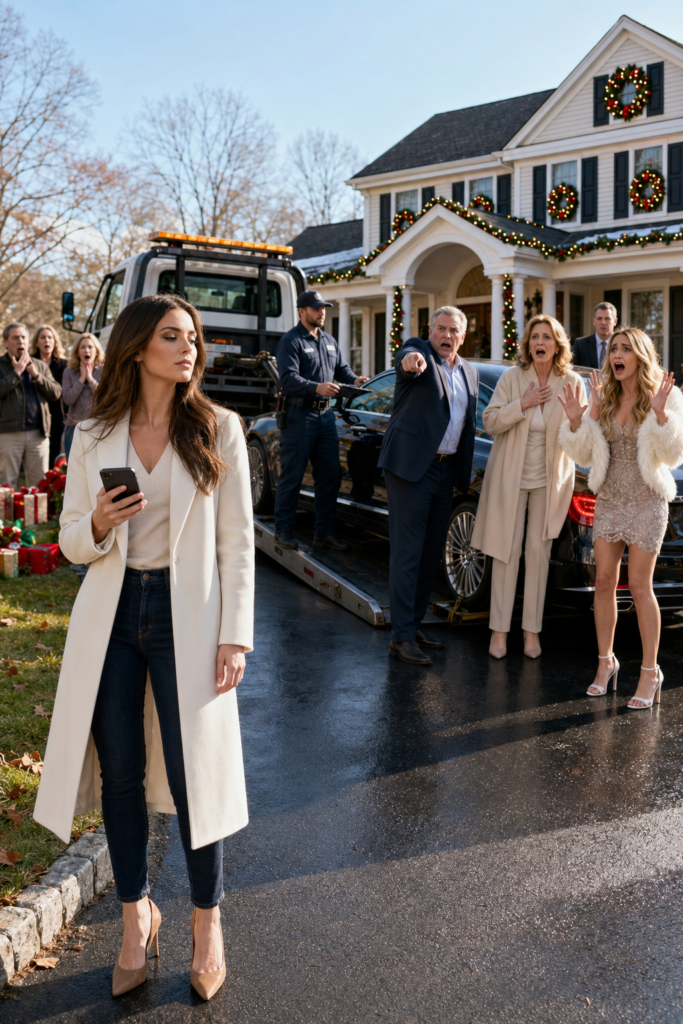
Family Ignored Me at Christmas — Then Sent Me a $25,000 Bill for Sister’s Car, So I Took Action …

They Didn’t Invite Me To Christmas But Sent A $25,000 Bill For My Sister’s Car. I Called The Bank And Said: “Repossess It. I’m Done Being Used…” They Were Shocked.
### Part 1
I saw the message while the elevator doors were closing.
Dinner starts at 7:00. Don’t be late.
The words glowed against my phone screen beneath the name Hale Family, followed by a photograph my mother had sent three minutes earlier. My father stood at the head of the dining table with a carving knife in one hand. My younger sister, Chloe, leaned toward the camera, laughing beside her husband. My aunt and two cousins occupied the far end.
Every chair was filled.
Except mine.
The elevator began moving, and the overhead lights flickered across my reflection in the brushed steel doors. I was still wearing the navy coat I had bought for the trip to Seattle. My suitcase waited in the trunk of my car at Denver International Airport, along with two carefully wrapped gifts and a bottle of bourbon my father had once claimed was impossible to find.
My flight had been scheduled for the next morning.
Apparently, Christmas dinner had been moved from December twenty-fifth to December twenty-third.
No one had told me.
I enlarged the photograph, wondering whether there might be an explanation hidden near the edges. Perhaps this was a rehearsal dinner. Maybe my mother had reused an old picture. Maybe the date displayed on my phone was wrong.
Then I noticed the centerpiece.
Three white candles surrounded by fresh cedar branches, exactly as my mother had described when she called me the previous Sunday.
“I’m doing something simple this year,” she had said. “Christmas dinner at seven. Your father expects you to be on time.”
She had meant seven o’clock two nights earlier than the date she gave me.
By the time the elevator reached the parking garage, another notification appeared.
It was an email from my father.
Subject: Chloe’s Vehicle.
No greeting. No explanation.
Attached was a statement showing a remaining balance of $25,000 on a black luxury SUV registered to Chloe and my father.
His message contained one sentence.
Transfer the full amount before the end of the month.
I stood between two concrete pillars while cold air rolled through the garage. Somewhere above me, tires hissed over wet pavement. A fluorescent bulb buzzed like an insect trapped behind glass.
I read the sentence again.
Then my phone rang.
Chloe.
I watched her name pulse until the call went to voicemail. Ten seconds later, she sent a text.
Just handle it, Nora. Dad’s already stressed. It’s not a big deal.
That phrase had followed Chloe through most of her life.
When she borrowed my college laptop and spilled coffee across the keyboard, it wasn’t a big deal.
When she used my apartment for a weekend party and left a hole in the bedroom door, it wasn’t a big deal.
When she announced her engagement during the dinner my mother had arranged to celebrate my first major cybersecurity contract, it wasn’t a big deal.
Nothing was ever a big deal when Chloe was the one taking something.
I unlocked my car but didn’t get inside. Instead, I rested both hands on the cold metal roof and looked through the windshield at the suitcase in the back.
For thirty-four years, I had occupied a strange position in my family. I was expected to arrive early, pay quietly, solve whatever went wrong, and disappear before anyone had to thank me.
They had excluded me from Christmas.
Then, before dessert was even cleared away, they had sent me a bill.
My phone buzzed again.
This time it was my mother.
Your father says you aren’t answering. Please don’t make tonight unpleasant.
I almost laughed.
Around me, strangers loaded groceries, folded strollers and argued cheerfully about forgotten gifts. Their voices echoed through the concrete structure. Ordinary lives. Ordinary frustrations. None of them knew that something inside me had just become very still.
I placed my phone on the passenger seat and drove home without turning on the radio.
Snow had begun falling by the time I entered my apartment. The rooms smelled faintly of pine cleaner and the cinnamon candle I had lit that morning. On the kitchen counter sat the itinerary for my Seattle flight.
I folded it once, then tore it down the middle.
After pouring a glass of water, I opened the attached vehicle statement on my laptop.
At first, everything looked ordinary: Chloe’s name, my father’s name, the lender, the overdue balance.
Then I reached the final page.
Beneath the borrower information was a third contact.
My company’s address.
And beside it, under “authorized financial representative,” was my name.
I had never seen the document before.
Someone had not merely expected me to pay Chloe’s debt.
Someone had already told the lender that I would.
### Part 2
I did not call my father.
That was the first decision.
The second was to print every page.
My printer hummed in the corner while snow tapped against the balcony doors. I arranged the documents across the kitchen counter in chronological order, the way I would prepare evidence for a security investigation.
The SUV had been purchased eleven months earlier from a dealership outside Seattle. Chloe had made four payments. My father had made two. After that, the account had fallen steadily behind.
There were late fees, collection notices and two rejected payment attempts.
The most recent notice was different.
It stated that an authorized representative named Nora Hale had agreed to satisfy the remaining balance before December thirty-first.
I had agreed to nothing.
The telephone number listed beside my name belonged to my father.
The email address was one I had not used since college.
That old address bothered me more than the phone number. My father could have obtained my work address from my company website. He could have found my office telephone number in seconds.
But the college email had been inactive for twelve years.
Only a few people knew it had ever existed.
I opened a clean notebook and wrote:
Vehicle owner: Chloe Hale Mercer.
Co-borrower: Richard Hale.
Claimed representative: Nora Hale.
Then I added the question I could not answer.
How did they verify me?
My phone continued vibrating on the counter. I turned it face down.
When I was eleven, I found an abandoned computer tower in our garage. The beige casing had yellowed near the vents, and every fan blade wore a thick gray coat of dust. I dragged it onto the kitchen table and removed the side panel with one of my father’s screwdrivers.
I knew almost nothing about computers then. I only understood that the mess of wires and green boards followed rules. Each piece had a purpose. Every connection could be traced.
My father entered while I was studying the motherboard.
He kept his coat on and looked at the scattered screws.
“Waste of time,” he said. “Do something real.”
Behind him, nine-year-old Chloe ran in holding a drawing of a horse wearing a crown.
My father crouched beside her.
“Now that’s talent.”
He taped the picture to the refrigerator while I carried the computer back to the garage.
That machine became the first system I ever rebuilt.
I worked on it after everyone went to bed, using library books and parts purchased with babysitting money. When it finally started, the monitor flashed blue, the fan rattled, and I felt as though I had opened a door no one else could see.
My family never asked how I did it.
Years later, they still described my work as “computer stuff.”
They did not know that the company I co-founded protected hospital networks, financial systems and municipal databases across six states.
They did not know my income.
They did not know about the acquisition offers.
They did not know because they had never asked.
Yet someone had known enough to use an old email address and my company’s name.
I opened the lender’s website and called the fraud department through the number listed there, not the number printed on the suspicious statement.
A woman named Marisol answered. Her voice was careful and professional.
I explained that I had been falsely identified as an authorized financial representative. She asked me to verify my identity and then placed me on hold.
Soft piano music played for nearly six minutes.
When she returned, her tone had changed.
“Ms. Hale, I need to be precise. Our record does not list you only as a contact. It shows that you submitted a written payment assurance.”
“I didn’t.”
“The assurance included an electronic signature.”
“I didn’t sign it.”
Another pause.
“Do you recognize the email address ending in northlake.edu?”
“It was mine in college.”
“The submission came from that address.”
A chill moved across my shoulders.
“That account hasn’t existed for years.”
Marisol advised me to file an identity-theft report and send a written dispute. She also warned that the vehicle was already eligible for repossession.
“Will my dispute stop that?” I asked.
“No. The borrowers are in default regardless of the disputed assurance.”
I looked at Chloe’s name on the statement.
“Then proceed according to your policy.”
After the call, I logged into the university’s archived account portal. To my surprise, the email address still existed as part of a lifetime alumni service.
The password had been changed twelve days earlier.
A recovery request had been sent to a secondary email.
I clicked the masked address.
Only three letters were visible before the domain.
D-I-A.
My mother’s name was Diane.
I stared at the screen until the letters seemed to float.
My father might have made the demand, but he had not done this alone.
### Part 3
At 6:14 the next morning, my father left his first voicemail.
“Nora, call me immediately.”
At 6:19, he left another.
“This is not how family behaves.”
By seven, there were nine missed calls.
I made coffee.
The grinder roared through the apartment, sharp and ordinary. I watched dark grounds tumble into the filter while my father’s tenth call vibrated across the counter.
I had spent most of my life responding quickly whenever he summoned me. Even after I moved to Denver, the old reflex remained. His name appeared, and some part of me became seventeen again, standing in the kitchen while he explained what I had done wrong.
That morning, I let the phone ring.
At 8:03, Chloe sent a photograph.
Her black SUV was being pulled onto a flatbed truck outside my parents’ house. She stood on the porch wearing plaid pajama pants and white slippers. My father pointed furiously at the tow operator. My mother hovered behind the glass storm door, one hand pressed to her throat.
The caption said:
WHAT DID YOU DO?
I replied with four words.
I declined your bill.
Her answer came immediately.
You reported the car.
I set my coffee down.
No, Chloe. The lender repossessed a vehicle after the borrowers stopped paying.
Three dots appeared, vanished, then appeared again.
You knew this would happen.
I did know, but only because I had read the documents they sent me. Chloe and my father had apparently expected me to see the $25,000 total, panic and transfer the money before asking questions.
That had worked before.
Not with a car, but with smaller things.
A $2,400 property-tax shortage my father claimed was temporary.
A $1,700 emergency veterinary bill for Chloe’s dog.
A $3,800 deposit for a family vacation I was later unable to attend because Chloe had changed the dates.
Each request arrived with urgency. Each repayment was implied. None ever came.
I had told myself I was helping.
The truth was less flattering.
I had been purchasing moments of peace.
My mother called just after nine.
Unlike my father, she left no voicemail. Instead, she sent a message.
Please tell me you’re safe.
I read it twice.
During childhood, my mother had often asked similar questions after my father lost his temper. She would enter my room quietly, sit at the edge of the bed and ask whether I was all right. If I said no, she rubbed my shoulder.
Then she returned downstairs and behaved as though nothing had happened.
Her concern had always arrived after the damage, never before.
I typed:
I’m safe. Are you?
She did not answer.
At ten, I joined a video call with my co-founder, Miles Carter. He appeared on-screen wearing a gray sweater, his dark hair still damp from the shower. Behind him, the engineering office was almost empty for the holiday week.
“You look like you slept in a server room,” he said.
“Family problem.”
“Small family problem or Thanksgiving-documentary family problem?”
“Christmas-documentary.”
He waited.
Miles and I had built Sentinel North from a rented two-room office above a dentist. In the early days, we survived on vending-machine crackers and contracts no established firm wanted. He knew I hated discussing my family and respected the boundary.
But he also knew when I was leaving out something important.
I told him about the car and the false payment assurance.
His expression sharpened.
“They used your company address?”
“Yes.”
“That’s not a family disagreement, Nora. That’s fraud.”
“I know.”
“Have they accessed anything else?”
“I’m checking.”
After the call, I reviewed personal credit reports, banking alerts and business filings. Nothing appeared unfamiliar. No new loans. No unknown accounts.
For a brief moment, I wondered whether the vehicle document was an isolated act. Perhaps my parents had panicked. Perhaps my mother had recovered the old email because she assumed I would eventually agree.
Then I received a message from our corporate attorney, Julia Bennett.
Miles had asked her to conduct an emergency search of public filings connected to my name.
Julia attached three documents.
The first two were ordinary.
The third was a financing statement filed eight months earlier in Washington State.
The debtor was listed as a company called Hale Family Hospitality LLC.
The secured party was a private lender.
And under additional guarantors, someone had entered my full legal name.
The address beside it was my childhood home.
My family had not started using my identity twelve days ago.
They had been building something behind my back for months.
### Part 4
Hale Family Hospitality LLC had been formed the previous spring.
The registered members were my father and Chloe.
Its business address was a two-story brick building in Tacoma that had once housed a neighborhood restaurant. I found photographs online: boarded side windows, faded green awnings and a weathered sign that still read The Mariner’s Table.
I had never heard my family mention it.
That alone was unusual.
My father narrated every investment as though he were delivering a lecture at Harvard Business School. When he bought a rental condominium, we heard about interest rates for three Christmases. When he purchased stock in a regional grocery chain, he sent weekly articles to the family group thread.
Yet an entire company had remained secret.
Julia called me before lunch.
“The filing doesn’t prove you signed a guarantee,” she said. “It shows the lender believes you did.”
“Can we get the underlying document?”
“We can demand it, but they may require an identity-theft affidavit first.”
“Send whatever is necessary.”
“Nora, I need to ask something uncomfortable. Does anyone in your family have access to copies of your identification?”
My eyes moved toward the locked file cabinet beside my desk.
“My mother might have an old copy of my passport. She kept family documents when I was younger.”
“Social Security number?”
“Both parents know it.”
“Signature samples?”
“They have birthday cards, tax forms, school records.”
Julia sighed softly.
“That’s what I was afraid of.”
At 1:30, my building concierge called.
“Ms. Hale, there are three people here asking to see you.”
I already knew who they were.
Through the security camera application, I saw my father in the lobby wearing a dark wool coat. Chloe stood beside him, her arms folded tightly. My mother remained several feet behind them, staring at the floor.
My father looked directly into the camera above the reception desk.
“Nora,” he said loudly, though the camera carried no audio to the lobby. “Come down.”
I told the concierge not to admit them.
Ten minutes later, my father called from an unknown number. I answered because I wanted a record of the conversation.
“You had security turn us away?” he demanded.
“You arrived without permission.”
“We flew here because you refused to behave rationally.”
“Sending me a stranger’s debt is not rational.”
“Your sister is not a stranger.”
“The loan is.”
A car horn sounded behind him. They were standing outside on the snowy curb.
“You let them take her vehicle two days before Christmas.”
“I did not make her stop paying.”
“She needed time.”
“Then she should have called the lender.”
“She called you.”
“She sent me a demand for $25,000 after excluding me from Christmas dinner.”
My father inhaled sharply.
“That dinner was changed because Chloe’s husband had to work on Christmas Day.”
“And no one could tell me?”
“It happened quickly.”
“The photograph was posted after everyone was seated.”
“You’re being dramatic.”
There it was: the phrase he used whenever facts did not favor him.
I opened Julia’s attachment on my laptop.
“Why did you form Hale Family Hospitality?”
The line went silent.
Outside, wind moved against my balcony glass.
My father recovered first.
“That has nothing to do with this.”
“Why is my name listed as a guarantor?”
Chloe said something in the background. My father covered the phone, but I heard the edge of panic in her voice.
“Nora,” he said, slower now, “you’re looking at documents you don’t understand.”
“I understand secured financing.”
“No one asked you to investigate us.”
“You used my name.”
“We listed family assets for preliminary approval. It was never finalized.”
“My identity is not a family asset.”
My mother’s voice rose faintly behind him.
“Richard, tell her.”
“Tell me what?”
He ignored the question.
“Call the lender and fix the car. Then we can discuss the rest privately.”
“No.”
“You are jeopardizing something much larger than you realize.”
His words were intended as a warning. Instead, they confirmed that the car was only one piece of the problem.
“What am I jeopardizing?”
My father lowered his voice.
“Your sister’s future.”
I looked again at the photograph of the boarded restaurant.
“What did Chloe buy?”
He ended the call.
A minute later, my mother sent a message.
Please don’t contact the restaurant lender yet. Give me one day to explain.
Before I could respond, another email arrived from Julia.
The private lender had produced the guarantee.
The final page carried a signature resembling mine.
But the document contained something far more disturbing than the forgery.
It pledged my shares in Sentinel North as collateral.
### Part 5
For several seconds, I could hear nothing except the blood beating in my ears.
My shares in Sentinel North were not merely valuable. They represented thirteen years of work, sleepless nights, failed product launches, difficult hiring decisions and every risk Miles and I had taken when no one believed our company would survive.
My family had pledged them to support a business they had never mentioned.
“Is the guarantee enforceable?” I asked Julia.
“Not if the signature is fraudulent.”
“Could the lender interfere with the company while this is investigated?”
“They could try. We’ll notify them immediately that the pledge is disputed and unauthorized.”
“Do it.”
Julia’s voice remained calm.
“I also want to involve federal investigators. The transmission crossed state lines, and the claimed collateral concerns a Colorado corporation.”
The word federal made my stomach tighten.
I had wanted distance, not destruction. A clean refusal. A boundary.
But the image of my father standing in the lobby returned to me. He had not come to apologize or explain. He had traveled twelve hundred miles to order me back into compliance.
“What happens to my family?” I asked.
“That depends on who created and submitted the documents.”
I turned toward the window. Denver’s streets were white with fresh snow, and pedestrians moved below like dark strokes across paper.
“Proceed.”
That afternoon, Miles came to my apartment carrying two paper bags from a Thai restaurant. The scent of basil, ginger and roasted peppers filled the kitchen.
“You haven’t eaten,” he said.
“I had coffee.”
“That’s not food. That’s anxiety with a lid.”
He placed a carton in front of me and read the guarantee while I forced myself to take several bites.
Miles stopped at the collateral paragraph.
“They pledged your founder shares?”
“They tried.”
“Why?”
“I don’t know yet.”
He scanned the company filing.
“A restaurant doesn’t normally require collateral like this unless the project is much bigger than a restaurant.”
That thought had occurred to me too.
We searched county records. The brick building had been purchased for $920,000 by Hale Family Hospitality. A second parcel behind it had been acquired three months later.
The rear parcel included a warehouse and river access.
The total debt exceeded $2.8 million.
“What were they planning?” Miles asked.
I found the answer inside an archived city-council agenda.
Hale Family Hospitality had applied for permits to build a boutique waterfront hotel with a restaurant, event space and twelve luxury suites.
The project description named Chloe as creative director.
My father was managing partner.
Projected opening: the following summer.
There were glossy renderings of stone patios, glass balconies and fire pits overlooking the water. The proposed name was The Serena House, using Chloe’s middle name.
I clicked through image after image.
My father had once called my software career a waste of time.
Now he had tried to mortgage the company that career created so Chloe could put her name on a hotel.
Near the end of the application packet, I found a letter of financial capacity. It stated that the Hale family had access to substantial technology-sector assets through a founding shareholder of Sentinel North.
My name was not printed in the public copy.
But there was no other founding shareholder in their family.
Miles leaned back.
“How many people have they told that you’re supporting this?”
I thought of my father’s pride, Chloe’s need to appear successful and my mother’s talent for turning lies into gentle omissions.
“Probably everyone who matters.”
At 6:40, my mother finally called.
I answered and activated the recording notice required by my phone system.
Her breathing sounded shallow.
“Nora, your father made a terrible mistake.”
“Did you recover my college email?”
Silence.
“Mom?”
“He said it was only to send documents.”
“You reset the password?”
“He told me you had agreed in principle.”
“I had never heard of the company.”
“I know that now.”
Her admission was so quiet I almost missed it.
“You knew before today.”
Another silence.
“How long?”
“Since September.”
The restaurant financing had closed in October.
“You knew before they submitted the guarantee.”
“I didn’t know he would use your signature.”
“But you gave him access to my email.”
She began crying. Softly, carefully, as if even her grief was afraid to take up space.
“I thought once the project succeeded, he would tell you everything and repay the loan.”
“With what money?”
She did not answer.
I looked at the hotel rendering on my screen. In the corner, beneath the architect’s logo, was a small handwritten note visible in the scanned copy.
Phase Two funded after Sentinel North transaction.
My fingers went cold.
“What transaction?”
My mother drew a broken breath.
“Nora, has your company received an acquisition offer?”
I had told no one in my family that we were negotiating one.
Yet somehow, my father had built his entire project around it.
### Part 6
Only six people knew about the acquisition discussions.
Miles and I.
Julia.
Our chief financial officer.
Two representatives from the purchasing company.
The negotiations had been conducted under strict confidentiality. Even most of Sentinel North’s senior staff did not know.
My mother waited on the phone.
“How did Dad hear about an acquisition?” I asked.
“He said you were going to become extremely wealthy.”
“That doesn’t answer the question.”
“I don’t know.”
“Did he mention a company name?”
“No.”
“A price?”
She hesitated.
That hesitation was the answer.
“What number?”
“Nora, I don’t want to make this worse.”
“You helped him access my email and stayed silent while he used my name. It is already worse.”
“He said your shares might be worth forty or fifty million dollars.”
The estimate was frighteningly close.
I stood so quickly that the chair legs scraped across the floor.
“Who told him?”
“He wouldn’t say.”
I ended the call and phoned Julia.
Within an hour, our internal response team was reviewing access logs, employee communications and file activity. The office holiday quiet disappeared. Engineers connected from home. Legal staff opened secure channels. Miles drove back to headquarters.
At 9:20, we found the first anomaly.
Three months earlier, someone had accessed a confidential valuation folder using the credentials of a junior accounting employee named Bethany Cole. The login originated from a residential internet address in Washington.
Bethany lived in Denver.
Her credentials had been stolen.
The Washington address belonged to Chloe’s husband, Aaron.
I stared at the record.
Aaron worked in commercial insurance. He had no technical background that I knew of, but he had attended our company anniversary party in September. Employees had used tablets at the registration desk. Guests signed into the building’s network.
“He could have captured credentials,” Miles said, standing beside me in the darkened conference room. “Or Chloe could have asked someone else.”
The building’s heating system clicked overhead. Beyond the glass walls, rows of empty desks sat beneath emergency lights.
I remembered Chloe at the anniversary party.
She had arrived late wearing a silver dress and complained that the event photographer had not taken enough pictures of her. At one point, she asked me for a private tour.
I had been pulled into a conversation with an investor, so Bethany showed her around.
Two days later, Chloe texted me:
Your office is cute. Still can’t believe people pay for this stuff.
At the time, I had rolled my eyes and deleted it.
Now I searched Bethany’s account activity.
The unauthorized user opened board summaries, capitalization tables and an acquisition briefing. They also downloaded an old corporate directory containing my office address and contact details.
“Do we call the police now?” Miles asked.
“Julia is contacting them.”
He studied my face.
“You don’t have to protect your family from the consequences of this.”
“I know.”
But knowing and feeling were not the same.
I walked into my office and closed the door.
On the shelf beside my desk stood a framed science-fair certificate from tenth grade. My mother had found it in a drawer years later and mailed it to me without a note. The paper was creased through the center. A faint coffee stain marked one corner.
I had kept it because it reminded me that neglect did not erase achievement.
Now I wondered whether my mother had sent it out of pride or guilt.
My phone rang at 10:06.
Chloe.
This time, I answered.
“You called law enforcement?” she shouted.
“I reported unauthorized access to my company.”
“Aaron didn’t steal anything.”
“I didn’t mention Aaron.”
She stopped.
The silence between us lasted less than a second, but it told me everything.
“Nora, listen. Dad said you were selling the company. He said you wanted to help us.”
“I never said that.”
“You always act like money doesn’t matter to you.”
“Because I don’t discuss my finances with you.”
“You have more than you could ever spend.”
“That does not make it yours.”
Her voice hardened.
“You were going to let us fail while sitting on millions?”
“You excluded me from Christmas and sent me a $25,000 bill.”
“That dinner wasn’t about you.”
“Exactly.”
I heard Aaron speaking urgently in the background.
Then Chloe lowered her voice.
“If the hotel loan collapses, Mom and Dad lose the house.”
The words landed heavily.
“What?”
“Dad borrowed against everything. The house, his retirement accounts, the cabin. He said your company sale would cover the final construction phase.”
My father had not merely lied to a lender.
He had gambled my parents’ entire life on money I had never promised.
Before I could respond, Chloe whispered, “There’s something else.”
A loud male voice interrupted her. The line went dead.
Seconds later, she sent a photograph of a document lying on a marble countertop.
It was a life-insurance policy.
The insured person was my mother.
The beneficiary was Hale Family Hospitality LLC.
### Part 7
The policy itself was not suspicious.
Business owners sometimes carried insurance tied to debt obligations. Couples named trusts, companies or each other as beneficiaries. Nothing on the page proved wrongdoing.
Still, the photograph unsettled me.
My mother’s signature appeared at the bottom.
The date was six weeks earlier.
Coverage amount: $3 million.
I called Chloe back. She did not answer.
I enlarged the photograph and noticed a yellow sticky note near the upper edge.
Bridge requirement satisfied.
The handwriting looked like my father’s.
Miles stood in my doorway.
“Julia says investigators are on their way.”
I turned the phone toward him.
He read the page, then looked at me.
“We should not speculate.”
“I know.”
“Has your mother been ill?”
“Not that I know of.”
“Did she understand the policy?”
“I don’t know.”
The investigators arrived at midnight. Special Agent Lauren Hayes had close-cropped dark hair, a gray overcoat and the patient expression of someone accustomed to hearing complicated lies.
Her partner, Agent Daniel Ruiz, carried a laptop case and spoke very little.
We gave them access logs, the fraudulent guarantee, the vehicle assurance and the acquisition documents. Hayes asked methodical questions about my family’s finances and personal relationships.
“Has your father ever threatened you?” she asked.
“Not directly.”
“Controlled your money?”
“He tried when I was younger.”
“Asked you to conceal transactions?”
“He called them family matters.”
“Do you believe your mother is participating willingly?”
I thought of her resetting my email password, knowing about the guarantee and remaining silent since September.
“I believe she chooses compliance because it feels safer than resistance.”
Hayes wrote something down.
“That is not the same as innocence.”
“No.”
Saying it aloud hurt more than I expected.
At 1:35, Julia received confirmation that the private lender had frozen all further disbursements to Hale Family Hospitality. Construction payments would stop immediately. The claimed pledge of my company shares had been flagged as fraudulent.
By morning, the hotel project would be financially paralyzed.
My phone displayed twenty-three missed calls from my father.
One voicemail arrived while I sat across from Agent Hayes.
I played it on speaker.
“Nora, whatever story you’ve invented, stop. You are damaging your own family over paperwork. Call the lender and confirm your support. Do it before morning.”
His voice remained steady until the final sentence.
Then a crack appeared.
“If you don’t, everything we built is gone.”
Agent Hayes asked, “Had you built any part of it?”
“No.”
“Did you invest?”
“No.”
“Did you consent to the use of your name?”
“No.”
“Then his wording is informative.”
Everything we built.
My father still considered my success a family possession, even though he had dismissed every step required to create it.
At 3:00, I drove home through empty streets. Snowplows had pushed gray ridges against the curbs. Holiday lights glowed from apartment balconies, red and gold behind curtains.
Inside my apartment, the air felt stale. I opened the balcony door, letting cold wind move through the kitchen.
A voicemail from my mother waited.
“Nora, I need you to understand something. Your father believed the project would repair our family. He thought if Chloe succeeded, we could all be together again. He said you would eventually see that.”
I paused the recording.
Our family had not been broken because Chloe lacked a hotel.
It had been broken because love was distributed according to usefulness.
I resumed.
“I should have told you. I should have stopped him. But there are things about the financing I didn’t understand until recently. I found documents. I hid copies where he wouldn’t see them.”
Her voice dropped to a whisper.
“There is a safe-deposit box at Rainier Community Bank. Box 418. Your name is listed as an authorized visitor. The key is inside the blue ceramic bowl in my sewing room.”
A sound came through the recording.
A door opening.
My father’s voice asked who she was calling.
The voicemail ended abruptly.
I replayed the final seconds.
Just before the line went dead, my mother had whispered four words.
“Don’t trust Chloe either.”
### Part 8
Christmas Eve morning arrived under a hard blue sky.
The first flight to Seattle was nearly empty. I sat beside the window with my coat folded across my lap, watching Colorado disappear beneath a sheet of cloud.
I had canceled this same trip less than forty-eight hours earlier.
Now I was traveling for a safe-deposit box, a hidden key and a warning from the mother who had helped steal my identity.
Agent Hayes knew where I was going. She had contacted federal officers in Washington and told me not to enter my parents’ house alone.
Rainier Community Bank stood on a quiet street near a bakery and a hardware store. Wreaths hung in the front windows. Inside, the carpet smelled faintly of dust and peppermint.
The branch manager examined my identification and confirmed that I had been added as an authorized visitor three months earlier.
“By whom?” I asked.
“Diane Hale.”
My mother had prepared an escape route long before she used it.
The safe-deposit box was narrow and surprisingly light. Inside were no jewelry, cash or family photographs.
Only documents.
I spread them across a private viewing table.
There were copies of loan applications, contractor invoices and emails between my father, Chloe and Aaron. Some messages discussed construction delays. Others discussed “Nora’s liquidity event” as though my company sale were guaranteed.
Then I found an email that changed the shape of everything.
It was written by Chloe to my father.
Nora doesn’t need to know until closing. Once the money is committed, she won’t embarrass us publicly by backing out. She cares too much about appearing responsible.
My father replied:
Your mother will handle the account access. Keep Aaron focused on the valuation.
Another message followed two days later.
Aaron says the company data supports at least $45M for Nora’s portion. Even if she refuses to invest, the family participation agreement gives us leverage.
I searched the box.
At the bottom was a document titled Hale Family Participation Agreement.
The paper claimed that all immediate family members had agreed to contribute ten percent of major financial windfalls to a shared investment fund. My signature appeared beside a date from six years earlier.
I remembered that date.
It was the day of my grandmother’s funeral.
My father had placed several papers before me at the funeral reception and said they concerned cemetery expenses and estate acknowledgments. I signed while relatives moved around us carrying casseroles and paper cups of coffee.
One of those pages must have been substituted or copied.
The agreement was absurd and almost certainly unenforceable, but it explained my father’s confidence. He believed he had created a moral and legal claim to my money.
I photographed every page.
The final folder contained records of transfers from my parents’ joint account into Hale Family Hospitality.
Most were large and regular.
One was different.
A $180,000 deposit had been made from the estate of my late grandmother, Margaret Hale.
My grandmother’s will had divided her remaining estate equally between Chloe and me.
I had received nothing.
Attached was a handwritten note from my mother.
Nora, I discovered this after the hotel loan closed. Your father told the estate attorney you had disclaimed your inheritance. I searched his office and found the waiver. I do not believe the signature is yours.
My hands began shaking.
Grandma Margaret had been the only person in my childhood who entered the garage and asked what I was building. She bought me my first toolkit. When I left for college, she pressed a twenty-dollar bill into my palm and said, “Make something no one can take from you.”
My father had taken the last thing she meant to leave me and given it to Chloe’s project.
At the bottom of the box lay a flash drive.
I inserted it into an isolated laptop Agent Hayes had provided.
There was one audio file.
My father’s voice came first.
“If Nora creates trouble, we show the participation agreement. She won’t risk the company’s reputation.”
Then Chloe laughed.
“She’ll fold. She always does.”
A third voice responded.
Aaron.
“And if she doesn’t?”
My father answered without hesitation.
“Then we make sure the acquisition disappears before she can sell.”
### Part 9
The audio recording lasted fourteen minutes.
For most of it, my family discussed me as a financial obstacle rather than a person.
Aaron had discovered the acquisition through stolen employee credentials. My father wanted enough information to convince the hotel lender that my future proceeds were available. Chloe wanted construction finished before summer so she could host a celebrity wedding influencer she had met online.
They assumed that once public announcements were made, I would contribute rather than expose the fraud.
But near the end, the conversation turned darker.
Aaron worried that if I discovered the unauthorized access, Sentinel North would report it and he could lose his insurance license.
My father proposed sending anonymous information to the acquiring company, suggesting Sentinel North had concealed a security breach.
The allegation would be false, but an investigation could delay or destroy the deal.
“We only need leverage,” my father said. “Nora understands consequences.”
My mother had apparently recorded the conversation from the hallway.
I sent the file to Agent Hayes and Julia.
Within an hour, the acquisition representatives were notified of the attempted interference. Julia assured them that the unauthorized access had been contained and documented. They agreed to continue negotiations but requested additional verification.
My family had already caused damage.
Not fatal damage, but real damage.
I left the bank shortly before noon.
Two federal agents waited outside. One escorted me to a black sedan while the other remained near the entrance.
“Your mother has agreed to meet us,” Agent Hayes told me by phone. “She is currently at a friend’s house.”
“My father?”
“At the project site with Chloe and Aaron.”
“Do they know about the box?”
“We don’t believe so.”
I looked through the car window at wet streets and gray winter trees.
“I want to see my mother.”
We met at a small hotel near the airport. She opened the door wearing the same cream sweater from the Christmas photograph. Without makeup, she looked older than she had two nights earlier.
Her eyes moved over my face.
“You came.”
“You told me where to look.”
She stepped aside.
The room smelled of coffee and hotel soap. A suitcase lay open on the bed, filled with clothes packed in uneven stacks.
My mother sat in the desk chair. I remained standing.
“Why didn’t you tell me earlier?”
“I was afraid.”
“Of Dad?”
“Of what would happen if the project failed. Of losing the house. Of Chloe blaming me. Of you never speaking to me again.”
“You were afraid I would stop speaking to you, so you helped them steal from me?”
Her face crumpled.
“When you say it like that—”
“How else should I say it?”
She pressed a tissue against her mouth.
“I kept believing Richard would fix it before you found out.”
“He stole Grandma’s inheritance.”
“I discovered that later.”
“And you still stayed.”
“I collected evidence.”
“You stayed.”
She lowered her eyes.
The silence felt like the kitchen of my childhood, heavy with everything she would not say.
“Did you move Christmas dinner intentionally?” I asked.
Her fingers tightened around the tissue.
“Your father didn’t want you there.”
“Why?”
“Chloe was going to announce the hotel project to the extended family. He was afraid you would ask questions.”
“So you let me believe I was invited.”
“I planned to call you afterward.”
“To tell me what?”
She had no answer.
I looked at the woman who had asked whether I was safe while repeatedly choosing the people who made me unsafe.
“Did Chloe know about my inheritance?”
“Yes.”
“Did she know my signature was forged?”
“Yes.”
“Did she know Aaron stole company information?”
My mother began to cry again.
“Yes.”
The answer removed the final excuse I had been holding for my sister.
Chloe had not been a passive beneficiary of our father’s favoritism.
She had become his partner.
A knock sounded at the door.
Agent Hayes entered with another woman carrying a document envelope.
“Nora,” Hayes said, “we need to show you something recovered from the project lender.”
The envelope contained a recent email drafted from an anonymous account but never sent.
It accused me of illegally selling customer data through Sentinel North.
Attached were fabricated screenshots designed to resemble internal records.
The document metadata identified its creator.
Not my father.
Not Aaron.
Chloe.
### Part 10
I called Chloe from the hotel room.
Agent Hayes advised me not to reveal the evidence, but she allowed the call to be recorded.
Chloe answered on the second ring.
“Are you happy now?”
Her voice was raw, as if she had been shouting.
“Where are you?” I asked.
“At the hotel site, watching Dad’s entire life fall apart.”
“His life?”
“You know what I mean.”
“No, I don’t.”
Behind her, machinery beeped. Wind rushed across the microphone.
“The lender froze everything,” she said. “Contractors are walking off. Dad had to tell the staff there won’t be paychecks.”
“How many employees?”
“Twenty-three.”
Twenty-three people had been hired for a project financed with fraud and imaginary money.
“Did they know the funding wasn’t secure?”
“Of course not.”
“Then your father lied to them too.”
“He believed you would help.”
“You all believed you could force me.”
“You’re my sister.”
“You tried to destroy my company’s acquisition.”
She stopped breathing for a moment.
“I don’t know what you’re talking about.”
“The anonymous accusations. The fabricated screenshots.”
“Nora—”
“The file still had your name in the metadata.”
A metallic crash sounded in the distance.
When Chloe spoke again, the anger had drained from her voice.
“I wasn’t going to send it.”
“You created it.”
“Dad said we needed insurance.”
“You fabricated evidence accusing me of a crime.”
“I was scared.”
“So was Mom. Apparently fear is the family excuse for every betrayal.”
“You don’t understand what this project means.”
“Then explain it.”
Her breath trembled.
“All my life, you were the smart one.”
I nearly laughed at the absurdity.
“Dad treated you like you were incapable of failure.”
“Because he knew I wasn’t like you.”
“What does that mean?”
“You could leave. You could build something. Every time you walked into a room, people knew you belonged there.”
“That was not my childhood.”
“You always looked down on us.”
“I paid your bills.”
“Exactly!” she shouted. “You made everything look easy. Dad talked about your company constantly when you weren’t around. He compared every idea I had to what you built.”
I sat slowly on the edge of the hotel bed.
For years, I had believed my father dismissed my success.
Perhaps he had publicly. Privately, he had turned it into another weapon, this time against Chloe.
“That doesn’t justify stealing from me.”
“I wanted one thing that was mine.”
“So you named a hotel after yourself using my inheritance, my identity and my company.”
She began crying.
For once, the sound did not activate my old instinct to rescue her.
“I thought after it opened, I could repay everything.”
“With what?”
“Events. Weddings. The restaurant. Aaron had projections.”
“Projections are not money.”
“Stop talking to me like I’m stupid.”
“Then stop demanding that I ignore stupid decisions.”
She inhaled sharply.
“You’ve always hated me.”
“No, Chloe. Hating you would have required me to stop making excuses for you years ago.”
My mother turned away, covering her face.
On the phone, Chloe whispered, “What are you going to do?”
“I’m cooperating with the investigation.”
“You would send Dad to prison?”
“I am not controlling the outcome.”
“You could tell them it was a misunderstanding.”
“It wasn’t.”
“Nora, please.”
The word please sounded strange coming from her. Chloe usually preferred commands disguised as assumptions.
“You didn’t invite me to Christmas because you wanted to celebrate a project built on stealing from me.”
“That was Dad’s decision.”
“And you sat at the table.”
She said nothing.
I ended the call.
That evening, agents executed search warrants at my parents’ home, Aaron and Chloe’s house and the hotel project office.
My father was questioned and released pending further action. Aaron surrendered his computers. Chloe refused to leave the project site until an agent warned her she could be arrested for obstruction.
At 9:00, Julia called.
“The good news is the acquisition remains active.”
“And the bad news?”
“The buyer wants a thirty-day delay. They need to evaluate whether the fabricated allegations could create reputational risk.”
Thirty days could become sixty. It could become an excuse to reduce the price or abandon the deal.
My family had not succeeded in destroying what I built.
But they had reached it.
As I ended the call, my mother touched my arm.
“There is one more thing,” she said. “Your father didn’t choose the Christmas date alone.”
I looked at her.
“Chloe moved it. She knew you would be traveling the next day.”
“Why?”
My mother’s answer was barely audible.
“Because someone was supposed to enter your apartment while you were in the air.”
### Part 11
The Denver police found no sign of forced entry.
That made sense.
My mother had mailed my father a spare apartment key two years earlier after I left it at their house during a visit. She told me she had sent the only copy.
She had not.
Security footage showed a man entering my building on December twenty-four at 8:12 in the morning, the exact time my original flight would have been crossing Idaho.
He wore a delivery uniform and carried an empty shipping box.
The key opened my apartment door.
He remained inside for eleven minutes.
Because I had canceled the flight and changed the building access list, he never reached the residential floor. The concierge stopped him when his visitor authorization failed. He claimed to have the wrong building and left before police arrived.
Investigators identified him as a private investigator named Lucas Vane.
My father had hired him.
Vane later admitted he had been instructed to locate computers, contracts or printed documents relating to the Sentinel North acquisition. He claimed my father told him the apartment belonged to a business partner who had withheld shared records.
The Christmas dinner had served two purposes.
Keep me away from the hotel announcement.
Convince me nothing unusual was happening before my scheduled flight.
The $25,000 bill was supposed to arrive after Vane searched my apartment. My father sent it early because the car lender scheduled repossession sooner than expected.
Their timing mistake exposed everything.
On December twenty-six, I returned to Denver with my mother.
She stayed in a hotel. I refused to let her stay in my apartment.
At headquarters, our security team replaced credentials, reviewed every system and interviewed employees who had interacted with Chloe or Aaron. Bethany Cole blamed herself for the stolen access until I reminded her that skilled manipulation was designed to create misplaced shame.
I understood misplaced shame better than most people.
Three days later, my father appeared outside the office.
This time, he did not shout at security. He waited on the public sidewalk beneath a gray sky, hands deep in his coat pockets.
I agreed to meet him in a conference room with Julia present.
He looked smaller than he had in my apartment lobby. His cheeks were unshaven. The skin beneath his eyes sagged with exhaustion.
Still, when he sat down, he arranged his expression into familiar authority.
“This has gone far enough.”
Julia placed a recorder on the table.
My father glanced at it.
“Is that necessary?”
“Yes,” I said.
He looked at me for a long moment.
“I built that project for this family.”
“You built it with stolen money and forged documents.”
“I made temporary arrangements.”
“You stole my inheritance.”
“Your grandmother’s money would have produced nothing sitting in an account.”
“It was mine to decide.”
“You had millions coming.”
“You did not know that.”
“I knew enough.”
“You hired someone to enter my home.”
His jaw tightened.
“To retrieve information that affected all of us.”
“My company does not affect all of you.”
“Everything you have came from this family.”
The statement was so detached from reality that I almost admired it.
“What exactly did you give me, Dad?”
“A home. Food. Education.”
“You gave Chloe a car at sixteen. You gave me a handshake.”
“She needed transportation.”
“You called my first computer a waste of time.”
“You were a child playing with garbage.”
“That garbage led to the company you tried to pledge as collateral.”
He leaned forward.
“I pushed you. That is why you succeeded.”
There it was.
He had rewritten neglect as strategy.
Dismissal became motivation. Favoritism became discipline. Theft became family planning.
“You did not build me,” I said. “You simply made sure I learned to build without you.”
His eyes hardened.
“The lender will take our house.”
“I know.”
“Your mother will have nothing.”
“She can seek her legal share during the separation.”
His head snapped toward me.
“What separation?”
My mother had met with a divorce attorney that morning.
I watched the news reach him.
For the first time, Richard Hale looked genuinely afraid.
“You turned her against me.”
“No. Your choices finally became too expensive for her to ignore.”
He stood.
Julia calmly told him the meeting was over.
At the door, he looked back.
“You think these people at your company are your family? The moment the money is gone, they’ll leave.”
I thought of Miles bringing food without asking for anything. Bethany working through Christmas to protect colleagues. Julia sitting beside me while my own father tried to intimidate me.
“They showed up,” I said. “You sent an invoice.”
His face twisted.
“You’ll regret humiliating us.”
Then he left.
That night, federal prosecutors filed charges related to wire fraud, identity theft and conspiracy against my father, Aaron and Chloe.
My mother was not charged immediately because of her cooperation.
But one unresolved question remained.
Someone had authorized the transfer of my grandmother’s inheritance years before the hotel project began.
And the estate attorney insisted he had verified the waiver with me by phone.
### Part 12
The estate attorney’s name was Franklin Moore.
He was seventy-two, semi-retired and deeply offended by the suggestion that he had approved a fraudulent waiver.
“I spoke to Nora Hale personally,” he told Agent Hayes. “She confirmed she wanted her share transferred to her sister.”
“Did you know Nora before that call?” Hayes asked.
“No.”
“Was it a video call?”
“Telephone.”
“What questions did you ask to verify her identity?”
Franklin produced his notes.
The caller knew my birth date, Social Security number, college name, childhood address and my grandmother’s nickname for me.
Maggie-Bee.
Only family members knew that name.
The call recording had been archived.
The voice did not belong to Chloe.
It belonged to my mother.
She confessed after hearing the first thirty seconds.
My father had told her the estate needed verbal confirmation and that I was too busy to respond. He gave her the answers and instructed her to impersonate me.
She claimed she did not know the purpose of the call.
I wanted to believe her.
Then Agent Hayes played the final portion.
Franklin Moore asked, “Ms. Hale, do you understand that by disclaiming this inheritance, you surrender all legal rights to approximately $180,000?”
My mother’s voice answered:
“Yes. I understand.”
There was no ambiguity.
No confusing paperwork.
No misunderstanding.
She had knowingly pretended to be me and surrendered my inheritance.
We sat in a federal interview room with beige walls and a table bolted to the floor. My mother stared at her hands.
“Dad told you to do it,” I said.
“Yes.”
“And that was enough?”
“He said Chloe needed the money more.”
“What did you think I needed?”
She looked up, tears gathering.
“You never seemed to need anything.”
The words passed through me like cold water.
I remembered being sixteen and walking three miles to an after-school job because Chloe had received the family’s extra car.
I remembered repairing old laptops to pay application fees.
I remembered sitting alone in an emergency room after a bicycle accident because my parents were attending Chloe’s cheerleading banquet.
I had needed plenty.
I had simply learned that asking changed nothing.
“You mistook my silence for permission,” I said.
“I was proud of you.”
“Privately.”
“I told people about your company.”
“Did you tell them you stole from me?”
She flinched.
“Nora, I am trying to make this right.”
“You are cooperating because the evidence exists.”
“That isn’t fair.”
“No, Mom. Fair would have been having one parent who protected me before federal agents arrived.”
Her face collapsed.
For a moment, I saw the mother who sat on my bed after my father criticized me. The woman who mailed me a creased certificate. The woman who asked whether I was safe.
But I also saw the person who repeatedly held the door open while harm entered.
“I will tell prosecutors everything,” she said. “I’ll testify against Richard. I’ll repay what I can.”
“That is what you should do.”
“Will you ever forgive me?”
I looked at her carefully.
Forgiveness had always been presented in my family as a reset button. Chloe caused damage, my mother softened the language, my father demanded everyone move on. The injured person was expected to prove love by abandoning consequences.
“I may reach a point where I no longer feel angry,” I said. “That does not mean you return to my life.”
She covered her mouth.
“I’m your mother.”
“And I was your daughter.”
The interview ended soon afterward.
In the hallway, Miles waited with two cups of coffee. He did not ask whether I was all right. He handed me one and walked beside me toward the elevator.
That simple act nearly broke me.
Not because it was grand.
Because it asked for nothing.
Over the next month, the case expanded. Contractors filed claims against Hale Family Hospitality. The lender moved to foreclose on the project and my parents’ house. Chloe and Aaron blamed each other through separate attorneys.
The acquisition of Sentinel North survived the additional review, but Miles and I made a different decision.
We rejected the offer.
My father’s actions had forced us to examine why we were considering the sale. We had been tired, flattered by the valuation and eager for relief. But neither of us actually wanted to leave the company.
Instead, we accepted a smaller strategic investment that allowed us to expand while retaining control.
When the agreement closed, I did not tell my family.
They learned from a business article weeks later.
That evening, Chloe called from a restricted number.
Her trial had not yet begun.
“I saw the news,” she said.
“What do you want?”
“You kept the company.”
“Yes.”
“So all of this was for nothing.”
“No, Chloe. What you did was for nothing.”
She began laughing, a sharp, brittle sound.
Then she said something that revealed she still had one final secret.
“Ask Mom who gave Dad the first copy of your signature.”
### Part 13
My mother denied it at first.
We met in Julia’s office because I no longer saw her alone. Diane had moved into a small apartment outside Seattle and started working part-time at a fabric store. Her divorce proceedings were underway.
She wore a blue scarf wrapped tightly around her neck.
“Chloe is trying to divide us,” she said.
“There is no ‘us’ for her to divide.”
Her eyes lowered.
“Who gave Dad my signature?”
“I don’t remember.”
“Then I will ask investigators to search every document you submitted.”
Her fingers moved nervously over the edge of her scarf.
“It was from your college financial-aid forms.”
“You kept copies?”
“Parents keep records.”
“And you gave them to him.”
“He said he needed to compare signatures because the bank had questioned one of the documents.”
“Which document?”
She remained silent.
The answer arrived through Julia two days later.
My father’s first attempt to forge my signature had not concerned the hotel, the inheritance or Chloe’s car.
It happened nine years earlier.
He had applied for a home-equity line using my name as an additional income source. The application failed because the lender contacted me directly. At the time, I received a confusing voicemail about a loan and assumed it was spam.
After that failure, my father became more careful.
My mother had known since the beginning.
She gave him signature samples and personal records, then told herself she was preventing conflict.
The pattern was not one catastrophic mistake.
It was a decade of small permissions.
That realization changed my anger. It became quieter and more permanent.
I instructed Julia to cease all direct communication with my parents and sister. Every message would pass through attorneys. I changed my phone number, apartment access and emergency contacts.
My mother sent a handwritten letter.
I returned it unopened.
My father accepted a plea agreement the following spring. He admitted to conspiracy, wire fraud and identity-related offenses. His sentence included federal prison time, restitution and supervised release.
Aaron also pleaded guilty after evidence showed he had stolen Sentinel North credentials and helped prepare fraudulent financial records. His professional license was revoked.
Chloe went to trial.
She insisted she had been manipulated by our father and husband. Prosecutors presented her emails, fabricated screenshots and messages describing my future wealth as “the family rescue fund.”
The jury convicted her on several counts.
At sentencing, she asked to address me.
I attended remotely from a conference room in Denver.
Chloe appeared on-screen wearing a plain navy dress. Her hair was pulled back. Without the careful makeup and bright clothes she had favored, she looked younger.
“Nora,” she said, “I know you think I never loved you.”
I said nothing.
“I was jealous. Dad made everything a competition. Whenever you achieved something, I felt smaller. The hotel was supposed to prove I could create something too.”
The judge watched her over his glasses.
Chloe continued.
“I made terrible choices because I was desperate to be seen.”
Part of me understood.
That was the tragedy.
I knew exactly what it felt like to be invisible in our family.
But I had responded by building a life.
She had responded by trying to steal mine.
“I hope someday you can forgive me,” she said.
When the judge invited me to speak, I turned on my microphone.
“You were harmed by our father’s favoritism,” I said. “But you also benefited from it, defended it and eventually weaponized it. You knew my inheritance was stolen. You knew my identity was used. You tried to damage a company supporting hundreds of employees.”
Chloe’s face tightened.
“I do not hate you. But I will not have a relationship with you. Whatever healing you pursue must happen without access to me.”
She began crying.
For the first time, I did not feel cruel for remaining still.
The court sentenced her to prison, followed by restitution and supervision.
Months later, the unfinished hotel property was sold at auction. The new owner demolished part of the structure and converted the rest into offices and riverfront retail space.
The Serena House never opened.
My parents’ home was sold during the divorce. My father’s cabin and investment accounts went to creditors. My mother received a modest portion of the remaining assets and moved into a one-bedroom apartment.
She sent me a Christmas card that year.
The envelope contained no request, no explanation and no demand.
Only five handwritten words.
I am sorry I failed you.
I placed the card in a drawer.
Not because I had forgiven her.
Because it no longer had the power to decide what kind of day I would have.
Then, on Christmas Eve, someone knocked on my apartment door.
### Part 14
For one startled second, I imagined my father, my mother or Chloe standing in the hallway.
Old fear moved quickly, even after the danger was gone.
I checked the security screen.
Miles stood outside holding two grocery bags and wearing a ridiculous sweater covered in blinking reindeer.
I opened the door.
“You look concerned,” he said.
“Your sweater appears to be transmitting a distress signal.”
“It was discounted.”
“That explains nothing.”
He lifted the bags.
“I have potatoes, pie and absolutely no plan.”
Behind him stood Julia, Bethany and three members of our engineering team. Julia carried wine. Bethany held a board game. Someone at the back had brought a small artificial tree still folded inside its cardboard box.
“What is this?” I asked.
Miles shrugged.
“Several people had nowhere they wanted to be tonight.”
The wording mattered.
Not nowhere to go.
Nowhere they wanted to be.
I stepped aside.
Within an hour, my quiet apartment filled with the smell of butter, rosemary and slightly burned dinner rolls. Music played from a speaker near the window. Bethany decorated the artificial tree with paper clips, candy wrappers and old security badges.
No one sat at the head of the table.
No one waited for permission to speak.
Miles ruined the gravy and blamed the saucepan. Julia opened the expensive wine too early. At one point, two engineers argued over whether a holiday movie qualified as a Christmas film if only the final scene contained snow.
I stood in my kitchen watching them.
This was not a replacement family assembled to prove a lesson. It was simply a room full of people who respected one another enough to arrive honestly.
That made it more valuable than anything my father had tried to manufacture.
After dinner, Miles helped me carry plates to the sink.
“You’re quiet,” he said.
“I’m listening.”
“To what?”
I looked toward the living room. Laughter rose above the music. The little tree leaned dangerously to one side, glittering with key cards and silver candy wrappers.
“To what silence doesn’t sound like anymore.”
He understood without asking me to explain.
Near midnight, everyone gathered on the balcony. Snow drifted between the buildings, catching light from the street below. Denver stretched around us, wide and bright.
I thought of the Christmas photograph that had started everything.
My family seated around a table, my chair absent, their secret project about to be announced.
For months, I had believed that photograph proved I had been erased.
Now I understood it differently.
They had given me evidence.
Their exclusion freed me from the final illusion that obedience might someday earn belonging.
My father had believed money created authority.
Chloe believed attention created worth.
My mother believed silence prevented harm.
Each of them had built a life around a lie.
I had built mine around systems that required truth. Every breach left a record. Every false entry created an inconsistency. Every hidden action eventually touched something visible.
Families were not so different.
The $25,000 car bill had been intended as another test of obedience. Pay quickly. Ask nothing. Protect Chloe. Preserve my father’s authority. Accept my mother’s silence.
Instead, it exposed the vehicle default, the forged assurance, the hotel financing, the stolen inheritance, the corporate intrusion and years of identity fraud.
One careless demand unraveled everything.
I never paid the bill.
I never recovered every dollar either. Restitution returned part of my inheritance over time, but money could not restore the years my grandmother’s gift had been missing or the trust my parents had spent.
That was all right.
Recovery was not the same as restoration.
Some things did not need to be restored.
My mother continued sending one card each year. I did not answer. I heard through attorneys that she attended counseling and volunteered at a community legal clinic helping older women organize financial records.
Perhaps she changed.
Change did not create entitlement to my presence.
My father wrote twice from prison. Both letters framed his crimes as misguided attempts to strengthen the family. I returned them unopened.
Chloe sent no letters after sentencing.
I hoped she eventually built a life that did not require someone else to become smaller.
But I would never again volunteer to be that person.
Sentinel North expanded into two new states. Bethany became director of internal security education. Julia joined our advisory board. Miles and I remained partners, professionally and, much later, personally, after years of friendship made the possibility feel natural rather than necessary.
He never rescued me.
He simply stood beside me while I rescued myself.
Just before one in the morning, our guests left carrying leftovers in mismatched containers. Miles stayed to help fold the artificial tree back into its battered box.
When the door finally closed, the apartment became quiet.
But it was not the old quiet.
The old quiet felt like waiting for judgment.
This quiet smelled of cinnamon, wine and burned bread. A paper ornament lay beneath the table. Two glasses remained near the balcony door. The sink was full of plates left by people who had laughed in my home and expected nothing in return.
I walked to the window.
My reflection looked back at me: shoulders relaxed, hair loose, face tired but peaceful.
People often say the hardest part of betrayal is letting go.
It isn’t.
The hardest part is accepting that the love you waited for may never arrive in the form you deserved.
Once you accept that, the waiting ends.
I no longer wondered whether my father would respect me, whether Chloe would choose me or whether my mother would finally step between me and harm.
Their answers had already been given.
My answer was the life around me.
I switched off the kitchen light and watched snow settle across the balcony rail.
My family had removed my chair from their Christmas table.
In doing so, they forced me to realize I had spent years sitting in the wrong room.
I did not forgive them.
I did not return.
And I never again confused being needed with being loved.
THE END!
Disclaimer: Our stories are inspired by real-life events but are carefully rewritten for entertainment. Any resemblance to actual people or situations is purely coincidental.