
He Found Four Orphans In His Barn, Then Saw The Paper She Hid-felicia

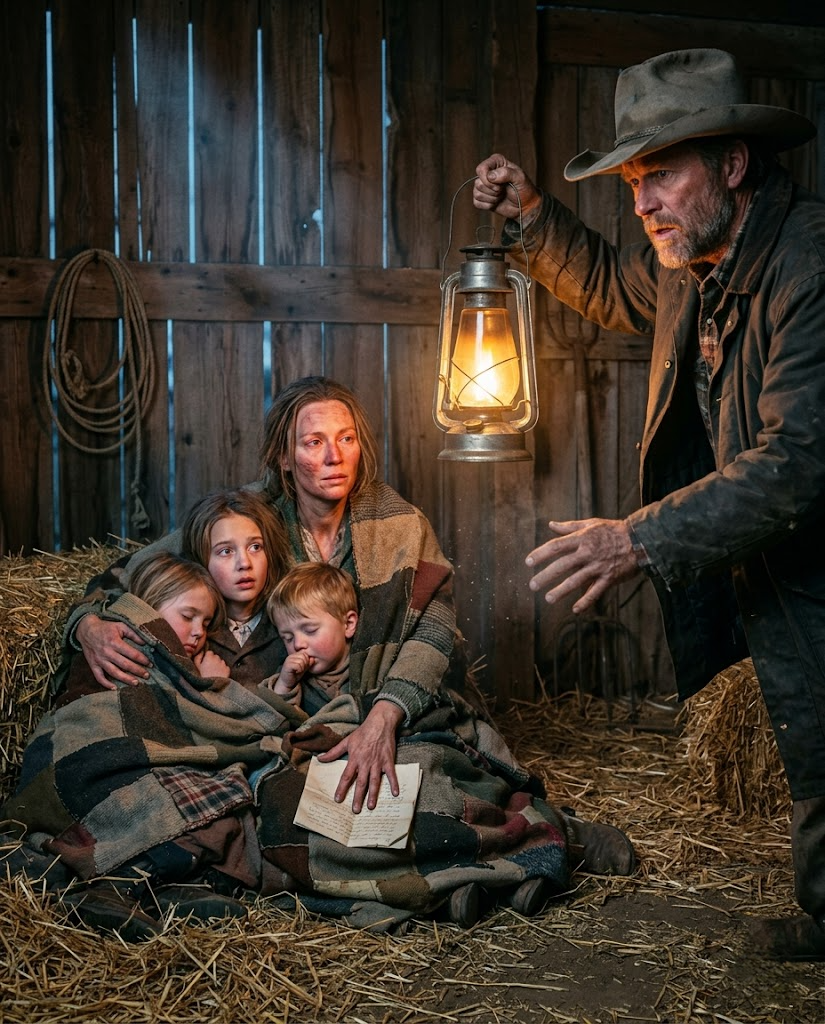
The lantern swung in Boon Carter’s grip as he crossed the frozen yard toward the hay barn.
Past midnight, the ranch should have been still.
The house behind him had gone quiet hours before, with only the wood stove ticking down and the ledger left open on the kitchen table beside a smoking lamp.
But something had moved in the barn.
Boon heard it once, then again, a low shift in the straw that did not belong to wind.
The October cold had hardened the ground under his boots, and every step cracked through frost.
He paused near the water trough and listened.
The dark did not answer.
That was almost worse.
A man with plenty can afford to be patient with strange noises.
A man with eight cattle left where fifty once grazed cannot.
Boon had spent that afternoon counting what remained of his life in columns.
Eight cattle.
Two sacks of flour.
Half a barrel of beans.
Root vegetables enough for two months if he cut every meal thin and stopped pretending hunger was temporary.
The numbers had not changed no matter how many times he dragged the pencil down the page.
His ranch was not failing all at once.
It was dying by inches, the way a man bleeds under a coat and hopes nobody notices.
So when he heard movement in the barn, his first thought was not mystery.
It was loss.
Coyotes after the feed.
A drifter after the tack.
Thieves after hay, rope, grain, anything they could carry off before sunrise.
Boon tightened his grip on the lantern handle and crossed the last stretch of yard.
That detail made his jaw set.
He had latched it.
He knew he had.
He lifted one hand to the rough wood and pushed.
The hinge gave a long, tired creak.
Golden light slid into the barn.
It touched the dirt floor first, then the stacked hay, then the old rake hanging crooked from a peg.
It reached the feed sacks under their tarp.
Then it found the far corner.
Boon stopped breathing.
A woman was asleep in the hay.
For one second, his mind refused the shape of her.
People did not simply appear in a man’s barn at midnight.
Not without trouble following.
Then the light steadied, and he saw the children.
Four of them.
Small bodies tucked against her like she had gathered them with both arms and refused to let the cold take even one.
Her shawl covered them as best it could.
It was patched so many times the original cloth had nearly disappeared, a dull, tired piece of fabric made of mending and need.
The smallest child could not have been more than three.
He had his thumb near his mouth, his face pressed to the woman’s shoulder, breathing in shallow little pulls.
Two boys lay curled against her side.
The oldest, a girl, had one hand clenched in the edge of the shawl so tightly her fingers had gone pale.
They slept the way frightened children sleep when rest is not comfort but surrender.
Boon lowered the lantern without meaning to.
The woman’s eyes opened.
She did not scream.
She did not scramble back.
She looked straight at him from the hay with dark, steady eyes and a face sharpened by hunger.
One hand stayed on the nearest child’s back.
The gesture was not dramatic.
It was automatic.
That told Boon more than words could have.
She had been protecting them long enough that her body kept doing it even half-asleep.
Then she whispered, fierce and low.
“They were cold.”
The words struck him harder than any excuse would have.
Not I am sorry.
Not please do not turn us in.
Not we meant no harm.
They were cold.
As if that was all the defense a human being should need.
Boon’s hand trembled, and the lantern light shook across her face.
She was young.
Maybe twenty-five.
Maybe younger, if hunger had added years to her cheeks and worry had carved the hollows beneath her eyes.
Her hair had come loose from whatever pins had once held it, and fine strands clung to her temple where sweat had dried and cold had tightened her skin.
Her lips were cracked.
Her knuckles were raw.
There was straw in the folds of her dress.
“Please don’t wake them,” she said.
Her voice was steady, but barely.
“They haven’t slept proper in three days.”
Boon looked at the children again.
Three days.
He had known cold.
He had known hunger.
But there are different kinds of hardship.
A grown man can make a bargain with his own empty stomach.
A child cannot.
The oldest girl shifted in her sleep and made a small sound.
It was not quite a word, but Boon caught the shape of it.
Mama.
The woman’s face crumpled.
Only for a moment.
Then she shut it away so fast he almost wondered if he had imagined it.
Almost.
She was not their mother.
But she was the person they reached for in the dark.
That was not a small thing.
Boon stood in the open barn door with the cold pushing at his back and his own poverty waiting in the house behind him.
He should have demanded names.
He should have asked where they came from.
He should have told her this was private property and that he had no food to spare.
Those were the practical words.
They were lined up in his head like fence posts.
But none of them came out.
Instead, he heard the pencil scratch from that afternoon in his memory.
Eight cattle.
Two months.
No room for strangers.
No room for weakness.
No room for children tucked under a shawl in his hay.
Survival has a cruel talent for dressing fear up as common sense.
It tells a man he is being careful when he is really being small.
Boon hated that thought because it sounded too much like his dead wife’s voice.
Mary Carter had been gone two winters.
He still caught himself setting two cups on the table if he was tired enough.
She had been the one who left biscuits wrapped in cloth for passing hands.
She had been the one who could look at a half-empty pantry and say that half-empty still meant somebody could eat.
After she died, Boon had closed the ranch around himself like a fist.
He told himself it was grief.
Then he told himself it was business.
By the second year, he no longer needed a reason.
He simply kept the gate shut.
Now a woman with four children had found the one door he had failed to guard.
“How long you been here?” he asked.
His voice came out rough.
The woman swallowed.
“Since dark.”
She glanced once toward the roof beams, as if measuring whether truth would hold.
“I saw your barn from the ridge. We just needed somewhere warm for one night. We’ll be gone come morning.”
Boon heard the care in her words.
Not the politeness.
The calculation.
She spoke like a person who had learned that every sentence could open a door or close one forever.
“Where from?” he asked.
Her hand moved slightly on the child’s back.
“Road.”
It was not an answer.
It was the edge of one.
Boon let it stand.
He could have pushed.
He did not.
The little boy coughed in his sleep, a thin sound that scraped the quiet.
The woman bent over him at once, tucking the shawl tighter beneath his chin.
That movement exposed her own shoulder to the cold.
She did not seem to notice.
Boon did.
He noticed the worn seam at her sleeve.
He noticed the way her wrist looked too small.
He noticed the oldest girl’s boots, cracked at the toes and tied with mismatched string.
A rancher notices condition.
Leather.
Fence.
Hoof.
Weather.
People are not so different when life has been hard on them.
Everything shows where it has been strained.
“You got kin?” he asked.
The woman’s eyes flicked up.
That question hit something raw.
“Not that will claim us.”
Us.
Not me.
Boon glanced at the children again.
“They yours?”
The oldest girl moved then, more awake than before.
Her eyelids fluttered, and she pressed closer to the woman.
The woman did not answer right away.
In that pause, Boon understood.
No.
Not by blood.
Maybe not by any paper a clerk would honor.
But paper had never warmed a child at midnight.
“They’re with me,” she said at last.
It was a plain answer.
It was also a vow.
Boon had heard vows in churches and vows at gravesides.
He had heard men swear over land, cattle, money, and marriage.
This one was quieter than all of them.
It sounded stronger.
He looked toward the covered feed sacks.
He had hay enough for the animals if winter did not turn cruel.
He had oats measured close.
He had bread in the house, but not much.
He had coffee.
He had beans.
He had a stove still holding heat.
He had one spare quilt in the cedar chest that had not been unfolded since Mary was alive.
That thought made his throat tighten.
The woman watched him watching the feed.
Her face changed.
Not much.
Just enough.
Pride and fear went through her together.
“We won’t take nothing,” she said quickly.
“You already took shelter.”
The second he said it, he regretted the hardness.
Her chin lifted.
“Then I’ll pay it back if I live long enough.”
There it was.
Not begging.
Not softness.
A person could be half-starved and still have iron in her.
Boon stared at her for a long moment.
Then he looked at the children and felt the argument inside himself begin to fail.
Mary would have known what to do.
That was the painful part.
She would not have stood there counting beans while children shook in the straw.
She would have crossed the barn, gathered the smallest one, and told Boon to stop looking like a thundercloud and fetch the quilt.
He could almost hear it.
Fetch the quilt, Boon.
Not tomorrow.
Now.
He shifted his weight.
The woman tensed.
The oldest girl’s eyes opened fully.
She was maybe nine.
Maybe ten.
Old enough to understand danger.
Too young to have become so quiet around it.
She looked at Boon’s lantern, then at his face.
“Are we in trouble?” she whispered.
The woman closed her eyes for half a second.
That question broke something in the barn.
Not loudly.
Worse than loudly.
It made the silence stand still.
The horses in the far stalls did not move.
The lantern flame ticked inside the glass.
Wind scraped one loose board against another.
One child breathed through a stuffy nose.
Nobody else made a sound.
Boon had spent two years keeping his heart from reaching toward anything it might lose.
But that little girl’s question found a place the grief had not managed to bury.
“No,” he said.
The word surprised all of them.
It surprised him most.
The woman opened her eyes.
Boon cleared his throat.
“Not from me.”
The oldest girl stared at him as if deciding whether grown men were allowed to say true things.
The woman did not relax.
That told Boon he had not reached the bottom of this.
A person running only from weather loosens when shelter is offered.
She had not loosened at all.
Her hand had shifted again, not to the children this time but to something in the straw beside her hip.
Boon noticed the movement.
He had missed it at first because the children took up the whole sight of her.
Now the lantern light caught the edge of it.
A folded paper.
Small.
Worn soft.
Creased so many times it seemed ready to fall apart.
Her palm covered most of it.
But not all.
Boon saw one dark line of writing across the outside.
Not enough to read.
Enough to know it mattered.
“What’s that?” he asked.
The woman went still.
The barn seemed to grow colder around her.
“Nothing you need concern yourself with.”
“Folks sleeping in my hay at midnight makes it my concern.”
She looked at him then, truly looked, as if measuring whether he was cruel, foolish, or merely a man with a locked door and a hungry winter.
The smallest boy whimpered.
She pressed her cheek briefly to his hair.
That tiny comfort undid the sharpness of her voice when she answered.
“It’s a name.”
Boon waited.
She did not go on.
“Whose name?”
Her lips parted, but no sound came.
The oldest girl reached for her sleeve.
“Mara,” she whispered.
So that was her name.
Mara.
The woman gave the child one warning look, not angry, only frightened.
The girl fell silent.
Boon let the name settle in his mind.
Mara.
It fit her in a way he could not explain.
Short.
Plain.
Hard to break.
“I’m Boon Carter,” he said.
She nodded once.
“I know.”
Those two words changed the whole barn.
Boon felt his fingers tighten on the lantern handle.
The flame shook.
“You know?”
Mara looked toward the open door again.
Not at the yard.
Past it.
Toward the ridge.
Toward the dark line of road beyond his fence.
“I was told there was a ranch here,” she said carefully.
“A poor one?”
A tired shadow crossed her face.
“An honest one.”
Boon almost laughed.
Not because it was funny.
Because the word honest felt too large to bring into a barn where four children were hidden in the hay and he was still deciding what kind of man he could afford to be.
“Who told you that?”
Mara’s hand closed over the paper.
Her knuckles whitened.
“Someone who said if we reached Carter place before the first hard frost, we might not die on the road.”
There are sentences that do not raise their voice because they do not have to.
That one silenced everything.
Boon looked at the children.
He looked at the shawl.
He looked at the folded paper beneath her hand.
The ranch did not feel empty anymore.
It felt watched by every choice he had ever made.
“You were looking for me,” he said.
Mara did not deny it.
“I was looking for a chance.”
The oldest girl started to cry then, but she did it silently, tears slipping down dirty cheeks while she tried not to wake the others.
Mara reached back and pulled her close without taking her eyes off Boon.
That was the thing that stayed with him later.
She never stopped protecting them, not even while facing a stranger who had every right to throw her out.
Boon set the lantern down on an overturned crate.
The light steadied.
His hands were free now.
That should have made Mara more afraid.
Instead, he saw her watch his hands the way a person watches weather.
Waiting to see what kind of storm is coming.
“I’ve got a stove in the house,” he said.
Her expression did not change.
“And I’ve got a quilt.”
Still nothing.
“And some beans left from supper.”
At that, one of the boys opened his eyes.
Hunger woke him faster than fear.
Mara saw it and closed her face again, but not quickly enough.
Boon saw what food meant.
Not comfort.
Emergency.
“No,” she said.
He frowned.
“No?”
“We’ll stay here.”
“It’s freezing.”
“We’ll stay here.”
Her voice had changed.
The iron was still there, but now it had panic underneath.
Boon understood then that the house scared her more than the cold.
A barn had exits.
A barn had shadows.
A barn did not require trust.
A warm room did.
He took a step back, giving her space.
“I won’t lock a door on you.”
Mara searched his face.
The children watched too, those who were awake.
Small eyes.
Too serious.
Too used to listening for danger in adult voices.
“You swear it?” the oldest girl asked.
Mara flinched.
Boon looked down at the child.
“I swear it.”
A promise should never be thrown around in a barn at midnight.
Not to children.
Not to the desperate.
Not to the dead wife whose voice still lived in the rafters of a man’s memory.
Boon knew that.
He said it anyway.
Mara’s shoulders dropped one inch.
Only one.
But Boon saw it.
He picked up the lantern again.
“I’ll bring the quilt here first,” he said. “Then food. You can decide after.”
The oldest girl looked at Mara.
One of the boys sat up, blinking hard.
The smallest child slept on, his cheek still pressed against her shoulder.
Mara nodded once.
It was not trust.
Not yet.
It was permission not to die for the next few minutes.
Boon turned toward the barn door.
He had taken only two steps when Mara spoke behind him.
“Mr. Carter.”
He stopped.
Her voice was thinner now.
Not weaker.
Just closer to the truth.
“If someone comes asking,” she said, “you never saw us.”
Boon turned back.
The lantern light caught the paper under her hand again.
This time, the fold had shifted.
He could see more of the writing.
Only a few words.
Enough.
His own name was on it.
Boon Carter.
Below it, written in a different hand, was one line that made the cold seem to climb straight through his coat.
Bring them to him.
For a long moment, he could not speak.
Mara saw that he had read it.
Her face changed from fear to something worse.
Hope.
Hope is harder to look at than fear when you are not sure you deserve it.
“Who wrote that?” Boon asked.
Mara’s eyes filled, but the tears did not fall.
“A woman named Mary,” she whispered.
The barn vanished for half a heartbeat.
The straw.
The children.
The lantern.
All of it blurred behind one name.
Mary.
Boon had not heard his wife’s name spoken by a stranger in two years.
He had not known it could still strike like that.
He reached for the stall rail because the world had tilted under his boots.
Mara watched him closely.
“She said if things ever got bad enough,” Mara continued, “and if I could get the children away, I was to find you. She said you would be angry first.”
A broken sound came from Boon’s throat.
It was almost a laugh.
Almost pain.
Mara held the paper out.
Her hand shook now.
“She said you would help anyway.”
Boon did not take the paper right away.
He looked at the children instead.
He looked at the woman who had carried them through three sleepless days because a dead woman had once promised her husband’s name could still mean shelter.
Mary had been gone two winters.
And still, somehow, she had left him a task.
Not in the ledger.
Not in the root cellar.
Not in anything he had counted.
She had left it in the hands of a hungry young woman in his barn.
Boon took the paper.
The creases were soft from being unfolded and folded again by desperate fingers.
The handwriting was Mary’s.
He knew it before he read the full note.
A man knows the shape of the hand that wrote his grocery lists, his birthday cards, his winter reminders, and the little notes she used to leave by his coffee when she rose before him.
He knew every curve.
Every slant.
Every small press of ink.
The note was short.
Mary had always known how to say enough.
Boon, if Mara reaches you, she has already done the brave part. Do not make her ask twice.
That was all.
No explanation.
No apology.
No room for his excuses.
Boon folded the paper again with hands that did not feel like his own.
The barn was very quiet.
The oldest girl stared at him.
Mara waited as if the next breath might decide all five of their lives.
Boon thought of the ledger.
He thought of the beans.
He thought of the cattle and the winter and the cold arithmetic of a ranch that had no space for mercy.
Then he thought of Mary’s last winter, how she had pressed her thin hand over his and told him not to become a locked door after she was gone.
He had failed her there.
For two years, he had failed her.
But maybe a man does not stop failing all at once.
Maybe he stops the way a lantern comes up in a dark barn.
One hand.
One breath.
One choice.
Boon tucked Mary’s note inside his coat.
Mara’s eyes followed the movement.
“I can’t feed five extra mouths long,” he said.
Her face tightened.
He raised a hand before she could speak.
“But I can feed them tonight.”
The oldest girl made a tiny sound.
One of the boys covered his mouth with both hands.
Mara closed her eyes.
Not in relief.
Not fully.
Relief takes time when fear has been living in the body too long.
“And tomorrow,” Boon continued, “we’ll figure out what Mary knew that I didn’t.”
At his wife’s name, Mara finally broke.
She did not sob.
She did not collapse.
She bowed her head over the smallest child and breathed once like someone who had been holding the same breath for miles.
Boon turned back toward the house.
This time, when he stepped into the cold, it did not feel like the same yard.
The ranch was still poor.
The cattle were still few.
The root cellar had not multiplied in the dark.
But something had changed.
The house was no longer only a place where a man survived beside his grief.
It was a place with a stove.
A place with a quilt.
A place his wife had believed could still open.
He brought the quilt first.
The cedar chest groaned when he lifted the lid, and the scent of dried lavender rose from the folded cloth so sharply he had to stop with one hand on the wood.
Mary had tucked lavender into everything.
He had forgotten and remembered in the same painful second.
He carried the quilt to the barn.
Mara touched it like it might disappear.
The children did not understand the history of it.
They only understood warmth.
That was enough.
Then he brought beans in a pot wrapped with a towel, a loaf of bread gone hard at one end, and tin cups of water.
The children ate carefully at first.
Too carefully.
Children who have not been hungry long enough grab.
Children who have learned hunger ration themselves.
Boon watched the oldest girl break her bread into five pieces before taking her own.
That sight did more damage to him than crying would have.
“What’s your name?” he asked her.
She glanced at Mara.
Mara nodded.
“Elsie.”
“Elsie,” Boon repeated.
He learned the boys’ names too.
Thomas.
Will.
Little Samuel, who was too sleepy to say his own.
Names made it worse.
Names always do.
A nameless hungry child can stay part of the world’s general sorrow.
A hungry child named Elsie becomes someone waiting for you to choose.
Boon set more bread by her hand.
She looked at it, then at him.
“For Samuel,” she said.
“For you,” Boon answered.
Her eyes widened.
Mara looked away.
That was when Boon understood that these children had been taught to take less than they needed.
Maybe by the road.
Maybe by whoever had failed them before.
Maybe by life itself.
An entire world had taught them to stay small enough not to be turned away.
His barn had nearly become one more lesson.
He was ashamed of that.
Not because he had hesitated.
A man may hesitate under the weight of winter.
He was ashamed because some part of him had wanted the ledger to be right.
Numbers are easier than faces.
By the time the pot was empty, the children’s eyelids had started to fall again.
Mara tried to stand.
Her knees almost gave.
Boon stepped forward.
She stiffened.
He stopped at once.
“Easy,” he said. “I was just going to say the house is warmer. You don’t have to come. But the offer stands. Door stays open. No lock.”
Mara looked at the children.
Then at the barn door.
Then at the paper shape inside Boon’s coat where Mary’s note rested.
“Why did she trust you?” Mara asked.
Boon could have answered with pride if he had been a different man.
Instead, he told the truth.
“Because she knew me before grief made me mean.”
Mara studied him.
At last, she gathered Samuel in her arms.
The boy did not wake.
Elsie helped Thomas to his feet.
Will dragged the shawl around his shoulders like a blanket.
Boon lifted the lantern and led them across the yard.
The cold came at them hard, but it was only a short walk.
That mattered.
Sometimes mercy is not a grand rescue.
Sometimes it is shortening the distance between a child and a stove.
Inside the house, the air held the faint warmth of banked coals.
Boon opened the stove, fed it, and watched the flames catch.
Orange light climbed the walls.
The children stood just inside the door, unsure what to touch.
Mara stayed behind them, ready to move if she needed to.
Boon set the quilt on the floor near the stove.
“There,” he said.
Elsie lowered herself first, still watching him.
The boys followed.
Samuel slept through all of it.
Mara remained standing.
Boon took two steps back and sat at the kitchen table, far enough to give her the room.
Mary’s ledger was still open there.
The numbers stared up at him.
Eight cattle.
Two months.
No room.
Boon reached out, closed the ledger, and set Mary’s note on top of it.
Mara saw.
So did Elsie.
Boon did not make a speech.
There was no need.
The paper had said enough.
By dawn, frost silvered every fence rail.
The children slept in a heap near the stove, faces softer now that warmth had found them.
Mara sat upright in a chair, finally losing the fight against exhaustion.
Her chin dipped, jerked up, dipped again.
Boon sat across the room with the shotgun near his boot, not because he feared them, but because he believed Mara now.
Someone might come asking.
Near first light, a horse sounded beyond the yard.
Mara woke instantly.
So did Boon.
They looked at each other, and neither needed to speak.
A second horse snorted.
Then came the crunch of wheels or hooves near the front track.
Boon rose and took the lantern, though dawn had begun to gray the windows.
Elsie sat up, white-faced.
Mara reached for the children.
Boon looked once at Mary’s note on the ledger.
Then he looked at the door.
The knock came hard enough to rattle the latch.
Three blows.
Not neighborly.
Not lost.
Claiming.
Mara’s face drained of color.
Boon picked up the note, folded it, and placed it back inside his coat.
For two years, grief had made him a locked door.
That morning, with four children behind him and Mary’s handwriting against his chest, Boon Carter opened it.
A man stood on the porch with frost on his coat and impatience in his mouth.
His eyes moved past Boon, trying to see inside.
Boon stepped wider, blocking the view.
“Morning,” Boon said.
The stranger did not return it.
“Looking for a woman,” he said. “Young. Dark hair. Four children with her. They passed this way.”
Boon kept his hand on the doorframe.
Behind him, the house was silent.
Even the children seemed to know how to disappear into quiet.
“Road runs long,” Boon said.
The man smiled without warmth.
“So do consequences.”
Boon looked at him for a steady moment.
He had been poor yesterday.
He was poor now.
He had no army, no lawman in the parlor, no proof beyond a dead woman’s note and the plain fact of children afraid to breathe.
But he had something he had not had the night before.
He had chosen.
That makes a man heavier in the doorway.
“Can’t help you,” Boon said.
The stranger’s smile thinned.
“Maybe you ought to think before answering.”
Boon did think.
He thought of the barn.
He thought of Elsie breaking bread into five pieces.
He thought of Mara whispering, They were cold.
He thought of Mary writing, Do not make her ask twice.
Then he answered.
“I did.”
The man stared at him.
For a moment, the whole morning seemed to hold its breath.
Then the stranger looked past Boon again and raised his voice.
“Mara, if you’re in there, you know this won’t end with hiding.”
A small sound came from inside the house.
Not Mara.
One of the children.
The stranger heard it.
His eyes sharpened.
Boon stepped out onto the porch and pulled the door shut behind him.
Not locked.
Never locked.
But closed.
There is a difference between trapping someone and standing between them and harm.
Boon understood that difference now.
The stranger’s gaze dropped to Boon’s hand.
“You want trouble over strangers?”
Boon looked toward the barn, where the open door still showed a scatter of straw in lantern light.
He looked back at the man.
“They stopped being strangers when they crossed my threshold.”
It was not a fancy line.
Mary would have liked it anyway.
The man’s jaw worked.
He seemed to be deciding whether poverty made Boon weak enough to push.
Many people make that mistake.
They see a thin pantry, a patched coat, a tired fence, and they think a man has nothing left to defend.
But sometimes having little clarifies everything.
Boon did not have enough to save the whole world.
He had enough to save the people in his kitchen.
That morning, it had to be enough.
The stranger finally stepped back.
Not defeated.
Not finished.
But delayed.
“This ain’t over,” he said.
Boon nodded once.
“Most things worth doing aren’t.”
The man turned away, boots striking frost from the porch boards.
Boon watched until the horse and rider moved beyond the ridge.
Only then did he go back inside.
Mara was standing in the center of the kitchen with Samuel in her arms and the other children gathered behind her.
She looked ready to run.
She also looked too tired to make it farther than the fence.
Boon shut the door gently.
“He’s gone for now.”
Mara’s lips trembled.
“You lied.”
“I did.”
“For us.”
Boon looked at the children.
Elsie was clutching the quilt in both hands.
Thomas had crumbs on his sleeve.
Will’s eyes were huge.
Samuel slept through the danger, which felt like its own small mercy.
“For Mary,” Boon said. “And for them.”
Mara sat down suddenly, as if her legs had been cut out from under her.
The chair scraped the floor.
She covered her mouth, but the sound escaped anyway.
Not a sob.
A breaking.
Elsie went to her at once.
The boys followed.
Boon turned toward the stove and gave them the privacy of his back.
He stirred coals that did not need stirring.
He set water to heat that was already warm enough.
He did ordinary things because ordinary things are sometimes the only respectful way to stand near grief.
When Mara could speak again, she told him enough.
Not everything.
Enough.
The children had lost their mother first, then the last relative who tried to keep them together.
Mara had been hired to help, then expected to leave when money ran thin.
But leaving would have meant watching the children be split apart and sent where she knew they would not be loved.
Mary had met her months earlier on a supply road during one of her last trips before sickness took her fully.
Mary had seen the children.
Mary had understood more than Mara knew.
So she had written the note.
Bring them to him.
Boon listened without interrupting.
Every sentence made Mary feel both nearer and farther away.
Of course she had done this.
Of course, even while dying, she had been making room for people Boon had not met yet.
That was Mary.
The ache of it nearly doubled him over.
But he stayed seated.
He let the children eat again.
He let Mara stop shaking.
Then he opened the ledger.
Not to prove there was no room.
To find some.
He scratched out the old calculation.
He wrote new ones.
Less coffee.
More beans.
Sell the broken wagon axle for scrap if he had to.
Butcher one steer earlier than planned.
Trade tack he no longer used.
Ask no favors from men who would turn mercy into gossip.
By noon, the plan still looked poor.
But poor and impossible are not the same word.
Boon had forgotten that.
The children stayed that day.
Then another.
Then through the first hard frost.
The barn was cleaned and locked properly again.
The spare room became a sleeping room.
The cedar quilt stayed near the stove until Samuel stopped waking at night with cold fear in his hands.
Mara never stopped watching the road.
Boon never asked her to.
Trust, he learned, was not something he could demand because he had done one decent thing.
Trust was a fence built rail by rail.
A bowl set down without strings.
A door left unlatched.
A promise kept after the danger had passed out of sight.
The stranger came once more before winter settled in fully.
This time, Boon was ready.
Not with bravado.
With neighbors who owed Mary kindness.
With a minister willing to witness what he had seen.
With the note in Mary’s handwriting.
With four children standing behind Mara, no longer hidden in hay, no longer being taught to stay small enough not to be turned away.
The man left with more anger than power.
That was not the end of hardship.
Stories like this do not become easy just because one good door opens.
The winter was lean.
There were nights when Boon went to bed hungry and pretended he had eaten enough.
There were mornings when Mara caught him doing it and silently put half her biscuit on his plate.
There were arguments too.
Fear does not vanish because a stove is warm.
Grief does not leave because children laugh in the next room.
But by Christmas, the house sounded different.
Boots by the door.
Tin cups clinking.
Elsie reading aloud from an old primer Mary had kept.
Thomas and Will carrying kindling as if they were ranch hands hired at full wage.
Samuel following Boon from room to room with the solemn devotion of a child who had chosen his person.
Mara began to sleep through the night.
Not every night.
Enough.
And Boon, who once thought survival meant counting what he could not spare, began to understand that Mary had left him a different kind of arithmetic.
A quilt divided among five people did not become less warm in the ways that mattered.
A pot of beans stretched thin could still be a meal if nobody ate alone.
A poor ranch could become poorer on paper and richer in every sound that filled it.
That did not make the ledger lie.
The ledger was true.
It was just not the whole truth.
Months later, when spring softened the yard and grass began to show along the fence line, Boon found Elsie in the barn doorway at dusk.
She was staring at the corner where he had first found them.
The hay had been turned over many times since then.
No trace remained.
Still, she remembered.
Children always remember the places where fear almost won.
Boon stood beside her.
“You all right?”
Elsie nodded.
Then she said, “I thought you were going to make us leave.”
Boon looked out at the ridge.
The sunset lay low and bright over the winter-battered land.
“So did I,” he admitted.
She looked up at him.
He did not soften the truth.
Children who have survived deserve honesty more than pretty stories.
“I’m glad I didn’t,” he said.
Elsie leaned against his side, lightly at first, as if testing whether the world would allow it.
Boon stayed still.
Then he rested one hand carefully on her shoulder.
In the house behind them, Mara called the boys in for supper.
Samuel laughed at something near the stove.
The sound carried across the yard, small and bright.
Boon thought of that first night, the lantern shaking in his hand, the woman looking him in the eye and whispering the only defense that mattered.
They were cold.
Those words had found him at the edge of becoming a locked door forever.
They had not saved the ranch from hardship.
They had not filled the root cellar by magic.
They had done something harder.
They had reminded him what a home was for.
And long after the ledger numbers changed, long after the barn was only a barn again, Boon Carter would remember the night he raised a lantern expecting thieves and found the last unfinished promise his wife had left behind.
He found a woman and four orphans sleeping in his barn at midnight.
But what he really found was the part of himself grief had not managed to kill.