
Her Daughter-In-Law Took Over Her Beach House, Then Saw the Deed-kieutrinh

At 70 years old, Eleanor Vance thought she knew what exhaustion felt like.
She had known the exhaustion of sewing until her fingers cramped.
She had known the exhaustion of raising a son after a funeral, smiling at him over dinner because children should not have to watch their mothers break.
She had known the exhaustion of saving dollar after dollar for a house by the water, not because she needed luxury, but because she needed one quiet place in the world where nobody could take from her.
So when she drove toward her Malibu beach house that Friday morning, she was not expecting drama.
She was expecting salt air.
She was expecting the wicker chair on the terrace.
She was expecting coffee in her own kitchen and the steady hush of waves beyond the deck.
That little place had been hers for 20 years.
Not given to her.
Not inherited.
Earned.
She had bought the land when she was 50, after her husband died, when Robert was still young enough to think his mother would always be there to catch him.
Back then, the property had been weeds, dust, and one cracked walkway leading nowhere.
People told her she was foolish.
A widow should not take on a mortgage like that.
A seamstress should not dream about ocean views.
Eleanor listened politely and did it anyway.
Every time she hemmed a bridesmaid dress, she put part of the money aside.
Every time she altered a suit jacket for a man who never said thank you, she put part of the money aside.
Every December, when other people bought what they wanted, she sent an extra payment.
That house became the proof that she had survived.
It was also the place where Robert brought Jessica years later.
Jessica had arrived with shiny sandals, nervous laughter, and a grocery-store bottle of wine clutched like an offering.
Eleanor had liked her then.
Jessica was sharp, pretty, and quick with compliments.
She asked about the embroidered apron hanging by the stove.
Eleanor explained that the blue flowers were stitched by hand during a hard winter in Chicago, when Robert had lost his job and she had quietly helped him with rent.
That was the trust signal Eleanor gave Jessica.
Access.
Stories.
A key on holidays.
A place at the table.
And later, Jessica used all of it like it had been owed to her from the beginning.
The first sign was the cars.
Eleanor turned into the driveway and stopped so abruptly her purse slid off the passenger seat.
There were vehicles she did not recognize near the garage.
A family SUV sat crooked by the side path.
Music thumped from inside the house, too loud for that quiet stretch of water.
Then she saw the lawn.
Beer cans winked in the grass.
A wet towel hung over her wicker chair.
One red geranium pot lay cracked near the terrace, soil scattered across the tile.
Two teenage boys were kicking a ball against the wall under the kitchen window.
Eleanor sat there with her hands on the steering wheel and felt the old seamstress’s calluses in her palms.
The ocean sounded the same.
The house did not.
When she stepped out, salt wind hit her face, but it could not clear the smoke drifting from the porch.
A man in a Hawaiian shirt stood there with a cigarette between his fingers.
He looked at Eleanor like she was interrupting him.
Jessica appeared in the doorway before Eleanor reached the step.
She was wearing Eleanor’s embroidered apron.
For one second, that hurt more than the ruined lawn.
The apron had always hung by the stove, not because it was expensive, but because it had been made with the hands that kept the family afloat.
“Jessica,” Eleanor said. “I didn’t know anyone was here.”
Jessica’s face changed.
Not surprise.
Annoyance.
“What is this old parasite doing here?” she said loudly. “There’s no place for you.”
The kitchen froze.
A paper plate stopped halfway to Jessica’s mother’s mouth.
Veronica, Jessica’s sister, looked over and then looked away.
One teenage boy let the ball roll against the wall and did not pick it up.
Nobody corrected Jessica.
Nobody said, “That’s her house.”
Nobody even looked ashamed.
That was the part Eleanor would remember later.
Not just the cruelty.
The permission around it.
“Where is Robert?” Eleanor asked.
“Working,” Jessica said. “Some people have responsibilities.”
The little laugh that followed was small, but it was enough.
Eleanor looked past Jessica and saw sand across the rug, a wet swimsuit on her sofa, and one of her good mugs chipped in the sink.
The house had not been borrowed.
It had been claimed.
“This is my house,” Eleanor said. “I pay the bills. I have the deed.”
Jessica rolled her eyes.
“Oh, there it is. The deed speech.”
Eleanor’s cheeks heated.
She hated that her face still betrayed her at 70.
Jessica crossed her arms.
“Robert told me we could use it whenever we wanted. You leave it empty most of the time while you live comfortably in Chicago.”
Comfortably.
Eleanor almost smiled.
Jessica had never seen the Chicago apartment when the heat went out.
She had never seen Eleanor eating soup from a mug because she was saving for Robert’s tuition.
She had never seen the shoebox of receipts, the extra shifts, the stiff fingers bent over navy wool at midnight.
People who inherit comfort are always quick to judge the shape of someone else’s sacrifice.
Jessica tilted her chin toward the driveway.
“We don’t have space here. Leave.”
For one ugly heartbeat, Eleanor imagined pushing past her.
She imagined opening every bedroom door and ordering those people out one by one.
She imagined taking the apron back with both hands.
Instead, she inhaled.
Salt.
Smoke.
Stale beer.
Then she smiled.
“All right, dear,” she said. “I understand the situation perfectly.”
Jessica thought she had won.
That was her first mistake.
Eleanor drove to the Pacific View Inn and paid $285 for a room she should never have needed.
At the front desk, she handed over her card with a steady hand, but humiliation sat in her throat like a stone.
She was not a tourist.
She was paying to sleep in a bed ten minutes from the bed she owned.
That night, she stood on the balcony and looked toward the glow of her house.
At 10:43 p.m., she opened the notes app and began writing.
Unknown sedan in driveway.
Family SUV near garage.
Beer cans on lawn.
Broken red geranium pot.
Wicker chairs wet with towels.
Man smoking on porch.
Jessica wearing embroidered apron.
At 11:18 p.m., she opened the folder labeled HOUSE.
Inside were the scanned deed, the property tax statement, the insurance policy, the utility account, and the locksmith receipt from six years earlier.
Every line carried Eleanor’s name.
Not Robert’s.
Not Jessica’s.
Hers.
At 6:00 the next morning, Eleanor woke before the alarm.
The room was pale with early light.
Her body ached from poor sleep, but her mind felt clean.
Anger can be wild when it is young.
At 70, anger becomes a file.
At 7:12, she wrote down every license plate she could remember.
At 7:38, she saved the hotel receipt.
At 7:51, she checked the scanned deed again.
At 8:00 exactly, she stood on her own porch and rang her own bell.
Veronica opened the door in pajamas.
“What do you want now?”
“I need my personal things,” Eleanor said. “And I need to speak with Jessica.”
“Jessica’s sleeping,” Veronica said. “Your things aren’t in the rooms anymore. We put them in bags in the garage so they wouldn’t be in the way.”
For a moment, Eleanor heard nothing but the refrigerator humming somewhere inside.
Then the sentence opened inside her.
They had gone through her things.
They had touched her drawers.
They had bagged her clothes, papers, photographs, and set them aside like trash.
Eleanor stepped forward.
Veronica tried to shift into the doorway, but Eleanor did not stop.
A quiet person moving with purpose can be more frightening than a loud one.
In the garage, the air smelled like cardboard, laundry soap, and hot concrete.
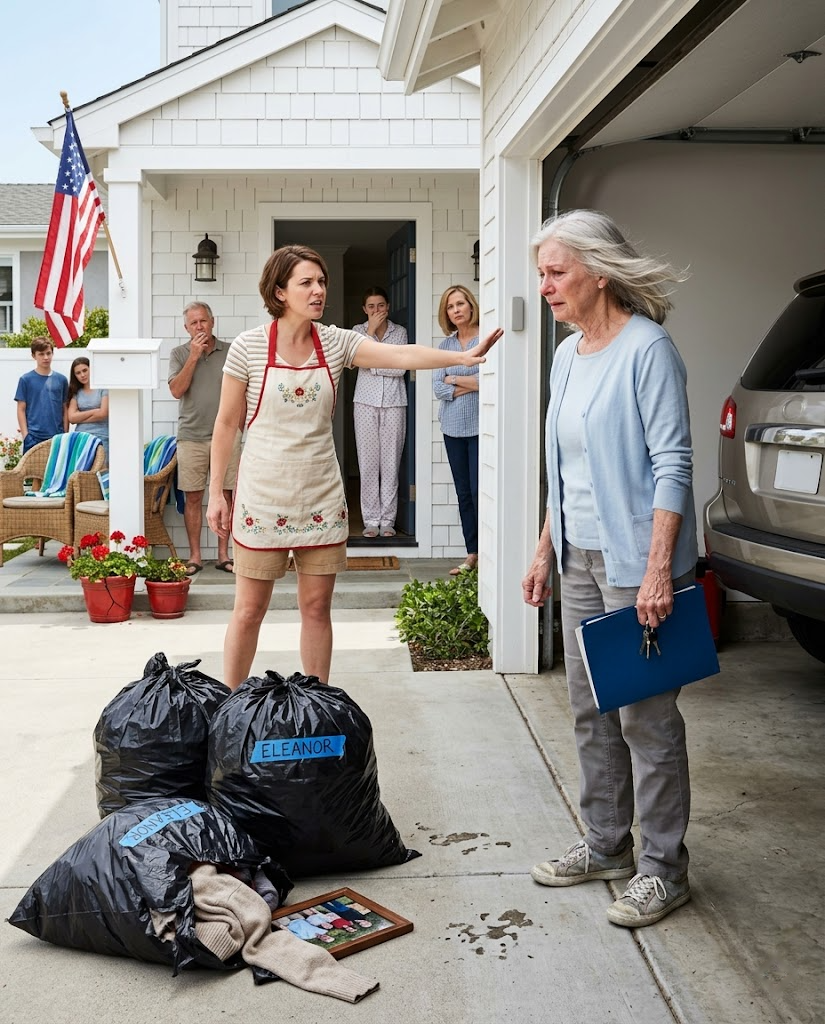
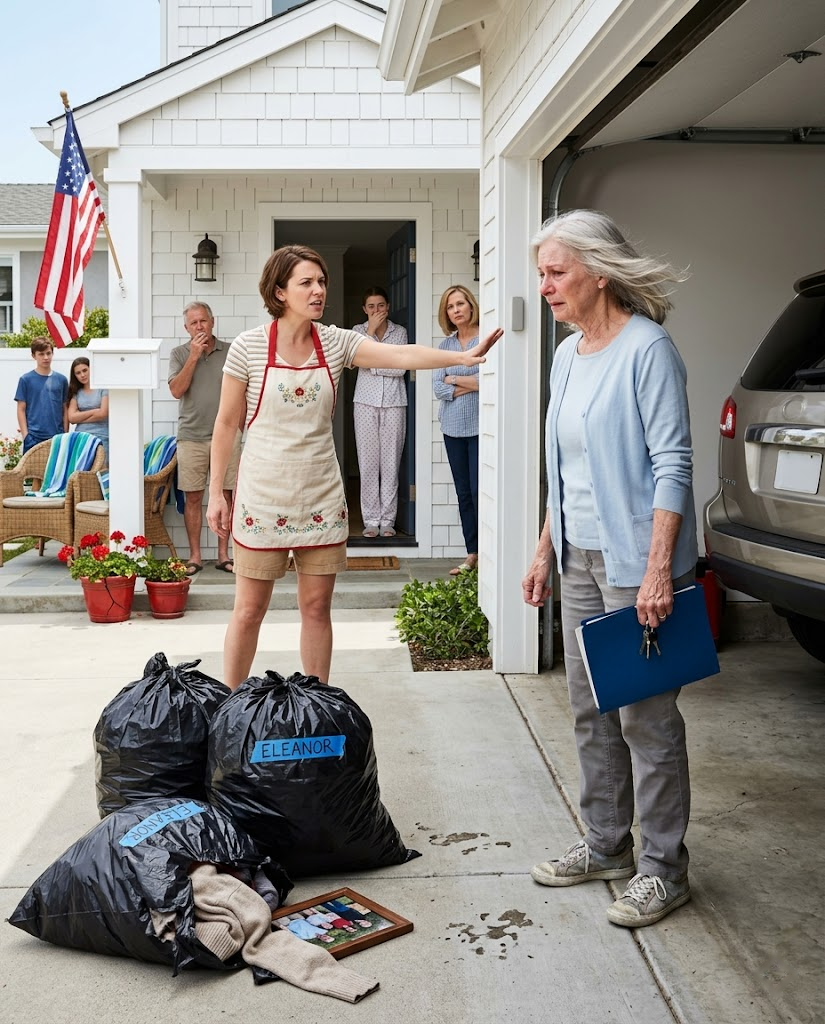
Black trash bags lined the wall beside the old sewing machine.
One had painter’s tape across the front.
ELEANOR.
Another had split at the top.
Her church sweater sleeve hung out.
A framed photograph of Robert at age seven lay face down on the floor.
The blue deed folder sat on a plastic bin, open just enough for Eleanor to know someone had handled it.
She picked up the photograph first.
Robert was missing his two front teeth in that picture.
His father had still been alive.
For the first time that morning, Eleanor’s hand shook.
Then Jessica’s voice came from behind her.
“You’re making this into something it isn’t.”
Eleanor turned.
Jessica stood in the garage doorway wearing the apron again, hair tied up, face irritated like a woman disturbed on vacation.
“You put my private things in trash bags,” Eleanor said.
“We were organizing,” Jessica replied.
“Organizing.”
“Don’t be dramatic. You weren’t even supposed to be here.”
That sentence would have broken a weaker version of Eleanor.
It did not break this one.
She opened the blue folder and saw a fresh smudge on the deed copy.
Then her phone buzzed.
The garage camera had sent a motion notification.
Robert had installed it years earlier during wildfire season after a neighbor reported break-ins.
Eleanor had forgotten it was still connected to her account.
The thumbnail showed Jessica dragging a black bag across the garage floor at 11:42 p.m.
Eleanor tapped the clip.
Jessica’s voice came out clear.
“Just throw the old woman’s stuff out. Robert will deal with her later.”
Veronica went pale.
Jessica’s mother appeared behind her daughter, mouth slightly open.
The teenage boys had wandered close enough to hear.
For the first time since Eleanor arrived, nobody laughed.
Eleanor held the phone in one hand and the deed folder in the other.
At that exact moment, Robert called.
Jessica lunged a step forward.
“Don’t answer that.”
Eleanor answered on speaker.
“Mom?” Robert sounded rushed. “Jessica said you showed up and scared everyone. What’s going on?”
“I am standing in my garage beside trash bags full of my belongings,” Eleanor said. “Your wife and her family have occupied my house, damaged my property, and told me to leave.”
Silence.
Then Robert said, “What?”
Jessica snapped that Eleanor was exaggerating.
Eleanor pressed play.
The garage filled with Jessica’s recorded voice again.
“Just throw the old woman’s stuff out. Robert will deal with her later.”
When it ended, Robert did not speak right away.
The silence was not empty.
It was changing shape.
“Jess,” he said finally. “Tell me that wasn’t you.”
“She took it out of context,” Jessica said.
“It’s a sentence,” Robert answered. “What context makes that better?”
Veronica lowered herself onto a plastic storage bin like her knees had given up.
Jessica’s mother stopped holding her plate.
The man on the porch stepped back from the doorway.
Eleanor ended the call before it could become a shouting match.
“Robert, I will speak to you when the house is empty.”
“Mom, wait—”
“I said when it is empty.”
Then she hung up.
Jessica stared at her.
“You can’t just kick out family.”
Eleanor slipped the deed copy back into the folder.
“Family was invited,” she said. “You brought a crowd.”
At 8:27 a.m., Eleanor photographed the garage bags.
At 8:34, she photographed the broken flowerpot, beer cans, wet chairs, chipped mug, cigarette ash on the porch, and sand ground into the rug.
At 8:49, she called the sheriff’s non-emergency desk and asked how to document unauthorized occupants and property damage without escalating the situation.
She did not use dramatic words.
She used accurate ones.
Property owner.
Uninvited occupants.
Damaged personal property.
Recorded statement.
Deed available.
At 9:22, she called the locksmith.
At 9:41, she opened a damage note with her insurance company.
At 10:05, she texted Robert four photographs, the deed scan, and one sentence.
This house is in my name only. I expect it empty today.
Robert arrived at 10:36.
He came in work clothes, not beach clothes, his face tight and pale.
For one second, Eleanor saw the little boy with the missing teeth.
Then she saw the grown man who had let his wife speak to his mother like a trespasser.
“Did you tell Jessica she could use my house whenever she wanted?” Eleanor asked.
Robert rubbed a hand over his face.
“I told her we could ask you. I didn’t think she’d come without telling you.”
Jessica made a sharp sound.
“You said your mother never uses it.”
“I said she comes on holiday weekends,” Robert said. “I didn’t say you could move your whole family in.”
Jessica’s mother finally spoke.
“We were told this was family property.”
Eleanor looked at her.
“It is family property because I allow my family to be loved here. It is not community property because your daughter likes the ocean.”
The woman looked away.
That was the first apology Eleanor almost received.
Almost.
The sheriff’s deputy arrived at 11:18.
Eleanor met him outside by the small American flag near the porch and handed him the deed copy, her driver’s license, and the printed list she had started at the hotel.
He did not storm in.
Real consequences are often quiet at first.
He asked who owned the property.
Eleanor answered.
He asked who had permission to stay.
Eleanor answered.
He asked whether anyone inside had a lease, written permission, or paid arrangement.
Nobody answered.
Jessica crossed her arms.
“This is ridiculous. She’s doing this because she doesn’t like me.”
The deputy looked at the trash bags in the garage.
Then he looked at the deed folder.
Then he looked at Robert.
“Sir, is this your property?”
Robert’s jaw worked.
“No.”
Jessica looked at him like he had slapped her.
The deputy nodded.
“Then everyone who does not have the owner’s permission needs to leave.”
Jessica started crying then.
Not the kind of crying that asks forgiveness.
The kind that asks witnesses to switch sides.
Veronica gathered the teenagers.
The man in the Hawaiian shirt muttered about hotels.
Jessica’s mother picked up her purse with stiff dignity, as if dignity had survived anything about that morning.
Robert helped carry coolers and bags to the cars.
Eleanor stood near the garage and watched.
She did not smile.
She did not gloat.
She counted.
Seven beach towels.
Three coolers.
Two folding chairs that were not hers.
One cigarette burn on the porch rail.
One chipped mug.
One cracked geranium pot.
One trash bag label that said ELEANOR.
By noon, the driveway began to clear.
Jessica was the last to leave.
She stood beside the family SUV, mascara dark under her eyes, the embroidered apron clenched in one fist.
For a moment, Eleanor thought she might finally hand it back with an apology.
Instead Jessica said, “You ruined everything.”
Eleanor took the apron from her.
“No,” she said. “I found out what everything was.”
The SUV pulled away.
The house went quiet so suddenly Eleanor could hear the ocean again.
Robert remained.
“I’m sorry,” he said.
Eleanor turned the apron over in her hands.
The blue flowers were stained near the pocket.
“Are you sorry she did it,” Eleanor asked, “or sorry I made you see it?”
Robert flinched.
That was the question he deserved.
He did not answer quickly.
Finally, he said, “Both. But mostly the second one scares me.”
That was honest enough to keep her from closing the door in his face.
They spent the afternoon cleaning.
Not together in an easy way.
Together in a necessary way.
Robert picked up beer cans.
Eleanor washed sand from the rug.
Robert replaced the broken pot.
Eleanor set the framed photograph back on the shelf after wiping dust from the glass.
At 3:12 p.m., Eleanor took the house key from Robert’s ring.
He did not argue.
At 3:20, the locksmith arrived.
By 4:05, every exterior lock had been changed.
At 4:17, Eleanor texted Jessica one final message.
All future requests about this property must come to me in writing.
Then she blocked her for the weekend.
She did not block Robert.
She was angry, not cruel.
The following week, Eleanor filed the police report for documentation and sent the itemized damage list to Robert.
She asked him to reimburse the hotel, the locksmith, and the damaged items.
$285 for the hotel.
The locksmith invoice.
The replacement mug.
The garden pot.
The cleaning.
Not because the money would change her life.
Because accountability has to begin somewhere concrete.
Robert paid it.
Jessica sent three messages from a different number before Eleanor stopped reading.
The first said Eleanor had embarrassed her.
The second said families were supposed to share.
The third said Robert had been cold since “that garage stunt.”
Eleanor saved screenshots and did not respond.
In the months that followed, the beach house became quiet again.
The geraniums came back slowly.
The porch rail was sanded and sealed.
The apron never went back on the hook by the stove.
Eleanor folded it into a drawer with other things that had survived but no longer needed to be displayed.
Robert came alone one Saturday in October.
He brought groceries.
Not flowers.
Not a speech.
Groceries.
Milk, bread, coffee, peaches, and the kind of butter Eleanor liked but rarely bought because it felt wasteful.
He set them on the counter and said, “I changed the way I talk about your house.”
Eleanor looked at him.
“How did you used to talk about it?”
He swallowed.
“Like it would be mine someday.”
There it was.
The root under the weed.
“And now?”
“Now I say it’s yours.”
It was not everything.
But it was the first true repair.
That night, Eleanor slept in her own bed with the window cracked open.
The air smelled of salt and clean sheets.
She thought of the driveway, the bags, the laughter, the word parasite, and the moment Jessica’s face changed when the deed folder came out.
An entire house had taught Eleanor to wonder whether love had to come with surrender.
It did not.
Sometimes the most loving thing a mother can do is stop making her boundaries comfortable for everyone else.
By morning, sunlight filled the kitchen.
Eleanor made coffee, carried it to the porch, and sat in the wicker chair that had finally dried in the ocean air.
The little American flag near the porch moved in the breeze.
The geraniums looked bruised but alive.
So did she.