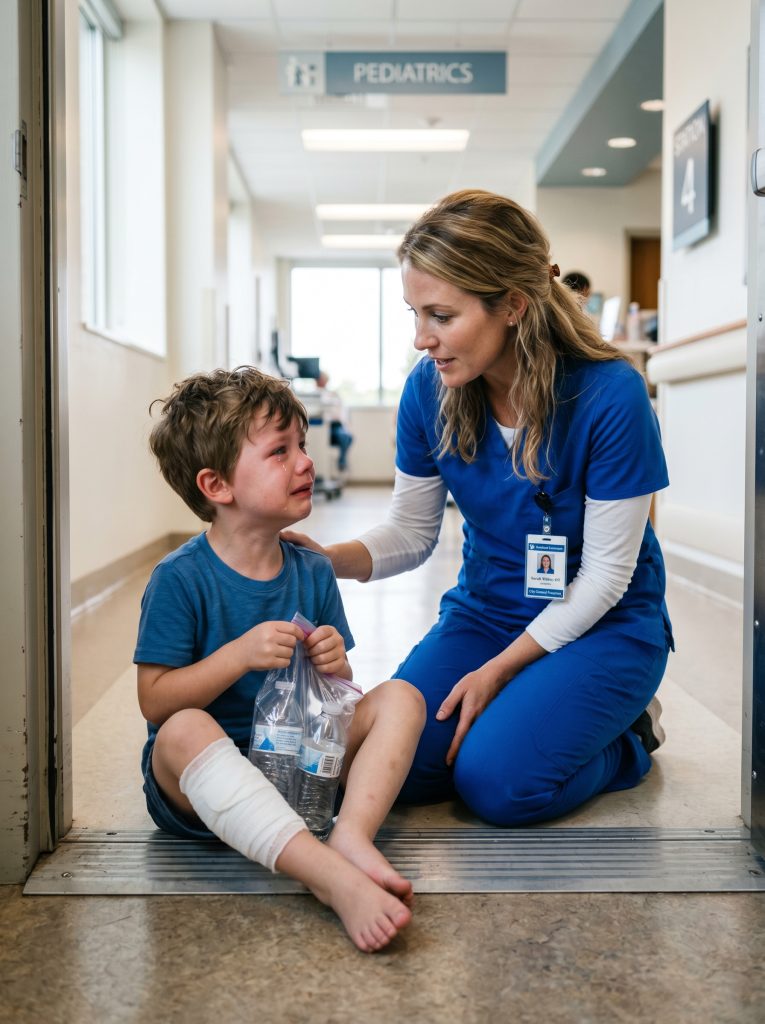
I Was Closing My Small Clinic On A Rainy Evening When A Limping 5-Year-Old
The Boy Who Came In From The Rain
The rain had been falling all afternoon, soft at first and then steady enough to turn the parking lot outside my little wellness clinic into a sheet of silver. I was locking the front drawer, already thinking about the quiet drive back to my apartment, when I heard the bell above the door give one tired little ring.
A small boy stood in the doorway, soaked from his hair to his sneakers, one hand pressed against the wall as if the whole world had become too heavy for him to cross without help. He could not have been more than five. His sweatshirt hung off one shoulder, his pants were muddy at the knees, and against his chest he held a crinkled grocery bag like it contained something precious.
“Ma’am,” he whispered, looking at the floor, “can you fix my leg? I can pay.”
Before I could answer, he emptied the bag onto my counter. A few coins rolled beside two crushed soda cans and three empty bottles.
“The man at the recycling place said it’s almost seven dollars,” he explained. “I can bring more tomorrow.”
His name, he told me, was Oliver. The moment I lifted the wet fabric away from his ankle, my hands went still. His leg had been neglected for far longer than a single afternoon, and there were other marks too, old ones, the kind a child learns to hide beneath long sleeves.
But what truly stole the breath from my lungs was his face.
Those wide gray-blue eyes. That narrow chin. The faint bend in one eyebrow that looked exactly like mine when I was trying not to cry.
“Oliver,” I asked carefully, “what is your father’s name?”
He swallowed.
“Grant Whitaker.”
The room seemed to tilt.
Five years earlier, Grant Whitaker had been my husband. He came from one of the wealthiest medical families in Colorado, the kind of people whose names appeared on hospital wings and charity galas. I had been Elise Harper, a small-town herbal practitioner raised by my grandfather, with no fortune, no famous last name, and no place in the polished world Grant’s family guarded like a locked gate.
When our son was born, Grant’s mother had taken one look at me and decided I was a stain on their family portrait. She brought papers. She brought a check. She brought threats wrapped in perfect manners. She told me my baby would have a better future if I stepped aside.
I signed because I was young, frightened, and led to believe that surrendering him was the only way to keep him safe.
And now that same child stood in front of me with recycled bottles and a leg that had needed help long before he found my door.
What A Child Learns To Hide
I brought Oliver to the back room and wrapped him in a clean towel while I warmed soup on the little hot plate I kept for long days. He watched every movement I made, not with curiosity, but with caution, as if kindness might be a trick.
When I reached for his ankle, he flinched and covered his head with both arms.
“Please don’t be mad,” he said quickly. “I’ll be good. I promise.”
I had to turn away for a second because my face would have frightened him if he saw it. Not anger at him. Never at him. Anger at every adult who had taught a child to apologize for needing care.
“You are not in trouble,” I told him, keeping my voice low. “You came to the right place.”
He ate the soup like someone had taught him food could disappear without warning. When he finished, he tried to slide off the chair to wash the bowl himself, but pain pulled a cry from him before he could stop it.
Then came the apology again.
“I’m sorry. I’m sorry. I didn’t mean to.”
I caught him before he fell and held him against me. He was so light that he felt like a bundle of laundry left out in the rain.
Outside, thunder rolled across the rooftops. Inside, I looked at the little boy in my arms and understood something with a certainty that settled into my bones.
I could not send him back.
Later, after I cleaned him up and made a small bed for him in the recovery room, fever flushed his cheeks. In his sleep, he murmured broken little phrases.
“Don’t lock the door… I’ll listen… I won’t ask again…”
My hand shook as I picked up my phone. I had erased Grant from my daily life, but memory is a stubborn thing. His number was still there, buried where pain keeps old names.
He answered on the second ring.
“Elise?”
I did not say hello.
“I found Oliver.”
Silence filled the line.
“Where is he?”
“With me. And before you ask for the address, tell me something. Did you know your son has been walking around with an untreated leg and old marks all over him?”
I heard something crash on his end.
“Where are you?”
I hung up before my voice failed me.
The Father At The Door
Grant arrived twenty minutes later in a black SUV, drenched before he even reached the clinic door. He looked older than I remembered, still handsome in that polished Whitaker way, but with tired eyes and a face that lost all color when I led him to the back room.
Oliver was sleeping, curled on his side.
Grant stepped closer and reached toward his forehead.
Oliver, still asleep, lifted his arms over his head.
“Don’t be mad… I’ll be quiet…”
Grant froze as if the room had turned to ice around him.
For a long time, he said nothing. The man who once knew how to command boardrooms, doctors, donors, and half the city could not find a single sentence in front of his own child.
At dawn, Oliver woke. When he saw Grant, his whole body went stiff.
“Dad?”
It did not sound like a greeting. It sounded like asking permission to exist.
Grant lowered himself into the chair beside the cot.
“Buddy, may I look at your leg?”
Oliver pulled the blanket back instantly, too obedient, too ready.
“It doesn’t hurt,” he said. “I don’t cry.”
Grant pressed his lips together.
“Who told you not to cry?”
Oliver looked down at the blanket.