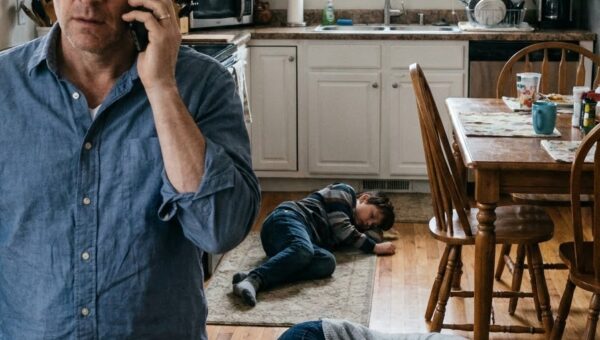
My dad told me, “Come to dinner with your brother’s fiancée, but hide the fact that you’re his sister.

My father called me over on a Thursday afternoon, three days before my younger brother’s engagement dinner, and the first thing I noticed was that every family photo in his study had been moved. Not removed exactly. Just hidden a little. My Army dress blues were tucked behind a brass lamp. The county Veterans Day clipping sat half-buried under tax folders. Even the photo of me and my brother outside Fort Liberty had been placed facedown beside Dad’s coffee mug.
“Dad?” I said from the doorway.
Robert Hale looked up too quickly. “Claire. You made it.”
I was thirty-four, old enough to recognize a smile hiding a lie. After eleven years in the Army, I had learned to read rooms, checkpoints, and faces before they told the truth. My father had never been good at lying to me.
He gestured toward the leather chair. “Sit down.”
“I can’t stay long. I still need to pick up my dress.”
His mouth tightened at the word dress, as if even that had become a problem.
My younger brother, Evan, was getting engaged to Lydia Bell, a woman he loved with the terrified happiness of a man who couldn’t believe someone good had chosen him. Two weeks earlier, he had called me breathless. “She said yes, Claire. She actually said yes.”
I had laughed so hard I had to sit on the edge of my bed. Evan had been my shadow since childhood, following me into creeks, treehouses, grocery stores, and every argument with our father. He was twenty-nine now, an architect with clients and clean shirts, but when he said my name that night, he sounded eight again.
Then he told me about Lydia’s family. Her grandfather was a federal judge. Her grandmother had run a legal foundation. Her parents were attorneys. There were judges, prosecutors, clerks, and professors everywhere.
I told him love did not need a résumé.
Now, in Dad’s study, I wasn’t sure he agreed.
“This dinner matters,” Dad said. “The Bells are respected people.”
“So is Evan.”
“Of course.”
“So am I.”
His eyes flicked toward my hidden Army photo, then away.
That tiny movement landed like a slap.
I sat very still. “Say what you called me here to say.”
He exhaled. “Please don’t take this the wrong way.”
“That has never once been followed by something harmless.”
“At the dinner, I think it would be better if you didn’t tell people you’re Evan’s sister.”
For one second, I thought I had misheard him.
Then I laughed.
It came out sharp and empty. “That’s the joke?”
He didn’t laugh.
“You want me to attend my little brother’s engagement dinner and pretend I’m not related to him?”
“Just for the evening.”
“What am I supposed to be?”
“A family friend.”
The words hung there, ridiculous and cruel.
I looked at the photo of my late mother on his shelf. Diane Hale stood in a yellow sundress, smiling in our old backyard like she knew the world was hard but worth loving. She had been gone twelve years.
“She would be ashamed of you,” I said quietly.
Dad flinched, then hardened. “Your mother understood presentation.”
“My mother bragged about me to strangers at gas stations.”
“She also understood that different rooms require different behavior.”
“What behavior are you afraid of? Standing straight? Saying yes, sir? Knowing how to shine shoes?”
“Claire, don’t make this ugly.”
“You made it ugly before I walked in.”
His jaw moved. “Lydia’s family lives in a different world. Federal judges. Senior attorneys. Polished expectations. Your career is honorable, but some people don’t understand the military. It could invite questions.”
“Questions you’re too embarrassed to answer?”
“I’m trying to protect Evan.”
“No. You’re trying to protect yourself.”
The room went silent except for the ticking clock.
“I’m asking for one peaceful evening,” he said.
I should have walked out. But I pictured Evan grinning at Lydia like she was sunrise, caught between Dad’s pride and my anger. I hated myself for knowing which burden I would choose.
“If I do this,” I said, “it’s for Evan. Not for you.”
Dad nodded too quickly.
“And don’t touch my photos again.”
I picked up the facedown frame and set it upright so the two of us outside Fort Liberty faced the room again.
At the door, Dad said, “Claire. Wear something simple on Saturday. Nothing that starts conversations.”
I didn’t turn around.
For the first time in my life, my father had made my own last name feel like a uniform he wanted me to take off.
Part 2: The Judge Who Remembered Me
Saturday arrived bright and cold. I stood in front of my mirror for twenty minutes, deciding who I was allowed to be. My Army dress uniform hung in the closet, dark and perfect, medals arranged with the precision of a life measured in service. Beside it hung the navy dress from alterations: modest, elegant, forgettable if I let it be.
I touched the uniform first.
Then I chose the dress.
Not because Dad had asked me to disappear, I told myself, but because this night belonged to Evan. I added my mother’s pearl earrings, low heels, and a thin black bracelet my unit had given me after a flood-relief mission in Tennessee. Most people wouldn’t notice it. I knew what it meant.
The Bell engagement dinner was held in the Magnolia Ballroom at the Whitford House Hotel. Marble floors reflected chandeliers. The air smelled like lemon oil, lilies, and money.
At the entrance, the hostess checked the seating chart.
“Claire Hale.”
Her finger stopped near the bottom. Her polite smile flickered.
That was the first clue.
She led me past ivory linens, white roses, blue hydrangeas, and guests laughing over champagne. I spotted Evan near the front beside Lydia, smiling so wide it hurt to see. Lydia had warm brown hair and nervous kindness in her eyes. She looked across the room as if searching for someone.
For me, maybe.
I lifted my hand slightly.
Before she could notice, Dad stepped into her line of sight.
The hostess kept walking.
All the way to the back.
My table was tucked near the service entrance, half hidden by a potted ficus, close enough to hear plates clatter whenever the kitchen doors swung open. There were four place settings. Three stayed empty.
“Is this right?” I asked, though I already knew.
The hostess lowered her voice. “I’m sorry, ma’am. This is what I was given.”
I looked toward the head table.
Dad saw me.
Then looked away.
I sat down.
I had eaten meals in tents with sand in my teeth and spent birthdays on frozen video calls. Sitting at the wrong table should not have hurt.
But humiliation has weight. Sometimes it simply sits beside you and breathes.
The toasts began. Lydia’s father, Everett Bell, praised Evan’s ambition, discipline, and humility. Dad beamed like he had personally invented all three. Lydia’s mother, Marion, spoke about love, patience, and legacy before introducing relatives at the head tables.
“Judge Samuel Bell, my father-in-law, and his wife, Ruth…”
An elderly man lifted his hand.
I barely glanced at him.
Then I looked again.
White hair combed neatly back. Sharp eyes behind rimless glasses. A stillness that did not need attention because attention came to it.
I had seen him before.
Not in a ballroom. Under fluorescent lights, beside folding chairs, with a legal pad in his hand and exhaustion in his face.
My stomach tightened.
The evening continued. My salad arrived last. I picked at lettuce and watched Evan whisper something that made Lydia smile. Twice, he glanced toward the back. Twice, Dad touched his arm and drew him back into conversation.
That was the second clue.
Evan knew where I was.
He also knew not to come get me.
Near the end of the salad course, Ruth stood.
“We are grateful to meet the people who shaped Evan into the man our Lydia loves,” she said.
Dad nodded solemnly, accepting credit as if love had not been a group project.
Then Ruth’s gaze moved across the ballroom.
It passed over me.
Stopped.
Judge Bell followed her line of sight.
His expression changed so suddenly my fork froze.
He leaned toward Ruth. She whispered something. He did not answer.
Slowly, he pushed back his chair.
The room quieted as he walked toward me.
By the time he reached my table, even the kitchen doors had stopped swinging.
I stood because my body remembered respect before my mind caught up.
The judge stopped in front of me and studied my face, as if confirming something he had not expected to find in that room.
Then his eyes shone.
“Major Hale,” he said softly. “I owe you everything.”
Part 3: The Sister They Tried to Hide
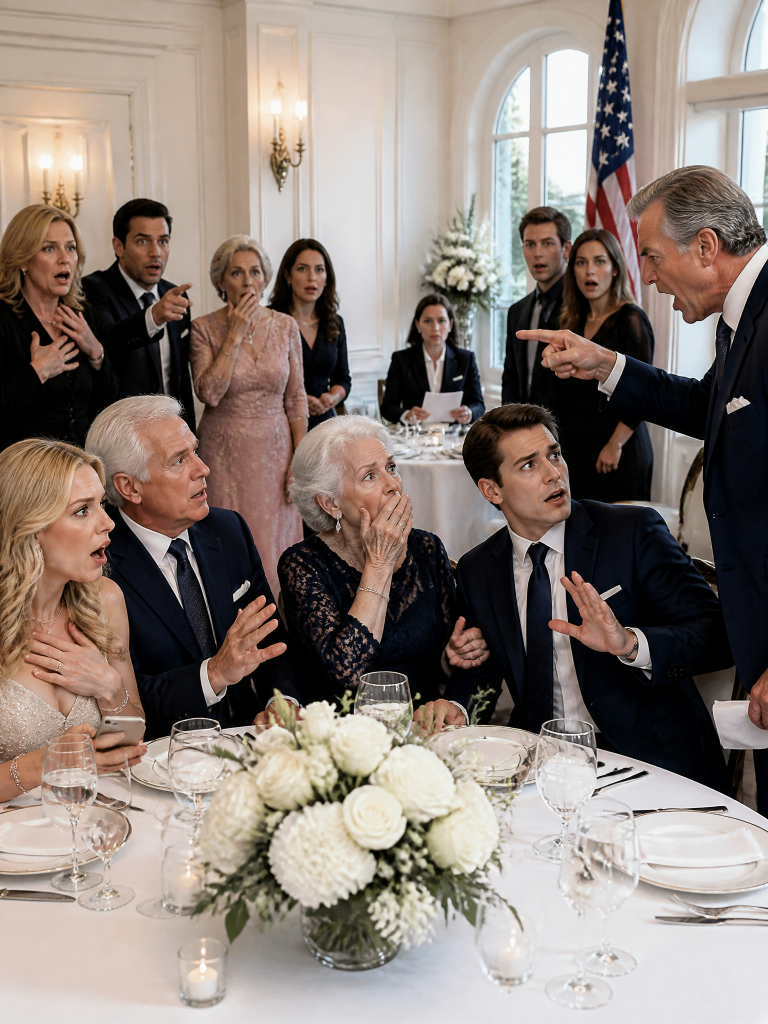
Six words silenced the ballroom.
Judge Bell extended his hand. I took it automatically.
“Judge Bell,” I said. “I didn’t realize this was your family.”
“And I didn’t realize this was yours.” He looked at the empty chairs around me, then toward the head table. “Or perhaps I am still trying to understand whether it is.”
A whisper moved through the room.
Dad stood so fast his napkin fell.
“Samuel,” he called too loudly. “There’s been a small seating issue.”
Judge Bell did not look away from me. “Has there?”
Heat climbed my neck. I had survived briefings, after-action reviews, and bad-news calls, but nothing prepared me for being publicly uncovered in a room where my own family had hidden me on purpose.
Ruth reached her husband’s side. “Samuel, is this the officer you told me about?”
“The very one.”
She turned to me, both hands over her heart. “My dear, I have heard your name in our house more than once.”
“I hope for good reasons.”
“For the best reason,” Judge Bell said.
Lydia had risen from her chair now. “Granddad, who is she?”
The question landed harder than expected.
Not how do you know her?
Who is she?
Evan closed his eyes briefly.
Dad stepped forward. “She’s a close family friend.”
I looked at him.
Some betrayals are loud. Others are your father lying about your blood under crystal chandeliers while your brother says nothing.
Judge Bell turned slowly toward Dad. “A family friend?”
Dad swallowed. “Yes.”
Evan’s face went pale.
Lydia looked between them. “Evan?”
He didn’t answer fast enough.
That was the third clue, and now Lydia saw it too.
Ruth turned back to me. “Dear, may I ask plainly? Are you related to the groom?”
The room held its breath.
I looked at Evan. His eyes were wet and ashamed.
I looked at Dad. He gave the smallest shake of his head.
A warning.
A plea.
An order disguised as embarrassment.
Then I heard my mother’s voice in memory: Claire, never lie just because someone powerful is listening.
So I stood taller.
“Yes,” I said. “Evan is my brother.”
Gasps and whispers rippled across the room.
Lydia’s mouth parted. “You’re Evan’s sister?”
“Yes.”
“But I asked about his family. I asked several times.”
Her eyes moved to Evan.
He looked down.
That hurt more than Dad’s lie.
Because Dad had always cared too much about appearances. But Evan knew me. I had packed his lunches when Mom was sick, helped with college applications from a base housing kitchen at midnight, sent money when his first apartment flooded, and stood beside him under one black umbrella at our mother’s grave.
Evan knew.
Judge Bell’s voice turned cold. “Mr. Hale, why was Major Hale introduced as a family friend?”
Dad gave a brittle laugh. “This is being blown out of proportion.”
“No,” Lydia said quietly. “I want to hear the answer.”
Dad tugged at his cuff. “I only wanted tonight to be smooth. There are accomplished people here, and sometimes military service becomes a complicated conversation.”
“Complicated,” Ruth repeated.
Dad reddened. “I chose the wrong word.”
“You chose several,” I said.
The truth had entered the room and refused to sit down.
“You told me not to say I was Evan’s sister,” I said. “You said my career might embarrass the Bells.”
Marion Bell covered her mouth. Everett’s expression hardened. Lydia stared at Evan as if he had become someone she did not recognize.
Evan finally stood. “Claire, I was going to tell her.”
“When? After dinner? After photos? After your new family spent three hours thinking I was a polite stranger tucked near the kitchen?”
“I didn’t want a fight,” he said.
“You let me become the price of peace.”
His face crumpled.
That almost broke me.
Judge Bell turned to the room. “Before anyone takes another bite, this family needs context.”
Dad lifted a hand. “Judge, with all due respect—”
“No,” the judge said.
One word. Calm. Final.
Judge Bell looked at me. “Major Hale, I will not tell your story without permission.”
“You can tell what you know,” I said.
He explained that two years earlier, his grandson came home from service with benefits delayed, housing issues, and a legal mess caused by someone exploiting his absence. Their family had attorneys and connections, but not everyone understood military life from the inside.
“At a Veterans Legal Outreach event in Raleigh,” he said, “Major Claire Hale stayed six hours after her scheduled panel ended. She did not know my grandson was related to me. She sat with him, explained every form, called the right office, and refused to let him be treated like a number.”
My throat tightened.
I remembered that young man: quiet, proud, angry at needing help, apologizing for taking up my time.
“Yes.”
“I was trying to apologize.”
“No. You were trying to regain control.”
He flinched.
“I made mistakes tonight.”
“That’s a small word for a long pattern.”
“Do you want me to beg?”
“No. I want you to stop performing remorse and actually sit with what you did.”
For once, he had no answer.
After a long moment, he whispered, “After your mother died, I didn’t know how to talk to you. You were so capable. You handled everything. I thought you didn’t need me.”
The old daughter inside me lifted her head.
“I needed my father,” I said. “You needed a scapegoat.”
His face crumpled.
“I was angry. You had somewhere to go. A purpose. Structure. People who saluted you and needed you. I was left in that house with her coffee mug still in the sink and Evan crying into his pillow. I hated that you could leave.”
“I had orders.”
“I know that now.”
“You knew it then.”
He closed his eyes.
There it was. Almost an apology. Close enough to tempt forgiveness. Not whole enough to deserve trust.
“I’m sorry,” he said. “For tonight. For what I told Evan. For making you feel like service made you less belongable.”
The word hit because it was accurate.
“I believe you’re sorry right now,” I said.
Hope flickered in his face.
“But I’m not coming back into the family the way you want. I’m done being available for appearances and emergencies. I’m done being hidden when inconvenient and praised when useful. I’m done letting you decide which version of me belongs in the room.”
His eyes filled, but softness was not surrender.
“I need distance,” I said. “Real distance. If we ever rebuild anything, it will be slow, honest, and without Mom’s memory used as your shield.”
My phone buzzed.
A text from Evan.
Please don’t leave before I talk to you.
Then another.
I told Lydia the truth. All of it. Dad too. I’m sorry. I know sorry doesn’t fix it.
My eyes burned.
Dad saw my face change. “Is it Evan?”
“Yes.”
“Is he okay?”
“No,” I said. “But maybe he’s finally becoming honest.”
I waited in the hotel courtyard until Evan came out, wrecked and shivering.
“Lydia postponed the engagement,” he said. “She didn’t end it. But she said she can’t wear the ring until she knows I understand partnership.”
“She’s smart.”
He told me he had confessed everything: Dad’s manipulation, his resentment, his fear, and knowing where I was seated while being too afraid to cross the room.
“That last part matters most,” I said.
“I know.”
He took one step closer, then stopped, no longer assuming he had the right.
“I don’t expect you to forgive me tonight.”
“Good.”
“I love you,” I said. “But love does not make me responsible for absorbing whatever shame you refuse to confront.”
He cried silently.
“I spent years translating Dad for you,” I continued. “Making his distance sound like stress, his criticism sound like concern, his forgetfulness sound like grief. I’m not doing it anymore.”
“I don’t want you to.”
“That means when Dad pushes, you don’t look to me to steady the room.”
“I won’t.”
“When he rewrites history, you don’t stay silent because it’s easier.”
“I won’t.”
“When your future wife asks where I am, you tell her the truth before she has to search the back of a ballroom.”
His face broke. “I won’t ever do that again.”
I believed he wanted to mean it.
That was not the same as trusting him yet.
Months passed. Evan called every week. At first, I let most calls go to voicemail, not to punish him, but to teach us both that access to me was no longer automatic. His messages slowly changed from desperate apology to quiet accountability. He corrected Dad. He started counseling. He found Mom’s old recipe card marked “Claire’s brave attempt” under my terrible lemon cookies.
Hannah—Lydia—sent me one message after New Year’s.
I don’t know what will happen with Evan and me, but I’m grateful I saw the truth before marriage made it harder. You didn’t ruin anything. You revealed what needed light.
I saved it.
Dad sent long messages full of regret, explanation, memory, and occasional self-pity dressed as sorrow. I answered only twice.
I need space. Please respect it.
And later:
Do not use Mom’s things to create conversations I did not agree to have.
After that, he stopped.
Three months later, I met him in a public park. No house. No symbols. No family photos. He carried nothing.
That was the first good sign.
He said he had begun counseling. He apologized to Evan not for one night, but for years. He admitted that I had not abandoned Evan. He had.
I waited for the excuse, the plea, the quiet demand that I heal faster.
It did not come.
“I miss my daughter,” he whispered.
The old part of me reached toward that sentence like a hand toward flame.
Then I let it pass.
“I missed my father for a long time,” I said. “You were standing right in front of me for most of it.”
He cried.
“I don’t know how to fix that.”
“You don’t fix it. You live differently long enough that the truth has somewhere new to stand.”
At my car, he asked if he would see me again.
“Yes,” I said. “But not at the last minute. Not for holiday photos. Not because Evan needs smoothing over. Lunch next month. One hour. Public place. No Mom as a bargaining chip.”
He nodded.
“And Dad?”
“Yes?”
“If you ever ask me to hide who I am again, from anyone, that will be the last time we speak for a very long while.”
“I understand.”
Belief was not forgiveness.
But it was a place to begin from a distance.
Part 7: The Best Seat in the Room
By spring, the first engagement dinner became something neither family told casually. That was another change. Painful things were no longer polished into anecdotes or buried under silence.
Evan and Lydia did not rush back into engagement. For six months, they dated with intention instead of momentum. They learned to argue without family pressure. Evan learned to say, “I’m scared,” before fear became dishonesty. Lydia learned she could love him and still require proof.
In September, Evan called.
“I’m going to ask her again.”
I was in the grocery store, comparing peanut butter like national security depended on it.
“Does she know?”
He laughed. “Basically. We picked the ring together this time. No surprise performance. No ballroom. No speeches.”
“Good.”
“I want you there afterward. Not hidden. Not symbolic. Just there.”
I stared at the labels until they blurred.
“I can do that.”
The proposal happened on a Saturday morning at a botanical garden under late roses. Lydia said yes with tears on her face and dirt on her dress because Evan knelt in a damp patch of grass and she pulled him up too fast.
Afterward, twelve of us gathered for brunch on a patio in white sunlight.
No crystal ballroom.
No weaponized seating chart.
Dad arrived alone. He carried no dramatic gift and greeted me carefully.
“Good morning, Claire.”
Not sweetheart, which he used when he wanted something.
Not Major, which he used when he wanted to sound proud in public.
Just my name.
We were not healed.
But we were not performing.
That mattered more.
At brunch, Judge Bell raised his glass.
I tensed.
He noticed and smiled faintly.
“I will keep this brief,” he said. “Today is not about titles, résumés, or perfect families. It is about two people choosing truth before ceremony. May that habit last longer than the flowers.”
Everyone laughed softly.
Later, Lydia found me near a fountain.
“I wanted to ask you something,” she said.
“If it’s about seating charts, I charge consulting fees now.”
She laughed, then grew serious.
“Will you stand on my side at the wedding? Not as a bridesmaid if that feels too traditional. Not because of what happened. I don’t have a sister, and you told me the truth when everyone else was managing my feelings. I would be honored if you stood with me.”
The old Claire would have checked Evan’s face, then Dad’s, then the room, calculating the answer that caused the least trouble.
The woman I was becoming did not do that anymore.
“I’d be honored,” I said.
The wedding took place the following May in a small chapel outside Charlottesville, dogwoods blooming white along the road. My dress was deep blue. My mother’s pearls were in my ears. My uniform was not on my body, but it didn’t need to be.
Nothing about me was hidden.
Dad walked Evan to the front, then sat in the second row. He did not give a speech. That had been his idea.
“I’ve said enough in rooms where I wanted control,” he told me the week before. “This time I want to listen.”
And he did.
At the reception, there was no head table. Lydia had arranged one long farm table under a tent, with candles in glass jars, wildflowers in blue pitchers, and handwritten place cards.
Mine sat between Lydia and Evan.
Dad’s was three seats away.
Close enough to be included.
Far enough to be honest.
During dinner, Evan leaned toward me. “I keep thinking about the first engagement dinner.”
“So do I.”
“I’m glad it happened,” he said, then winced. “That came out wrong.”
“No,” I said. “It didn’t.”
I understood.
That night had hurt. It cracked us open in public. It cost Evan an easy engagement, Dad his authority, and me the last illusion that my family would protect me without being forced to see me.
But some truths only enter through broken doors.
After dinner, Dad approached me near the tent’s edge. Fireflies blinked beyond the lights.
“You look like your mother tonight,” he said.
I stiffened.
He noticed immediately.
“No. That wasn’t fair.” He took a breath. “You look like yourself. She would have loved seeing it.”
That was the difference.
Not perfection.
Correction.
“I’m still learning,” he said.
“I know.”
“I’m sorry that learning came late.”
“Late love doesn’t erase early harm.”
“No,” he said. “It doesn’t.”
“But it can behave better from here.”
When the music slowed, Evan held out a hand.
“One dance? No saving me required.”
“Good. Because I retired from that job.”
We were terrible. He counted under his breath, stepped on my shoe twice, and apologized like he had committed a federal offense. I laughed harder than I had in months.
Across the tent, Dad watched us with tears in his eyes.
I saw him.
I did not go comfort him.
That was not cruelty. It was the shape of the life I had chosen after being hidden at the back of a ballroom.
I could love my father from a distance that protected me.
I could forgive pieces without handing him the whole house key to my heart.
I could stand beside my brother without becoming his shield.
I could honor my mother without letting anyone use her memory to silence me.
And I could belong in any room I entered, not because a judge recognized me, not because applause followed me, and not because my service impressed the right people.
Because I had stopped asking permission to be seen.
Near the end of the night, Judge Bell handed me a slice of cake wrapped in a napkin.
“For the road, Major Hale.”
“Thank you, Judge.”
He glanced toward the long table, the laughing guests, and the open space where no one had been hidden.
“Better seating this time.”
“Much better.”
When I left the reception, the moon was high. Mason—Evan—and Lydia were still dancing. Dad sat with the Bells, listening more than speaking. The night air was cool on my face.
I touched my mother’s pearls once, then let my hand fall.
For years, I thought the best seat in the room was the one my family saved for me.
I was wrong.
The best seat is the one you no longer beg anyone to give you.
So I walked to my car and drove home beneath steady stars, carrying my own name like something no one could hide again.
THE END