
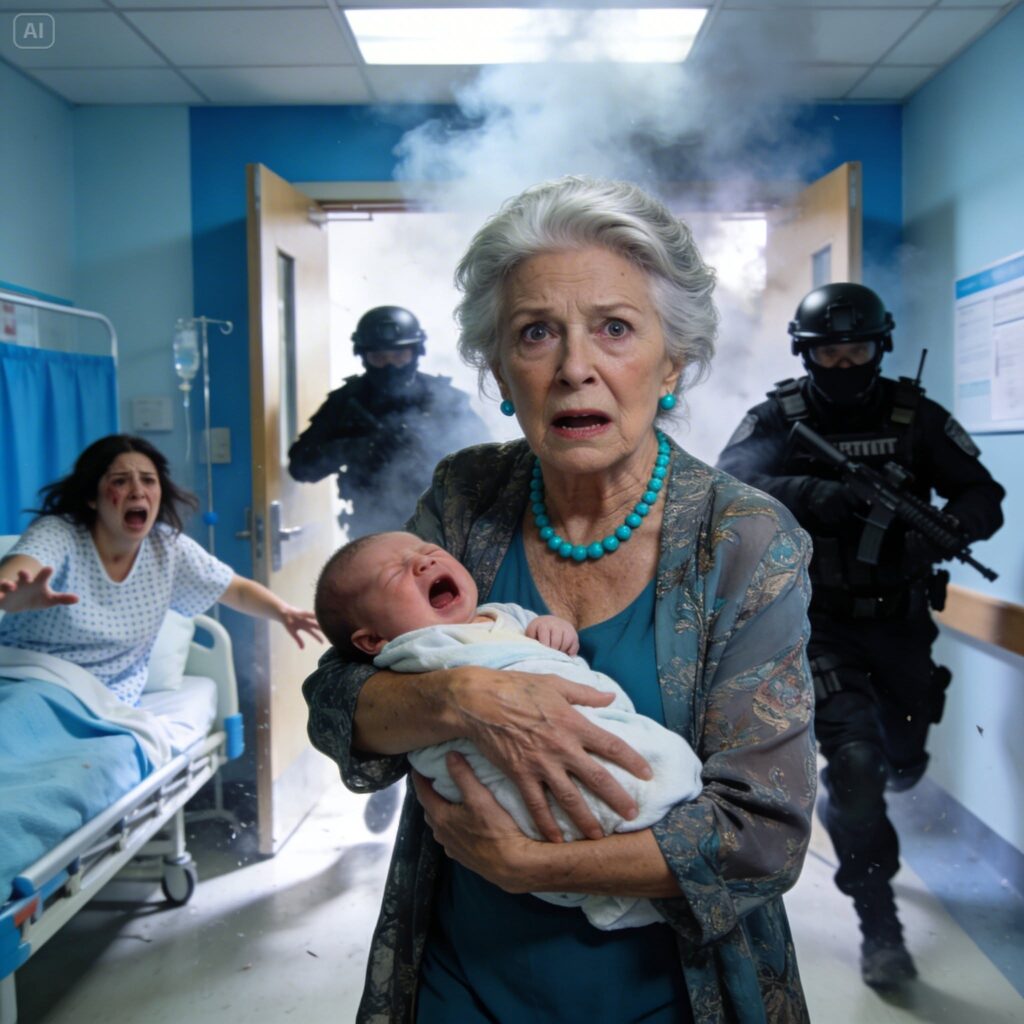
My Mother-In-Law Thought I Was A Lazy Unemployed Freeloader—Until She Tried To Steal One Of My Newborn Twins

Part 1
I never told my mother-in-law that I was a judge.
To Mrs. Beatrice Sterling, I was simply Elena—the quiet wife her son had foolishly married. A woman who wore loose dresses, stayed home often, avoided family business dinners, and never seemed to “work” in any way she considered respectable.
In her world, work meant visible exhaustion. Men in suits. Women managing charities with cameras nearby. Bank statements that could be bragged about over brunch.
My work was different.
My work wore black robes, read sealed evidence, signed emergency protection orders, and decided where frightened children would sleep when adults failed them.
But Beatrice Sterling did not know that.
To her, I was a lazy, unemployed freeloader living off her son.
And for a while, I let her believe it.
My husband, Daniel Sterling, knew the truth, of course. He knew I was Judge Elena Vance, newly appointed to the family division after years as a prosecutor handling domestic violence and child welfare cases. He knew I kept my public life separate from his family because the cases I heard were sensitive, sometimes dangerous, and because I did not owe his mother access to my identity simply because she demanded it.
Daniel hated the way his mother spoke to me.
I hated it too.
But I had spent years studying people. Beatrice was the kind of woman who revealed herself more honestly when she believed the person in front of her had no power.
So I stayed quiet.
I watched.
I listened.
And I learned.
I learned that Beatrice measured women by what they produced for men. Sons. Reputation. Obedience. Social advantage. I learned that my sister-in-law, Karen, had spent years suffering infertility under her mother’s poisonous pity until grief became entitlement. I learned that Daniel had grown up loved only when useful and punished when disobedient.
I also learned that Beatrice did not understand boundaries.
Not emotional ones.
Not legal ones.
And certainly not mine.
The day my twins were born, I thought, foolishly, that even Beatrice would soften.
Leo and Luna Sterling arrived by emergency cesarean after thirty-seven hours of labor, two fetal heart scares, and one terrifying moment when the room filled with too many doctors speaking too quickly. By the time I heard Leo’s first cry and then Luna’s, my body was shaking so hard the anesthesiologist kept one hand on my shoulder.
Daniel cried openly.
He kissed my forehead and whispered, “You did it, Elena. They’re here.”
Our son, Leo, was placed against my cheek first. Then Luna, tiny and fierce, her little mouth open in protest as if already offended by the world.
I loved them so violently it frightened me.
Later, in the recovery suite at St. Jude’s Medical Center, the room looked more like a quiet hotel than a hospital. Not because I wanted luxury. Because my position required privacy and security. The hospital had assigned the VIP suite after chambers notified them I was delivering under confidentiality precautions.
At my request, they hid the expensive orchid arrangements sent by the District Attorney’s Office, the courthouse staff, and two Supreme Court justices who had known me since law school.
No titles.
No cards visible.
No “Honorable Judge Vance” on display.
I wanted one day to be only a mother.
Leo and Luna slept in clear bassinets beside me, wrapped like miracles. My abdomen burned from the incision. My mouth was dry. My lip was cracked from biting through pain before surgery. But when I looked at them, every ache became background noise.
Daniel had left the room for less than twenty minutes.
A nurse needed signatures. My husband also wanted to call my father, who was waiting anxiously in the hospital chapel because he still believed pacing near holy ground improved outcomes.
I was alone when the door flew open.
Beatrice Sterling marched in wearing a fur-trimmed coat, pearls, and rage.
The first thing I noticed was not her perfume, though it entered before she did.
It was the folder in her hand.
She scanned the room—the soft lighting, the private nurses’ station visible through the side door, the silk pillows I had not asked for—and her face twisted.
“A VIP suite,” she said.
I blinked, still hazy from medication. “Beatrice?”
She kicked the foot of my bed.
Pain shot through my abdomen so sharply I gasped.
“My son works himself to death,” she snapped, “and you waste his money on silk pillows and room service?”
I gripped the blanket, forcing myself not to cry out.
“This suite was arranged by—”
“By your greed,” she cut in. “You really are a parasite.”
Leo stirred in his bassinet.
My whole body tightened.
“Lower your voice,” I said.
Beatrice laughed.
Then she tossed the folder onto the rolling table beside my bed.
“Sign it.”
I looked at the papers.
Parental Rights Relinquishment.
My vision blurred, then sharpened.
“What is this?”
“Don’t pretend to be stupid. Karen is downstairs in the car. She needs Leo.”
For a second, I thought the pain medication had caused me to mishear.
“She needs what?”
“A son.” Beatrice said it as if discussing furniture. “Karen is infertile. You have two babies. She has none. The Sterling name requires balance.”
I stared at her.
“These are my children.”
“You can keep the girl.”
A cold, clean fury moved through me.
“Get out.”
Beatrice’s eyes hardened.
“Don’t be selfish. You can’t handle twins. You don’t even have a job.”
“I said get out.”
She moved toward Leo’s bassinet.
Every instinct in me screamed.
“Do not touch my son.”
Beatrice reached down.
Despite the tearing pain in my abdomen, I lunged forward.
She spun and slapped me across the face.
The blow snapped my head into the bed rail. White light burst behind my eyes. My stitches screamed. Somewhere, Luna began crying.
“Insolent brat,” Beatrice hissed.
Then she lifted Leo.
My newborn son wailed in her arms.
Something inside me went very still.
The submissive Elena—the polite daughter-in-law, the woman who stayed quiet at dinners, the wife who swallowed insults because dignity did not need performance—died in that hospital bed.
I slammed my palm against the red emergency button on the wall.
CODE GRAY / SECURITY.
Sirens screamed through the suite.
Beatrice clutched Leo tighter.
“You stupid girl.”
The door burst open.
Four security guards rushed in, led by Chief Mike Donnelly, a broad-shouldered former police officer who ran hospital security with military precision. Tasers drawn. Nurses behind him. Chaos in the hallway.
Before I could speak, Beatrice transformed.
Tears filled her eyes instantly.
“Help me!” she cried. “My daughter-in-law has postpartum psychosis. She attacked me. She tried to strangle the baby!”
I sat there bleeding from the lip, hair disheveled, gown twisted, arms reaching for my screaming son.
Chief Mike’s eyes moved from me to Beatrice to the papers on the table.
“Ma’am,” he said to me carefully, “I need you to stay calm.”
Beatrice sobbed louder. “She’s unstable. She never wanted two babies. She said she hated him!”
“That is a lie,” I said.
But my voice shook.
A guard stepped toward me.
Mike reached for his taser.
Then his eyes locked fully on my face.
For one suspended second, he froze.
His color drained.
“Judge Vance?”
The room went silent.
Mike immediately removed his cap.
“Lower your weapons,” he barked. “Now.”
Beatrice stopped crying.
I lifted one trembling hand and pointed at her.
“She assaulted me, attempted to remove my newborn son from this room, and brought illegal relinquishment documents for execution under coercion hours after surgery.”
Mike’s jaw tightened.
“Take the baby from her. Carefully.”
Beatrice backed away.
“No. I’m his grandmother.”
I looked at her then—not as her daughter-in-law, not as the woman she had humiliated for years, but as the judge who had seen exactly what people like her did when they thought love gave them ownership.
“No,” I said coldly. “You are now a suspect.”
Part 2
Chief Mike moved fast.
Two nurses took Leo from Beatrice’s arms and placed him against my chest. I sobbed the moment his tiny body touched mine. Luna cried beside us, and a nurse lifted her too, tucking both babies safely against me while another checked my incision.
Beatrice was still performing.
“This is absurd!” she shouted. “She is nobody. She married my son for money.”
Mike looked at her. “That woman is Judge Elena Vance.”
Beatrice’s face went blank.
At that exact moment, Daniel came running in.
He saw my bleeding lip, the adoption papers, his mother restrained by security, and Leo crying against my chest.
“What happened?”
I could barely speak.
Mike answered for me.
“Your mother attempted to take your son.”
Daniel turned to Beatrice.
She lifted her chin. “Karen deserves a child. Elena has two. I was fixing what nature got wrong.”
Something broke in my husband’s face.
“You tried to steal my son from his mother?”
“I tried to protect this family.”
“No,” Daniel said. “You tried to own it.”
Then the police arrived.
Beatrice screamed that I was crazy, that Daniel was bewitched, that no court would punish a grandmother. But when officers reviewed the security footage, saw the slap, heard her demand my signature, and found Karen waiting downstairs with a car seat and a pre-packed diaper bag, the story changed.
Karen sobbed in the lobby.
“Mom said Elena agreed.”
But her text messages said otherwise.
Make her sign before Daniel returns.
Take the boy first. The girl is useless to me.
If Elena resists, claim postpartum psychosis.
Daniel read the messages and went pale.
I watched him look at his sister, then his mother, then our twins.
For the first time, he fully understood the family he had been trying to survive.
Beatrice was arrested.
Karen too.
As officers led them away, Beatrice shouted, “You think your robe makes you powerful?”
I kissed Leo’s head and looked at her.
“No,” I said. “But the law does protect my children from women like you.”
Part 3
The hospital room did not become peaceful after Beatrice was taken away.
People imagine justice arrives like a clean ending: the villain restrained, the truth spoken, the innocent protected, and the room instantly filled with relief.
That is not how trauma works.
After the police left with my mother-in-law and sister-in-law, I sat in the recovery bed with both babies pressed against me, shaking so violently the nurse had to help support my arms. Leo had stopped crying, but his little breaths still hitched. Luna rooted against my gown, furious and hungry, as if she had decided survival required immediate protest.
My face throbbed where Beatrice had slapped me.
My abdomen burned.
But the worst pain was not physical.
The worst pain was the image of her hands lifting my son from his bassinet while I was too freshly cut open to stand.
Daniel stood at the foot of the bed, pale and shattered.
He looked like a man who had reached into his own family tree and found rot beneath every root.
“Elena,” he whispered.
I looked at him.
For the first time since we married, I saw fear in his eyes—not fear of his mother, not fear of scandal, but fear that I might never forgive him for bringing his family close enough to harm us.
He came to my side slowly.
“Can I touch you?”
That question nearly broke me.
I nodded.
He took my hand with both of his, careful of the IV, careful of the monitor wires, careful as if I were glass and fire at once.
“I am sorry,” he said.
The words were too small.
He knew it.
“I should have stopped her years ago. Every insult. Every dinner. Every time she called you lazy or useless. I told myself I was choosing peace. I told myself you were strong enough to ignore her.” His voice cracked. “I let her believe silence meant permission.”
I closed my eyes.
I wanted to say it was not his fault.
But part of it was.
Not the crime. Not the slap. Not the attempted abduction. Those belonged to Beatrice and Karen alone.
But the road that led them to believe they could enter my hospital room and take my child had been paved with years of tolerated disrespect.
So I told the truth.
“You kept asking me to be patient with cruelty because it came from your mother.”
Daniel bowed his head.
“Yes.”
“And I agreed too often because I thought dignity meant not defending myself.”
His eyes lifted.
“No. You had dignity. I lacked courage.”
The honesty hurt.
It also began something.
Chief Mike returned an hour later with two uniformed officers and a detective from the special victims unit, Detective Mara Kell. Mike stood at the doorway like a man unsure whether to salute or apologize.
“Judge Vance,” he said quietly.
“Please don’t call me that right now.”
His face softened. “Elena.”
That nearly undid me too.
At the courthouse, Mike Donnelly had testified before me dozens of times when he was still active law enforcement. I knew him as professional, steady, disciplined. But in that room, he looked ashamed.
“I almost made the wrong call,” he said.
I understood what he meant.
When he entered, he saw a wealthy older woman in fur holding a baby and a disheveled postpartum mother bleeding and shouting. If he had not recognized me, the next five minutes might have become another nightmare.
“You paused,” I said.
“Too late.”
“But you corrected.”
He swallowed.
“That doesn’t make it enough.”
“No,” I said. “But it makes it honest.”
Detective Kell took my statement gently but thoroughly. She photographed my injury. The nurses documented the reopened bleeding near my incision from lunging toward Leo. Security preserved the footage. The forged relinquishment papers were placed into evidence.
They were not merely inappropriate.
They were predatory.
The documents had been prepared by a private attorney connected to Beatrice’s social circle, with lines already marked for my signature. There was no independent counsel listed for me. No medical clearance. No waiting period. No proof of informed consent.
They had intended to frighten a woman hours after major surgery into signing away her newborn son.
When Detective Kell asked whether I wanted to continue the interview later, I looked at Leo and Luna sleeping against me.
“No,” I said. “Now.”
Daniel sat beside me the entire time.
Not speaking for me.
Not interrupting.
Just there.
That mattered.
By morning, the story had reached places we could no longer control.
A nurse had not leaked it. Neither had hospital security. It was Beatrice.
From the holding room, before her phone was taken, she had managed to send messages to half her social circle claiming her “unstable, unemployed daughter-in-law” had fabricated an assault to keep the Sterling heir away from his rightful family. Within hours, whispers spread through private group chats, then society blogs, then local media.
Beatrice Sterling had always trusted reputation more than truth.
She should have known better than to challenge a judge with evidence.
At nine that morning, while I was nursing Luna and Daniel was learning how to swaddle Leo with the grave concentration of a man defusing a bomb, my chief clerk called.
“Judge Vance,” Andrea said, voice tight. “Do you want the court to issue a privacy statement? Reporters are calling chambers.”
I looked at Daniel.
His jaw clenched.
For months, I had kept my identity hidden from his family. Not because I was ashamed, but because I wanted one part of my life untouched by title and performance. That privacy was gone now.
“Keep it brief,” I said. “Confirm that I am on maternity leave, that there is an active criminal investigation, and that my children are safe. No further comment.”
Andrea paused.
“Are you all right?”
I looked down at my twins.
“No,” I said. “But I will be.”
The arraignment happened two days later.
I did not attend in person. I was still in the hospital, moving like my body had been split in two and stitched back together by faith. But I watched through a secure video feed because Detective Kell believed Beatrice might try to influence the narrative in court.
She did.
Beatrice arrived in a cream suit, pearls, and righteous outrage. Karen looked smaller beside her, eyes swollen, hands clenched around a tissue. The attorney Beatrice hired tried to frame the incident as a family misunderstanding caused by postpartum confusion.
Then the prosecutor played the hospital audio.
Beatrice’s voice filled the courtroom.
Karen needs a son.
You can keep the girl.
Make her sign before Daniel returns.
The judge presiding, an older man named Howard Bell, removed his glasses and stared at Beatrice with open disgust.
“Mrs. Sterling,” he said, “I have presided over many custody disputes, but rarely have I heard entitlement this naked.”
Beatrice’s attorney objected.
Judge Bell sustained nothing.
Bail was set high. Protective orders were issued immediately. No contact with me, Daniel, Leo, Luna, or any hospital staff involved. Karen sobbed when the order was read.
Beatrice did not cry.
She glared into the camera as if she could still reach me through the screen.
Daniel stood behind my hospital bed and took my shoulder gently.
“She cannot touch them,” he said.
I wanted to believe him.
My mind did.
My body did not.
Every time someone opened the hospital door, I startled. Every time Leo cried, I reached for him too fast, pain tearing through my incision. The nurses began announcing themselves before entering. Mike placed a trusted guard outside the suite. Daniel slept in a chair between the bassinets and the door.
On the fourth night, I woke to find him standing over the twins, one hand on each bassinet, crying silently.
“Daniel?”
He wiped his face quickly.
“I’m sorry. I didn’t mean to wake you.”
“What is it?”
He looked at Leo and Luna.
“When my mother said Karen needed a son, I remembered being twelve.”
I waited.
Daniel rarely spoke about childhood without sanding the edges first.
He did not sand them now.
“My father had just died. Mother told me I was the man of the family. She made me stand beside her at the funeral and thank every guest. I cried once in the bathroom. She slapped me and said Sterling men don’t leak weakness in public.”
My chest tightened.
Daniel looked down at Leo.
“She taught me love was duty. Performance. Obedience. I thought I had escaped her because I married you.” His voice broke. “But I still kept trying to manage her instead of confronting her.”
I reached for him.
He came to me immediately, kneeling beside the bed.
“Our children will not learn love that way,” I said.
“No,” he whispered. “Never.”
The next day, he did something I had not asked for.
He called a press conference.
Not a flashy one. Not a circus. A short statement outside the hospital with our attorney present.
I watched from bed, heart pounding.
Daniel stood before the cameras looking exhausted, unshaven, and more honest than I had ever seen him publicly.
“My wife, Judge Elena Vance, gave birth to our twins this week. Hours later, my mother and sister attempted to coerce her into surrendering our son. My mother’s public statements about my wife are false. Elena is not unstable. She is not unemployed. She is not a freeloader. She is one of the strongest, most principled people I have ever known.”
He paused.
His voice hardened.
“And let me be clear: my wife’s worth would not be greater if she were a judge, and it would not be less if she were a housewife, a maid, a cashier, or unemployed. The crime here is not that my mother insulted a powerful woman by mistake. The crime is that she believed any mother could be bullied into giving up her child because she seemed powerless.”
Tears blurred my vision.
Daniel looked straight into the cameras.
“The Sterling family name will not be used to excuse cruelty. Not anymore.”
That statement changed everything.
People expected me, as the judge, to deliver the moral blow. But Daniel’s words struck differently because he was the son choosing truth over bloodline mythology.
For the first time, he publicly broke the spell.
After we brought Leo and Luna home, the mansion felt different.
I had refused to move into the Sterling family estate after marriage, thank God. Daniel and I lived in a brownstone near the courthouse, warm and narrow and ours. Still, Beatrice’s shadow followed us through the early weeks of parenthood.
Exhaustion made fear sharper.
One night, while feeding Leo at three in the morning, I began to shake so badly I nearly dropped the bottle.
Daniel took it from me.
“Elena.”
“I saw her take him again.”
He set the bottle down and wrapped one arm around me while holding Leo safely with the other.
“She’s not here.”
“I know.”
“She cannot come here.”
“I know.”
“You’re safe.”
“I know.”
But knowing is not the same as feeling.
I began therapy six weeks postpartum, after my doctor gently said trauma and hormones had formed a storm I did not need to walk through alone. Daniel began therapy too. That mattered more than flowers, apologies, or promises. He wanted to understand why confrontation with his mother had felt impossible for so long.
Parenthood became our healing and our test.
Leo was calm unless hungry, then furious beyond reason. Luna slept with one hand thrown dramatically over her face. Daniel became a master of diaper changes and a terrible singer of lullabies. I learned that being a judge did not make me immune to crying over spilled breast milk, fear, sleep deprivation, or the ache of loving two tiny people who depended completely on my body and courage.
The criminal case against Beatrice and Karen expanded when investigators seized Karen’s phone.
There were messages going back months.
At first, Karen had resisted.
Mom, Elena will never agree.
This is insane.
Daniel will hate us.
Then Beatrice’s replies:
Daniel is weak because of that woman.
A boy belongs to the Sterling line.
Elena has no career, no standing, no leverage.
Once she signs, she can scream all she wants.
The texts made me cold.
Karen had not been innocent.
But she had been shaped by the same woman who shaped Daniel. Infertility had been weaponized against her until longing became desperation. That did not excuse her. It explained why she looked so broken when police arrested her.
At the preliminary hearing, Karen pleaded guilty to conspiracy and attempted custodial interference in exchange for testimony against Beatrice. Her statement revealed that Beatrice had paid the attorney to prepare documents and had coached Karen to wait outside with a car seat, formula, and a fake discharge plan.
Beatrice refused all plea offers.
She believed a jury would understand “family tradition.”
She was wrong.
The trial happened ten months later.
By then, Leo and Luna were chubby, bright-eyed, and determined to place everything in their mouths. I returned to the bench part-time. My first day back, Chief Mike stood in the courthouse lobby. He had retired from hospital security and returned to court protection services after the incident triggered a major review of postpartum emergency protocols.
He removed his cap when he saw me.
“Judge Vance.”
“Chief.”
His eyes softened. “How are the twins?”
“Loud.”
“Good.”
Then he said quietly, “The hospital changed its Code Gray response training. No postpartum patient is to be approached as a threat without immediate medical and witness assessment unless there is active violence. Your case did that.”
I breathed in.
Something good had come from terror.
Not enough to justify it.
But enough to matter.
At trial, I testified not as a judge, but as a mother.
That was harder.
On the stand, the defense tried to make my title sound like manipulation.
“Judge Vance, isn’t it true that once security recognized you, everyone immediately believed your version?”
I looked at the attorney.
“No. They believed the security footage.”
A few jurors shifted.
He tried again.
“You concealed your profession from Mrs. Sterling, correct?”
“Yes.”
“Why?”
“Because my profession was not her business.”
“And had she known you were a judge, perhaps this misunderstanding—”
“This was not a misunderstanding,” I interrupted.
The judge warned me to answer only the question.
I apologized.
Then answered.
“If Mrs. Sterling would not have assaulted me and attempted to take my newborn had she known I was a judge, that does not prove she misunderstood. It proves she believed I was safe to abuse when she thought I had no power.”
The courtroom went silent.
Even Beatrice looked away.
Daniel testified after me.
He did not protect his mother.
Not once.
He described years of control, the obsession with bloodline, the pressure over a male heir, the insults toward me, the way Beatrice had spoken of Karen’s infertility as a family defect needing correction. He cried when he described seeing my bleeding lip and Leo in his mother’s arms.
The prosecutor asked him, “Mr. Sterling, who had the right to decide whether Leo left that hospital room?”
Daniel looked at the jury.
“My wife. Only my wife. And later both of us together as his parents. No grandmother. No aunt. No legacy.”
The verdict came quickly.
Guilty.
Attempted kidnapping.
Assault.
Coercion.
Conspiracy.
Forgery-related charges connected to the relinquishment documents.
Beatrice showed no remorse at sentencing. She stood in front of the judge and said, “Everything I did was for family.”
The judge replied, “No, Mrs. Sterling. Everything you did was for control.”
Karen, who had already been sentenced to probation, mandatory counseling, and a long protective order, cried in the gallery. I did not hate her by then. I did not trust her either. Forgiveness, I had learned, was not the same as access.
Beatrice received prison time.
Not forever.
But long enough to learn that legacy did not outrank law.
After the sentencing, Daniel and I stood outside the courthouse. Reporters called our names. Cameras flashed. For a moment, I felt the old panic rise—the hospital room, the slap, Leo’s cry.
Daniel reached for my hand.
“Ready?”
I looked at him.
At the man who had once been too quiet in the face of his mother’s cruelty and had chosen, painfully and publicly, to become different.
“Yes.”
We walked past the cameras without speaking.
One year after the birth, we held Leo and Luna’s birthday party in our tiny backyard.
No society guests. No Sterling relatives except one distant cousin who had sent diapers anonymously during the trial and earned my cautious affection. My father came. Andrea from chambers came. Chief Mike came with two enormous stuffed bears. Detective Kell came with board books about brave animals.
Daniel baked the cakes himself.
They leaned.
Badly.
“Structural integrity is not your gift,” I told him.
He kissed flour from my cheek.
“Good thing I married a judge, not an architect.”
Leo smashed frosting into his hair. Luna attempted to eat a candle before three adults stopped her. My father cried during the birthday song. I cried after it because motherhood had made me ridiculous and holy in equal measure.
That evening, after everyone left and the twins finally slept, Daniel and I sat on the floor of the nursery between their cribs.
“I used to think protecting them meant keeping danger away,” he said.
I leaned my head against his shoulder.
“And now?”
“Now I think it means teaching them no one owns them. Not family. Not tradition. Not fear.”
I looked into Luna’s crib, where she slept with one fist raised like a tiny revolutionary.
“And teaching them that love does not require surrendering their voice.”
Daniel took my hand.
“Or their child.”
Silence settled around us.
Soft this time.
Safe.
Months later, the state legislature passed a new law requiring independent counsel and judicial review before any voluntary parental rights relinquishment involving a hospitalized postpartum parent could be accepted. The bill was informally called Leo’s Law by the press, though I always insisted Luna’s name belonged there too, because Beatrice’s cruelty toward my daughter was part of the same crime.
She had valued one child and dismissed the other.
The law protected both.
I returned fully to the bench when the twins were eighteen months old.
My first case back involved a grandmother petitioning for emergency custody. The facts were different. The grandmother was kind. The mother was struggling with addiction and asking for help. I listened carefully, separating my trauma from the law, because justice requires discipline even when memory has teeth.
After the hearing, I sat alone in chambers for a moment.
On my desk stood a photograph of Daniel holding Leo and Luna, both babies laughing, his face full of exhausted joy.
Next to it was a small card from Mike.
Judge Vance,
Thank you for reminding us to see the person before the panic.
—Chief Donnelly
I kept that card for years.
Not because I needed praise.
Because it reminded me how close the world had come to misreading me in the most vulnerable moment of my life.
A bleeding mother could be called crazy.
A rich grandmother could be called concerned.
A newborn could be called legacy instead of child.
A woman without a visible job could be called useless until someone recognized her title.
That was why Daniel’s statement mattered so much.
My title had saved me quickly.
But it should not have been required.
Years later, when Leo and Luna asked about their grandmother, we told them the truth in pieces they could carry.
“She was someone who thought love meant control,” I said.
Luna frowned. “That’s not love.”
“No,” Daniel said. “It isn’t.”
Leo asked, “Did she say sorry?”
Daniel’s face tightened.
“No.”
“Then we don’t have to visit,” Luna declared.
I smiled.
“No, sweetheart. You don’t.”
At five, Luna asked why the law had Leo’s name but not hers. Daniel choked on his coffee. I promised her that in our house, the law was called the Twins’ Law. She accepted this after demanding pancakes shaped like gavels.
At seven, Leo asked why Aunt Karen sent birthday cards but never came inside. We explained that some people can be sorry and still not safe enough for closeness yet. He nodded gravely, then asked if he could have her stickers.
Children accept boundaries better than adults when adults tell the truth.
As for Karen, she spent years in therapy. Eventually, she wrote me a letter that did not ask forgiveness, which made it the first decent thing she had ever given me.
She wrote:
I thought my grief entitled me to your joy. It did not. I am sorry for seeing your son as an answer instead of a person.
I placed the letter in a drawer.
I have not answered yet.
Maybe one day.
Maybe not.
Both are allowed.
On the twins’ eighth birthday, we visited St. Jude’s Medical Center for a ceremony. The maternity wing had created a new patient advocacy room for postpartum mothers facing family coercion, domestic pressure, adoption fraud, or custody threats. They asked me to speak.
I stood at the podium with Daniel in the front row, Leo and Luna beside him, both bored but trying to behave.
I looked at the nurses, doctors, security staff, advocates, and young mothers holding babies in the back.
“I am alive, safe, and still raising both my children because one security chief paused long enough to recognize me,” I said. “But no woman should need to be recognized as a judge to be believed as a mother.”
The room went very still.
I continued.
“Postpartum women are vulnerable, not voiceless. Pain does not make them irrational. Blood does not make them dangerous. Tears do not make them unstable. And family pressure, even when dressed as tradition, can become violence when it seeks to take away consent.”
Daniel wiped his eyes.
Chief Mike pretended not to.
Luna whispered loudly, “Mom is using her judge voice.”
Leo whispered back, “That means clap after.”
People did.
After the ceremony, Mike knelt to greet the twins.
“You two caused quite a lot of legal reform,” he said.
Luna tilted her head. “We were babies.”
“Exactly. Very efficient.”
Leo looked impressed.
That night, after the children fell asleep, Daniel and I stood in the nursery doorway the way we had when they were infants. The cribs were gone now, replaced by two small beds, a mountain of books, and toys that multiplied when no one watched.
Daniel slipped an arm around my waist.
“Do you ever wish they had been born into a simpler family?”
I looked at our children.
Leo sleeping diagonally, one foot off the bed.
Luna clutching a stuffed dragon like a weapon.
“No,” I said. “I wish the family had chosen to be worthy of them.”
He kissed my temple.
“We are trying.”
“Yes.”
I leaned into him.
“That is what makes us their family.”
Beatrice Sterling never became the grandmother she believed she had the right to be. Legacy did not give her access. Blood did not erase harm. The Sterling name continued, but not in the way she demanded. It continued in Leo’s kindness, Luna’s ferocity, Daniel’s healing, and in the law that protected mothers she would have dismissed.
As for me, I no longer hide who I am to make cruel people comfortable.
I am Elena Vance.
Judge.
Wife.
Mother of twins.
Woman who once pressed a panic button with a bleeding lip and a fresh incision while another woman tried to steal her son in the name of family.
People sometimes ask whether I regret not telling Beatrice earlier that I was powerful.
I do not.
Because the truth is, she did not reveal who I was.
She revealed who she was.
And when the police chief whispered, “Judge Vance?” the room finally saw what had always been true:
I was never the freeloader in that family.
I was the line they should never have crossed.