“Pretend You’re Hugging Me,” the Boy Pleaded — Not Knowing the Stranger Was a Billionaire Spotlight8

## Chapter 1
The boy hits him like a piece of the storm.
One moment the man is walking through the glittering cold of downtown Chicago, counting his footsteps — nine hundred and twelve, nine hundred and thirteen — and the next, a small wet body has slammed into his chest hard enough to knock the air out of him, and two small arms are locked around his coat, and a voice is shaking against his collar:
“Please. Please just pretend you’re hugging me.”
He looks down. The boy can’t be more than eight. Dark hair plastered flat to his skull by the rain. A thin jacket too small in the shoulders, seams straining like life has been pulling at him from every direction at once. Sneakers soaked through, one lace dragging in the water like a leash. But it’s the eyes that stop him cold — wide, terrified, the eyes of a child who already knows, with a certainty no kid should ever have to learn, exactly what happens to him if he gets caught.
Behind the boy, two men in dark uniforms come barreling down the sidewalk, boots smashing through puddles, faces red from the cold.
“Ethan! Ethan Miller! Get back here right now!”
The boy flinches so hard the man feels it through the wool of his own coat.
He should step away. A careful man would weigh the risks, count the headlines. Because this man isn’t just anyone — he’s Andrew Whitman, founder of one of the most powerful technology companies in the country, a name that hangs on glass towers, a face that ends boardroom arguments before they start.
But Andrew Whitman stopped being a reasonable man the night a wet highway took his wife and the daughter they had already named Lily.
He wraps both arms around the boy and pulls him in close.
“There you are,” he says loudly, voice suddenly calm and deep and controlled. “I’ve been searching every block for you, son.”
The two men slow. Confidence flickers on their faces like a candle in a draft.
“Sir,” the taller one says, breathing hard, “that boy is with us. He ran off during supervised recreation.”
“This boy is my son,” Andrew says. “Ethan Whitman. And unless you want to explain to my attorneys why two grown men are chasing a terrified child through downtown Chicago, I suggest you take a step back.”
The name lands like a door slamming shut. Recognition passes across the guards’ faces like weather — the coat, the watch, the way he doesn’t need to raise his voice to be heard. They know exactly what kind of man they’re standing in front of. The kind who owns the buildings behind them.
The shorter guard swallows. “There may have been a mistake.”
“There may have been,” Andrew agrees.
They back away, muttering apologies the rain swallows whole. Only when they’ve vanished around the corner does the boy finally loosen his grip — but he doesn’t let go completely. His fingers stay knotted in Andrew’s coat like a lifeline.
“Thank you,” Ethan whispers.
Andrew looks down at the small, soaked, trembling creature clinging to him and feels something crack open inside his chest — something he believed frozen solid for fifteen months. It hurts. But it’s a different kind of hurt. The kind that means blood is moving again.
“You’re safe for this minute,” Andrew says quietly. “Now tell me why you were running.”
Ethan stares down the empty street where the men disappeared, as if they might tear their way back out of the rain at any second. His small chest rises and falls in quick, uneven breaths. Rain slides from his hair onto his cheeks, mixing with tears he’s trying very hard to hide.
“They were taking me back,” he says at last. “To the home.”
Andrew waits.
Ethan’s voice drops so low the storm almost swallows it. “Because they’re sending my little brother away tomorrow morning. A family wants Noah. Not me. They said I’m too old. They said nobody wants older kids who ask too many questions.”
Something cold and violent moves through Andrew’s chest. Not anger. Something deeper. Something already taking a shape he doesn’t have a name for yet.
“I don’t need you to save me,” Ethan says, wiping his face with the back of his hand, meeting his eyes with a ferocity that doesn’t belong on an eight-year-old. “Just help me get Noah. Please.”
Andrew stares at the boy — at his shaking, scarred hands, at his impossible courage, at the whole terrible weight of a life no child should have to carry.
For the first time in fifteen months, Andrew Whitman knows exactly what he’s going to do.
He doesn’t know yet that pretending is over.
## Chapter 2
A black SUV slides to the curb almost soundlessly, headlights cutting through the rain. The driver steps out with an umbrella, takes in the scene — his employer, soaked, holding a strange child — and schools his face into careful neutrality.
“Mr. Whitman,” Marcus says. “Sir.”
“Open the door, Marcus.”
Ethan’s eyes go wide. “No. No cars.” He steps back, arms stiffening. “I can’t.”
Andrew crouches low, bringing himself nearly eye to eye with the boy. “Listen to me. I’m not forcing you anywhere. You can stand right here if you want, and those men can come back and take you wherever they were taking you. But you’re soaked through, you’re shaking, and you’ve got a brother to save. I know a hotel nearby. Warm lobby. Cameras everywhere. You get dry, you get food, you tell me what happened. And after that — we decide what comes next.”
“We,” Ethan repeats, the word slipping out like he has never once been included in a decision before.
“We,” Andrew agrees.
The boy stares at him for a long moment, weighing something invisible. Then, slowly — still coiled to run if the world betrays him again — Ethan climbs into the SUV. Andrew slides in beside him, leaving a full seat of space between them so the boy won’t feel trapped.
Inside, warm air brushes over Ethan’s wet clothes. He sits stiffly, hands gripping his knees, eyes flicking from window to door handle to Andrew’s face. Andrew has negotiated billion-dollar deals with men who lie for a living — none of it ever felt as fragile as this silence.
“What’s your full name?”
“Ethan Miller.”
“How old are you?”
“Eight.”
Andrew turns toward the window, pretending to watch the traffic so the boy won’t see the pain cross his face. His daughter would have been born in the spring — too small for names, too small for grief to mean anything. But this boy beside him already knows too many words that grief teaches early.
“Those men,” Andrew says carefully. “Where were they taking you?”
The SUV rolls past glowing storefronts, past families with shopping bags, past the whole glittering city of warmth behind glass — a city where a child can still be cold.
“Back to the home,” Ethan says finally. He touches the edge of the cashmere scarf around his shoulders, not stroking it exactly, just checking it’s still real. “They said I caused trouble. They said I don’t listen. But I only ran because they’re going to send Noah away.”
“You have a brother.”
Ethan nods. And for the first time since crashing into him, the boy’s face breaks completely. “His name’s Noah. He’s six. He gets scared at night. He won’t eat unless I sit next to him. He thinks if he lets go of my hand, I’ll disappear like Mom and Dad did.”
The SUV slows at a red light. Rain drums on the roof.
“They’re separating you.”
Ethan nods again, tears spilling now, no longer trying to stop them. “A family wants him, but not me. They said I’m too old. They said nobody wants older kids who ask too many questions.”
The cold, violent thing in Andrew’s chest tightens — a promise forming before he understands it.
“I don’t need you to save me,” Ethan says, small and steady. “Just help me get Noah.”
Andrew doesn’t answer — doesn’t trust his voice. He watches the boy’s reflection in the dark glass and feels the first real thing since the crash: a purpose, sharp as a blade.
The Grand Ashton rises ahead like a palace of light — gold, marble, glass. Ethan presses his face to the window, staring at the lobby like a dream he’s never been allowed to enter.
“We’re just going inside to get warm,” Andrew says gently. “Nothing more.”
Ethan nods, but his small hands still hover near the door handle, ready to run if the world changes its mind.
Inside, conversation softens. Heads turn. Andrew Whitman is recognized everywhere in this part of the city — magazine covers, charity banners, news interviews. But tonight no one is looking at the billionaire first. They’re looking at the child beside him: wet sneakers squeaking on marble, pants clinging to his legs, an adult’s cashmere scarf hanging off his narrow shoulders like a flag of surrender. Ethan drops his head as people stare, as if he’s learned long ago that being noticed usually means trouble.
“Mr. Whitman,” the concierge says with practiced warmth, his eyes flicking toward the boy. “Your suite is ready.”
“Thank you, Daniel. Have hot food sent up. Soup, bread, fruit. And warm clothes — for a boy around eight.”
The concierge pauses a fraction of a second. “Of course, sir.”
In the elevator, Ethan stands in the far corner, back against the wall, eyes moving from the polished doors to the camera overhead to the glowing floor numbers. Andrew keeps his distance. He understands now that fear has rules. Move too fast and it runs. Ask too much and it hides. So he waits.
The elevator rises in silence until Ethan finally whispers, “You really live here?”
“No. I stay here sometimes. When I don’t want to go home.”
“Why wouldn’t somebody want to go home?”
The question is innocent, but it cuts clean through him. Andrew looks at the boy’s reflection in the elevator doors. “Because sometimes home reminds you of everything you lost.”
Ethan’s face changes — not with pity, but with recognition.
The suite stretches out before them: floor-to-ceiling windows over a rain-covered city, furniture elegant and untouched, a place with everything money can buy and nothing that feels alive. Ethan stops at the threshold and doesn’t step onto the carpet until Andrew says, “It’s okay.” Even then, he moves like a boy afraid that leaving a footprint might get him punished.
“Tell me about Noah,” Andrew says.
At the sound of his brother’s name, Ethan’s face softens and breaks at the same time. “He still talks in his sleep. Sometimes he wakes up calling for Mom. Sometimes he thinks the smoke is back.”
“The smoke?”
Ethan swallows hard. “The fire. That’s how our parents died.”
Andrew sits down slowly, every nerve in his body going still.
## Chapter 3
Ethan stares at the floor for a long time, gathering something inside himself. Then, very quietly, he tells Andrew the story.
It was night when he woke to a smell like burnt toast — but wrong, sharper, thicker. Smoke was curling under the bedroom door. Dad was yelling somewhere beyond it. Mom was coughing. He couldn’t see anything, and Noah was still asleep with his blanket over his head, so he shook him, and shook him, and Noah wouldn’t wake up until he started coughing too.
“I wanted to go to Mom,” Ethan says. “I did. But Noah grabbed my shirt, and he was crying. And I remembered what Dad always said.” His voice hardens with the effort of keeping it steady. “If something bad happens, you get your brother out first.”
So he got down on the floor, because Dad taught him smoke goes up. He made Noah crawl like a soldier and hold on to his shirt. He told him it was a game. Noah kept saying he wanted Mom, and Ethan kept pulling him.
“The hall was hot,” Ethan says. “The wall burned my hand when I touched it. I couldn’t see. I just kept pulling him.”
The kitchen was on fire, so he went the other way — through the back door, but the lock was stuck. His breathing quickens at the memory. Andrew leans forward. “Ethan. You’re here. You’re safe.”
“No,” Ethan says, shaking his head. “I had to get him out.”
He lifts his right hand, and Andrew sees it clearly for the first time: a pale scar running down his palm, thin but deep, toward his wrist.
“I broke the little window beside the door with my elbow. Then I reached through and turned the lock.” He looks at the scar like he’s surprised it’s still there. “The glass cut me, but Noah was crying, so I didn’t stop.”
He pushed Noah outside first. Noah kept trying to go back in for their parents, and Ethan held him, held him so hard his little brother screamed at him — thought he was being mean. And then the roof fell in.
The suite is silent except for the rain tapping the glass. Andrew closes his eyes for one second. Just one. This child didn’t simply survive a tragedy — at eight, he made a choice no grown man should have to make, then spent every day since being told he was difficult, angry, unwanted.
“Did anyone at the home know?” Andrew asks.
Ethan nods. “I told them.”
“What did they say?”
His face goes flat in that terrible way children learn when disappointment becomes normal. “They said I was exaggerating. They said kids make up stories when they want attention.”
Andrew stands so suddenly the chair scrapes the floor. Ethan flinches, and Andrew immediately lowers his voice, gentles it. “I’m sorry. I’m sorry.” But inside him, something has shifted forever. He spent fifteen months thinking grief had emptied him. Now he understands it was only waiting for a reason to become something else.
He sits back down slowly.
“Tell me about him,” Andrew says. “Noah. What is he like?”
Something in Ethan’s face cracks open. “He’s six. He still talks in his sleep. He thinks monsters live in the dark, so I made up a superhero for him. Captain Flashlight. He’s not strong. He can’t fly. He just has a flashlight that makes monsters disappear.” A ghost of a smile crosses his face and vanishes. “Noah still believes he does. At the home, when the lights go out, he asks me to be Captain Flashlight. I don’t have a real flashlight, so I put my hand over his eyes and tell him the dark can’t get past me.”
Andrew’s throat tightens.
“Noah won’t sleep unless I’m next to him,” Ethan goes on, the words pouring out now, as if a door has opened and everything true has to come out at once. “He cries if someone raises their voice. He hides food in his pillowcase because he thinks maybe there won’t be breakfast. Sometimes he forgets Mom and Dad are gone, and he asks when they’re coming back.”
“What do you tell him?”
Ethan’s eyes fill, but he blinks hard. “I tell him they loved us. I tell him they didn’t leave on purpose.” His voice cracks on the last word. “I tell him I’m still here.”
Andrew looks at the child in front of him and finally understands the terrible shape of his life. Ethan isn’t just a runaway. He isn’t just an orphan. He’s a little boy who has been forced to become a father, a mother, a shield, and a promise all at once.
“What happens when they keep you apart?” Andrew asks.
Ethan’s hands tighten. “Noah stops talking. He just sits in the corner and rocks. If they try to move him, he screams. Then they say he’s being bad. But he’s not bad. He’s scared.” His voice grows stronger, sharpened by love. “They don’t know which songs calm him down. They don’t know he won’t drink milk unless you shake the carton first. They don’t know he counts my fingers when he’s nervous. They don’t know anything.”
“And you do?”
“I know everything about him.” For a moment he looks older than Andrew — older than grief, older than fear. Then his small body folds forward, and he whispers the truth he’s been holding back all night. “If they take him tomorrow, he’ll think I broke my promise.”
That’s when Andrew stands.
Not quickly, not dramatically, but with the quiet certainty of a man whose life has just been given direction. He walks to the desk, picks up his phone, and calls the one person in Chicago who can wake a courthouse, a law firm, and half the city with a single sentence.
When the line connects, Andrew says, “Rachel, I need you tonight. Not tomorrow. Tonight.”
Ethan looks up, startled.
Andrew turns back to him. “And bring everything we need to stop a child from disappearing.”
## Chapter 4
Rachel Monroe arrives in less than twenty minutes — dark coat over a navy suit, silver hair pulled back, leather briefcase in one hand, phone pressed to her ear. She has been Andrew Whitman’s attorney for eleven years, has handled mergers, lawsuits, hostile takeovers, scandals that would have destroyed weaker men. But the moment she sees Ethan curled on the sofa in Andrew’s oversized scarf, her voice softens.
“I’ll call you back,” she says, and ends the call.
Ethan straightens immediately, the fear snapping back into his face, sharp and quick. Andrew moves closer — not touching, just standing where the boy can see he isn’t alone. “This is Rachel. She helps me when something is wrong.”
Rachel lowers herself into the chair across from Ethan instead of standing over him. “Hi, Ethan.”
He doesn’t answer.
She opens her briefcase slowly and takes out a yellow legal pad. “Andrew told me you have a little brother. Noah.”
At the sound of the name, Ethan’s eyes lift.
“They’re taking him tomorrow,” he says.
“I understand,” Rachel says. “And we’re going to find out exactly who made that decision, whether they had the right to make it, and how to stop it before morning.”
Ethan stares at her like she has just spoken a language he dreamed of but never heard out loud.
“Ethan,” Rachel says gently, “I need to know everything you remember. Not because you did anything wrong. Because the truth matters.”
For a long time, the boy says nothing. Then he whispers, “It started with the fire.”
Rachel’s pen touches the paper. And Ethan tells her the whole story — the smoke under the door, the crawl through the burning hall, the stuck lock, the window he broke with his elbow, the scar, the roof falling. His voice stays small but never stops. When he finishes, Rachel puts her pen down.
“Ethan. Did anyone at the children’s home know this?”
He nods. “I told them.”
“And what did they say?”
His face goes flat. “They said I was exaggerating. They said kids make up stories when they want attention.”
Rachel’s eyes shine with tears she does not let fall. She looks at Andrew, and something passes between them — an understanding older than this room. This is not an angry child. This is a witness.
Rachel picks up her phone. “I’m filing for emergency intervention tonight.”
“No,” Andrew says quietly.
Rachel turns.
His voice is steady, carrying the weight of a vow. “Not just intervention. We bring Noah here. We keep them together. And then we find out who looked at this boy and called him trouble — instead of calling him brave.”
Rachel looks at him for a long moment. Then she nods, once, and begins to write.
By sunrise, Andrew Whitman no longer looks like a man asking permission. He looks like a man walking into a battle he has already decided to win.
Rachel has secured an emergency appointment for an official visit to the children’s home. It is not full custody, not rescue — not yet. But it’s enough to get Andrew through the front door.
Ethan insists on going.
Andrew almost says no. The boy looks too tired, too fragile, too recently saved to be dragged back into the place he ran from. But when Ethan stands in the doorway, hair still damp from the shower, wearing the new gray sweater the hotel staff found for him, his face carries a quiet force that makes Andrew stop.
“Noah won’t believe you came for him unless he sees me,” Ethan says.
That ends the argument.
The children’s home sits on the far south side, tucked behind a chain-link fence topped with curling wire. The sign near the gate reads MAPLE HOUSE YOUTH RESIDENCE in cheerful blue letters. Nothing about the building feels cheerful. A squat gray block of concrete, narrow windows, rusted railings, a parking lot cracked open by weeds. Andrew’s black SUV looks painfully out of place there. So does hope.
Ethan goes still the moment he sees the building. His hands curl into fists at his sides, but he doesn’t step back. Andrew watches the way his breathing changes — shorter, quieter, like even his lungs remember the rules of that place.
“You don’t have to go in,” Andrew says.
Ethan shakes his head. “Noah is in there.”
## Chapter 5
Inside, the air smells like bleach, old carpet, and food reheated one too many times. The front desk sits behind scratched plastic. A woman barely looks up before asking for identification. The hallway is worse. Fluorescent lights buzz overhead; a leak has stained the ceiling tile near the drinking fountain. Posters line the walls in friendly colors: EVERY CHILD MATTERS. KINDNESS STARTS HERE. TODAY IS A NEW BEGINNING.
Andrew looks at the posters, then at the locked doors, the chipped paint, the silence pressing down the hallway — and feels something cold settle in his stomach. The words on the walls aren’t comfort; they’re decoration over damage.
A staff member leads them toward the common room.
Children sit scattered across old couches and plastic chairs. Some watch a muted television; some stare at nothing. A little girl holds a doll with no clothes. A boy near the window rocks slowly, thumb pressed hard against his mouth. No one laughs. No one plays. It isn’t the noise that troubles Andrew — it’s the quiet. The kind children make when they’ve learned that being noticed can be dangerous.
Ethan’s eyes sweep the room. Then his whole body changes.
Across the room, a small boy with light brown hair sits on the floor beside a bookshelf, knees pulled to his chest. His face is pale. His eyes are too large for his thin face. For half a second he stares at Ethan like he’s afraid to believe what he’s seeing. Then he runs.
“Ethan!”
Noah crashes into his brother with such force that Ethan nearly falls backward. The two boys wrap around each other, shaking, crying, clinging as if someone might try to pull them apart again at any moment.
Andrew stands frozen. He has watched reunions in movies, at airports, at hospitals. This is different. This isn’t joy first. It’s relief dragged out of terror.
“They said you were bad,” Noah sobs into Ethan’s chest. “They said you left me.”
“I didn’t.” Ethan holds him tighter. “I promised. I don’t leave you. Remember?”
A woman’s voice cuts across the room like a blade.
“That’s enough.”
Andrew turns. Patricia Carter stands in the doorway, director badge clipped to her jacket, smile tight and eyes cold. She looks at the two boys like their love is a disorder, like their fear is an inconvenience.
“Ethan has a long history of emotional outbursts,” she says smoothly. “We try not to encourage dependency between siblings.”
Dependency.
Andrew looks back at the two boys still holding each other like shipwreck survivors. That’s the word she uses for love.
Rachel’s pen stops moving.
Andrew’s voice stays calm, but every word carries steel. “Miss Carter, if this is what your care looks like, I’d hate to see your punishment.”
Patricia Carter’s smile doesn’t move, but her eyes change. For the first time since Andrew walked through her door, she seems to understand he isn’t here for a polite tour. He isn’t here to donate blankets, sign a check, and leave feeling generous. He’s looking — and worse for her, he’s listening.
“Mr. Whitman,” she says, folding her hands, “I understand this may look emotional. Sibling visits often are. But Ethan has a long pattern of disruptive behavior.”
Ethan’s arms tighten around Noah. Andrew doesn’t look away from Patricia.
“Define disruptive.”
Patricia sighs, the kind of sigh adults use when they want to make cruelty sound reasonable. “He argues with staff. He refuses instructions. He inserts himself into situations that don’t concern him. He questions every decision we make for his brother.”
Noah buries his face deeper into Ethan’s sweater.
“Because they’re bad decisions,” Ethan whispers.
Patricia’s head snaps toward him. “That is exactly what I mean.”
Rachel steps forward. “You consider it disruptive for an eight-year-old to ask about his younger brother’s care?”
“We consider it disruptive when a child refuses to respect structure,” Patricia replies. “Children in trauma need boundaries. Ethan rejects them.”
Andrew’s voice stays low. “What boundaries did he reject?”
Patricia looks pleased, as if she has been waiting to open a file and make a child disappear beneath official language. She gestures to a staff member. “Bring me Ethan Miller’s behavioral record.”
The staff member returns with a folder — too thick, Andrew’s first thought. How can an eight-year-old have a file that heavy?
Patricia opens it and begins to read. “October 2nd — Ethan refused to return to his assigned room after lights out. October 6th — Ethan became verbally aggressive when staff separated him from Noah during group processing. October 9th — Ethan attempted to enter the medical office without permission. October 15th — Ethan accused staff of mistreating his brother.”
“I didn’t accuse them,” Ethan says, his voice shaking. “I told the truth.”
Patricia closes the folder halfway. “You see—”
“No.” Andrew takes a step closer. “I don’t see.” He points at the file. “Read the details. Not the labels. The details.”
Patricia’s smile thins. “Excuse me?”
“You said he refused to return to his room. Why?”
Patricia hesitates. Rachel looks up from her notes. Ethan answers before Patricia can smooth it over. “Noah was crying.”
Noah nods against Ethan’s chest. “I had a bad dream.”
Andrew looks at Patricia. “October 6th. Why did he become ‘verbally aggressive’?”
Ethan’s small voice comes again, harder now. “They took Noah’s dinner because he spilled milk.”
“That is not accurate—”
“It is,” a little voice says.
Every adult turns. A girl on the couch — the one with the naked doll — fixes her eyes on the floor, terrified of what she has just done.
Andrew sees it. Rachel sees it. Patricia sees it too, and her face hardens.
Andrew presses on, his tone still calm, though anger now burns behind every word. “October 9th. He entered the medical office. Why?”
Ethan lifts his chin. “Noah had a fever. They said he was pretending because he didn’t want school.”
Noah pulls back just enough to speak. “My head hurt.”
Patricia snaps the folder shut. “Children here often exaggerate discomfort to gain attention.”
Andrew stares at her. There it is. The whole sickness of the place in one sentence. Pain is attention. Fear is defiance. Love is dependency. Courage is a behavior problem.
Patricia turns back to him, her voice cooler now. “Mr. Whitman. Ethan is charming when he wants to be. But he is manipulative. He has learned to use his brother as an excuse to challenge authority.”
Ethan flinches as if she has slapped him.
## Chapter 6
Andrew sees the boy’s face close in on itself, the familiar shame settling over him. How many times have adults said those words until he started to wonder if love really is something wrong with him?
Andrew steps between Patricia and the boys.
“No.”
The word is quiet, but it stops everyone.
“No,” Andrew repeats. “A child asking why his brother is hungry is not manipulative. A child checking on a fever is not defiant. A child refusing to let his little brother cry alone in the dark is not a problem.” His voice deepens. “He is eight years old. He survived a fire. He pulled his brother out of a burning house. And instead of protecting him, you built a file to punish him for still caring.”
Patricia’s face loses color.
Behind Andrew, Ethan doesn’t move. But Noah reaches for his brother’s hand and holds it with both of his.
Andrew looks down at them, then back at Patricia Carter.
“You call him difficult because he asks questions,” Andrew says. “I call him the only person in this building brave enough to ask the right ones.”
Patricia Carter doesn’t answer.
For the first time, the room belongs to someone else — not to her clipboard, her locked doors, or the thick file she used like a weapon against an eight-year-old. Every child in that room seems to feel it. They don’t move; they barely breathe. Their eyes fix on Andrew Whitman as if watching something impossible — an adult standing between them and fear.
Patricia recovers just enough to lift her chin. “Mr. Whitman, you’re clearly upset. But emotional reactions don’t change legal procedure.”
Rachel’s voice cuts in before Andrew can respond. “No. But documented negligence does.”
Patricia’s eyes flash. “Excuse me?”
Rachel closes her legal pad. “You have a child with trauma symptoms being labeled manipulative. You have sibling separation moving forward without proper emotional assessment. You have staff using punishment where care should be. And if even half of what these children just said is true, you have a serious problem.”
Patricia’s face tightens. “These are children. Their stories are unreliable.”
Andrew looks at Ethan. The boy is still holding Noah, but his eyes are no longer lowered. Frightened, yes. Exhausted, yes. But beneath all of that, something else is beginning to appear — a fragile belief that maybe, just maybe, telling the truth was not a mistake.
Andrew turns back to Patricia. “Then let the court decide whose story is reliable.”
Patricia gives a short, brittle laugh. “Court?”
Rachel steps up beside Andrew. “Emergency petition. Immediate review of the sibling separation. Request for temporary placement. Full investigation into facility practices.”
Noah’s fingers tighten around Ethan’s shirt.
*Temporary placement*, Ethan whispers.
Andrew hears the fear in that word. Temporary — the only kind of safety these boys have ever known. Temporary beds, temporary meals, temporary promises. Everything can be taken back, signed away.
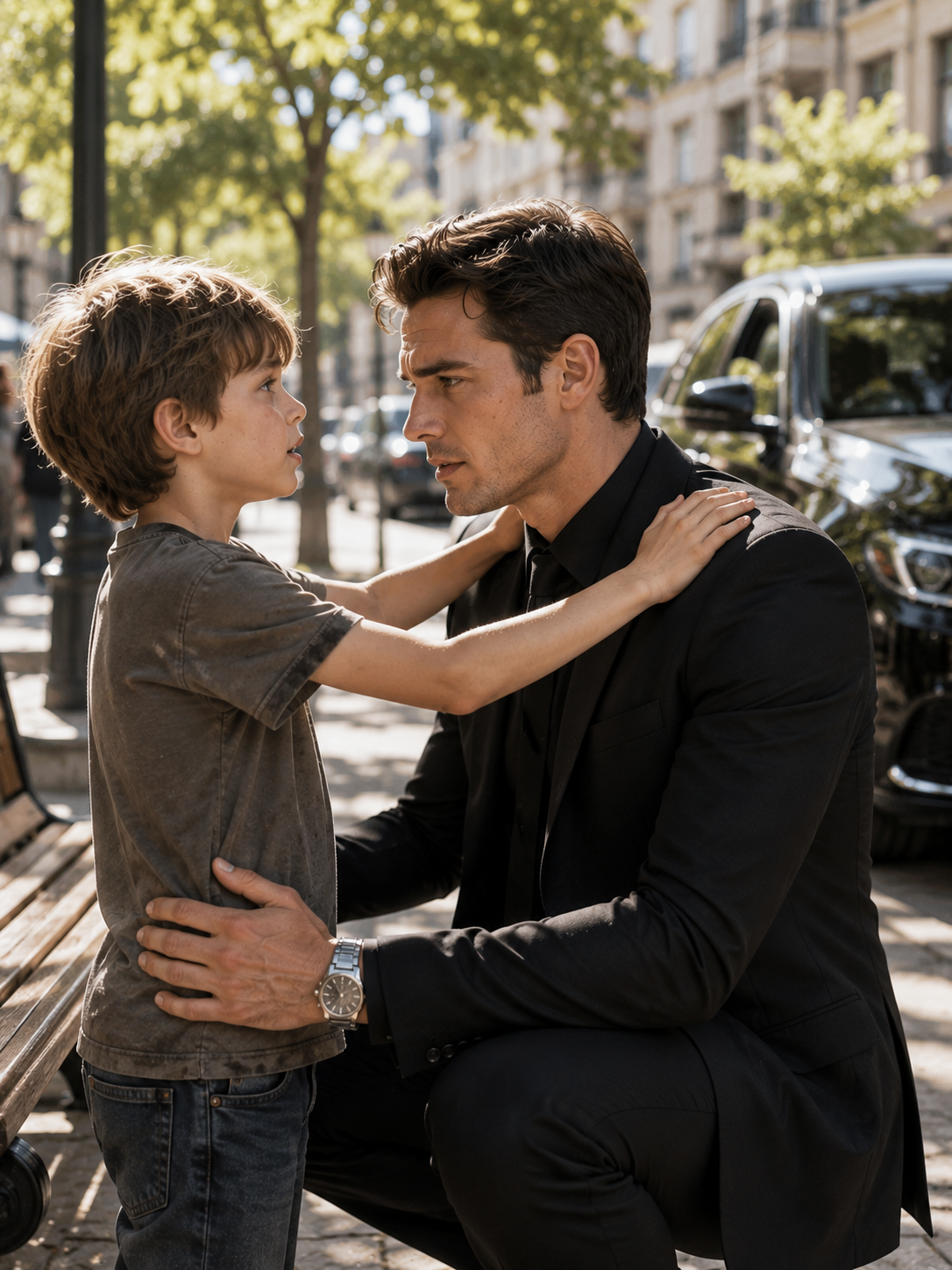
Andrew kneels in front of them.
The polished billionaire disappears. The magazine covers, the boardrooms, the towers — gone. In his place is only a man looking at two boys who have lost too much and learned not to trust hope when it comes near.
“Ethan,” he says gently. “Listen to me.”
Ethan’s eyes flick to Patricia, then back to Andrew.
“I told you last night you weren’t going back alone,” Andrew says. “I meant that.”
Noah looks at him with wide, uncertain eyes. “Are you taking Ethan away?”
The question breaks something open in Andrew’s chest. “No,” he says at once. “I’m not taking him away from you.”
Noah’s bottom lip trembles. “They said people only want little kids.”
Andrew swallows hard. He has heard cruelty in boardrooms, seen men destroy families with numbers on a spreadsheet and call it strategy. Nothing has ever sounded as brutal as that sentence in a six-year-old’s voice.
He looks at both boys. “I don’t want only one of you.”
Ethan goes completely still.
“I want to help keep you together,” Andrew says, each word a promise that will change his life forever. “And if the court allows it, if the people who make these decisions say I’m worthy of it — I want to bring both of you home.”
The room vanishes around them.
Ethan stares at him like he hasn’t understood. Noah whispers, “Home?”
Andrew nods. “A real one.”
Ethan shakes his head slowly — not in refusal, in disbelief. “You don’t even know us.”
Andrew’s eyes soften. “I know you ran through the rain to save your brother. I know you pulled him out of a fire. I know you gave up food because he hadn’t eaten. I know you were called trouble because you loved him too loudly for people who didn’t want to listen.” His voice lowers. “And I know I’ve spent fifteen months in a house that stopped feeling like a home the day my family died. Maybe I can’t get back what I lost — but maybe I can still become someone who protects what’s in front of him.”
Rachel looks away, blinking fast. Even Patricia has gone silent.
Ethan holds Noah tighter, tears rolling freely now. “You’d take both of us.”
Andrew nods once. “Both.”
Noah reaches out first. His small hand touches Andrew’s sleeve, soft as a question. Andrew doesn’t grab it. He lets the boy decide. Then Ethan, trembling, places his scarred hand over Noah’s.
And in the middle of that cold, gray room, surrounded by children who have learned not to expect miracles, Andrew Whitman makes the first promise he has meant in fifteen months.
“No one separates you today.”
For one brief moment, the room feels warmer. Then Patricia Carter shatters the moment.
“This is impossible,” she says. The polite mask is slipping; beneath it is something hard, frightened, and angry. “Mr. Whitman, you are interfering with state custody. You removed a minor from supervised care last night. You brought him to a luxury hotel without authorization.” She steps closer, lowering her voice but sharpening every word. “Do you understand how serious that is?”
Ethan’s face drains of color. Noah clutches his brother’s sweater.
Andrew sees Patricia’s eyes flick toward the boys. She wants them afraid — wants Ethan to believe hope was a trap.
He rises slowly, placing himself fully between her and the children.
“I understand exactly how serious it is,” he says. “Which is why my attorney has already filed.”
Patricia’s phone buzzes on her hip.
She looks down at it. The color that left her face a moment ago does not return.
## Chapter 7
Patricia Carter stares at her phone. Whatever she reads there costs her the last of her composure.
“Your judge,” Andrew says mildly. “Who is it?”
She doesn’t answer. Rachel does.
“Judge Merritt,” Rachel says. “Family court, docket nine. Emergency hearing at four o’clock.” She glances at her watch. “Which means we have about five hours to prove these boys should never have been separated.”
“You have nothing,” Patricia says, but her voice has lost its knife. “I’ve run this house for nine years. I’ve placed children in good homes—”
“Six siblings separated in eighteen months,” Rachel says quietly. “Five pairs. All from Maple House. All referred to the same placement agency. Would you like to explain that, or should I?”
Patricia’s hands go very still.
Andrew watches the two women face each other and understands this was never about one desperate boy in the rain. It’s about a system that has learned to call cruelty a process — and he has just walked into the middle of it holding the one thing it never counts on.
A witness.
The morning dissolves into phone calls, paper, and the smell of rain on concrete. Andrew sits on a bench in the courthouse hallway, the boys pressed against him, feeding Noah crackers from a vending machine while Ethan still refuses to eat until his brother has finished. By noon, Rachel has something none of them expected.
A file.
The agency that “selected” Noah has returned two children in the past year — returned like merchandise. Their records carry the same words, over and over, in different handwriting: *too much.*
“Too much feeling,” Rachel says quietly. “That’s what they call a child who loves his brother.”
At four o’clock the courtroom smells of old wood and wet coats. Judge Merritt, silver-haired, her eyes full of every version of this story she has seen, listens to Rachel’s evidence, to the records, to the letter Andrew wrote by hand in the lobby — the first thing he has written by hand in years.
“And you’re prepared to take both of them,” she says when he finishes. “Not one. Not after a trial period. Both now, as yours — if the law permits.”
“There is no condition,” Andrew says, “under which I would accept only one of them.”
Ethan stares at his lap, shoulders shaking once. The judge looks at him a long moment, then asks the question nobody has asked him in two years.
“Ethan. What happened to your hand?”
The boy lifts his scarred palm and tells the whole story — the smoke under the door, the crawl down the burning hall, the stuck lock, the window he broke with his elbow, the roof falling behind him while he held his little brother safe in the cold. His voice never breaks. The courtroom goes silent in the way rooms do when something true has been spoken.
Judge Merritt sets down her pen. “I’ve read that file. It calls him aggressive, manipulative, a behavioral problem.” She looks at Ethan. “It says nothing about a broken window. Nothing about a scar. Nothing about the only person who carried his brother out of a fire alive.”
Patricia Carter opens her mouth.
“Miss Carter,” the judge says, “I would like you to remain silent until I am finished.” She looks back at Ethan, and her voice softens. “I have never used this word in my courtroom before. But you are brave, son. The bravest person in this room.”
Andrew feels his chest crack open — the same crack the boy made in him in the rain, wider now, filling with light.
The judge grants emergency placement — both boys — and orders a full investigation into Maple House Youth Residence and its placement agency, effective immediately.
Patricia Carter is escorted from the courtroom like a woman discovering her reflection has vanished.
The car ride home is quiet. Noah falls asleep against Ethan’s shoulder before they hit the expressway; Ethan stays awake the whole way, staring out at the city like it might dissolve before they arrive.
Andrew’s house — the house that stopped being a home fifteen months ago — sits high above the city, all glass and cold lines and rooms no one has entered for years. The boys stand in the doorway, holding hands, looking at it the way they looked at the hotel lobby: like a dream they aren’t allowed to enter.
“It’s okay,” Andrew says. This time, he says it to both of them.
They show him everything — the songs, the games, how to shake the milk carton before pouring. Noah refuses dinner until Ethan is served first; then Ethan refuses until Noah has eaten. Andrew stands in the kitchen watching two starving children argue over who should eat first, and turns away before they see his face.
That night, Andrew opens a door he hasn’t opened in fifteen months.
The room is exactly as it was the day he closed it — pale yellow walls, a crib that never held a child, a rocking chair Emily picked out. The name on the wall, in small painted letters, says LILY.
He expects it to hurt. It does hurt. But standing there in the doorway, with Noah’s small hand slipping into his, he discovers the hurt has changed. It no longer feels like drowning. It feels like rain.
“Is this for a baby?” Noah asks.
“Yes,” Andrew says. “It was for my daughter.”
“Where is she?”
“With her mother.” Andrew kneels down. “They can’t be here. But that doesn’t mean this room can’t be used for someone who needs it.” He looks at Noah. “What if it was yours?”
Noah looks at the crib, then at Ethan, who stands in the doorway, arms wrapped around himself.
“I get my own room?” Noah asks.
“You get your own room,” Andrew says. “And Ethan gets the one next to it. And if you ever get scared, the doors stay open.”
Noah looks at Ethan, then at Andrew. Then he climbs into the crib, lies down on the mattress that never held a child, and closes his eyes.
Ethan stands in the doorway for a long moment. Then he walks over, places his scarred hand on Noah’s chest, and whispers something only his brother can hear.
Andrew steps out into the hall and lets them be.
Later, when the house is dark and the rain has finally stopped, Andrew stands at the window, watching the lights come up across Chicago — the same city that watched him walk its streets like a ghost for fifteen months. Behind him, two boys sleep in rooms that have been empty since before they were born.
His phone buzzes. Rachel. The investigation has turned up another file. Another pair of siblings. The same words written in the margins, in someone’s tight, angry handwriting: *too much.*
Andrew reads the message twice. Then he puts the phone down and looks back at the city.
He wanted to die for fifteen months.
Now he has somewhere to be in the morning.
The end