The CEO’s wife mistook me for a waitress, publicly humiliated me right in front of my four-year-old daughter,

The CEO’s wife mistook me for a waitress, publicly humiliated me right in front of my four-year-old daughter, and barked at me to use the service entrance. She had absolutely no clue that I actually own 62% of the entire corporation. Before the sun comes up tomorrow, I’ll be the one deciding if her husband even has a job left.
Part 1: Mistaken for Staff
“Excuse me… are you one of the staff?”
Her voice was polished, but the contempt beneath it was unmistakable.
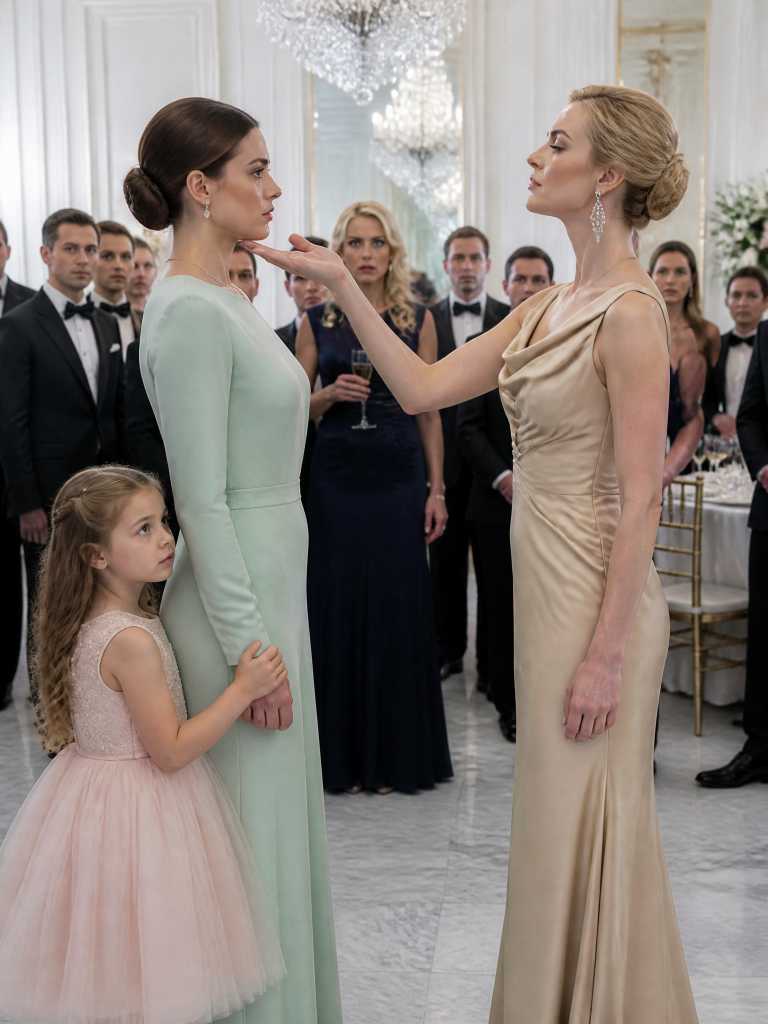
I turned and found myself facing Vivian Blackwell, the CEO’s wife. The Ritz-Carlton ballroom glittered around us with crystal lights, champagne, string music, and executives laughing as if the world had been built for them.
Her eyes moved over my simple black dress, comfortable shoes, pulled-back hair, and lack of jewelry. In one glance, she decided I was unimportant.
“The service staff should use the side entrance,” she added, waving one manicured hand. “It keeps things more organized.”
Behind her, several finance executives smirked into their glasses.
Beside me, my four-year-old daughter, Mia, tightened her hand around mine. She had been excited all day about wearing her pink dress and seeing what she called a princess castle.
Now she looked afraid.
“Mommy,” she whispered, “did we do something wrong?”
Those words hurt more than Vivian’s insult.
“I’m not with catering,” I said calmly.
Vivian blinked, irritated that I had answered.
“Then who are you? This is an executive event. Invitation only.”
“I know,” I replied. “I made the guest list.”
Before she could respond, a familiar voice cut through the music.
“Vivian, darling, I see you’ve met—”
Robert Blackwell, the CEO, stopped mid-sentence. His face went pale.
“Ms. Hart,” he stammered. “I didn’t realize you were attending this year.”
Mia pressed against my leg.
“I almost didn’t,” I said. “But I wanted my daughter to see our annual celebration.”
“Your daughter?” Vivian repeated, glancing down.
Then she lifted her chin. “I’m Vivian Blackwell.”
“I know exactly who you are.”
The executives who had laughed suddenly became fascinated by their drinks.
Robert tried to smile.
“Evelyn has a very unusual sense of humor. She was just—”
“Leaving,” I finished. “My daughter is tired, and we’ve seen enough.”
I lifted Mia into my arms and walked toward the exit.
Behind us, Robert’s furious whisper sliced through the music.
“Do you have any idea who that was?”
By sunrise, I had called an emergency board meeting.
Because I was not the caterer.
I was the silent partner who owned sixty-two percent of the company.
Part 2: The Pattern Beneath the Insult
By the time I reached home, my phone was full of missed calls.
Robert. Robert again. Marissa Chen, chief legal counsel. Two board members. Robert once more.
I ignored them all.
For years, I had preferred being invisible. It was not weakness. It was strategy.
My late father used to say the quietest person in the room often heard the most. After he died and left me control of Hartwell Innovations, I learned that ownership and leadership were not the same. Owning sixty-two percent gave me power, but it also gave me a choice: stand beneath bright lights and let people perform, or stay quiet and see who they were when they thought I did not matter.
That night, Vivian showed me something.
But Robert showed me more.
Not when he went pale. Not when his wife insulted me. In the half second before he said my name, his first instinct was not concern for my daughter.
It was fear.
At home, my nanny, Mrs. Alvarez, helped me put Mia to bed. Mia woke briefly as I changed her into pajamas.
“Mommy,” she murmured, “was the lady mad because we weren’t shiny?”
I brushed a curl from her forehead.
“No, sweetheart. Some people make mistakes because they only look with their eyes, not their hearts.”
Mia thought about it.
“She should use her heart next time.”
Downstairs, Mrs. Alvarez made tea and asked what happened. I told her enough.
Her mouth tightened.
“Your daughter saw it. That is the part I cannot forgive.”
Then Marissa called.
She had heard enough to know Robert was panicking.
“Are you all right?” she asked.
The question surprised me. People asked if the company was stable, if deals were safe, if votes would hold. Few asked if I was all right.
“I will be,” I said.
“And Mia?”
“She asked if someone was angry because we weren’t shiny.”
Marissa went silent.
Then her voice hardened.
“I’m sorry.”
I asked her to call an emergency board meeting at 6:30 a.m. and pull all executive conduct reports from the last eighteen months, including anything marked informal or resolved without action.
“That’s broader than tonight,” she said.
“Yes.”
Files arrived through the night.
At first, the pattern was quiet: complaints handled informally, women in senior roles leaving after exclusion from client dinners, promotions favoring loyalty over competence, a vendor contract awarded to one of Robert’s college friends and buried in committee notes.
Individually, each item had an explanation.
Together, they had a smell.
At 3:06 a.m., Marissa sent an encrypted packet.
Inside was a finance memo flagging irregular consulting payments through a subsidiary account. The payments were repeated, oddly timed, and coded as strategic advisory fees.
The recipient was Larkspur Consulting.
At the bottom of one invoice was a signature:
V. Blackwell.
Vivian.
The woman who had sent me toward the side entrance had been receiving consulting payments from the company her husband ran.
But the real problem was not that she had taken money.
It was that someone had already noticed—and Robert had marked the matter reviewed, no further action.
Part 3: The Board Turns
The board meeting began before sunrise.
Faces appeared on my screen: tired, wary, irritated, careful.
Robert appeared last, polished but gray beneath the eyes.
“Good morning,” he said, trying to sound in control.
No one answered.
He began with an apology.
“Evelyn, about last night. Vivian misunderstood the situation. It was unfortunate. She feels terrible.”
I let the silence stretch.
“Does she?”
“Deeply.”
“Interesting. She has not contacted me.”
He said she wanted to give me space.
Board member Helen Vargas, who had built and sold companies and terrified lazy executives for sport, cut in.
“Robert, perhaps let Evelyn set the agenda.”
I opened the packet.
“Last night was unpleasant,” I said. “But this meeting is not about my feelings. It is about judgment, culture, governance, and whether leadership understands the difference between personal embarrassment and institutional risk.”
I listed three items: informal handling of conduct complaints, undisclosed conflicts of interest, and consulting payments to Larkspur.
At the word Larkspur, Robert’s eyes flickered.
Helen noticed too.
Marissa explained that Larkspur had never reached the full audit committee. Robert said it was a minor advisory engagement, reviewed internally.
“By whom?” Helen asked.
“Finance.”
“Finance flagged concerns,” Marissa replied. “You closed the review personally.”
Robert tried to warn me that a personal incident could look like retaliation.
There it was.
Not apology.
Leverage.
I kept my voice even.
“My daughter was humiliated by your wife. That was personal. Your failure to disclose payments to a company connected to your household is not.”
The board learned that Vivian was Larkspur’s managing member.
Over eighteen months, Larkspur had received $486,000.
Robert called the amounts small. The room did not agree.
The next hour was slow and clinical. No shouting. No theatrics. Just polished defenses weakening under documents.
At 7:42 a.m., Helen moved to place Robert on temporary administrative leave pending independent review. The vote was nearly unanimous.
Robert stared into the camera.
“Evelyn, this is a mistake.”
“Perhaps,” I said. “That is why we are reviewing it.”
His smile thinned.
“Your father understood loyalty.”
The mention of my father landed harder than I expected.
“My father understood accountability,” I said.
For one second, Robert’s expression shifted.
Not guilt exactly.
Memory.
And I wondered what my father had left buried behind the company he gave me.
Part 4: Diane’s Warning
At breakfast, Mia asked if I had to go to the big building because of the mean lady.
“Because sometimes grown-ups make choices that need to be checked,” I said. “And when we are responsible for something, we have to take care of it.”
She compared it to forgetting to feed her classroom guinea pig.
Then she said, “Maybe someone should help the lady remember to use her heart.”
At 9:30, I arrived at Hartwell Innovations.
Recognition moved ahead of me like weather. The silent partner was in the building. Robert was on leave. Something had happened at the gala.
Marissa met me outside the boardroom.
“Vivian is here,” she said.
Vivian stood in Robert’s office, wearing cream trousers and sunglasses indoors, collecting personal items.
She did not look ashamed.
She looked inconvenienced.
“Ms. Hart,” she said coldly.
“Mrs. Blackwell.”
She asked to speak privately. Marissa stayed nearby.
Vivian removed her sunglasses. Her eyes were red-rimmed.
“I owe you an apology,” she said. “I made an assumption. It was wrong.”
“You humiliated my child.”
A flinch crossed her face.
“I did not intend to involve your daughter.”
“But you did.”
For the first time, her varnish cracked.
She admitted she was not good with children. It was not a defense, and she knew it.
When I asked why she was really there, she said she wanted to understand what I intended to do with Larkspur.
“That company was legitimate,” she said.
“Then the independent review will show that.”
We circled each other until she said something I did not expect.
“Ask Robert about your father.”
My pulse changed.
“What does that mean?”
She looked toward the doorway.
“Robert has survived this long because he knows where everyone buried something.”
“My father did not bury things.”
Vivian looked at me with pity or warning.
“All men like your father bury things. Some choose prettier gardens.”
Then Marissa interrupted.
Auditors had found another account.
Conference room four had no windows, which seemed fitting.
The second account was older than Larkspur, created nine years earlier, while my father was still alive and Robert was chief operating officer. Its purpose was vague: strategic transition reserve. Payments went to consultants, legal retainers, dissolved shell companies.
Then one name appeared.
Hart Family Office.
My father’s private office had received transfers from an Ashworth-controlled account three years before his death.
Not dividends.
Advisory reimbursements.
But my father was not an advisor.
He was the majority owner.
Robert’s words returned.
Your father understood loyalty.
Vivian’s warning followed.
Ask him about your father.
At noon, I called my mother in Vermont.
“Did Dad ever receive consulting payments from Hartwell?”
Silence.
Not confusion.
Recognition.
“You need to come here,” she said.
“What did Dad do?”
“He made a choice. At the time, he believed it was the least damaging one.”
“Damaging to whom?”
“To you.”
Part 5: The Drawer
At four o’clock, Robert called from an unknown number.
“You found it,” he said.
No greeting.
No denial.
“What is it, Robert?”
He told me to keep the review narrow: Larkspur, Vivian, even him—but not the old accounts.
“Why?”
“Because not every truth helps the living.”
He said he had protected my father.
“My father needed protection from what?”
Robert laughed tiredly.
“You really don’t know.”
When I demanded an answer, he only said, “Vivian is not your enemy. She is proud when cornered, careless when frightened, but she did not start this.”
Then he told me to look in my father’s drawer.
That evening, I drove alone to my father’s old house.
The study smelled of cedar, paper, leather, and the faint pipe tobacco scent he carried though he never smoked indoors. Behind a photograph of my grandmother was the brass key my mother had described.
The lower drawer of the walnut desk stuck before opening.
Inside were five folders in my father’s precise handwriting:
HARTWELL TRANSITION
PRIVATE MEDICAL
E.H. TRUST AMENDMENT
R. BLACKWELL
MIA
The last folder made the room disappear.
Mia.
My daughter had not even been born when some of these accounts began.
Inside was a sealed letter marked:
For Evelyn, when necessary.
My father wrote that years earlier, he discovered Robert had hidden information serious enough to end his career. Before he could remove him, Robert brought information of his own.
Not about the company.
About our family.
About a child.
My father admitted he chose delay over exposure, telling himself he was protecting me.
Then came the impossible line:
Find the original adoption file.
Not Mia.
Me.
A sound came from the doorway.
I looked up.
Vivian Blackwell stood there, rain on her coat, face pale, holding another envelope.
“I hoped you wouldn’t find that alone,” she said.
“How did you get in?”
“Your mother gave me the code years ago.”
“Why would my mother give you anything?”
Vivian’s eyes filled.
“Because before I was Vivian Blackwell,” she said, “my name was Vivian Hart.”
Part 6: The Sister at the Door
The room seemed to hold its breath.
Vivian Hart.
The words did not fit.
“No,” I said.
She nodded sadly.
“I know.”
She stepped into the study and looked around with recognition, not curiosity.
“I used to hide behind that curtain when I was little,” she said. “Your father kept butterscotch candies in the second drawer of that side table.”
I remembered those candies from childhood.
Gold wrappers twisted at both ends.
“You could have learned that from someone.”
“I could have. But I didn’t.”
I asked what she was.
She flinched, and I hated myself for the cruelty.
“I’m your sister,” she said.
I rejected it.
She did not fight me.
I reminded her of what she had done to me and Mia in the ballroom.
Her shame looked real.
“I am sorry,” she said. “Not because Gregory—Robert—told me to apologize. Because I saw a child beside her mother and made her feel small. There is no excuse.”
I wanted to keep my anger clean.
But Mia’s words returned: Maybe someone should help the lady remember to use her heart.
I opened the folder marked MIA.
Inside were a newborn photograph, Mia’s hospital bracelet, and a private genetic screening authorization signed by my father shortly after Mia’s birth.
My father had tested my daughter.
Vivian looked shocked.
“Mia?”
“Did he do this because of me?”
She did not know.
But she did know I was adopted.
The truth removed the air from the room.
Vivian told me her mother was Lillian Vale, who had worked with my father before Hart Holdings became powerful. My father had been young, brilliant, and reckless. Vivian’s mother raised her alone until illness forced her to contact him.
He paid for care.
But he did not bring Vivian home.
“Why?” I asked.
“Because your mother was pregnant.”
My mother and father had been trying for years, after painful losses. When my mother finally became pregnant with me—or so they believed then—my father convinced himself another child and another woman would destroy the household.
Lillian died when Vivian was nine. My father arranged a guardianship through attorneys. Vivian was raised in Connecticut, eventually becoming Vivian Blackwell.
“When did Robert find out?”
“Before he married me,” she said.
He had married her because of it.
He told her the Hart family had erased her, that she deserved a seat at the table, that Larkspur was compensation for what my father had never publicly admitted.
“Almost half a million dollars is not symbolic,” I said.
“I know that now.”
Then I asked the question that mattered most.
“Did you know who I was last night?”
Her silence answered.
“You recognized me and still said it?”
“I panicked.”
“By humiliating me?”
Her eyes shone.
“You looked like you belonged effortlessly to a life I spent decades trying not to want.”
It did not excuse her.
But it sounded true.
Then I opened the envelope my father had left for Vivian.
He wrote that she had never been a mistake, only a secret created by his cowardice. Money, education, and distance had not been protection. A child did not need protection from being loved.
Then one line froze me:
There is one more truth. It concerns the child Evelyn will one day have.
My father had written that before Mia was born.
He mentioned not only the original adoption file, but a sealed guardianship record involving Mia.
I called my mother.
Part 7: Daniel’s File
My mother answered as if she had been waiting.
She knew Vivian was with me.
I demanded the truth.
Was I adopted? Was Vivian my father’s daughter? Why was there a sealed guardianship record involving my child?
My mother said, “Mia is yours.”
Relief hit so hard I nearly sagged.
Then I asked why the guardianship file existed.
“Because after Daniel died, your father panicked.”
Daniel Reyes.
Mia’s father.
Kind, brilliant Daniel, who drew houses on napkins and believed every room needed one window that caught morning light. He died before Mia was born from a sudden heart condition no one knew to look for.
Or that was what I had been told.
My mother said Daniel’s family had threatened custody, claiming I had kept him away and even questioning Mia’s paternity. My father ordered genetic testing to stop the accusation before it went public and created protective custody contingencies without telling me.
“That was not his decision to make,” I said.
“No,” she whispered. “It wasn’t.”
Then she told me the part that made the room go still.
“The night Daniel died, he was on his way to see your father.”
Daniel had called my father because he had found something at Hartwell involving Robert.
He never made it to the house.
Robert had called me earlier and told me to look in the drawer. My mother said that meant I was close to the reason my father had kept him as CEO.
“Did Dad keep Robert because of me or because of Daniel?”
After a long silence, she said, “Both.”
Then Vivian’s phone rang.
Robert.
I told her to put it on speaker.
“Vivian, where are you?” he asked.
“With Evelyn.”
A long silence.
“That was unwise.”
I spoke.
“Hello, Robert.”
He admitted he had sent me to the drawer because secrets rot faster in the wrong hands.
I asked about Daniel.
Robert’s voice changed.
“Daniel was a good man.”
That angered me.
He said Daniel had come to his office two days before he died with questions about a patient transfer contract, a hospital pilot program, missing records, and emergency routing plans for a Northbridge Medical Center expansion.
Hartwell built hospital logistics software.
Daniel, as the architect, had noticed rooms listed as operational that were not complete and equipment marked delivered that had never arrived. Robert claimed no patients were harmed because the issue was caught before opening.
“Then why hide it?”
“Because the contract would have collapsed. Investors would have fled. Your father would have lost more than money.”
Again, Robert claimed my father had been protecting me.
Then he gave me an address: a Queens storage facility, Unit 417, where my father kept archives under a trust name.
“Why tell me?”
“Because someone else is looking for it now.”
Before he could say who, a woman’s voice sounded behind him.
“Gregory, hang up. She does not need to know about the child yet.”
The call ended.
Vivian stared at the phone.
“That wasn’t me,” she whispered.
“I know.”
My mother told me to leave the house.
But then I saw the drawer’s false bottom.
Inside was a slim black flash drive and one note:
If Gregory sends you here, he is not the last danger.
Beneath it was a name I had not seen in years.
A name from Daniel’s side of the family.
A name Mia carried as her middle name.
Vale.
Vivian went white.
“That was my mother’s name.”
I looked from the note to Vivian, then to Mia’s folder.
“What does your mother have to do with my daughter?”
No one answered.
And somewhere deep inside the quiet house, the doorbell rang.
THE END