The Drill Sergeant Humiliated Me in Front of 900 Recruits—

The Drill Sergeant Humiliated Me in Front of 900 Recruits—Then One Phone Call Exposed the Secret Order He Was Never Supposed to Give
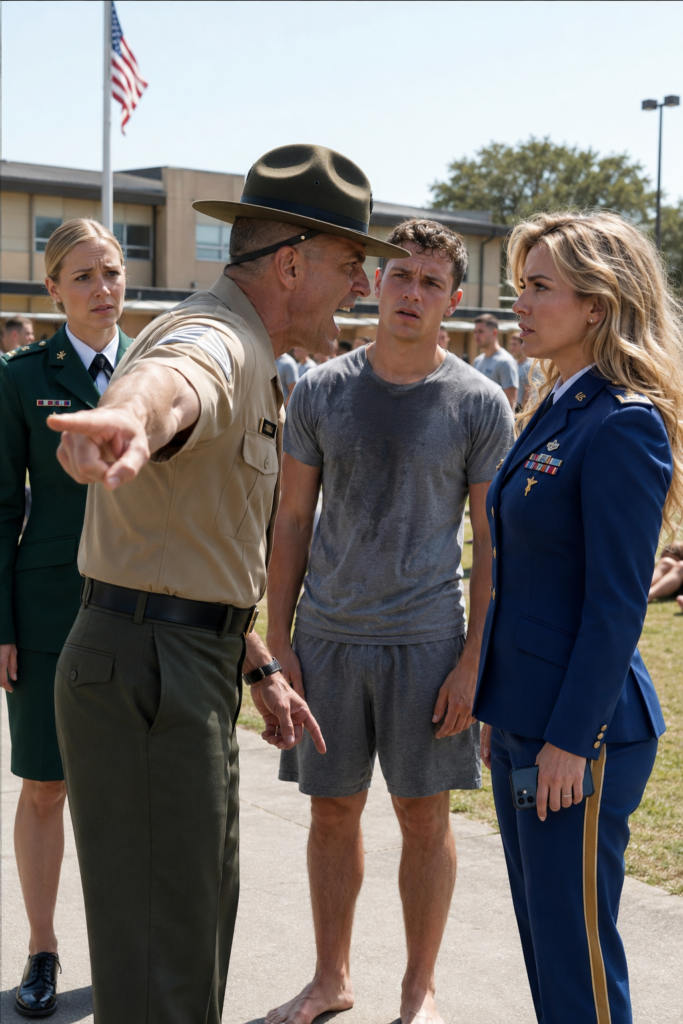
“Get off my field before I have you dragged off it.”
Drill Sergeant Mason Voss said it loud enough for nine hundred recruits to hear.
Then he pointed at my boots like I was dirt stuck to his parade ground and added, “Whatever office sent you here made a mistake.”
The whole field went quiet.
Not silent.
Quiet.
There’s a difference.
Silent means nothing is moving.
Quiet means everyone is watching to see who bleeds first.
I stood on the white chalk line at Fort Whitaker, Georgia, with the morning sun burning through the fog, a black duffel at my feet, and a sealed Pentagon envelope tucked inside my jacket.
My name was Captain Evelyn Hart.
Thirty-four years old.
Five feet six.
Hair pinned tight under a plain black cap.
No ribbons.
No unit patch.
No name tape.
By design.
And the man screaming in my face had no idea I was the reason every recruit on that field had been called out before sunrise.
He only saw a woman standing where he believed a woman had no right to stand.
He only saw civilian-looking boots.
He only saw an interruption.
He only saw his chance to make an example.
“Did you hear me?” Voss barked.
His voice rolled across the field.
It hit the bleachers.
It bounced off the cinderblock barracks.
It traveled past the flagpole where the American flag snapped hard in the wind.
A few recruits flinched.
One swallowed.
One young woman in the second formation, no older than nineteen, stared straight ahead with tears she refused to let fall.
That was when I knew this wasn’t just ego.
This was pattern.
Voss stepped closer.
His campaign hat cast a sharp shadow over his eyes.
“You lost, ma’am?”
I looked at his rank.
Then at his hands.
Then at the clipboard tucked under his arm.
There were three names circled in red.
I recognized two of them from the file.
Recruit Hannah Cole.
Recruit Marcus Reed.
Recruit Tyler Jensen.
All three had filed complaints.
All three had withdrawn them.
All three were standing on the field that morning.
And all three looked terrified.
“No,” I said calmly. “I’m exactly where I was ordered to be.”
A laugh snapped out of him.
“Ordered?”
He turned slightly so the whole formation could hear.
“You hear that, recruits? She was ordered.”
A few recruits gave nervous laughs because nervous people laugh when powerful men invite them to.
Voss smiled.
Not big.
Not friendly.
Just enough to show he enjoyed the sound.
“Who ordered you?” he asked. “Some diversity office? Some recruiting campaign? Some desk colonel who wants pretty pictures for a brochure?”
The young woman in the second formation blinked once.
Hard.
I kept my hands still.
My father used to say calm was a weapon if you knew how to hold it.
Voss leaned in.
“I said get off my field.”
I said, “No.”
The word was small.
The effect wasn’t.
A ripple moved through the recruits.
Voss’s jaw shifted.
“You want to try that again?”
“No.”
His nostrils flared.
Behind him, two assistant drill sergeants exchanged a look.
One of them, Sergeant First Class Darnell Price, looked away too quickly.
Not guilty.
Afraid.
Voss stepped closer until the brim of his hat was inches from my face.
“You have ten seconds to leave this training area.”
I looked past him at the field.
At the recruits sweating in perfect lines.
At the medic standing near the water station, eyes fixed on the ground.
At the black government SUV parked beside the admin building.
At the second-floor window where someone moved behind the blinds.
Then I looked back at Voss.
“Before you finish counting,” I said, “you should ask yourself why I came alone.”
His smile disappeared.
For one second, he saw something he didn’t like.
Not fear.
Not anger.
Authority.
Real authority rarely announces itself.
It waits.
Voss covered the moment with volume.
“Nine!”
The recruits stiffened.
“Eight!”
A crow lifted from the roof of the barracks.
“Seven!”
I reached slowly into my jacket.
His right hand moved toward his radio.
“Six!”
I pulled out a small black phone.
Not my personal phone.
The secure one.
Voss barked, “Do not make a call on my field.”
I tapped one number.
Just one.
Not because I was dramatic.
Because the number had been waiting for me since 0415.
Voss shouted, “Five!”
The line connected.
I put the phone to my ear.
A woman answered.
“Go.”
I looked Voss dead in the eyes.
“This is Hart. Confirming hostile obstruction at Phase Line Blue.”
The woman on the line paused.
Then said, “Is Drill Sergeant Mason Voss present?”
“Yes.”
“Is he interfering with a federal inspection?”
I watched Voss’s face change.
Just a fraction.
“Yes.”
“Stand by.”
I lowered the phone.
Voss stared at it.
Then at me.
Then at the admin building.
“Who was that?”
I didn’t answer.
He tried to laugh again.
It came out thinner this time.
“You think a phone call scares me?”
“No,” I said. “I think what comes after it does.”
I didn’t raise my voice.
I didn’t threaten him.
I didn’t explain.
Because men like Voss loved explanations.
They gave him something to cut apart.
So I let the silence do the cutting.
I let the recruits see him waiting.
I let the assistant drill sergeants hear the tiny tremor in his breathing.
I let the wind carry the flag rope knocking against the pole.
Clink.
Clink.
Clink.
Then the sirens started.
Not police sirens.
Not ambulances.
Base security.
Three vehicles rolled through the east gate with their lights flashing but no sound at first, like the whole base was holding its breath.
Voss turned.
The first Humvee stopped near the field.
Then a second.
Then a black sedan with government plates.
A colonel got out.
Then a brigadier general.
Then a woman in a dark suit with a leather folder under her arm.
Voss went pale.
Not white.
Gray.
The kind of gray that comes when a man realizes the door he locked from the inside was never actually locked at all.
The brigadier general walked across the grass.
Every recruit on the field snapped tighter.
Every drill sergeant straightened.
Voss recovered enough to salute.
“Sir—”
“Do not speak,” the general said.
Two words.
Flat.
Final.
Voss’s hand froze halfway down.
The general stopped beside me.
“Captain Hart.”
I saluted.
“General Mercer.”
Voss’s eyes cut to me.
Captain.
He heard it.
Everyone heard it.
But that was only the first crack.
General Mercer looked over the formation.
Then at Voss.
“You ordered her off the field?”
Voss swallowed.
“Sir, I had no verification of her authority and—”
The woman in the dark suit opened her folder.
“Drill Sergeant Mason Voss,” she said, “you were notified yesterday at 1900 that an external command climate inspection would occur within a seventy-two-hour window.”
Voss’s jaw hardened.
“I was told no officer would enter training areas without signing in.”
The woman looked at her folder.
“False.”
One word.
Another crack.
Voss shifted his weight.
“Ma’am, I run a controlled training environment.”
“No,” General Mercer said. “You ran a controlled fear environment.”
The recruits did not move.
But the air did.
You could feel it.
A pressure change.
A storm breaking somewhere close.
Voss looked at the general like he had been slapped.
“Sir, I maintain discipline.”
General Mercer glanced at me.
I gave one small nod.
The woman in the suit turned toward the field.
“Recruit Hannah Cole.”
The young woman in the second formation froze.
Voss’s head snapped toward her.
That was the mistake.
Everyone saw it.
Not concern.
Warning.
Hannah Cole’s lips parted.
No sound came out.
The woman in the suit softened her voice.
“Recruit Cole, you are not in trouble.”
Hannah’s eyes filled again.
Still, she stared straight ahead.
The woman continued.
“Recruit Marcus Reed.”
A tall recruit in the back row closed his eyes.
“Recruit Tyler Jensen.”
A red-haired kid near the center clenched both fists.
Voss said, “This is ridiculous.”
General Mercer turned slowly.
“I told you not to speak.”
This time Voss obeyed.
For twelve seconds.
Then his pride beat his survival instinct.
“Sir, with respect, those recruits failed to meet standards. They made accusations because they couldn’t handle pressure.”
I watched Hannah Cole’s shoulders.
They shook once.
Barely.
I stepped forward.
Not toward Voss.
Toward the recruits.
“Recruit Cole,” I said, “on March 18, at 2130, you reported being ordered into the equipment shed alone after lights-out.”
Voss’s face shut down.
“Recruit Reed,” I continued, “on March 22, you reported being denied medical evaluation after collapsing during a heat drill.”
The medic near the water station looked up.
“Recruit Jensen,” I said, “on April 2, you reported that your family was contacted and told you were mentally unstable before you ever spoke to behavioral health.”
Tyler Jensen’s eyes turned red.
I looked back at Voss.
“Those reports were withdrawn within forty-eight hours.”
Voss’s voice was tight.
“Because they were false.”
“No,” I said. “Because someone showed them discharge paperwork with their names already typed.”
That did it.
The first assistant drill sergeant, Price, looked like the ground had opened under him.
The second one stared straight ahead, jaw locked.
General Mercer looked at Voss.
“You have anything to say now?”
Voss lifted his chin.
“Sir, I have never forged discharge paperwork.”
I believed him.
That was the problem.
He hadn’t forged it.
Someone above him had.
Voss was cruel.
But cruelty wasn’t the whole machine.
Cruelty was just the hand on the lever.
That morning, I had come to find the lever.
But I was starting to see the hand behind it.
The woman in the dark suit turned one page.
“Captain Hart, proceed.”
Voss snapped his eyes to me.
There it was.
Recognition.
Not of my face.
Of my last name.
Hart.
His mouth tightened.
“You’re Daniel Hart’s daughter.”
The field shifted again.
General Mercer went still.
The woman in the suit looked up.
Voss smiled.
Tiny.
Ugly.
Like a man pulling a knife from under a table.
“That’s what this is about,” he said. “Personal revenge.”
My brother’s name moved through the air though no one spoke it.
Daniel Hart.
Staff Sergeant Daniel Hart.
Fort Whitaker.
Training accident.
Dead at twenty-seven.
Five years earlier.
The official report said heatstroke.
The official report said medical response delayed due to confusion.
The official report said no misconduct.
The official report lied.
Voss looked at the recruits, then at the general.
“Her brother died here. She blames the Army. She shows up pretending this is an inspection, but this is a vendetta.”
It was smart.
I’ll give him that.
Desperate, but smart.
He had found the only thing on that field that could make me look emotional.
Make me look compromised.
Make me look like a grieving sister with a badge.
The recruits stared.
The assistant drill sergeants stared.
Even General Mercer’s face became unreadable.
Voss pressed harder.
“Ask her why she really came.”
I turned to him.
“My brother died on this field.”
A few recruits blinked.
“My brother was denied water on this field.”
Hannah Cole’s face broke.
“My brother was mocked on this field.”
Marcus Reed stared at me now.
“My brother begged for a medic on this field.”
Tyler Jensen’s fists unclenched.
“My brother was called weak on this field.”
Voss stopped smiling.
“My brother died on this field,” I said again. “And five years later, you were still using the same playbook.”
The field went so quiet I could hear a recruit breathing three rows back.
I stepped closer to Voss.
Not much.
Just enough.
“But I didn’t come here because Daniel Hart was my brother.”
I reached into my jacket again.
This time I pulled out the sealed Pentagon envelope.
“I came because your name appeared in a protected witness statement tied to three training deaths, eleven medical falsifications, and a command-level cover-up.”
Voss’s eyes flicked to the envelope.
Then away.
Too late.
General Mercer saw it.
The woman in the suit saw it.
I saw it.
Voss whispered, “That’s classified.”
I said, “So you knew it existed.”
There are moments when a man convicts himself without saying the crime.
That was one.
The brigadier general turned to base security.
“Remove him from the field.”
Voss stepped back.
“Sir, wait.”
Two security officers approached.
Voss looked around, suddenly searching for allies among the same recruits he had terrorized.
No one moved.
No one spoke.
Not because they were brave yet.
Because fear takes time to realize its owner has changed.
“Sir,” Voss said, voice lowering, “you don’t understand what you’re touching.”
General Mercer’s face hardened.
“Are you threatening me, Drill Sergeant?”
Voss looked at me.
Then at the admin building.
Then at the second-floor window.
The blinds moved.
Just a sliver.
And there it was.
The second twist.
Voss wasn’t looking for help from the field.
He was looking for permission from someone inside.
Someone higher.
Someone watching.
Someone who had expected me to arrive.
Voss straightened.
His fear vanished too quickly.
Like a switch had been flipped.
He looked at me and smiled again.
Not the cruel smile from before.
A different one.
A relieved one.
“You made your call, Captain,” he said softly. “Now they’ll make theirs.”
Security reached for his arms.
Voss didn’t resist.
That scared me more than if he had fought.
As they walked him past me, he leaned just close enough for only me to hear.
“Daniel wasn’t the first Hart we buried.”
My body stayed still.
My face stayed calm.
But something cold opened behind my ribs.
Voss kept walking.
The recruits watched him leave.
Some looked stunned.
Some looked relieved.
Hannah Cole finally let one tear fall.
Only one.
She wiped it away fast.
General Mercer turned toward me.
“Captain?”
I looked at the admin building.
At the second-floor blinds.
At the shadow behind them.
“Sir,” I said, “we need to secure the records office.”
The woman in the dark suit followed my gaze.
“Why?”
Before I could answer, the fire alarm screamed.
Every head on the field turned.
Smoke pushed out from a side window of the admin building.
Not thick.
Not accidental.
A controlled burn.
Paper.
Files.
Evidence.
General Mercer shouted orders.
Security ran.
The recruits broke formation under command.
The woman in the suit sprinted toward the building.
I grabbed my duffel and ran with her.
Past the flagpole.
Past the water station.
Past the place where my brother had collapsed five years earlier.
The alarm tore through the morning.
Lights flashed red against concrete walls.
People poured out of the admin building coughing and confused.
I shoved through the side entrance with my sleeve over my mouth.
The hallway was filling with gray smoke.
Someone yelled, “Records room!”
We reached the door at the end of the hall.
Locked.
The woman in the suit cursed.
I dropped my duffel, pulled out a compact breaching wedge, and jammed it under the frame.
She stared at me.
“You brought a wedge?”
“I brought experience.”
The lock gave with a sharp crack.
We forced the door open.
Smoke rolled over us.
Inside, the metal trash can was burning.
Not the whole room.
Just one can.
Just enough to destroy select files.
I grabbed the fire extinguisher off the wall and blasted the flames white.
Paper scraps lifted and spun.
Blackened corners.
Half-burned forms.
Redacted memos.
Names.
Dates.
A training roster from five years ago.
My heart slammed once.
There, on the edge of a scorched folder, I saw my brother’s name.
HART, DANIEL R.
Beside it was another name.
Not Voss.
Not Mercer.
Not anyone in the original report.
A woman’s name.
Colonel Patricia Wren.
I knew that name.
Everyone in the Army knew that name.
She was up for promotion.
She had testified before Congress.
She had built her career on “clean training reform.”
And she had been inside Fort Whitaker the week my brother died.
The woman in the suit crouched beside me.
“Captain.”
Her voice had changed.
I followed her eyes.
Under the burned folder was a sealed evidence bag.
Not burned.
Placed.
Waiting.
Inside was a small silver USB drive and a folded note.
The note had only six words.
EVELYN HART IS NOT THE TARGET.
I stared at it.
The smoke alarm screamed overhead.
Boots pounded down the hallway behind us.
The woman in the suit whispered, “Then who is?”
My phone buzzed.
The secure one.
One incoming message.
No caller ID.
No number.
Just a video file.
I opened it.
The screen showed grainy night footage from five years ago.
Fort Whitaker.
This field.
My brother on his knees.
A drill sergeant shouting.
A medic being held back.
And then a voice off camera.
A woman’s voice.
Calm.
Cold.
Familiar.
“Let him drop. We need the data.”
The camera shifted.
For half a second, it caught the woman’s face.
Colonel Patricia Wren.
Then the video cut to black.
A new message appeared beneath it.
SHE KNOWS YOU’RE HERE.
Then the lights in the records room went out.