
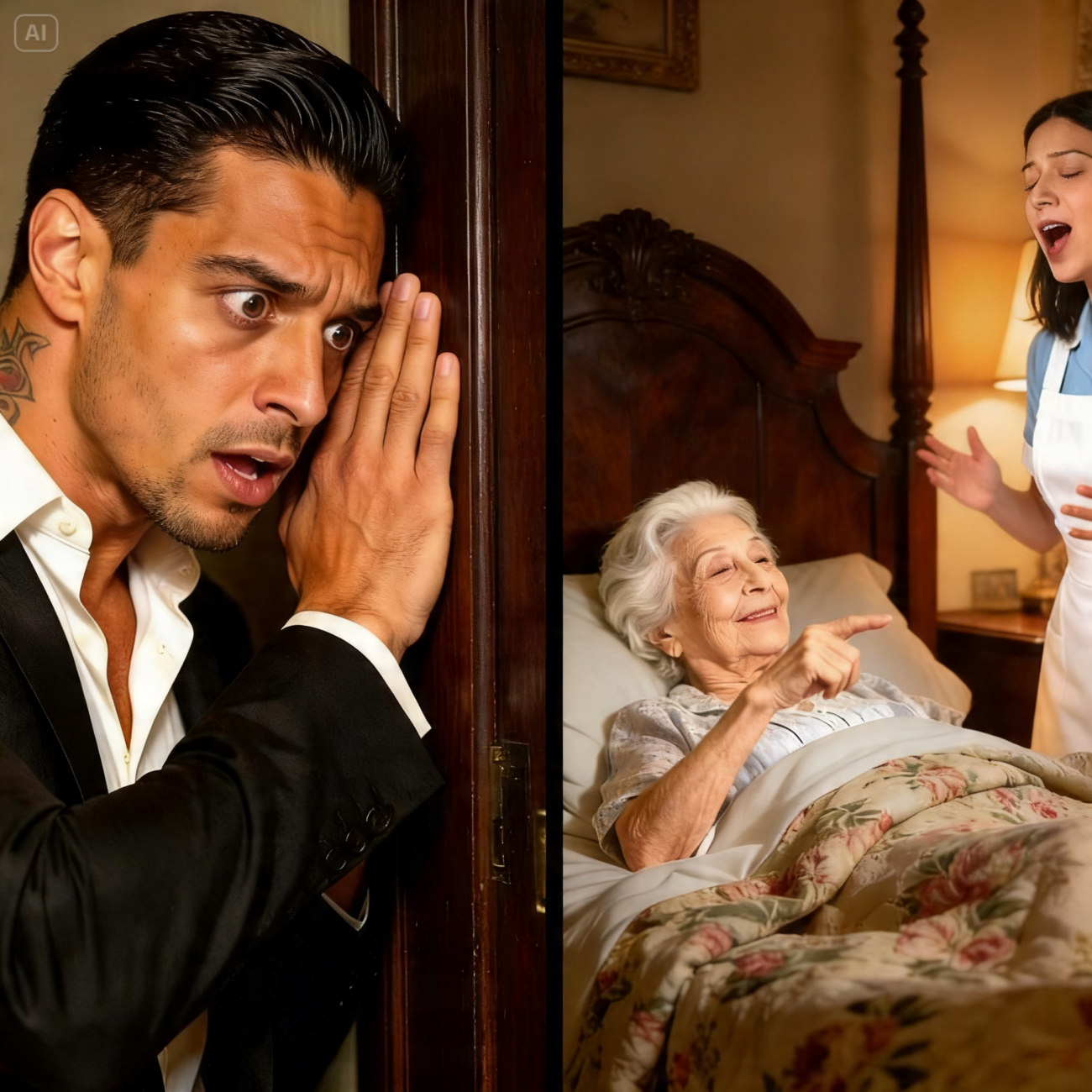
THE MAFIA BOSS CAME HOME EARLY EXPECTING SILENCE,

THE MAFIA BOSS CAME HOME EARLY EXPECTING SILENCE, BUT WHAT HE HEARD OUTSIDE HIS MOTHER’S BEDROOM EXPOSED THE ONE THING HIS MONEY, DOCTORS, AND POWER HAD FAILED TO SEE
Reed Callaway had faced guns without blinking.
He had sat across from men who wanted him dead and calmly finished dinner while they trembled over their wine glasses. He controlled half of Chicago’s underworld, from the darkest blocks of the South Side to the penthouses glittering above the Loop. His life was built on power, fear, money, and the kind of silence that followed when people knew better than to ask questions.
But nothing in his life prepared him for what he heard when he came home early one afternoon and stopped halfway up the stairs.
A voice.
Not just any voice.
His mother’s voice.
Cordelia Callaway, 78 years old, had not sung in four years. Not since the night her husband was shot three times in front of their own gate. Not since she watched him fall and something inside her closed forever. Her body had stiffened with severe arthritis, but her spirit had hardened even more. She lay in a third-floor bedroom surrounded by everything money could buy and nothing that could save her.
Reed had spent fortunes trying.
Doctors from Mayo Clinic flew in every month. Therapy specialists came and went. Nurses stood watch around the clock. The mansion itself had been turned into a private medical facility with a high-end hospital bed, monitoring machines, imported medicine, silk curtains, oil paintings, and the kind of quiet luxury that looked like care from the outside.
None of it worked.
Six nurses quit in four months.
Doctors shook their heads.
Therapists ran out of words.
Every night, Reed came home, climbed the stairs, and stopped outside his mother’s door for exactly one second.
He listened.
For four years, all he heard was silence.
And because silence was easier than grief, he taught himself to believe that silence meant she was still there. Still breathing. Still existing. Safe enough. Stable enough. Handled.
He did not know silence could be a cry for help.
He did not know the mother he thought he was keeping alive was slowly disappearing inside a room full of expensive things.
And he definitely did not know that the person who would bring her back would not be a doctor, not a nurse, not a specialist, and not anyone he had paid a fortune to find.
She was a 27-year-old maid named Bryer Ashford.
She arrived at 6:55 one morning with brown hair tied up in a rush, a fading bruise still yellowing the corner of her face, $47 in her bag, and hands roughened by a life that had never handled her gently.
She came to clean.
She did not come to save anyone.
But sometimes the miracle does not arrive wearing a white coat.
Sometimes it comes in quietly through the servant’s entrance, carrying a cleaning bucket and a song it has been humming since childhood just to survive.
Sully led Bryer through the black iron gate that stood nearly 10 feet high, then along the gray stone path toward the front door. The mansion opened before her like a dream built by someone who had forgotten how warmth worked.
Black marble floors gleamed so perfectly she could see her own reflection beneath her feet, pale and small in the vastness of the place. Crystal chandeliers hung from the high ceiling, each piece of glass like a frozen drop of water. The furniture was charcoal leather. The bookshelves were dark oak and dustless. A white porcelain vase stood on the console table in the front hall, empty, like an open mouth that had given up trying to speak.
Everything was perfect.
Everything was expensive.
Everything was dead.
Bryer knew it immediately.
Twenty-three years of surviving inside other people’s houses had taught her how to read a room in seconds. She knew the feel of polished floors and cold walls. She knew houses where nothing was out of place because nobody laughed hard enough to knock anything over. She knew beautiful rooms with no life in them.
She had been raised in houses like that.
Foster homes with clean kitchens and locked doors.
Places that looked safe until they weren’t.
Places where she learned not to draw attention.
Not to make noise.
Not to take up space.
Reed was waiting in the living room.
Black suit. Tie loosened by one notch. Coffee in hand. Phone in front of his face.
His eyes passed over Bryer for exactly three seconds, pausing briefly at the bruise near her eye before moving back to his screen.
“The kitchen is in the back,” he said without lifting his head. “Bedrooms are on the second floor. My mother is on the third. Don’t disturb her. Keep everything clean and in its place. That’s all.”
He did not ask her name.
He did not ask where she came from.
He did not ask about the bruise.
He handed her a spare key and walked away, his Oxford shoes striking the marble in an even rhythm, each step echoing through the house before dying in the empty space.
Bryer stood there with the key pressed into her palm.
Cold metal.
A familiar feeling.
She had been handed keys before. Keys to houses that were never hers. Keys that always came with invisible rules. Keys that could be taken back the moment she became inconvenient.
She closed her hand around it and went to work.
She started in the kitchen. Opened cabinets. Wiped shelves. Checked expiration dates in the pantry. She moved slowly and carefully, making only the sounds she needed to make. That was how she had learned to survive.
Don’t be seen.
Don’t be heard.
Don’t give anyone a reason to remember you are there.
At noon, she went upstairs to dust the rooms on the second floor. As she passed the staircase leading to the third, she heard something.
Not a voice.
A thud.
Heavy. Solid.
Something hitting the floor above.
Bryer stopped and looked up.
Sully passed behind her and saw her listening.
“Don’t mind it,” he said. “She does that a lot.”
Bryer said nothing.
But she remembered.
She knew the difference between something falling and something being thrown.
That sound was not an accident.
That was someone trying to make noise because it was the only way left to say, I’m still here.
The next day, Bryer arrived at exactly 7:00.
Sully had gone out early with Reed, leaving the mansion wrapped in a silence that felt too thick to move through. Bryer cleaned the kitchen, made oatmeal, and left it on the table for Cordelia according to Sully’s instructions. Then she started wiping down the second floor.
Everything was normal until she heard the glass break.
Sharp.
Clean.
Unmistakable.
From the third floor.
Bryer set the cleaning cloth down.
Her heart began to beat faster, but not from fear. Instinct. Twenty-three years of living in places where danger announced itself in small sounds had taught her that breaking glass was never nothing.
She climbed the stairs with one hand on the railing.
Cordelia’s bedroom door was open.
Inside, white pills were scattered across the floor among shards of broken glass. A bottle of antidepressants lay on its side, the cap thrown loose, the label wet from spilled water.
Cordelia sat in bed with her back against the pillows, both hands resting in her lap.
She was not looking at the pills.
She was looking straight at Bryer.
That look was not an apology.
Not panic.
Not a plea.
It was a challenge.
There. What are you going to do? Pick it up and leave like everyone else?
Bryer knew that look.
She had worn it herself.
Every time a social worker walked into another temporary bedroom with another pitying face. Every time someone said, “You’ll be fine.” Every time another family decided she was too much, too quiet, too damaged, too inconvenient.
She had stared back with that same expression.
Go ahead.
Pretend to care.
I dare you.
Bryer did not rush in.
She did not gasp.
She did not call for help.
She stood in the doorway with her arms at her sides and looked back.
Not with pity.
Not with judgment.
Just steady.
A silence that said, I see you, and I am not leaving because you made a mess.
Cordelia waited.
One second.
Five seconds.
Ten.
She was used to winning this. People always looked away first. They sighed, shook their heads, cleaned up the mess, and vanished behind the door. All six nurses had done it. They saw a difficult old woman. They saw a patient refusing help. They saw a problem.
Bryer saw a person.
And Cordelia was the one who looked away first.
For the first time in four years.
Only then did Bryer step inside.
She knelt and picked up the pills one by one. Slowly. Carefully. Without hurry. She gathered the broken glass with her bare hands, with the practiced ease of someone who had spent a lifetime learning how to handle sharp things without bleeding.
She set the medicine bottle back on the bedside table. She wiped the spilled water. She put the glass back in place. Through all of it, she did not say a word.
When she finished, she stood, brushed off her knees, and walked toward the door.
Then, without turning back, she said one sentence.
“I know what it feels like to want to smash everything.”
Her voice was not warm in the polished, fake way people used around sick rooms. It was not dramatic. It did not tremble.
It was just true.
Plain as the pills on the floor.
Then Bryer walked away and went back to work as if nothing had happened.
Cordelia sat in bed and watched the young woman disappear beyond the doorframe.
Four years.
Six nurses.
Three doctors.
Two therapists.
Every one of them had looked at her with pity. Every one had tried to fix her. Every one had left.
This girl had not pitied her.
Had not tried to fix her.
Had not even tried to explain her.
She had only looked.
And in that look, Cordelia saw something she had not seen in anyone in four years.
Recognition.
The kind that only comes from someone who has survived the same kind of darkness.
Three days passed.
Neither Bryer nor Cordelia mentioned the broken medicine bottle again.
But something changed.
It was fragile, almost invisible, like a spider’s thread stretched across a doorway. Both women knew it was there. Neither one touched it.
Bryer still arrived at exactly 7:00 every morning. She still cleaned the kitchen first, prepared food, wiped counters, and moved through the house like she was trying not to disturb the air. Then one day, Sully gave her a new task.
“Wipe down the hallway on the third floor.”
Bryer nodded.
She carried a bucket and cloth upstairs, started at the far end of the hall, and knelt to clean the tile one square at a time. Cordelia’s bedroom door stood slightly open, the way it always did, just wide enough for a strip of pale light to spill across the hallway floor.
Bryer did not look in.
She kept wiping.
Then she forgot herself.
Her hands were wringing out the cloth. Her knees were damp. The scent of floor cleaner stung her nose. And before she realized it, a melody began to move in her throat.
No words.
No title.
Just a line of notes she had hummed since she was four or five years old.
Back in that first foster home, when the room was dark and the door was locked from the outside, Bryer had used that melody to lull herself to sleep. Nobody had sung to her. Nobody had told her stories. Nobody had come when she cried.
So she made a sound for herself.
It was not beautiful in any formal way. It was not a song anyone would recognize. It was just the rope she held in the dark to remind herself she had not disappeared.
Over the years, it became habit.
She hummed it while washing dishes.
While mopping floors.
While walking home late through streets with no lights.
Never loud. Never for anyone else.
Just enough for her to hear.
Just enough to stay alive.
Inside the room, Cordelia lay facing the window.
When the melody slipped through the crack in the door, she stopped breathing for half a second.
Then she breathed again, slower this time, listening.
She did not recognize the song itself. There was barely enough of it to call a song.
But she recognized the way it was sung.
That was not performance.
That was survival.
The way a person hums when nobody is supposed to hear. The way a person keeps sound inside herself because silence is too dangerous. The way a person sings only because if she stops, the dark might swallow her whole.
Cordelia knew that kind of singing.
Before the stage.
Before the spotlight.
Before The Velvet Room.
Before the man at the corner table who never applauded because he said applause was for strangers and he loved her.
Back when she was just 16-year-old Cordelia Maze on the South Side, sitting on the back steps of a damp rented house, humming alone in the dark because her mother was drunk inside and she did not dare go in.
Cordelia had sung to survive.
The girl in the hallway was doing the same.
By the time Bryer had wiped almost to the bedroom door, she realized what she was doing. The hum caught in her throat. She stopped so abruptly her back stiffened.
She glanced through the opening and found Cordelia looking at her.
Not with the challenge from the broken-pill day.
Not with the empty stare she wore when Bryer first arrived.
This look was different.
Like Cordelia was trying to remember something she had believed was gone forever.
“I’m sorry,” Bryer said. “I didn’t mean to make noise.”
Cordelia did not answer.
She only looked at her for a few more seconds, then blinked slowly and turned back toward the window.
But this time, the turning away was different.
She was not dismissing Bryer.
She was hiding what had risen behind four frozen years.
Bryer did not know that.
All she knew was that Cordelia had not sent her away.
And for Bryer, not being sent away was already a lot.
That evening, Sully went upstairs to collect Cordelia’s breakfast tray and stopped.
The toast had been bitten through by more than half. The orange juice was down by a third. The strawberries were gone.
For four years, Sully had carried that tray back almost untouched.
Maybe one corner of toast missing.
Maybe nothing at all.
Today, more than half was gone.
He said nothing.
He washed the tray, put everything away, and looked toward the kitchen door where Bryer had left hours earlier.
For the first time in a long time, Sully wondered what that girl had done on the third floor.
The next morning, a note waited on the kitchen table.
Clean the storage room on the third floor. Far end of the hall on the left. Sort what should stay. Throw away what isn’t being used.
Bryer folded the note and slipped it into her pocket.
The storage room sat across from Cordelia’s bedroom behind a heavy wooden door she had to push open with her shoulder. Inside, the air smelled of damp wood and old paper. She pulled the ceiling chain, and pale yellow light spread over cardboard boxes, old chairs draped in white cloth, broken lamps, stained tablecloths, and a bookshelf with one crooked leg.
Dust covered the floor so thickly her footsteps left prints like snow.
No one had been there in years.
Bryer started in the right corner, sorting box by box. Most of it was clutter. Porcelain dishes with missing pieces. Old linens. Household objects nobody wanted enough to keep but nobody had thrown away.
Then she reached a wooden crate.
It was heavier than the others.
The lid was tight but not locked.
Bryer opened it and stopped.
Inside were vinyl records.
Dozens of them.
Some sleeves yellowed with age. Some still glossy. Beside them lay rolled posters. She pulled one out, carefully slipped off the brittle rubber band, and spread it across the floor.
The poster showed a jazz club.
The Velvet Room.
Under the title was a performance schedule. Most names meant nothing to her.
Except one.
Cordelia Maze.
Bryer stared at that name.
Cordelia’s maiden name.
The woman she had been before wife.
Before mother.
Before widow.
Before the third-floor bed.
She lifted the records one by one. The third had a white label with a blue border.
Cordelia Maze. Live at The Velvet Room. 1972.
At the bottom of the crate was a record player in a dark brown leather case with dull metal clasps. Bryer opened it. The needle was still there. The turntable still moved.
It worked.
She sat in the storage room with the record player in her lap and the vinyl on the floor, thinking of Cordelia lying across the hall with her eyes fixed on the window.
She did not think long.
She picked up the record player in one hand, the vinyl in the other, crossed the hallway, knocked lightly on the half-open door, and stepped inside.
Cordelia looked at her.
Then at what she was carrying.
Something flickered in her eyes.
Bryer saw it.
She said nothing.
She placed the record player on the table by the window where the afternoon light caught the label. She put the vinyl on the turntable with the name facing up.
Cordelia Maze.
She did not press play.
She did not ask if Cordelia wanted to hear it.
She did not say she had found it.
She just left it there.
Ready.
Waiting.
Then she returned to the storage room.
Inside the bedroom, Cordelia stared at the record player for a long time.
Her right hand lifted slowly from the bedspread. The finger joints were stiff as rusted metal. Her hand reached halfway toward the machine, trembling in the air.
Then it lowered again.
She did not touch it.
But she did not ask anyone to take it away.
The next morning, Bryer went up earlier than usual with a cloth and glass spray. As she passed Cordelia’s room, she saw the record player still exactly where she had left it. The vinyl rested on the turntable. The needle had not been lowered.
No one had touched it.
No one had removed it.
Bryer went to the hallway window and began cleaning.
Halfway through the glass, she heard a voice from inside the room.
Low.
Rough.
Human.
“What was that you were singing yesterday?”
Bryer froze with the cloth still pressed against the window.
It was the first time Cordelia had spoken to her by choice.
Not reacting.
Not challenging.
Asking.
Bryer stepped to the doorway.
“I don’t know the name of it, ma’am. It’s just a melody I’ve remembered since I was little.”
Cordelia still faced the window, but when she spoke again, her voice sounded a little less hoarse.
“Sing it again.”
Two words.
Not a command.
Not politeness.
The words of someone dying of thirst who had just seen water.
Bryer stepped into the room and stood beside the chair near the bed. She did not sit. Suddenly, she realized she had never sung for anyone before.
That melody belonged only to her.
It lived in the most hidden part of her throat.
To sing it for someone else meant letting another person see the fragile thing she had protected since childhood. And Bryer had learned early that when people saw how breakable you were, they often tried to break you.
But Cordelia’s eyes were not the eyes of someone waiting to hurt her.
They were the eyes of someone suffocating who had just seen a window open.
So Bryer drew in a breath.
And she hummed.
The first note trembled.
The second steadied.
The third found air.
Then the melody moved naturally, the way it had always moved when she was alone, except now someone was listening.
Cordelia closed her eyes.
Not from exhaustion.
Not to sleep.
She closed them the way singers close their eyes when they stop making music and let music move through them.
Her face changed.
The lines around her mouth softened. The tightness around her eyes loosened. Pain did not vanish, but something else entered the room and made room beside it.
For the first time in four years, Cordelia Callaway looked less like a woman enduring life and more like a woman inside it.
When Bryer finished, the silence that followed was different.
Softer.
Cordelia opened her eyes.
“You don’t know how beautiful your singing is.”
Bryer did not know what to say.
She lowered her head, picked up the cloth and spray, and went back to work.
Her hands trembled when she wrung the cloth out.
She did not let anyone see.
After that, something formed on its own.
Every morning, Bryer arrived at 7:00, cleaned the kitchen, made oatmeal or eggs, wiped the dining table, then went upstairs with a cloth and glass spray as if she were going to clean.
But both of them knew she was not there for dust.
She stepped into Cordelia’s room, stood by the window, breathed deeply, and hummed.
At first, Cordelia only listened.
On the fourth day, Bryer heard tapping.
Soft.
Rhythmic.
She opened her eyes and saw Cordelia’s index finger tapping against the wooden bedframe exactly in time. The finger was swollen and red from arthritis. Every tap had to hurt.
Cordelia did not stop.
On the fifth day, Cordelia corrected her rhythm.
Bryer was humming too quickly through the middle phrase when Cordelia gave a slight shake of her head.
“Slower.”
Her finger tapped more slowly.
Bryer followed.
The melody opened.
It had more room. More breath.
Cordelia nodded.
On the sixth day, she began to teach.
Not like a formal lesson.
Just short sentences between phrases.
“That note is higher.”
“Hold your breath here.”
“Don’t rush.”
“Let the note fall.”
Every time Cordelia spoke about music, something lit in her eyes that no medicine had ever reached.
Her hands changed most of all.
Arthritis had tightened her joints until she could barely hold a glass. But music called them awake in a way therapy had not. First came tapping. Then she moved her whole hand. Then her wrist. Then her arm. She traced the rhythm in the air like she was conducting an invisible orchestra.
Her fingers were still swollen.
Still bent.
Still painful.
But they moved.
And each day they moved more.
Between melodies, they began to talk.
Only fragments at first.
Cordelia told Bryer about The Velvet Room, the tiny stage with barely enough space for a microphone and piano, the smell of cigarette smoke and bourbon, the heat of the spotlight on her neck. She told her about the man who came every night and sat at the corner table.
Her husband.
“He never applauded,” Cordelia said one day, voice softer. “Everyone else clapped, shouted, whistled. He just watched. And when I came down from the stage, he said, ‘Applause is for strangers, and I love you.’”
Then she fell silent.
She did not cry.
She just went quiet.
Bryer had no right words, so she offered none.
The next day, in the pause between phrases, Bryer said something before she could stop herself.
“No one has ever listened to me sing before.”
The moment it left her mouth, she knew she had revealed something she had never told another soul.
Cordelia turned her head slowly.
“Now you have me.”
Four words.
Rough.
Soft.
Steady as steel.
Something tightened in Bryer’s chest. Not pain exactly. A strange ache from hearing, for the first time, that she was not invisible.
She nodded and kept singing.
But there was still a secret between them.
If Reed found out she spent every morning singing to his mother instead of cleaning, she would be dismissed.
No one had to say it.
Reed had hired her to clean. Not to sit beside his mother and keep her alive with a melody.
Cordelia knew her son.
So every morning they watched the time. They began after Bryer finished the kitchen, around 8:30. They ended before noon, before Sully might return. Every time they heard a car engine in the drive, Bryer stopped mid-note, picked up the cloth, and by the time anyone came in, she was wiping windows or straightening pillows.
Cordelia returned her face to the window.
Still.
Empty.
A statue in the bed.
As if nothing had happened.
Their secret lived between humming and silence.
Between a cleaning cloth and a melody.
Between morning and noon.
Then Reed came home late one night as usual.
He took off his shoes near the door, tossed his keys on the console table, loosened his tie, and climbed the stairs. The mansion was dark, motion lights flicking on as he moved. As always, he stopped outside his mother’s room for one second.
It was not deliberate anymore.
His body simply remembered.
He tilted his head toward the closed door.
For four years, silence.
But that night, he heard something else.
Not a voice.
Not music.
A sigh.
Soft.
Long.
Relieved.
The kind of breath a person lets out after setting down something heavy.
Reed put his hand on the doorknob.
The metal was cold under his palm.
He held it there for three seconds.
Four.
Almost turned it.
Then he let go and walked away.
In his room, he sat on the edge of the bed and stared at the floor.
He did not know what he had heard.
But he knew it was not silence.
After that, Reed began noticing things.
Not because he meant to.
Because once the first crack appeared, light started getting in.
On Tuesday morning, as he passed his mother’s room before leaving for a meeting, he noticed the curtains were wide open.
Not cracked.
Not barely parted.
Open.
For four years, the curtains had stayed drawn except for a narrow slit of light. That slit had become part of the room, narrow and fixed, like a crack in a wall no one cared enough to repair.
Now sunlight poured in.
He saw Cordelia’s shadow propped against the pillows, her face turned toward the window.
He kept walking.
But the image stayed.
On Thursday, Sully gave a brief report in the car.
“The antidepressants are running out slower than usual.”
Reed looked out the tinted window and said nothing.
On Saturday, he came home around 9:00 and saw the white porcelain vase in the front hall.
The same vase that had stood empty for four years.
It now held three yellow chrysanthemums and a few sprigs of white baby’s breath.
Market flowers.
Wrapped in newspaper.
Arranged a little crookedly.
Fresh.
Reed stared at them.
“Who put the flowers there?”
“Bryer,” Sully said. “Bought them with her own money this morning.”
Reed said nothing.
He went to his study, poured whiskey, and sat behind his desk while the pieces moved through his mind.
The sigh.
The curtains.
The medicine.
The flowers.
The maid who had brought life into a vase no one else even saw.
He unlocked the right drawer of his desk and took out a photograph, face down.
When he turned it over, there was Cordelia Maze onstage at The Velvet Room, sometime around 1972 or 1973. Her eyes were closed. Her mouth was open in the middle of a high note. Golden stage light fell over her black hair like a halo.
The photo almost made sound.
Reed brushed his thumb over the worn edge.
Then he put it back, face down, and locked the drawer.
For the first time in four years, Reed Callaway asked himself the question he had avoided since his father fell outside the gate.
Was his mother living?
Or only waiting to die?
The answer came sooner than he expected.
The next week, a deal collapsed at 1:00 in the afternoon. Two million dollars hung in the air, and the middleman Reed trusted had been playing both sides.
In the back seat, Reed twisted his tie in his hand.
“Cancel the rest of the meetings,” he said. “We’re going home.”
Sully drove under the hard Chicago sun and reached the mansion just before 2:00, five hours earlier than usual.
Reed got out at the gate.
Instead of using the front door, he circled around back.
No clear reason.
Instinct.
Always use the door people do not expect.
Always arrive without warning.
He entered through the back door, slipped off his shoes, and crossed the marble in socks without making a sound.
The kitchen was empty.
The living room empty.
The first floor silent.
He climbed the stairs slowly.
Past the second floor.
Toward the third.
Halfway up, he heard it.
At first, he thought it was wind in the walls.
Then pipes.
Then his own imagination.
But it was not.
It was a human voice.
No.
Two.
One young and light, carrying a melody with the steady ease of water moving toward a place it knows.
The other older, trembling, fragile, falling behind and beginning again. A voice that had not sung in years and was trying to remember how.
Reed froze on the staircase.
His hand closed around the railing so tightly the wood pressed into his bones.
He recognized the second voice.
His mother.
Cordelia Callaway was singing.
Four years.
He had not heard that voice in four years. Not since the night his father died in the driveway. Not since his mother closed her mouth and never truly opened it again.
Now her voice drifted down the stairwell.
Fragile as a thread.
Unsteady as candlelight.
But real.
Alive.
Reed climbed the last steps without feeling his feet touch the floor.
Cordelia’s door was slightly open.
He looked inside.
Bryer sat in the chair beside the bed, back straight, eyes closed, hands folded in her lap. She was humming the nameless melody.
And Cordelia lay propped against the pillows, her face turned toward Bryer. Both hands were lifted from the bedspread, swollen and reddened fingers rising and dipping through the air, tracing the music as if she were conducting an orchestra only she could see.
Her mouth was moving.
Not speaking.
Singing.
The sound caught low in her throat, snagging between voice and lips like a stream breaking through four years of ice.
But it was moving.
It was trying.
Reed stood outside the door.
What rose in his chest was not anger.
He wanted it to be anger because anger was something he understood. Anger had direction. Anger had a target. Anger gave him something to do.
This was not anger.
It was recognition.
Painful and slow.
His mother had not been dying from arthritis alone.
She had not been dying from depression alone.
She had not been dying from a lack of specialists, equipment, or medicine.
She had been dying from the void of connection.
And Reed Callaway, the man who could buy almost anything and destroy almost anyone, had stood outside her door every night for four years, heard the silence, accepted it as normal, and walked away.
A housemaid with $47 in her bag and a fading bruise on her face had seen what he, her son, failed to see.
Or refused to see.
Reed leaned against the hallway wall and closed his eyes.
Inside the room, the melody continued.
Bryer leading.
Cordelia following.
Two small streams moving toward the same place.
For the first time in a very long while, Reed felt small.
Then he pushed the door open.
The melody died instantly.
Bryer opened her eyes and went still. Her back locked. Her hands clenched in her lap. Her face drained of color.
She knew this script.
She had lived it too many times.
She had done something wrong.
She would be sent away.
On the bed, Cordelia’s smile vanished so quickly it looked like it had never been there. Her hands dropped to the coverlet. Her eyes withdrew, like a snail pulling back into its shell at the first touch of danger.
Reed looked at Bryer.
Then at his mother.
Then at the chair Bryer sat in, the chair no one had used in four years because no one had stayed long enough.
He looked at the record player by the window, the vinyl resting on the turntable, the name Cordelia Maze facing up.
Then he drew one long breath.
He did the one thing neither woman expected.
He dragged the dusty gray velvet chair from the corner of the room, placed it beside the bed across from Bryer, and sat down.
He did not shout.
He did not accuse.
He did not order anyone out.
He sat.
And he looked at his mother as if seeing her for the first time.
Her white hair on the pillow. Her face thinner than he remembered. Her skin fine enough to show blue veins near her temples.
But her eyes were not the eyes of a dying woman.
Those eyes had just been bright.
They had just smiled.
They had just sung.
“You were singing, Mom,” he said.
His voice trembled on the last word.
Cordelia looked at him.
For several seconds, neither spoke.
Then she said, slowly and clearly, “For four years, I heard your footsteps stop outside my door and then walk away. Every night.”
Reed’s jaw tightened.
For four years, she had known he was there.
One step away.
And every night, he had chosen not to enter.
“I thought you already had everything,” he said.
The words sounded foolish as soon as they left his mouth.
But they were true.
That was what he had told himself so he would not have to face the fear of walking in and seeing what grief had done.
Cordelia did not look away.
“I had everything except you.”
Five words.
Soft.
Rough.
Devastating.
Reed bowed his head, elbows on his knees, hands locked together.
The room filled with four years of footsteps pausing and retreating. Four years of trays returned untouched. Four years of curtains cracked open. Four years of silence both of them had heard and neither had broken.
Then Reed lifted his head and looked at Bryer.
She was still sitting motionless, eyes on the floor, waiting to be dismissed.
“How did you do it?”
Bryer looked up.
There was no pride in her eyes. No triumph. Only the weariness of someone used to being asked the wrong question.
“I didn’t do anything,” she said. “I just didn’t leave.”
Reed stared at her for a long moment.
Then he nodded slowly, as if that answer had explained everything he had failed to understand.
“Stay,” he said. “Not to clean. Keep doing exactly what you’re doing. Stay with my mother. Double your pay. Set your own schedule. I’ll handle separate medical support.”
Bryer did not nod.
She looked at him carefully.
“If she wants to stop, it stops,” she said. “No one forces anything. And if one day I need to go, I go. No one keeps anyone.”
Reed heard what she was really saying.
Don’t cage me.
A language spoken by someone trapped too many times in houses that belonged to other people.
He nodded.
“Deal.”
Then Cordelia spoke from the bed.
Clear.
Steady.
With the tone of the woman who had once made The Velvet Room hold its breath.
“The girl stays. That’s my decision.”
For four years, Cordelia had demanded nothing.
Now she gave an order.
And her voice was not the voice of a patient.
It was the voice of a woman taking back control of her life, beginning with one small command in a third-floor bedroom.
That night, after Bryer left and Cordelia slept, Reed sat in his study with a glass of untouched whiskey beside him.
He called Sully in.
“Investigate Bryer Ashford,” he said. “Everything. Background, family, finances, records if there are any. Forty-eight hours.”
Sully nodded.
Two nights later, a yellow envelope landed on Reed’s desk.
It was not thick.
Ten pages.
Enough.
Bryer Ashford.
Born March 12.
Twenty-seven years old.
Mother deceased when Bryer was four. Cause of death: overdose. Father unknown. Placed into the Illinois foster care system immediately after her mother died.
Seven foster homes in 14 years.
Reed read the list.
First family, 11 months. Financial hardship.
Second family, eight months. Not a good fit.
Third family, two years. Returned after child was hospitalized.
He stopped.
Hospitalized.
She was nine.
Two broken ribs.
Cause listed as a fall down the stairs.
Reed had spent too many years in the underworld not to know what “fall down the stairs” often meant when the victim was a nine-year-old child in a stranger’s home.
He kept reading.
Fifth family.
Ten months.
Hospitalized again at 12.
Second-degree burn injury to the right hand.
Cause listed as a kitchen accident.
Reed thought of Bryer’s hands gathering broken glass from his mother’s floor with careful familiarity.
Now he knew why.
At 16, she aged out.
No adoption.
No family.
No one kept her.
Her employment history was scattered. Bar server. Dishwasher. Hotel cleaner. Motel housekeeper. No degree. No certification. No real bank account. A small savings account with a zero balance.
Emergency contact lines on every form were blank.
Not one name.
Not one number.
Not a single person in the world to call.
Then the last page.
Restraining order against Deacon Marsh.
Issued two years earlier.
Expired.
Reason for request: facial injury, left cheekbone.
Hospitalized at 24.
Cause: domestic violence.
Reed finished reading and leaned back.
His face gave nothing away.
But his right hand gripped the desk until his knuckles whitened.
He remembered what Bryer said in his mother’s room.
I know what it feels like to want to smash everything.
Now he understood.
She had recognized his mother’s loneliness not because she was specially trained. Not because she knew more than six nurses and three doctors. She recognized it because she had lived inside loneliness almost her entire life.
From age four to 27.
Twenty-three years in the dark with no one to pull her out.
And somehow, she still got up every morning. Still rang the bell at strangers’ houses. Still picked medicine from the floor for an old woman she barely knew. Still sang in hallways because it was the only way she knew how to stay alive.
Reed set down the whiskey.
“Deacon Marsh,” he said. “Full name. Address. Workplace. Vehicle. Routines. Put him under watch. If he comes near her—”
He did not finish.
Sully did not need him to.
In Reed Callaway’s world, unfinished sentences often carried more weight than spoken ones.
Three months passed.
The furniture in the Callaway mansion did not change. The black marble floors remained. The chandeliers remained. The charcoal leather furniture remained.
But the house itself changed.
Anyone who stepped inside could feel it.
Not see it.
Hear it.
Every morning, humming drifted from the third floor.
Two voices now.
One young.
One old.
Sometimes slow. Sometimes correcting. Sometimes stopping halfway and starting over. The music was never loud, but it changed the air like someone had opened a window no one knew had been shut for four years.
Cordelia began eating.
Not all at once.
In the first week, she finished half a tray. In the second, she asked for salt. In the third, she told Bryer to cook instead of accepting Sully’s prepared food.
Bryer made chicken porridge.
Cordelia said it was bland.
Bryer seasoned it.
Cordelia tasted it again, nodded, and ate nearly the whole bowl.
By the fourth week, Cordelia made requests.
“Butternut squash soup,” she said one morning. “Not too much cream. A little nutmeg.”
Bryer did not know how to make butternut squash soup.
She learned.
She made it wrong once.
Then again.
The second time, Cordelia ate it and did not complain.
That was the highest praise she gave.
Her hands still hurt. Arthritis did not disappear because of music. Every morning, her swollen fingers needed slow massage before they could move. But they moved more. She tapped rhythm against the bedframe. She conducted in the air. Then one day, when Bryer brought a glass of water, Cordelia reached out with both hands and took it herself.
Ten stiff, reddened knuckles wrapped around the glass.
Trembling.
Holding.
Bryer said nothing.
She only watched Cordelia drink water with her own hands for the first time in a very long while.
Reed started coming home earlier.
Not every day.
But often enough for Bryer to notice.
At first, he only stood outside the bedroom door and listened, the way he had always done at night, except now he stayed. Then, little by little, he came in, pulled over the gray velvet chair, sat down, and listened until the melody ended.
One evening, Cordelia did not sing.
She told a story instead.
“Do you remember the piano in the old house?” she asked Reed. “The Steinway your father bought from that jazz club that closed down?”
Reed nodded.
“You used to hide under it every time there was thunder,” Cordelia said. “Tiny thing. Curled under the pedals with both hands over your ears. Your father had to crawl down and pull you out every time.”
The corner of Reed’s mouth moved.
“I remember the smell of the wood,” he said. “Under the piano, it smelled like wood and polish.”
Cordelia nodded.
“You would lie under there, and I would sit on the bench. I didn’t play. I just sang until you stopped covering your ears.”
Bryer sat by the window, picturing Reed Callaway, mafia kingpin, curled under a piano afraid of thunder.
And then all three laughed.
Not loudly.
Not wildly.
Just enough.
Reed gave a soft breath through his nose. Cordelia laughed hoarsely. Bryer laughed with her eyes narrowing at the corners.
Three small laughs in one third-floor room.
The first time in four years the mansion had heard more than one person laugh at once.
When the laughter faded, Bryer stood to leave.
She was used to that. Used to stepping back when moments became too warm. Leaving before being told to leave hurt less.
But Cordelia looked at her.
“Sit down,” she said. “You’re part of this family too.”
Bryer froze.
She looked at Cordelia.
Then Reed.
Reed said nothing.
But he did not tell her to go.
So she sat again, back straight, hands in her lap, feet flat on the floor, ready to rise.
Cordelia noticed.
She did not push.
Instead, she said, “Your voice has color.”
Bryer blinked.
“I’ve listened to you sing every morning for months,” Cordelia said. “You sing by instinct, but you don’t know how to use your breath. Breathe from your belly, not your chest. Open your throat. Don’t tighten it. Let the note come out on its own.”
Her eyes lit as she spoke.
“Your voice has color. It only needs someone to teach you how to use it.”
Then came Deacon.
On a cold Saturday morning, Bryer went to the market earlier than usual. Every weekend now, she used her own money to buy flowers for the empty porcelain vase in the front hall. No one asked her to. No one paid her extra. She had simply seen that empty vase and wanted the house to hold something besides silence.
That day, she bought white chrysanthemums and lavender wrapped in newspaper for $3.50.
She turned to walk back to the mansion and stopped.
At the far end of the street sat a gray pickup truck.
Peeling paint on the driver’s door.
Cracked side mirror held with black tape.
Illinois plates.
Her body recognized it before her mind could catch up.
Deacon.
She could not see him clearly through the windows, but she did not need to.
She knew that truck the way she knew the scars on her own body.
Each one tied to a night her bones refused to forget.
Bryer dropped the bouquet and ran.
She did not look back.
She punched in the gate code with shaking hands, had to do it twice, slipped inside, ran through the back door, locked it behind her, and stood in the kitchen with her back pressed to the door, gasping.
Sully looked up from making coffee.
Bryer shook her head.
“I’m fine.”
She was not fine.
That afternoon, the house phone rang.
Sully answered.
A man’s voice came through, thick and slightly slurred.
“Tell the brown-haired girl I know where she is.”
Sully held the line for three seconds, noting the background sounds. Traffic. Faint country music. Wind.
Then he hung up and sent the details to Reed.
That night, Bryer did not sleep.
She sat in the corner of her room with her back against the wall, knees drawn to her chest, arms locked around her shins. She knew that position. It was the shape her body took when danger returned. Make yourself small. Reduce the target. Survive.
She thought about leaving.
Packing before dawn.
A bus to another city.
A new job.
A new room.
A new version of the same loneliness.
Every time she began to have something, it was taken from her. A room. A job. A person. A little warmth. She had learned to leave before loss could do it for her.
But in the dark, she thought of Cordelia.
Tomorrow morning.
Seven o’clock.
The third-floor door slightly open.
The old woman waiting.
Not for cleaning.
Not for medicine.
For Bryer.
For the nameless melody that now belonged to them both.
If Bryer left, tomorrow would be silent.
Cordelia had already suffered enough silence.
Bryer did not pack.
She stayed on the floor until morning.
At 7:00, Reed called her into his study.
Sully stood by the door.
Reed wasted no words.
“Who was the man who called yesterday?”
Bryer stood still.
Three seconds passed.
Then she said, “I don’t belong to anyone.”
It did not answer the question directly.
It answered a bigger one.
No one comes looking because they want me.
They come because they want to own me.
Control me.
Break me.
Reed looked at her for a long time.
Then his voice dropped low.
“You do now.”
Bryer did not answer.
Part of her wanted to believe him so badly it scared her. Part of her, the part with broken ribs at nine and a burned hand at 12 and a fractured cheekbone at 24, warned her that belief was how people got hurt.
She did not know which part would win.
Only that this was the first time anyone had said those words while their eyes told the truth.
After that, Reed did not press her. He did not demand details. He did not make a grand promise. He simply watched differently.
He noticed her clearing dry leaves from the third-floor balcony so Cordelia could sit there without wind blowing debris into her face. No one had told her to do it.
He heard her voice tremble during a song, not because she missed the note, but because the melody passed too close to an old wound.
He saw the scars on her hands one night when she washed dishes, sleeves pushed up in hot water. Two short parallel marks on her wrist. A burn scar on her forearm. She noticed him looking and pulled her sleeve down quickly.
Reed said nothing.
The next morning, when Bryer came downstairs at 6:45, a cup of hot coffee sat on the kitchen table.
No note.
No explanation.
Just coffee.
She did not know Reed had gotten up at 5:00 to make it, left it there, then gone back upstairs before she arrived.
The next day, it happened again.
And the next.
That became their first silent conversation.
Then Chicago turned colder.
Bryer still wore the thin thrift-store coat she brought on her first day. The zipper snagged. The elbows were worn thin.
Reed noticed.
He told Sully to buy a coat.
Not designer.
Warm.
Good.
Sully left a black down coat on the chair in the front hall.
Bryer saw it, picked it up, looked at it, then folded it and placed it on the console table beside the flowers. The next morning, she carried it into Reed’s study and set it on his desk.
“I don’t know what the price of this is,” she said.
Reed understood immediately.
She was not asking about money.
She was asking what she would have to pay.
Because in her world, nothing came free. Foster homes gave a roof and collected pain. Deacon gave shelter and collected flesh. Every gift had a price.
Reed stood, picked up the coat, placed it on the chair by the door, and said, “There’s no price. It’s cold. You need a coat.”
Then he sat and continued reading as if the matter was finished.
Bryer left without taking it.
The next morning, the coat was hanging outside her room.
She stared at it for ten seconds.
Then she put it on, zipped it to her chin, and stood still.
Warm.
It fit.
Cordelia watched from the third-floor balcony as Bryer left through the gate wearing the coat while Reed headed to Sully’s idling car. They did not look at each other. They did not speak. They walked in opposite directions.
Cordelia smiled.
A small, slow smile.
The first smile not caused by a song or story, but by seeing something her two foolish children could not yet see in themselves.
Then, one night, Bryer woke before 1:00 with a dry mouth and went downstairs for water.
At the bottom of the stairs, she stopped.
Reed stood in the dark hallway with his back to her, phone pressed to his ear. His suit was wrinkled. His tie was gone. His voice was low and measured.
“Tell him next time there won’t be a next time.”
Silence.
Then, colder, “I don’t repeat myself.”
He hung up.
As he turned, the motion light flicked on.
Bryer saw the blood.
A dark red smear across the right cuff of his white dress shirt.
Not enough to suggest a wound.
Enough to stand out.
She froze.
Her mind did not see Reed Callaway.
It saw Deacon.
Different face.
Different voice.
Same energy.
A man in the house late at night with violence on him and no regret in his tone.
She knew what that energy felt like when it turned toward her.
Reed had not seen her.
Bryer stepped back silently, returned to her room, locked the door, and sat with her back against the wall, knees to her chest, heart pounding.
The next morning, she arrived at 7:00 and cleaned.
She did not go to the third floor.
She did not sing.
Upstairs, Cordelia waited.
8:30.
9:00.
9:30.
No footsteps.
No humming.
No knock.
By 10:00, Cordelia turned her face to the wall.
The second day was the same.
The third day, Bryer stood at the foot of the stairs and almost went up. Her left foot touched the first step. Then she remembered the blood on Reed’s cuff, his cold voice in the dark, and pulled back.
Later, she stood at the back door with her bag, thinking seriously about leaving.
Then from the third floor, faint and thin, came her name.
“Bryer.”
Cordelia.
Calling for the only girl who had not walked away.
Bryer closed her eyes.
Tears slid down her face.
She set down the bag.
Took off the coat.
Hung it on the hook.
And stayed.
The next morning, Reed found her wiping the kitchen table.
He was wearing a dark blue shirt.
Clean cuffs.
No blood.
He knew something was wrong.
Three days without singing. Three days his mother facing the wall. Three days the house losing the sound he had barely begun to understand.
“What’s wrong?”
Bryer looked at his cuff first.
Then into his eyes.
“Who are you, really?”
Her voice was calm.
Her eyes were not.
She was not asking what he did for a living.
She was asking something more important.
Are you like him?
Are you the kind of man who would use that hand on me?
For the first time in his life, Reed Callaway had no answer.
Bryer went upstairs. The humming returned, but it was thinner now. Guarded. Like someone singing with one hand on a doorknob, ready to leave.
Reed went to his study, closed the door, and looked at his hands.
The hands that had threatened.
Ordered.
Controlled.
Hurt men in the dark.
For the first time, he asked himself what those hands looked like to someone who had survived men like Deacon.
Three days passed that way.
Then, on the fourth afternoon near 6:00, Sully called through the security feed.
“Someone’s here.”
Reed looked at the screen.
The gray pickup truck was parked outside the iron gate.
The driver’s door hung open.
A tall, broad-shouldered man in a torn denim jacket stood beside it, swaying slightly.
Drunk.
Deacon Marsh slammed a hand against the gate.
“Bryer!”
Her name came out of his mouth like a bark.
“Bryer, I know you’re in there.”
Inside the mansion, Bryer heard it.
Her whole body went cold.
But she did not run.
This time, she walked to the front door.
Reed and Sully moved behind her.
At the gate, Deacon smiled when he saw her.
“There you are,” he slurred. “You think you can hide from me in a rich man’s house?”
Bryer stood inside the gate with both hands clenched at her sides.
She was shaking.
But she stayed.
And when she spoke, every word was clear.
“I’m not afraid of you anymore. Go.”
Deacon stopped smiling.
His hand reached through the bars.
And Reed was there.
Not beside Bryer.
Between them.
Between Deacon’s hand and the girl standing behind him.
Reed did not hit him.
Did not shout.
Did not pull a weapon.
He only stood there and said, “I’m Reed Callaway. This is my house. She is under my protection. You have 30 seconds to leave this street. If I see this truck or your face anywhere in this city one more time, there won’t be a third chance for you to drive it away.”
It was not anger.
It was fact.
Plain and absolute as gravity.
Deacon looked at Reed.
At Sully.
At the mansion.
At the cameras.
At the iron gate.
Then at the eyes of the man in front of him.
Even drunk, he understood not to test it.
He stepped back, got in the truck, started the engine, and drove away.
Twenty-four hours later, Sully confirmed the gray pickup had left Illinois.
Deacon Marsh disappeared from Chicago.
And in Reed Callaway’s world, disappeared meant disappeared.
But what Bryer remembered most was not Deacon leaving.
It was not Reed’s voice.
Not Sully’s expression.
It was the moment Reed stepped between.
Between her and Deacon.
Between her and the storm she had faced alone for 23 years.
He had not asked whether she wanted him standing there.
He simply stood.
And that answered the question she had asked him.
Who are you, really?
He was the man who stepped between her and the storm.
Not the man who made the storm.
That night, Bryer stood behind the second-floor window and looked down at the drive. The gate was closed. The street was empty. The gray truck was gone.
Tears moved silently down her face.
She was not crying because she was afraid.
She was crying because for the first time in her life, when the storm came, someone had not left her behind.
Later that same afternoon, as darkness settled over Chicago, Reed and Bryer went up to the third floor to tell Cordelia it was over.
Neither spoke on the stairs.
Reed reached his mother’s door, turned the knob, pushed it open, and stopped cold.
Cordelia was standing.
Not sitting.
Not propped up.
Standing.
Both bare feet on the cold floor.
Her right hand clutched the bedrail, knuckles white. Her left hand braced against the bedside table, which had been shoved out of place because she had used it to pull herself upright. Her legs trembled violently. Her knees knocked. Her calves jerked.
But she was standing.
Four years in bed.
Four years of muscle wasted from disuse.
Four years of arthritis gnawing at joints until walking seemed to belong only to memory.
And she was standing.
Reed could not speak.
Bryer stepped beside him and went still.
Cordelia looked at them, eyes bright with fierce life.
“I heard the girl,” she said, breath broken from the effort of staying upright. “I heard him shouting outside the gate. And I heard her say, ‘I’m not afraid of you anymore.’”
She breathed.
Then looked at Bryer.
“I had to come down.”
Bryer shook her head in disbelief.
Cordelia had heard everything.
Deacon pounding the gate.
Bryer’s voice shaking but refusing to break.
Reed’s warning.
And the woman who had not left her bed in four years had pulled herself to her feet because the girl who sang to her every morning was down there facing the storm.
Cordelia released the bedside table with one trembling hand and pointed toward the door.
“I want to go downstairs. I can make it to the door.”
She stepped.
Left foot first.
Painful.
Short.
Real.
Then the right.
Another few inches.
Then another.
Then another.
She walked like someone crossing a wire, every movement a battle between will and gravity.
She made it to the doorway.
No farther.
On the fifth step, her legs buckled. Her hand shot out to catch the frame.
Reed moved forward, but Cordelia lifted one hand to stop him.
Then she did something no one expected.
She sang.
The first note broke.
Rough.
Thin.
Like an instrument untouched for years and tuned too quickly.
But the melody was clear.
Bryer recognized it even though she had never heard it before.
Reed recognized it because he had heard his mother sing it all his life.
It was the song Cordelia sang the night her husband proposed to her at The Velvet Room.
The song he stood to hear with tears in his eyes while she smiled through her own tears. The song where her voice cracked on the high note and became more beautiful because it broke.
Now she sang it again.
Standing in the doorway of her room, one hand gripping the frame, legs shaking, voice breaking.
Only a few notes.
But they filled the room.
Spilled into the hallway.
Moved down the staircase.
And entered every cold corner of a mansion that had not heard a true note in four years.
Reed Callaway stood in front of his mother and cried.
Quietly.
Openly.
He did not wipe the tears away.
He could not remember the last time he cried. Maybe the night his father fell outside the gate. Maybe before that.
It did not matter.
He was crying now because he understood at last.
For four years, he had not been losing his mother to illness.
He had nearly lost her to silence.
And a girl with $47 in her bag had broken that silence with the only thing she had.
Her voice.
That night, the Callaway mansion sank into a different kind of quiet.
Not the dead silence.
Not the heavy quiet of grief.
This was warm silence.
The silence of a house that had survived a storm and found everything still standing.
Cordelia slept in her bed without medicine for the first time in years. Her face was relaxed. Not tight with pain. Not hardened in defense. Just sleeping, like someone who had finally put down something too heavy to carry.
Sully locked the gate and turned off the lights.
Only the glow near the back steps remained, where Reed and Bryer sat side by side.
Reed held a glass of whiskey he did not drink.
Bryer sat with both hands in her lap, looking into the dark garden.
The wind was cold.
Neither went inside.
For once, the silence did not need breaking.
Then Reed spoke.
“I built everything with power and money,” he said, staring into the garden. “I believed if I spent enough, every problem would have a solution. Doctors who charged a thousand dollars. Nurses who spoke three languages. Medicine imported from overseas. I poured money into my mother like she was a project.”
He paused.
“But the thing that pulled her out of that bed was the girl I paid to clean my house.”
Bryer looked down at her hands.
“I didn’t save her,” she said softly. “I just didn’t leave. Because I know what it feels like to be left behind.”
The wind moved through the garden.
Reed set the whiskey down.
Then he said, softer than almost anything he had ever said, “Stay.”
Bryer looked up.
“Not for my mother,” he said.
In his eyes, there was none of the coldness from the day he handed her the key. None of the menace from the hallway with blood on his cuff.
Only loneliness.
The loneliness of someone who had everything and almost no one.
Bryer looked up at the Chicago sky. The city lights blurred most of the stars, but a few small points still showed through.
“I’ve never had a home,” she said.
No self-pity.
Just truth.
Reed answered with three quiet words.
“Now you do.”
Bryer did something then she had never done in her life.
She leaned her shoulder lightly against his.
No embrace.
No hand in his.
Just a small shift to the left, enough to feel the warmth of another person through the coat he had bought for her.
To anyone else, it would have looked like nothing.
To Bryer, who had never dared lean because every time she leaned, she fell, it was everything.
Reed did not move.
He only let her lean.
For the first time in a very long while, his shoulder felt lighter instead of heavier.
Then, from the third floor, faintly, came humming.
Cordelia.
Not asleep after all.
Or perhaps she had slept and woken.
The melody was not Bryer’s nameless tune. Not the proposal song. Something else. Slow and soft. A melody only Cordelia knew, maybe one she had carried from long before the spotlight, the stage, the man at the corner table, and the grief that stole her voice.
It drifted through the ceiling.
Down through the house.
Out into the garden.
She sang for herself.
For them.
For the house that had finally found its sound.
Reed Callaway had once believed money could buy every solution.
He had been wrong.
Six nurses.
Three doctors.
A mansion full of equipment.
Hundreds of thousands of dollars.
None of it made his mother leave that bed.
But one girl with nothing except a humming voice, a bruised past, and the courage to stay had made Cordelia rise, walk, and sing again.
The thing that keeps a person standing is not always found in a bank account, a contract, a locked drawer, or a doctor’s file.
Sometimes it is found in a nameless melody hummed at 5:00 in the morning when no one is listening.
In an old vinyl record placed on a turntable without pressing play.
In a $3.50 bouquet set inside an empty vase.
In a cup of coffee left on a kitchen table with no explanation.
In someone who stays long enough to hear the breathing behind the silence.
Kindness, when it is given with a whole heart, does not only heal the body.
It reaches the part of a person the world forgot to touch.
And sometimes, that is what truly keeps us standing.