
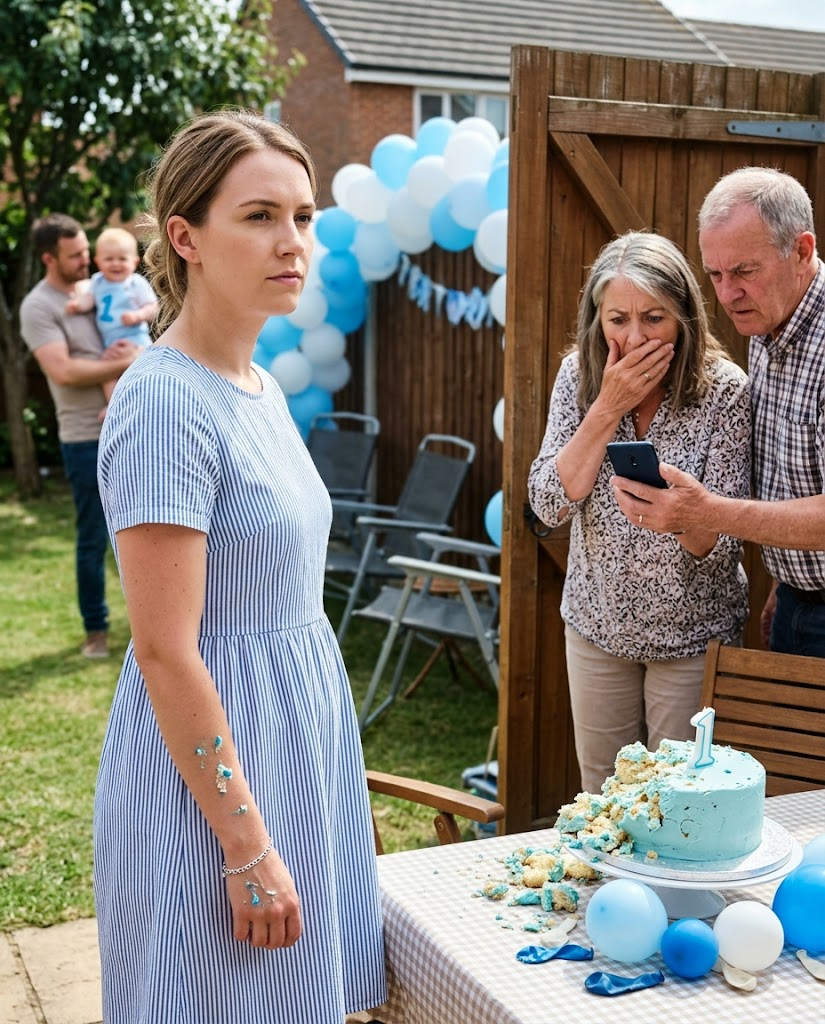
They Rejected Their Grandson—Then Opened the Wrong Email
My son’s first birthday cake leaned so far to the left that my husband, Mason, kept circling it like a nervous engineer trying to stop a small structural disaster.
“Do not touch it,” I warned, pointing a frosting-covered spoon at him.
“I’m not touching it,” he said.
“I’m just letting it know I believe in it.”
The cake was vanilla with pale blue frosting, and it looked exactly like what it was: a loving attempt made by a tired mother who had been awake until nearly one in the morning trying to pipe neat little clouds around the edges.
By daylight, half the clouds looked like melted marshmallows and the top layer had shifted just enough to make the whole thing lean.
Noah, my son, would not have cared even if it had collapsed.
He was turning one.
His interests were simple, urgent, and honest: bananas, ceiling fans, crinkly paper, and the sound of his own squeal bouncing off kitchen cabinets.
Outside, the backyard looked warm and cheerful in the late-morning sun.
Mason had mowed before breakfast, and the fresh-cut grass mixed with the smell of charcoal from the grill.
Blue and white balloons bumped gently against the fence whenever the breeze moved through.
A few plastic chairs we borrowed from our neighbor sat around the patio.
It was simple, slightly crooked, and full of effort.
It was exactly the kind of day I had wanted for Noah.
What I had not wanted was the familiar ache sitting under all of it.
My parents had not answered the invitation.
That alone would not have surprised anyone who knew them.
My parents, Robert and Denise, treated invitations like bills: something to ignore unless failing to respond might cost them something later.
For most of my adult life, I had been the thing that cost them less.
I was the daughter who always fixed the problem before it became visible.
When Dad’s hours got cut, I “helped out.” When Mom forgot a payment, I “bridged the gap.” When their debt began piling up from bad choices disguised as bad luck, I became their quiet solution.
It had started small enough that I could lie to myself about it.
A utility bill here.
A grocery run there.
Then it became a mortgage payment after Dad said it was just a timing issue.
Then a truck payment.
Then an insurance lapse.
Then a debt-consolidation plan because my parents had reached the point where even their creditors had stopped sounding surprised.
I work in accounting.
Numbers calm me.
Numbers explain what people are too ashamed to say aloud.
My parents used that about me the same way they used everything else.
They would arrive embarrassed, emotional, and full of stories, and I would sit at my laptop, log into portals they never remembered passwords for, and clean up another mess while they promised it would be the last time.
It was never the last time.
When I met Mason, he noticed the pattern before I was ready to name it.
We had been dating only four months when he watched me leave a movie early because my mother had called crying about a shutoff notice.
On the drive to my parents’ place, he asked gently, “How often does this happen?”
“Only when things get bad,”