
Dad Found His Kids Serving Relatives. Then Grandma Lost Her Party.-thuyhien

Thomas heard his father’s voice before he saw the tables.
“If Thomas couldn’t build a proper family the way God intended, then at least his children can learn to serve people from a young age.”
The sentence floated over the event garden in Denver like it belonged there.
Like it was part of the music.
Like it was another joke for the uncles, cousins, neighbors, and old family friends eating under white canopies in the afternoon sun.
Thomas stopped with his car keys still in his hand.
The July air smelled like grilled meat, cut grass, warm frosting, and the faint chlorine tang from the little fountain near the back fence.
Plastic chairs scraped against concrete.
Someone laughed near the buffet line.
A speaker played an old song his mother loved, something bright and cheerful enough to make the scene look normal from a distance.
Then Thomas saw Rebecca.
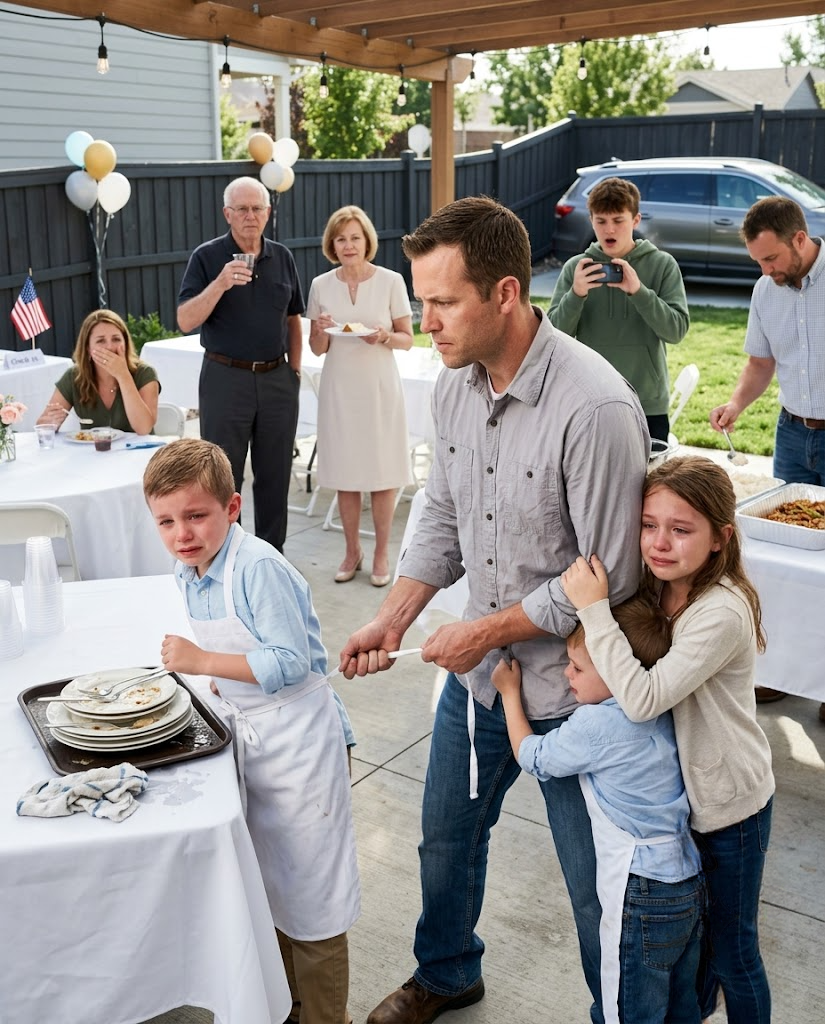
She was ten years old, standing beside a folding table in a white apron that hung too long on her small body.
Her eyes were red.
Not a little red.
Swollen, rubbed raw, the way a child’s eyes look when they have been trying to cry quietly because adults have made it clear tears will only make things worse.
Samuel, eight, was a few steps away with a serving tray balanced in both hands.
The tray was almost wider than his arms.
Dirty plates slid slightly every time he shifted his weight.
Jacob, six, was bent over a table with a wet rag, scrubbing at a soda ring while two teenage cousins held up their phones and recorded him.
For one second, Thomas could not understand what his eyes were telling him.
He had left his children with their grandparents.
He had asked Robert and Helen to watch them for two hours while he finished checking a catering event across town.
He had said it on their front porch that morning, with Jacob leaning against his leg and Rebecca reminding Samuel to bring his inhaler.
“Just watch them for a couple of hours,” Thomas had said.
Helen had smiled like the picture of a sweet grandmother.
“Of course, son. Don’t worry. We’ll bring them early. They’ll be fine.”
At 12:06 p.m., she had texted him.
Kids are here. Everything is perfect.
At 12:41 p.m., Robert had sent a photo of the event garden.
The picture showed balloons, the big birthday cake, the white tablecloths, and the small American flag near the check-in table fluttering behind the gift station.
It did not show Rebecca crying.
It did not show Samuel carrying plates.
It did not show Jacob being filmed while he wiped tables.
Thomas had built his life around not letting his children feel like mistakes.
Rebecca, Samuel, and Jacob had different mothers.
That was true.
It was also the least important fact about them.
At home, Rebecca helped Jacob with his shoes and pretended not to care when he hugged her before school.
Samuel saved the biggest chicken tender for Rebecca even when he claimed he was starving.
Jacob climbed into Thomas’s bed during thunderstorms and somehow always ended up kicking everyone in the ribs.
They fought over the TV remote.
They left cereal bowls in the sink.
They defended each other with the fierce loyalty of children who understood they belonged to the same roof.
To Thomas, they were not evidence of failure.
They were home.
But Robert and Helen had never seen them that way.
For years, they had spoken about Thomas’s family like it was a stain that could be scrubbed out if everyone agreed to be embarrassed enough.
“Three children, three mothers, no wife,” Robert would say.
“A respectable man doesn’t leave families scattered everywhere,” Helen would add, usually while accepting money from the same son she was judging.
Thomas had heard those lines at holidays, backyard cookouts, church breakfasts, and family dinners.
He had heard them in the driveway while helping his children buckle into his SUV.
He had heard them in the kitchen while paying Helen’s electric bill from his phone.
He had heard them from Robert while picking up prescription refills that Robert could not afford without him.
And he had stayed quiet.
Not because it did not hurt.
Because some children grow into adults and still keep one small foolish room in their hearts where they hope their parents will eventually be proud.
Thomas had owned two modern diners in the city and a small catering business by the time he was thirty-seven.
He had started working kitchens at nineteen.
He had washed dishes, loaded trucks, learned inventory, learned payroll, learned how many ways a business could almost die before breakfast.
He had built something real.
He had also lent his parents a suburban house to live in.
He paid the utilities.
He covered groceries when Helen said the card was short.
He handled Robert’s medication and car insurance.
His name was on the auto-payments they never mentioned when they lectured him about responsibility.
Respect is strange in some families.
The person carrying everyone is often the one ordered to bow.
That Sunday was supposed to be different.
Helen was turning seventy.
Thomas had wanted the party to feel generous, beautiful, and peaceful.
He rented the event garden.
He ordered flowers.
He hired music.
He paid the deposit, signed the venue contract, and approved the final food count.
At 11:18 a.m., he had confirmed the catering balance on his phone while standing behind one of his diners with a paper coffee cup going cold on the prep table.
He had done all of it because he wanted his children to feel included.
He wanted them to sit with cousins, eat cake, and hear someone call them family without hesitation.
Instead, he walked into a yard where they were being used as props in his parents’ lesson.
Robert raised his glass when he noticed Thomas standing by the entrance.
He did not look ashamed.
He looked pleased.
“Just look at that,” Robert said loudly. “This is how you fix bad parenting. Nobody here is special just because they’re Thomas’s children.”
Some relatives laughed.
Not all of them.
That almost made it worse.
Some looked away.
One aunt stared down into her paper cup.
An uncle suddenly became fascinated by the grass near his shoe.
A neighbor shifted in her chair and did nothing.
The whole garden froze in pieces.
A fork paused halfway to a mouth.
A plastic cup crumpled in someone’s fist.
A serving spoon hovered over a pan of rice while steam kept rising like nothing human had happened.
One of the teenage cousins kept recording.
Nobody moved.
Jacob saw Thomas first.
“Dad…”
It was barely a word.
It was a crack.
Thomas walked across the garden.
He did not run.
Later, that was one of the things people remembered.
He did not shout.
He did not throw a chair.
He did not slap the phone out of the cousin’s hand, though for one ugly second his body wanted to move before his mind could stop it.
Rage can be so big it has to find a place to stand before it burns the whole room down.
Thomas found that place in his children’s faces.
He reached Jacob first.
The boy still had the rag in his hand.
Thomas took it gently and dropped it onto the table.
Then he lifted Jacob into his arms.
Jacob clung to him immediately, both arms tight around his neck, his little body shaking with the effort of not sobbing in front of everyone.
Samuel stood frozen with the tray.
Thomas set one hand beneath it before the plates slid.
He took the tray from Samuel and placed it on the nearest table hard enough that every fork jumped.
Then he untied the apron from Samuel’s waist and pulled it off.
Samuel’s lower lip trembled.
He looked like a child trying to decide whether it was safe to be rescued.
Rebecca was last because Rebecca had learned too early how to stand still when adults were cruel.
Thomas pulled her into his side.
That was when she finally cried.
Not loudly.
Worse than loudly.
She cried with her face turned into his shirt so no one else could see all of it.
“Who put these on you?” Thomas asked.
His voice was calm.
Too calm.
The kind of calm that makes a room understand the argument is no longer an argument.
Helen stepped forward with a slice of cake on a paper plate.
She wore a pale church dress and the same soft smile she used in family photos.
“Don’t exaggerate,” she said. “We were teaching them humility.”
Thomas looked at the rag.
He looked at the apron in his hand.
He looked at Rebecca’s red eyes, Samuel’s stiff shoulders, and Jacob’s fingers twisted into the collar of his shirt.
“Humility,” he repeated.
Robert laughed once.
“See? That’s the problem. You baby them. Somebody had to teach them their place.”
The word place moved through Thomas like a match dropped into gasoline.
He thought of every utility bill he had quietly paid.
He thought of Helen asking him to cover groceries while telling him his children were proof he had no values.
He thought of Robert lecturing him about manhood from a house Thomas owned.
He thought of Rebecca hearing all of it.
Samuel hearing all of it.
Jacob being filmed because two teenagers had learned cruelty from adults who called it discipline.
Then Thomas saw one cousin lower his phone.
Not fast enough.
The screen was still lit.
Thomas shifted Jacob higher on his hip.
“Delete it,” he said.
The cousin swallowed.
“It was just funny.”
“Delete it.”
Helen sighed loudly, trying to reclaim the crowd.
“Thomas, you’re ruining my birthday.”
That sentence did what Robert’s insults had not done.
It made Thomas almost smile.
Not because anything was funny.
Because the selfishness was so complete it had become clear.
“Your birthday,” Thomas said.
He turned slowly, looking at the tables, the flowers, the rented speakers, the cake, the staff waiting near the buffet, and the relatives pretending they had not participated by staying silent.
“You mean the birthday I paid for?”
Helen’s smile tightened.
Robert set his glass down.
“Don’t start that,” he said.
Thomas took out his phone.
The event garden manager had been standing near the catering table with a clipboard, watching the scene with the stiff posture of someone who wanted to intervene but knew she needed direction from the person who had signed the contract.
Thomas raised his hand slightly.
She stepped closer.
“Mr. Thomas,” she said quietly, “do you want us to stop service?”
That was when the party changed shape.
Helen looked from the manager to Thomas.
Robert’s face hardened.
Several relatives sat up straighter.
They had forgotten something important.
Thomas was not a guest at his mother’s party.
He was the reason the party existed.
The venue contract was in his name.
The final invoice was attached to his catering account.
The staff had his card on file.
The birthday cake, the music, the flowers, the food, the tables, the chairs, the whole bright little performance of family dignity had been built on his money.
“You wouldn’t,” Helen said.
Thomas looked at her.
“I already did too much.”
Robert stepped toward him.
“That’s your mother.”
“Those are my children.”
The words landed harder than shouting.
Rebecca’s hand tightened around Thomas’s sleeve.
Samuel pressed closer.
Jacob tucked his face into his father’s neck.
From the far table, Robert’s brother cleared his throat.
He was one of the men who had laughed when Robert made the first comment.
Now he stared at the apron in Thomas’s hand and said, barely above a whisper, “Robert… you went too far.”
Robert turned on him.
“Stay out of this.”
“No,” the man said, but his voice cracked. “They’re kids.”
That was the first honest thing anyone at the party had said.
Thomas opened the family group chat on his phone.
The video was already there.
One of the teenage cousins had posted it at 12:39 p.m.
In the clip, Jacob wiped the table while Robert’s voice laughed in the background.
Rebecca could be seen behind him, trying to wipe her face with the heel of her hand.
Samuel carried plates past a table of adults who did not help him.
The caption under the video was short.
Learning early.
Thomas turned the screen toward Robert.
For the first time that afternoon, his father’s confidence shifted.
Not sorry.
Scared.
Robert understood witnesses when they were sitting at tables.
He did not understand evidence when it was time-stamped.
Helen whispered, “Thomas, put that away.”
“Why?” he asked. “It was harmless, wasn’t it?”
No one answered.
The manager looked at Thomas’s phone, then at the children, then back at Thomas.
Her face softened for half a second before she returned to professional stillness.
“Do you want service stopped?” she asked again.
Thomas looked at his children.
Rebecca’s breathing had slowed, but her eyes were still fixed on the ground.
Samuel stared at the apron like it might reach for him again.
Jacob’s small fingers had not loosened.
An entire garden had taught them to wonder if they deserved humiliation.
Their father had to teach them, immediately and publicly, that they did not.
“Yes,” Thomas said.
The manager nodded once.
She signaled to the staff.
The music stopped first.
That silence was enormous.
Then the buffet line closed.
Two servers began covering trays.
A staff member stepped behind the cake table and moved the knife away.
Helen made a sound like she had been slapped.
“You are embarrassing me,” she said.
Thomas almost laughed again.
“No,” he said. “I’m stopping you from embarrassing my children. There’s a difference.”
Robert pointed a finger at him.
“You think money makes you the man now?”
Thomas kept Jacob in one arm and the apron in the other hand.
“No. Protecting my kids does.”
Someone at the back muttered that this had gone too far.
Someone else said Helen should apologize.
Helen’s face flushed.
“Apologize? To them? After all we’ve done for him?”
That was the sentence that emptied the last small room in Thomas’s heart.
After all we’ve done for him.
He thought of the house.
The utilities.
The grocery runs.
The pharmacy calls.
The car insurance.
The quiet transfers.
The way he had never once humiliated them for needing help.
Money shame is only shame when the wrong person has it.
When parents take from a child, they call it family.
When that child finally says no, they call it disrespect.
Thomas turned to the manager.
“Please print the final receipt. I want the service ended under my name, and I want a copy of the contract emailed to me.”
“Of course,” she said.
Robert stared at him.
“What are you doing?”
“Documenting it.”
The word made several people go quiet.
Thomas looked at the cousin with the phone.
“Send me the original video. Not the edited one. The original.”
The cousin’s hand shook.
“Why?”
“Because my children were recorded without my permission while adults humiliated them at a party I paid for.”
The cousin sent it.
Thomas watched the file arrive.
12:39 p.m.
He saved it.
He took photos of the aprons.
He took a picture of the wet rag.
He took a picture of the tray Samuel had been carrying.
Not because he wanted revenge.
Because people who rewrite cruelty later hate proof.
Helen began to cry then.
Not the broken kind of crying Rebecca had done.
The public kind.
The kind that looks around after every tear to see who is watching.
“I just wanted them to learn humility,” she said.
Rebecca lifted her head.
Her voice was small, but everyone heard it.
“Grandma said if we didn’t serve right, Dad would be ashamed of us.”
Thomas went very still.
Robert closed his eyes.
Helen whispered, “Rebecca.”
That one word told the whole truth.
Not denial.
Warning.
Thomas crouched slightly so he could look Rebecca in the face without letting go of Jacob.
“Listen to me,” he said. “I have never been ashamed of you. Not for one second of your life.”
Rebecca’s mouth trembled.
“Even if people say we’re not a real family?”
There are questions children should never have to ask.
Thomas held her tighter.
“Especially then.”
Samuel wiped his face with his sleeve.
Jacob finally whispered, “Can we go home?”
“Yes,” Thomas said. “We’re going home.”
Helen stepped in front of him.
“You cannot just leave my birthday like this.”
Thomas looked at the cake behind her.
The gold letters still spelled her name.
The candles were still unlit.
“Watch me.”
He walked past her.
No one stopped him.
The manager met him near the entrance with a printed receipt and a copy of the service stop note.
She kept her voice low.
“I’m sorry,” she said. “For what it’s worth, I saw enough.”
Thomas nodded.
“Thank you.”
In the parking lot, the children’s silence was heavier than crying.
Rebecca climbed into the back seat first.
Samuel sat beside her, still looking down at his hands.
Jacob did not want to let go of Thomas’s neck.
Thomas stood beside the SUV for a moment with the driver’s door open, feeling the heat rise off the pavement.
Then his phone started buzzing.
Helen.
Robert.
An aunt.
A cousin.
Another cousin.
The family group chat exploded.
You embarrassed your mother.
You made a scene.
They were only helping.
Kids need discipline.
You always think money makes you better.
Thomas read none of it out loud.
He turned the phone face down in the cup holder and drove home.
At the first red light, Rebecca said, “Dad?”
“Yeah, baby.”
“Are we in trouble?”
He gripped the steering wheel until his knuckles whitened.
There it was.
The real damage.
Not the apron.
Not the rag.
Not even the recording.
The fear that being defended might somehow be their fault.
“No,” he said. “You are not in trouble. None of you are.”
Samuel whispered, “Grandpa said we needed to earn being there.”
Thomas pulled into a gas station parking lot because he could not safely keep driving with that sentence in the car.
He parked near the edge, under a bright sky, beside a trash can and a rack of windshield squeegees.
Then he turned around.
“You don’t earn being my children,” he said. “You already are.”
Jacob sniffed.
“Forever?”
Thomas nodded.
“Forever.”
That night, after the kids ate grilled cheese on the couch and fell asleep under one blanket in the living room, Thomas sat at the kitchen table with his laptop open.
He saved the video file.
He downloaded the event receipt.
He made a folder with the date.
He wrote down the timeline while it was still fresh.
12:06 p.m., Helen texted that everything was perfect.
12:39 p.m., video posted to family group chat.
12:41 p.m., Robert sent party photo.
1:07 p.m., Thomas arrived.
1:14 p.m., service stopped by account holder request.
He did not know yet what he was going to do with all of it.
He only knew he was done letting his parents turn his silence into permission.
The next morning, Helen called from the house Thomas had lent them.
He let it ring once.
Twice.
Then he answered.
She did not apologize.
She began with, “Your father didn’t sleep.”
Thomas looked through the kitchen doorway at his children still curled together on the couch.
“Neither did Rebecca.”
Helen went quiet.
Then she said, “You are taking this too far.”
“No,” Thomas said. “I should have taken it this far years ago.”
Robert got on the line then.
His voice was rough.
“You’re not going to hold money over our heads.”
Thomas looked at the folder on his laptop.
The receipts.
The video.
The message.
The proof.
“You’re right,” he said. “I’m not.”
Robert breathed out like he had won something.
Then Thomas finished.
“I’m going to stop sending it.”
The silence on the phone lasted so long Thomas could hear the refrigerator humming.
Helen whispered his name.
He did not soften.
He had softened for years.
He had mistaken softness for honor.
Now he understood that honor without boundaries becomes an invitation.
“The house will be handled properly,” Thomas said. “I’ll give you time to make arrangements. I won’t put you on the street. But I will not keep funding people who humiliate my children. Utilities, groceries, insurance, medication extras, all of it stops going through me.”
Robert’s anger came back fast.
“After everything we did raising you?”
Thomas closed his eyes.
There was the old hook.
The old debt.
The old chain.
“You raised me,” he said. “You didn’t buy the right to break my kids.”
Helen cried again.
Robert cursed.
Thomas hung up.
For the next few days, the family divided itself the way families do when truth becomes inconvenient.
Some people said Thomas had done the right thing.
Some said he should forgive because Robert and Helen were old.
Some said the kids would forget.
Those were the people Thomas stopped listening to first.
Children do not forget humiliation just because adults call it small.
They remember who laughed.
They remember who looked away.
They remember who came for them.
A week later, Rebecca asked if she could skip the next family barbecue.
Thomas said yes before she finished the sentence.
Samuel asked if Grandpa was still mad.
Thomas told him Grandpa’s feelings were not Samuel’s job.
Jacob asked if aprons were bad.
That one hurt in a different way.
Thomas took him to one of the diners after closing.
He tied a clean apron around his own waist first.
Then he tied one around Jacob.
Then one around Samuel.
Then one around Rebecca, who pretended she was too old for it but smiled anyway.
They made pancakes at 9:30 p.m. with the lights bright and the chairs stacked on tables.
Thomas showed them how to flip batter, how to wipe a counter because you take pride in your own place, and how service is honorable only when it is chosen or fairly paid, never when it is used to put someone beneath you.
Jacob got flour on his nose.
Samuel burned the first pancake.
Rebecca laughed for the first time in a week.
That was when Thomas knew they would be okay.
Not untouched.
But okay.
Months later, when people still tried to tell the story as if Thomas had overreacted at a birthday party, he would remember the exact weight of that apron in his hand.
He would remember Rebecca asking if they were a real family.
He would remember Samuel saying they had to earn being there.
He would remember Jacob asking to go home.
And he would remember the garden going silent when he finally stopped bowing.
An entire garden had taught his children to wonder if they deserved humiliation.
Their father spent every day after that teaching them they never did.