He Pushed His Pregnant Wife Into The Snow. The Rescue Changed Everything-yilux

Valerie Robles learned that a person can smile like a husband and plan like a stranger.
That was the thought that came back to her later, in a hospital bed with an intake bracelet around her wrist and snowmelt still tangled in her hair.
But before the hospital, before the police report, before Dominic Vance stood in a black suit at a funeral that was not really a funeral, there was the mountain.
There was the SUV heater blowing stale coffee-scented warmth across her knees.
There was the pale cashmere scarf Dominic had bought her that morning and insisted she wear.
There was Mount Rainier disappearing and reappearing through sheets of white wind while Valerie rested both hands on her stomach and tried to convince herself the tightness in her back was only another false contraction.
She was nine months pregnant.
Their son was due any day.
Dominic had called the trip one last peaceful afternoon before everything changed.
He said it the way he said most things in public, gently enough for other people to admire him.
He had booked a luxury alpine cabin with a stone fireplace and wide windows facing the trees.
He had packed hot cocoa in a steel thermos.
He had even joked that once the baby arrived, they would never again have a quiet drive without a diaper bag, a car seat, and a plastic giraffe wedged under the passenger seat.
Valerie had laughed because that was what wives did when they were still trying to make a marriage feel normal.
For five years, she had defended Dominic against everyone who sensed the cold under his charm.
When former employees said he could cut people off without blinking, Valerie said the shipping industry was brutal.
When her friends said he monitored her too closely, Valerie said he was protective.
When her mother, dying sixteen years earlier in a hospital room that smelled like antiseptic and old flowers, warned her that control dressed as love was still control, Valerie was too young and too lonely to understand.
Dominic had found all the empty places in her life and filled them with himself.
That was the first trust signal she gave him.
Access.
He knew she had no siblings.
He knew her mother was gone.
He knew her father had vanished from her life long before she learned how to spell disappointment.
He knew that when people asked who Valerie would call in a crisis, the answer had become him.
By the time she realized that answer was dangerous, she was already sitting beside him on an icy mountain road while their son shifted under her ribs.
The first crack had come a week earlier.
Valerie had gone looking for a spare phone charger in Dominic’s home office and found a folder wedged behind a stack of shipping contracts.
The label read VANCE MARITIME LIABILITY REVIEW.
Inside were debt ledgers, internal memos, and a spousal acknowledgment page carrying Valerie’s signature.
Except she did not remember signing it.
Below that was a life insurance policy.
Fifty million dollars.
Her name appeared as the insured.
Their unborn child appeared in a secondary indemnity clause written in language so cold it took her three readings to understand why her hands had begun to shake.
She had taken two photos while Dominic was in the shower.
One of the policy summary.
One of the signature page.
Then she had put everything back exactly where she found it.
People think fear makes you careless.
Sometimes fear makes you precise.
Valerie did not confront him that night.
She waited.
She watched.
She noticed Chloe Salgado calling his phone after midnight and hanging up whenever Valerie entered the room.
Chloe was Dominic’s executive assistant, but she had moved through his life with the ease of someone who had been given more than calendar access.
At company dinners, she always appeared with a refill before Dominic asked.
She knew which fork he preferred, which client names made him tense, and how to laugh softly at his jokes without seeming obvious.
Valerie had once told herself Chloe was just good at her job.
That was before the mountain.
At 3:18 p.m., Dominic pulled off near an isolated scenic overlook.
The time mattered later because it appeared on the cabin booking receipt, on the maintenance truck dash camera, and on the first page of the incident report.
At the time, all Valerie knew was that the road had narrowed, the snow was coming harder, and her phone showed no service.
She looked around for another car.
There was none.
She looked for a ranger truck.
Nothing.
She looked at Dominic and saw that he was not looking at the view.
He was looking at the drop.
“Let’s go back,” she said.
Her voice sounded small in the wind.
Dominic stood beside her with his hands in the pockets of his dark wool coat.
“Are you going to keep asking about the ledgers?” he asked.
Valerie’s breath stopped for half a second.
So he knew.
“I was going to ask why my signature is on paperwork I never signed,” she said.
His jaw tightened.
Snow caught in his eyelashes and melted there, but his face did not soften.
“You always did have a talent for becoming inconvenient,” he said.
That was the last sentence he spoke to her as her husband.
The next thing he did belonged to someone else entirely.
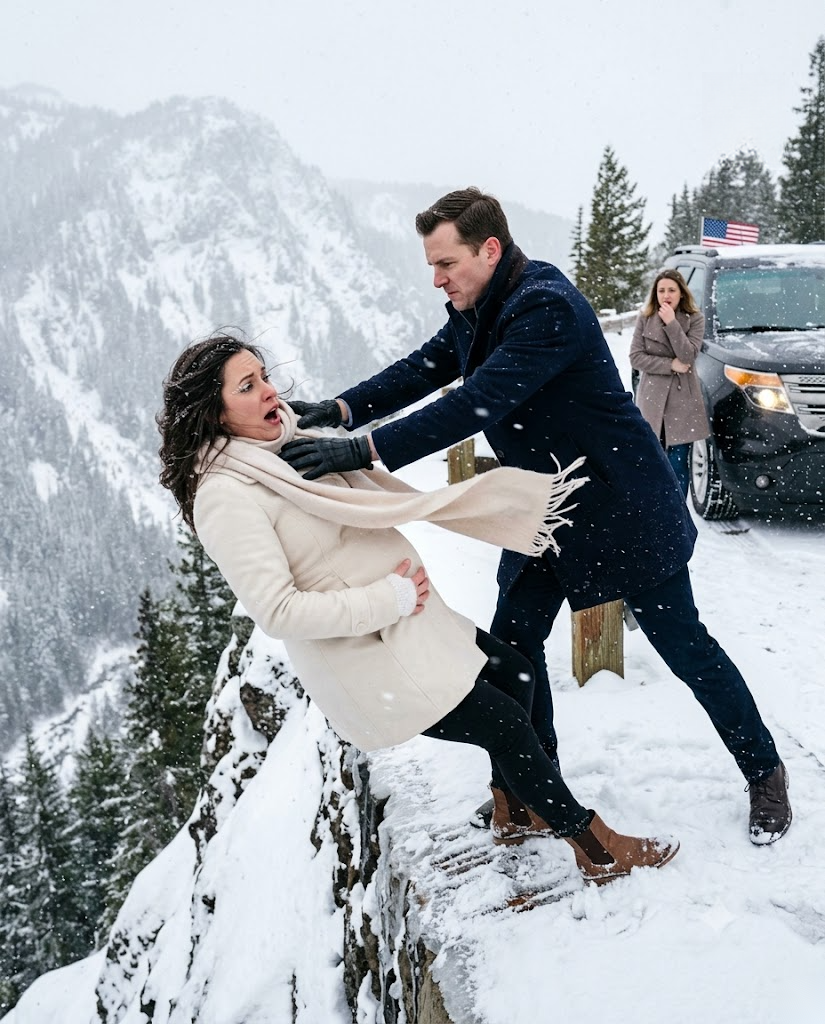
He put both hands flat against her shoulders and shoved.
Valerie fell backward into the white air.
She screamed his name, but the storm tore it away.
For a fraction of a second, she saw him above her, leaning over the edge with the eerie calm of a man watching a shipment clear customs.
Then the ledge hit her.
Her right wrist folded under her with a flash of pain so bright she almost blacked out.
Her ribs seized.
Something warm slid from her hairline and cooled instantly in the snow.
But her left arm moved before thought did.
It wrapped around her stomach.
“Stay with me,” she whispered.
The baby moved.
A small pressure.
A stubborn answer.
That movement kept her awake.
Above her, Dominic looked down into the ravine.
“Don’t make this harder than it needs to be,” he called.
His voice was neat.
Office neat.
Boardroom neat.
“Neither of you will suffer long.”
Then he stepped away.
For a while, Valerie heard nothing but wind.
She counted breaths.
In for the baby.
Out for the baby.
Again.
Again.
Rage could wait.
Her son could not.
Then Chloe’s voice came from above.
“Is she gone?”
Valerie’s eyes opened.
The pain in her body was terrible, but the sound of that woman’s voice beside Dominic’s did something pain could not do.
It made the whole plan visible.
Dominic laughed once.
“For a fifty-million-dollar life insurance payout, she better be.”
There are moments when grief does not break your heart.
It organizes it.
The mountain drive.
The policy.
The copied signature.
The unborn child’s clause.
The scarf.
The isolated overlook.
Nothing had gone wrong.
Everything had gone according to plan.
Dominic and Chloe walked back toward the cabin while the snow thickened around Valerie’s body.
They thought the storm would cover the ledge.
They thought nobody had seen the SUV near the overlook.
They thought a pregnant woman with a broken wrist and no cell signal could not become evidence.
They were wrong about all three.
The first person to see Valerie was not a tourist.
He was a maintenance worker who had been clearing access markers below the ridge before the storm closed the route.
He had stopped because he saw a strip of pale fabric moving where no fabric should have been.
The cashmere scarf Dominic had chosen so carefully had caught on a branch below the ledge, whipping in the wind like a signal.
The maintenance worker swung his flashlight up once.
Then again.
The beam found Valerie’s face.
“Ma’am, don’t move,” he shouted. “I see you.”
She tried to answer.
Only a broken sound came out.
His radio crackled.
He called for rescue support.
He gave the location.
Then, because he had worked mountain roads long enough to notice what rich people assumed nobody noticed, he added one more detail.
A black SUV had been parked crooked near the overlook at 3:41 p.m.
His dash camera had caught the plate.
That plate mattered.
By the time Dominic and Chloe reached the cabin porch, a white maintenance truck was already rolling into the drive.
The small American flag decal on its rear window was half-covered with ice.
Chloe saw it first.
The paper cup in her hand slipped and spilled cocoa across the porch boards.
Dominic turned toward the truck, and the face he had practiced for years failed him for the first time.
The radio on the worker’s shoulder crackled from below the ridge.
“Live patient located in the ravine. Pregnant female. Requesting rescue support now. Possible assault.”
Chloe gripped the railing.
Dominic did not speak.
That silence became part of the report too.
Rescue took forty-three minutes.
Valerie remembered pieces of it in flashes.
Hands securing a rope.
A voice telling her not to sleep.
Someone saying the baby still had a heartbeat.
The sharp smell of a thermal blanket.
The terrible relief of being lifted away from the rock shelf and into bright cold air.
At the hospital intake desk, she gave her name twice because the first time her teeth were chattering too hard to make the letters clean.
A nurse cut away the sleeve of her coat.
A doctor checked the baby.
A deputy placed a recorder on the bedside table and asked if she felt able to describe what happened.
Valerie looked at the ceiling tiles.
Then she looked at the monitor where her son’s heartbeat moved in steady little spikes.
“Yes,” she said.
She told them everything.
She told them about the folder.
She told them about the policy.
She told them about Chloe’s voice.
She told them what Dominic had said into the ravine.
A police report can make terror look tidy.
Time, location, injuries, statement, evidence.
But Valerie knew what every line really meant.
She had survived long enough for Dominic’s story to have a witness.
The doctors kept her hidden under an administrative privacy hold while investigators moved carefully.
That part was not dramatic.
It was paperwork.
It was signatures.
It was a hospital security note placed in her file.
It was a deputy standing outside the maternity wing and a nurse who refused to confirm anything when Dominic called pretending to be frantic.
Dominic gave his first statement four hours after the fall.
He said Valerie had wandered away while emotional.
He said she had been anxious about the birth.
He said he searched until the storm made it impossible.
Then he said the sentence that would later make one investigator pause the recording and play it again.
“My wife would never do anything reckless with our son.”
He was trying to sound devoted.
Instead, he sounded certain she was already dead.
Chloe’s statement was worse.
She said she had remained at the cabin the entire time.
The maintenance truck dash camera disagreed.
It showed her coat at the overlook.
It showed her walking beside Dominic.
It showed the black SUV.
It showed the time.
Dominic’s second mistake came two days later.
When investigators did not immediately announce that Valerie was alive, Dominic believed the mountain had finished the job.
He allowed the funeral home to prepare a closed memorial based on the assumption that recovery efforts would confirm death.
He stood in a black suit beside a framed photograph of Valerie and placed one hand over his heart.
People from his company came.
Neighbors came.
Chloe came in a dark dress and sat in the second row with her face lowered.
Dominic smiled when an older client squeezed his shoulder and said Valerie would have wanted him to be strong.
It was a small smile.
But the deputy at the back of the room saw it.
So did Valerie.
She was not in the room as a grieving ghost or a dramatic reveal.
She was in a hospital bed miles away, watching the service through a secure video feed arranged by investigators after she insisted on seeing what he would do when he thought she could no longer speak.
Her wrist was wrapped.
Her ribs were taped.
A hospital wristband circled her left arm.
Her son’s monitor hummed beside her.
When Dominic smiled at her funeral, Valerie did not cry.
She reached for the folder on the tray table.
Inside were printed stills from the dash camera, copies of the insurance policy, photographs of the copied signature page, and the first draft of her sworn statement.
She signed where the deputy pointed.
Not panic.
Not an accident.
Not a grieving husband confused by snow.
Paperwork.
A plan.
A record.
The arrests did not happen during the service.
Investigators waited until Dominic stepped into the hallway, away from the guests, away from the framed photograph, away from the flowers he had chosen for a woman he believed he had erased.
Chloe saw the deputies first.
Her face collapsed before anyone touched her.
Dominic tried to ask what this was about.
No one answered the way he wanted.
One deputy read the assault and fraud allegations in a calm voice.
Another asked Chloe to place her hands where he could see them.
Dominic looked toward the chapel doors, where people were starting to turn.
His grief mask slipped.
Under it was fear.
Valerie watched the recording later.
She replayed only one part.
Not the cuffs.
Not Chloe crying.
Not Dominic trying to explain himself to men who had already read the documents.
She replayed the moment his smile disappeared.
Their son was born nine days after the mountain.
The delivery was difficult, and Valerie cried when the nurse placed him on her chest because his tiny fingers opened and closed against her skin like he had been fighting too.
She did not give him Dominic’s name.
She did not let Dominic’s family into the hospital room.
She signed the birth certificate with her left hand because her right wrist was still braced.
The letters came out uneven.
She kept them that way.
They reminded her that survival does not always look graceful.
Sometimes it looks like a shaky signature on a form you never thought you would live to fill out.
Months later, when the case moved through court, the fifty-million-dollar policy became evidence.
So did the cabin receipt.
So did the dash camera video.
So did Chloe’s messages to Dominic about timing, weather, and whether the overlook would be empty.
Valerie did not attend every hearing.
She did not need to see Dominic every time a lawyer said her name.
But she went once.
She stood in a hallway outside the courtroom with her son asleep against her shoulder and watched Dominic turn his head.
For five years, he had believed he was the person she would call in a crisis.
That day, he saw the truth.
He had become the crisis.
And she had survived him.
Valerie never called the mountain a miracle when people asked.
She called it what it was.
A maintenance worker who noticed a scarf.
A dash camera that kept recording.
A nurse who protected a patient’s privacy.
A deputy who wrote down every word.
A baby who moved at the exact moment his mother needed a reason to stay awake.
Care showed up through actions, not speeches.
That was the lesson Valerie carried home.
Not the luxury cabin.
Not the hot cocoa.
Not the husband who performed devotion until the road turned empty.
The real love in that story was a stranger shining a flashlight into a ravine and refusing to look away.
Years later, Valerie still kept the cashmere scarf sealed in an evidence bag inside a box she never opened unless the court required it.
She did not keep it because she missed anything.
She kept it because one day her son might ask how they lived.
And when he did, she wanted to tell him the truth without trembling.
His father had tried to turn them into a payout.
A storm had tried to bury them.
But a thin beam of light crossed the snow, stopped, and came back.
That was why they were still here.