
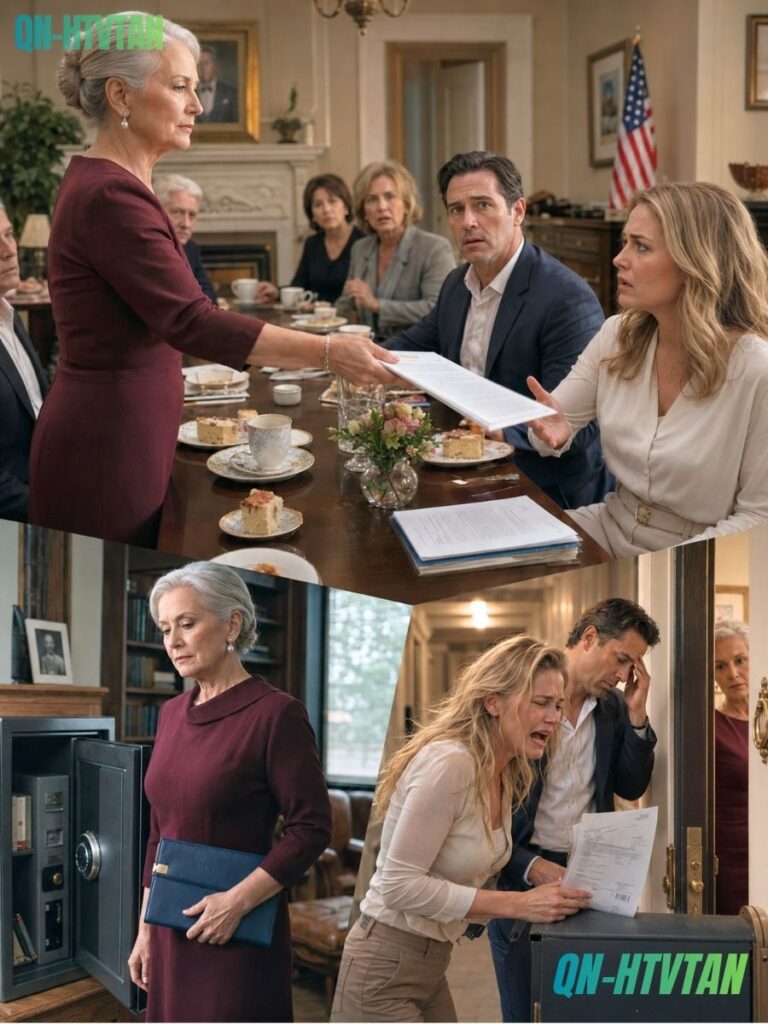
My daughter-in-law called it a “Holiday contribution” and charged me eighty dollars at my own front door.

My daughter-in-law called it a “Holiday contribution” and charged me eighty dollars at my own front door. The guests laughed politely. They stopped laughing when i reached for the house documents.
(Please skip the first part if you have read it on Facebook, the full story is below)
When my daughter-in-law held out her hand at my own front door and demanded eighty dollars before I could step into my own dining room, I did not argue.
I did not raise my voice. I did not remind her that the wreath on the door had been bought with my money, that the table inside had belonged to my mother, or that the roof over all of us had been paid off long before she ever learned my son’s last name. I simply looked at her open palm, then at the guests already gathered in the dining room behind her, and felt something old and patient inside me finally stand up.
Her name was Brooke, and she smiled like she was running a business transaction instead of blocking a widow from Thanksgiving dinner in her own house.
“Eighty bucks,” she said brightly. “Evelyn, think of it as a holiday contribution.”
A few people near the doorway heard her and laughed politely. Not real laughter. The awkward kind people use when they are hoping something is a joke because the alternative is too uncomfortable. My son, Sean, stood just behind her with his hands in his pockets, staring at the floor as if the hardwood had suddenly become fascinating.
He said nothing.
That silence told me more than Brooke’s hand ever could.
I am Evelyn, and that house had been mine for thirty-one years. My late husband and I bought it when Sean was still small enough to fall asleep in the back seat on the way home from school. We painted the kitchen ourselves, refinished the floors, planted the maple tree out front, and paid the mortgage down month by month until the final statement came in and my husband opened a bottle of cheap champagne on the porch. When he passed away two years ago, he left me that house free and clear, not as a burden, but as a place where I could still belong.
Then Sean and Brooke moved into the upstairs apartment.
At first, it had seemed reasonable. They had a young son, little Leo, and rent in town had gotten ridiculous. Brooke said it would only be temporary, just until they caught up, just until Sean got promoted, just until life felt a little easier. I loved my son. I adored my grandson. And after my husband died, the house felt large and quiet in a way that made their footsteps above me almost comforting.
So I said yes.
But temporary arrangements have a way of becoming permanent when the people benefiting from them never intend to leave.
Over time, the boundaries blurred. Brooke started using my pantry when she ran out of things upstairs. Sean borrowed my tools and forgot to return them. Their laundry appeared in my washer. Their packages came to my door. Brooke rearranged the hallway table because she said it made the entryway look “less elderly.” She volunteered me to babysit Leo whenever her schedule became inconvenient, and if I hesitated, she sighed and said, “I thought you wanted to be close to your grandson.”
I told myself to be generous.
I told myself young families needed help.
I told myself peace was worth swallowing a little disrespect.
But respect does not disappear all at once. It is taken in teaspoons until one day you look up and realize someone has emptied the whole cup.
Thanksgiving was supposed to be simple. Brooke had offered to cook because, in her words, it was time for “the next generation to take over some hosting duties.” I allowed it, even though every dish, every platter, every chair, and every room belonged to me. I paid for the turkey, the wine, the flowers, and most of the groceries after she sent me a list and said, “You already know where everything is cheaper.”
Still, I dressed nicely that afternoon. I wore a soft gray sweater, my pearl earrings, and the bracelet my husband had given me on our fortieth anniversary. I told myself to be pleasant. I told myself not to take little things personally. I even brought down the antique silver teapot from my study because Brooke had mentioned it would look beautiful on the dessert table.
Then I reached my own front door, and Brooke charged me admission.
For a few seconds, I studied her face. The business-like smile. The cold little brightness in her eyes. The absolute certainty that I would be embarrassed enough to pay quietly because guests were watching.
She was right about one thing.
I did pay quietly.
I opened my purse, took out a fifty and three tens, and placed them in her palm.
Brooke’s smile widened with victory. “Thank you. See? That wasn’t so hard.”
The laughter behind her faded slowly as people realized real money had changed hands. Sean shifted his weight and looked away. I stepped inside, removed my coat, and walked to the head of the table, the place where I had sat for decades beside my husband. Brooke hesitated when she saw where I was going, but she said nothing. Even she knew better than to challenge that in front of guests.
Dinner passed in a strange, polished haze.
The turkey was dry. The mashed potatoes were good, though I knew they were from a restaurant container hidden in the trash. The candles burned low in the center of the table, and the windows reflected all of us back like a painting of a family pretending nothing had cracked. Brooke floated from chair to chair, pouring wine, laughing too loudly, and explaining her “household management system” to anyone who would listen.
“It’s really all about structure,” she said, resting one hand on Sean’s shoulder. “When you have a multi-generational household, someone has to keep things organized.”
A cousin nodded. My sister glanced at me from across the table, concern flickering in her face, but I only gave her a small reassuring smile.
Brooke went on about how much work it took to maintain the property, how lucky I was to have “active support,” how she and Sean were trying to make things easier for me. I sat silently and listened. The truth was, I paid the landscaper. I paid the utilities. I paid the property taxes. Brooke clipped flowers from my garden and called it contribution.
Still, I did not correct her.
Not yet.
After dinner, while the guests moved toward the living room for coffee and dessert, I slipped away to my study. My husband’s old desk still sat beneath the window, polished dark wood with a little scratch near the drawer where Sean had once carved his initials as a boy. I opened the closet safe, entered the combination, and pulled out the thick blue leather binder.
Inside were the house documents. The deed. The property title. The conditional residency agreement Sean and Brooke had signed when they moved upstairs, back when Brooke still smiled sweetly and promised they would never take advantage. I had almost forgotten about that agreement because, for two years, I had behaved like kindness was stronger than paper.
My husband had known better.
When I stepped back into the hallway with the binder in hand, I stopped.
Brooke was standing by the sideboard, wrapping my antique silver teapot in a dish towel and sliding it into a tote bag.
She looked up when she saw me and did not even have the grace to seem embarrassed.
“I figured we could borrow this for the next family gathering at my parents’ place,” she said casually. “It’ll look nice with their holiday table.”
I did not answer.
I walked past her and placed the blue binder on the entryway console where everyone could see it.
Sean noticed immediately. His face changed. He swallowed hard, and for the first time all evening, he looked directly at me. He knew what that binder meant. He knew the house belonged to me. He knew their right to live upstairs was not ownership, not inheritance, not entitlement. It was conditional, dependent on respect, cooperation, and clear boundaries.
Brooke, apparently, had forgotten that.
I returned to the dining room and sat with the remaining guests until the evening ended. I was polite. I thanked people for coming. I let Brooke accept praise for hosting as if she had not charged me to eat at my own table. Around eleven, the last coat was collected, the final leftovers were wrapped, and the front door closed behind the last guest.
The house fell quiet.
That was when I turned to Sean and Brooke.
I rested my fingers lightly on the blue binder.
“Tomorrow at ten o’clock,” I said, my voice calm and steady, “we are going over the new rules for this house.”
Brooke blinked. Sean opened his mouth, then closed it again.
I went to bed.
The next morning, at exactly nine, there was a knock at my kitchen door.
Brooke stood there holding Leo by the hand, a tote bag full of toys shoved toward me like a package I was expected to accept. She had not even brushed her hair properly. Her face carried the irritated confidence of someone who believed last night’s warning had been nothing more than a mood.
“Evelyn, we need to run downtown for errands,” she said. “You can watch Leo for a bit. And could you clean up the kitchen from yesterday? We did so much for you last night.”
In the past, I would have stepped aside. I would have taken Leo’s little hand, kissed his head, cleaned the kitchen, and told myself it was worth it because I loved my grandson. But that morning, I saw the trap for what it was. Love was being used as a leash.
I took one step back and blocked the doorway with my body.
“No, Brooke,” I said. “I have my own plans today. I won’t be babysitting, and I won’t be cleaning up your kitchen.”
Her mouth fell open.
“You charged me eighty dollars for dinner,” I continued. “That made me a paying customer. Customers don’t do the dishes.”
Brooke’s face tightened with shock, then irritation. “Are you serious?”
“Completely. And from now on, babysitting needs to be requested at least three days in advance. I am no longer your on-call free child care.”
Sean came down the stairs just in time to hear the end of it. He looked from Brooke to me, helpless and uncomfortable, exactly the way he had looked at the front door the night before.
“Mom,” he muttered, “don’t be like that. It’s just for an hour.”
I looked at my son without anger, but with a firmness he had never seen from me before.
“I am not being any way, Sean. I am setting boundaries. Your time management is your responsibility.”
Then I closed the kitchen door.
My heart was pounding so hard I could feel it in my throat, but I stood there smiling in the quiet. The first step had been taken.
Later that afternoon, while they were out of the house, I made the next practical move. Until then, Sean and Brooke had keys to every room. They walked into my living space whenever they pleased, took tools from my closet, raided my pantry, and used my laundry room without asking. So I called a local locksmith, a man who had serviced our neighborhood for years.
Within two hours, he replaced the deadbolts on my front door, the basement door, and the laundry room. When he left, I held three new keys in my palm, shiny and small and powerful.
My privacy had finally become physical.
Around four o’clock, I heard them return. A moment later, the doorknob to my apartment rattled sharply. Then again. Then harder.
Brooke pounded on the door.
I opened it a few inches and looked at her calmly.
“What is this?” she demanded. “Why doesn’t our key work anymore?”
“I had the locks changed,” I said. “Since we are now operating on a transactional basis, where meals and services are billed, a clear physical separation is necessary. My apartment is officially private property.”
Sean stepped up behind her, his face flushed.
“Mom, come on. You can’t do this. We’re family.”
“Families don’t charge their own mother admission to eat in her own home,” I said.
He looked away.
“Starting tomorrow, the utilities are changing too,” I added. “I’ll drop the paperwork in your mailbox.”
Then I closed the door and turned the deadbolt.
Over the next few days, the house became eerily quiet. The footsteps overhead sounded heavier. When we crossed paths in the driveway, Brooke stared straight ahead as if I were a ghost she refused to acknowledge. I did not let the coldness bother me. Instead, I sat down at my desk and pulled up the bank statements from the last two years.
Until that week, I had been paying for everything. Heating, electricity, water, trash pickup, high-speed internet. I had viewed it as helping a young couple get on their feet, but generosity requires respect, and mine had officially been revoked.
I created a precise spreadsheet and calculated their share based on the square footage of the upstairs apartment. It was not revenge. It was arithmetic.
On Friday evening, I slipped the invoice into their mailbox in the hall.
Total due by the first of the month: $450.
Ten minutes later, Sean came stomping down the stairs with the paper in his hand.
“Mom, this is ridiculous,” he said, his voice tight. “We agreed we could live here rent-free.”
“You are still living rent-free,” I replied, pouring myself a cup of tea. “But you are responsible for your own living expenses. I am no longer willing to subsidize your lifestyle while being expected to pay for my own food in this house. The transfer needs to be in my account by the third.”
He stood there searching for an argument, but there was none.
“If that doesn’t work for you,” I added, “you are free to find an apartment elsewhere.”
Sean turned and went back upstairs without another word.
Brooke was not the type to back down without a fight. Once she realized her words had no power over me, she resorted to passive-aggressive stunts.
Continue below
When my daughter in law demanded $80 just so I could step into my own dining room, I didn’t argue. I paid her, took my seat at the head of the table, and let her believe she was the one running the show right up until I reached for the house documents. I was standing at my own front door when my daughter-in-law, Brooke, held out her hand. “80 bucks.
” “Evelyn, think of it as a holiday contribution for Thanksgiving dinner.” She said with a clinical, business-like smile, inside my own dining room. The family was already gathered, chatting softly. My son, Sean, stood just behind her, staring intently at the floor, completely silent. A few guests overheard us at the door and laughed politely, assuming it was a joke.
But Brooke’s eyes remained cold and transactional. I didn’t feel an impulse to scream or cry. Instead, a deep, clear calm washed over me. Ever since my husband passed away two years ago, Sean and Brooke had been living in the upstairs apartment of my house, and over time, the boundaries had completely blurred. Brooke had offered to cook for today’s feast, but demanding admission for me to sit at my own table was the absolute breaking point.
Without saying a word, I reached into my purse, pulled out a 50 and three 10s, and dropped the cash into her palm. Brooke smiled triumphantly and stepped aside. I walked in, took my place at the head of the table, and watched the room. The guests’ laughter gradually died down as they realized real money had just changed hands.
I ate in silence, listening to Brooke lecture the table on her household management system and made my decision after dinner. While everyone was distracted with coffee, I slipped away to my study. I opened the small safe in the closet and pulled out the thick blue leather binder. It held the deed, the conditional residency agreement, and the property title.
As I stepped back into the hallway with the documents in hand, I caught Brooke already packing up my antique silver teapot. Brooke looked up as I walked into the room, setting the silver teapot down without a hint of embarrassment. “I figured we could borrow this for the next family gathering at my parents’ place,” she said carelessly.
I didn’t answer. Instead, I placed the blue binder prominently on the entryway console. Sean caught sight of the folder and swallowed hard. He knew exactly what those documents meant. The house belonged to me, fully paid off and free of debt. While the two of them only had a conditional right to live upstairs predicated entirely on mutual respect and cooperation.
During dinner, Brooke had gone on and on about how much work it took to maintain the property and how lucky I was to have such active support. The truth was, I paid the landscaper, and she merely snipped flowers for the table. I sat back down with the guests, remaining polite but emotionally detached.
When my sister quietly asked if everything was all right, I just nodded and gave her a reassuring smile. There was no reason to cause a scene and ruin the holiday for everyone else. I watched Brooke run the room, pouring wine and acting like a generous hostess who had allowed me at the table out of pity. Sean remained the passive bystander he had always been whenever his wife called the shots.
When the guests finally said their goodbyes around 11:00, they thanked Brooke for hosting. She soaked up the praise proudly, but the moment the front door clicked shut and silence returned to the house, I turned to the two of them, looking Brooke dead in the eye. I lightly tapped the leather binder. “Tomo
rrow at 10:00 a.m.,” I said, my voice quiet and steady. “We are going over the new rules for this house.” The next morning at exactly 9:00, there was a knock at my kitchen door. Brooke was standing there, holding little Leo by the hand, shoving a tote bag full of toys toward me. “Evelyn, we need to run downtown to run some errands. You can watch Leo for a bit.
Right. And could you clean up the kitchen from yesterday? We did so much for you last night,” she said, her tone dripping with entitlement. In the past, I would have agreed instantly just to keep the peace and spend time with my grandson. But today, I saw right through it. I took a step back, subtly blocking the doorway with my body, and shook my head.
“No, Brooke,” I said calmly. “I have my own plans today. I won’t be babysitting, and I won’t be cleaning up your kitchen. You charged me $80 for dinner, which made me a paying customer. Customers don’t do the dishes.” Brooke’s face contorted with shock and irritation. She opened her mouth to snap back, but I didn’t give her the chance.
And as for Leo, any babysitting needs to be requested at least 3 days in advance. I am no longer your on-call free child care. Sean came down the stairs just in time to catch the end of it. He looked back and forth between his wife and me, utterly helpless. Mom, don’t be like that. It’s just for an hour.
He mumbled weakly. I looked at my son without bitterness, but with a firmness he had never seen in me before. I’m not being any way, Sean. I am setting boundaries. Your time management is your responsibility. Without waiting for a response, I closed the kitchen door on them. I heard Brooke hissing furiously in the hallway as they walked away.
My heart was thumping, but it felt incredibly good. The first step was taken. Later that afternoon, I used the time they were out of the house to put the next practical step into motion. Up until now, we had shared keys to every single room. Sean and Brooke walked in and out of my living space whenever it suited them, taking tools, raiding my pantry, and using my washing machine without a second thought.
I called a local locksmith who had serviced our neighborhood for years. Within 2 hours, he replaced the deadbolts on my front door, as well as the locks to the basement and the laundry room. When he finished, I held three shiny new keys in my hand. My privacy was finally physically secured. Around 4:00, I heard them return. The doorknob to my apartment jiggled, followed by an annoyed, aggressive rattling.
Brooke was trying to force her old key into the lock, but it wouldn’t budge. A few seconds later, she pounded heavily on the wood. I cracked the door open just a few inches and looked at her calmly. “What is this? Evelyn, why doesn’t our key work anymore?” she demanded, visibly rattled by the sudden loss of control.
“I had the locks changed.” I explained in a level tone. “Since we are now operating on a transactional basis, where services and meals are strictly billed, a clear physical separation is necessary. My apartment is officially private property.” Shawn stepped up behind her, his face flushing red with embarrassment. “Mom, come on.
You can’t do this. We’re family.” He protested. “Families don’t charge their own mother admission to eat in her own home.” “Shawn.” I replied simply. “Starting tomorrow, the utilities are changing, too. I’ll drop the paperwork in your mailbox.” I closed the door and turned the deadbolt. Over the next few days, the house was eerily quiet.
The footsteps overhead sounded heavier, and whenever we crossed paths in the driveway, Brooke stared straight ahead, treating me like a ghost. I didn’t let the icy atmosphere bother me. Instead, I sat down at my desk and pulled up the bank statements from the last two years. Up until this point, I had been footing the bill for the entire property’s heating, electricity, water, trash pickup, and high-speed internet.
I had viewed it as a way to help the young couple get on their feet, but that generosity was officially revoked. I put together a precise spreadsheet itemizing the fixed utilities and calculated their exact share based on the square footage of the upstairs unit. It wasn’t malice. It was just basic math.
On Friday evening, I slipped the invoice into their mailbox in the hall. The total they owed me by the 1st of the month came out to $450, money they usually kept for vacations and shopping sprees. Not 10 minutes later, Shawn came stomping down the stairs. He held the paper in his hand, his fingers trembling slightly. “Mom, this is ridiculous.
We agreed we could live here rent-free.” He yelled, clearly under pressure from Brooke, who was listening from the top of the stairs. “You are still living rent-free, Shawn.” I said calmly, pouring myself a cup of tea. “But you are responsible for your own living expenses. I am no longer willing to subsidize your lifestyle while being expected to pay for my own food in this house.
The transfer needs to be in my account by the 3rd of the month.” He swallowed hard, searching for an argument, but found none. My logic was ironclad. “If that doesn’t work for you, you’re entirely free to find an apartment elsewhere.” I added. He turned around without a word. Brooke wasn’t the type to back down without a fight.
Once she realized her words had no power over me, she resorted to passive-aggressive stunts. On Monday, she parked their bulky stroller right in the middle of the narrow entryway, barely leaving me room to squeeze past. On Tuesday, she stacked their overflowing trash bags directly outside my patio door. I watched it all through the window without letting my temper flare.
An angry outburst from me was exactly what she wanted fuel to paint me as the tyrannical mother-in-law to the rest of the family. I wasn’t going to give her that satisfaction. Instead, I took action. I wheeled the stroller out into the uncovered backyard just as a drizzle was starting. As for the trash, I put on some gardening gloves and moved the leaking bags right in front of the driver’s side door of Brooke’s sedan.
When she went out to drive to work the next morning, she had to manually haul her own garbage out of the way just to open her car door. Shawn watched the whole thing play out from the upstairs kitchen window. Later that day, I ran into him alone by the mailbox. He looked exhausted with dark circles bruising the skin under his eyes.
“Mom, can we please just stop? This Brooke is completely stressed out and we are fighting constantly.” He said quietly, almost pleading. I placed a hand on his shoulder but kept my emotional distance. “Shawn, I didn’t start this conflict. It started at my front door when I was charged $80. I am simply defending my space and my right to be respected.
If Brooke is stressed, it’s the consequence of her own actions.” He lowered his gaze and walked back upstairs. I could feel their united front cracking. Brooke was losing her grip and I was already setting up the final move. The most important lesson life has taught me is to never make empty threats, just present finished results.
With the utility issue settled for the upcoming month, I turned my attention to the long-term setup of the house. The upstairs floor had originally been built as a fully independent mother-in-law suite with its own separate submeters for electricity and water. Something my husband and I had designed for the future.
I contacted a local real estate agent, an old acquaintance named Marcus, and asked him to evaluate the current market rental value of the upstairs unit. The rental market in our suburban town was booming, and prices had skyrocketed over the last few years. Marcus discreetly confirmed that I could easily list the apartment for $1,200 a month.
I had him draw up a professional rental listing sheet and prepare a standard, legally binding lease agreement. My intention wasn’t to throw my own flesh and blood onto the street, but rather to give them a definitive choice. Either they engaged in a normal, contractually regulated tenancy at a fair rate, or they made room for a tenant who would respect both my property and my boundaries.
I signed the landlord portion of the documents and placed them alongside the market analysis inside my blue leather binder. The following weekend was my brother’s annual birthday get-together. Brooke had suggested we all go out to a restaurant nearby, no doubt to avoid the tension inside the house, but I declined and invited the family to my dining room instead.
I baked the cake myself, bought the coffee, and made sure everything was immaculate. When the relatives arrived on Sunday, the mood was polite, but visibly tense. Everyone could sense the tectonic plates had shifted. The afternoon went smoothly until my niece mentioned how incredibly difficult it was to find an affordable place to rent in the area.
Brooke instantly seized the moment to take a passive-aggressive swipe at me. Oh, definitely. Some people just get lucky and sit on a massive house without having any clue how much work and money it takes to run it day-to-day. She said, cutting a sharp glance in my direction. The rest of the table fell dead silent.
Everyone present still vividly remembered the $80 incident from Thanksgiving. I offered a mild smile, stood up, and walked over to the console table where the blue binder was waiting. I picked it up, walked back to the table, and set it down directly in front of Brooke. Since you brought up the costs and value of housing, Brooke, the timing is actually perfect, I said, my voice ringing out with absolute clarity.
I opened the binder and slid the professional market analysis and the lease agreement across the table to her. This is the current market valuation for the upstairs apartment. As you can see, it’s valued at 1,200 a month. Brooke turned pale, while Shawn just stared at the paperwork, his mouth slightly open.
What is this supposed to mean? Evelyn, she stammered, completely blindsided. It means your rent-free arrangement ends at the conclusion of this year, I explained matter-of-factly. This is a standard lease for $900. Consider it a family discount. You have 2 weeks to sign it and begin paying rent in January.
If you choose not to, I’ll take that as your notice to vacate, and Marcus will list the apartment for a standard tenant. The entire room held its breath. No one was laughing now. Brooke tried to lock eyes with Shawn to get him to back her up. But my son just stared helplessly at the contract. They were completely cornered.
In the days following the family gathering, a heavy stillness settled over the house. No more slamming doors. No more strategically placed trash bags. The balance of power had completely shifted, not through legal threats or dramatic screaming matches, but through the cold, hard reality of property rights. Shawn tried to talk to me alone in the kitchen on Wednesday evening.
He sat at the table, burying his face in his hands. “Mom, 900 plus utilities. That’s a massive hit for us. We were trying to save up for a down payment on our own place.” he said quietly. I took a seat across from him. “I know, Shawn, but respect and family dynamics aren’t a one-way street. When your wife decided to treat me like a stranger to be nickel-and-dimed at my own front door, she showed me that you don’t see me as a mother.
You see me as an amenity to exploit. If you want to treat this relationship like a business, then you have to pay business rates.” He looked up and saw the absolute certainty in my eyes. He knew there was no room for negotiation. On Friday night, exactly one day before the deadline, the signed lease agreement was sitting in my mailbox.
There was no dramatic handoff, no grand conversation. They surrendered because they knew finding anything comparable on the market would cost them hundreds more, and moving right after the holidays would be an absolute nightmare. When I saw their signatures, I didn’t feel a surge of triumph or petty satisfaction.
It was just the deep, quiet relief of a woman who had successfully reclaimed her dignity and her peace in her own home. The boundaries were finally in writing. And that was all that mattered. Six months have passed since that autumn, and life in the house has settled into a comfortable, predictable rhythm. The rent and utilities hit my bank account automatically on the 1st of every month.
The physical boundaries created by the new locks are strictly honored. Neither of them steps foot into my space without an invitation anymore. Brooke’s attitude toward me is now distant, but perfectly civil. The fake, transactional smile is gone, replaced by a cautious, quiet respect. We don’t host big, performative family dinners together anymore.
And there was never a tearful, dramatic reconciliation. And frankly, that’s for the best. Forced harmony doesn’t do anyone any favors. Instead, I have scheduled quality time with Leo now, when he hangs out down here. We have a wonderful time. I am his grandmother, not an on-call babysitter who can be taken for granted. Sean actually looks less stressed these days.
He no longer has to play referee since the lines are clearly drawn. With the extra income from the rent, I finally treated myself to something I’ve wanted for years. I booked a solo trip to Vermont for the fall foliage, and bought a beautiful new armchair for my reading nook. When I sit there in the evenings, sipping my tea and enjoying the quiet of my home, I feel a profound unshakeable contentment.
I didn’t lose my home to family drama. I preserved it through practical, decisive boundaries. I am the master of my own domain again, free, independent, and respected. Sometimes, an outrageous $80 bill is exactly the wake-up call you need to remember the true value of your own peace.