She Bought 33 Pounds Of Beef—Then Her Son Packed It Away-heuh

I bought thirty-three pounds of beef for our Sunday family barbecue.
Thirty-three pounds.
It sounds like too much when you say it out loud.
To me, it sounded like making sure nobody left hungry.
My name is Betty Miller, and at sixty-five I had become the person everyone expected to host.
That was not something I resented at first.
I loved a busy table.
I loved hearing chairs scrape back, plates being passed, the kettle clicking on for another round of tea, someone laughing from the garden while Tom fussed over the grill.
Our house was not impressive.
It was a tidy semi-detached place with a narrow hallway, coats on the hooks by the front door, and a back garden just big enough for a long wooden table if everyone tucked their elbows in.
But it was ours.
And for years, it had been where people came when they wanted to feel like a family.
Birthdays happened there.
Sunday lunches happened there.
Small celebrations, awkward reunions, holiday meals, and those ordinary afternoons that turn into memories before anyone realises they matter.
I believed food could soften almost anything.
A difficult week.
A disagreement.
A bit of distance between people who ought to know each other better.
That belief made me generous.
It also made me slow to notice when generosity had become an expectation.
On the Saturday morning before the barbecue, I sat at the kitchen table and made a list on the back of a receipt.
Brisket.
Ribs.
Steak.
Sausages.
Roast potatoes.
Green salad.
Fresh bread.
Grilled onions.
Three cheeses, because Tom always said one cheese looked mean and five looked like I had lost control.
He came in while I was writing, rain still shining on his coat shoulders, and stood behind me to read over my head.
“Betty,” he said, “how many people are coming?”
“Family,” I said.
“That is not a number.”
I smiled without looking up.
“We’ll have leftovers.”
He made the little sound he always made when he knew I was not going to be talked out of something.
“We always have leftovers when you cook.”
“That is the point.”
He kissed the top of my head and left me to it.
At the butcher’s counter, I chose carefully.
Not the cheapest cuts.
Not the showiest either.
Good meat.
Food that would take time, attention, and a bit of pride.
When everything was wrapped, labelled, and weighed, the total came to thirty-three pounds of beef.
The bill came to almost £250.
I looked at the card reader for half a second.
Then I tapped my card.
It was a lot of money.
But it was for family.
That was the sentence I used on myself whenever the number bothered me.
It was for family.
My only son, Julian, was coming.
He was bringing his wife, Rachel, and Rachel’s mother, Stella.
Julian had always been a gentle sort of man.
As a boy, he would carry shopping without being asked.
As a teenager, he would pretend not to care, then quietly bring me a blanket if I fell asleep on the sofa.
Even after he left home, he used to ring on Sundays just to ask what we were having for dinner.
Then he married Rachel.
I did not dislike her at first.
She was polished and confident, with neat nails, perfect hair, and the sort of smile that made people feel they had passed or failed a test they had not known they were taking.
She could be charming when she wanted to be.
But over time, I noticed Julian changing around her.
He checked her expression before answering questions.
He laughed at remarks he did not find funny.
He cancelled plans with us after Rachel had “had a long week”.
When she made a cutting comment, he looked down.
When she rolled her eyes, he went quiet.
Stella was different only in age.
She had the same smooth voice, the same careful glance around a room, the same way of making ordinary things feel slightly beneath her.
She could look at a cushion, a plate, or a person and somehow make them seem second-hand.
Still, when Julian asked if Stella could come to the barbecue, I said yes.
I told myself it would be unkind to say no.
I told myself maybe this was how families blended.
I told myself many things because the alternative was admitting I felt like a guest in my own son’s life.
On Sunday morning, I woke before the alarm.
The sky outside was grey, and the garden stones were wet from overnight rain.
I made tea, tied my apron, and started moving.
The kitchen warmed slowly.
Steam gathered on the window.
The smell of onions, seasoning, and fresh bread filled the rooms.
Tom went outside in his old jacket and began preparing the grill with the seriousness of a man handling a national emergency.
I passed things through the back door to him.
He asked for tongs.
Then the longer tongs.
Then the dish he had definitely seen me put beside him two minutes earlier.
It felt normal.
It felt safe.
By late morning, the house had that full, expectant feeling I had always loved.
Plates were stacked near the back door.
Glasses stood ready.
A tea towel hung from my shoulder.
The first tray of meat rested under foil.
On the sideboard, I had put out serving spoons, folded napkins, and a small card I had written for myself so I would not forget what needed reheating when.
That was another thing age teaches you.
You can remember every wound from twenty years ago, but not whether the potatoes are still in the oven.
Erica and Louisa arrived first.
They were my nieces, and they had never turned up empty-handed in their lives.
Erica carried a homemade pie balanced carefully in both hands.
Louisa brought fruit salad and two bottles tucked under one arm.
“What do you need?” Erica asked before her jacket was off.
That was family, to me.
Not perfect manners.
Not grand gifts.
Just noticing there was work and stepping towards it.
They helped set the table.
They cut bread, filled glasses, moved chairs, and laughed when Tom complained that everyone kept opening the back door and ruining his “controlled smoke environment”.
The afternoon had almost begun to feel easy.
Then the doorbell rang.
I wiped my hands on the tea towel and went to answer it.
Julian stood on the front step.
Behind him were Rachel and Stella.
Rachel looked immaculate, as usual.
Stella wore a pale jacket that made me instantly worry about sauce, which was probably what she intended.
Neither of them held a dish.
No salad.
No pudding.
No drinks.
Not even a packet of biscuits picked up on the way.
But they had brought something.
Rachel had a large canvas bag over her arm.
Stella carried another one.
As she stepped into the hallway, it rattled.
A hollow, plastic sound.
Lids knocking against tubs.
I heard it clearly.
I remember that sound more sharply than anything else from the doorway.
Rachel leaned forward and kissed my cheek without quite touching me.
“Betty, the food smells wonderful.”
“Come in,” I said.
Stella looked along the hallway, her eyes moving over the shoes by the wall, the coats on the hooks, the framed photograph of Julian when he was small.
“How cosy,” she said.
There are words that can be either kind or cruel depending on the mouth they come from.
That day, cosy was not kind.
I led them through to the back garden.
Tom lifted the grill lid proudly, as if revealing treasure.
“Betty bought thirty-three pounds of beef for everyone,” he said.
Rachel looked at Stella.
Stella looked back.
There was no surprise in their faces.
No gratitude.
Something colder moved between them.
Calculation.
“Thirty-three pounds?” Rachel said, laughing lightly.
Then she patted the canvas bag at her side.
“Good thing we brought containers. Wouldn’t want it going to waste.”
Nobody had eaten yet.
I looked at Julian.
He did not meet my eyes.
The polite thing to do would have been to laugh.
The old version of me might have done exactly that.
A small laugh, a soft correction, a change of subject.
But something in me paused.
Not snapped.
Not yet.
Just paused.
I told myself to get through lunch.
There were guests.
There was food.
There were years of habit pressing down on me, telling me not to make a scene.
So I did not.
Rachel and Stella sat while the rest of us carried dishes, found serving spoons, passed plates, and shifted chairs away from the dampest part of the paving.
Stella commented that the flowers by the fence looked neglected.
Rachel touched the tablecloth and smiled.
“This is charmingly old-fashioned.”
It had belonged to my mother.
I said, “Thank you,” because that is what British women of my generation are trained to say when someone insults them with a clean fork in their hand.
The food came out.
Tom served the first round.
People praised the brisket.
Erica asked how long the ribs had been smoking.
Louisa said the onions were perfect.
Rachel cut a careful piece of steak and said, “It’s a little smoky for me.”
Stella said the dressing had “quite a sharpness”.
Then they both finished their plates.
Then they both went back for more.
Rachel arranged the meat before eating it, turning the plate towards the light, taking photographs from several angles.
She smiled down at her phone as though documenting an achievement.
Not mine.
Hers.
Julian sat beside her with his shoulders tight.
Every so often I saw him glance towards me and then away.
That hurt more than Rachel’s comments.
A stranger can be rude and remain a stranger.
Your child’s silence sits at the table with you.
For a while, I busied myself with ordinary things.
More bread.
Another jug of water.
A fresh mug for Tom because his tea had gone cold near the grill.
I carried plates in and out and let the rhythm of hosting protect me from what I was feeling.
But the containers stayed in my mind.
Those two bags by Rachel’s chair.
They had not brought food to share.
They had brought storage for what they planned to take.
After lunch, the table loosened.
People leaned back.
Cutlery rested on plates.
The garden smelled of smoke, rain, and cooked meat.
There was still plenty left, because I had planned for that.
Leftovers for Tom and me.
A plate for Erica.
Some for Louisa.
Maybe something for Julian if he asked.
Asking mattered.
That is the small hinge this whole thing turned on.
Rachel looked over the trays as if reviewing stock.
“There is no possible way all this will be finished,” she said.
Stella nodded.
“It would be a terrible shame to waste such expensive meat.”
I set down the plate I was holding.
Rachel turned to Julian.
“Bring the bags, babe.”
He stood immediately.
Not after a look at me.
Not after saying, “Mum, is it all right?”
Immediately.
He went to the chair, picked up the two canvas bags, and brought them to the table.
Rachel opened hers first.
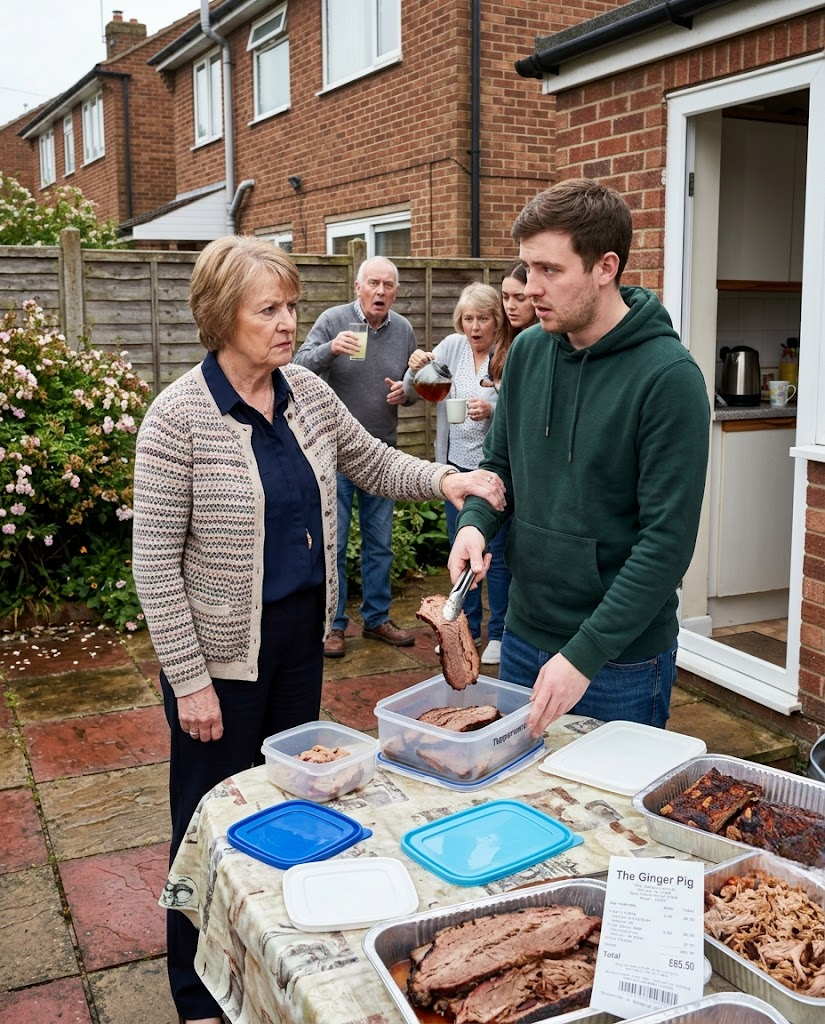
Plastic containers came out one after another.
Large ones.
Small ones.
Deep ones.
The sort people use when they have planned meals for the week.
Stella laid out lids with the neatness of someone setting up a business transaction.
Still nobody spoke.
It is strange how silence can arrive in stages.
First, the conversation thins.
Then one person notices.
Then everyone notices that everyone else has noticed.
Tom stood by the grill with his hand still on the handle.
Erica had lifted the jug of tea and frozen halfway to a glass.
Louisa’s fork hovered just above her plate.
I watched my son pick up the serving tongs.
I watched him reach for the brisket.
Not the end pieces.
Not a modest serving.
The best slices.
He placed them into Rachel’s container.
Then he reached for the steak.
Something inside me went very still.
Not angry in the hot way.
Not loud.
Clear.
For years, I had mistaken peacekeeping for kindness.
I had let little things pass because they were little.
A comment about the house.
A cancelled visit.
A joke at my expense.
A look across a table.
But little things gather weight when nobody ever puts them down.
And there, in my back garden, my only son was packing away food I had bought with my money, cooked with my hands, and offered to everyone present.
Not food I had offered them to take.
Food they had simply decided belonged to them.
Rachel watched him approvingly.
Stella held another lid ready.
My mother’s tablecloth was covered in plastic tubs.
The butcher’s receipt was still inside on the kitchen worktop, almost £250 printed plainly at the bottom.
I thought of the card tapping against the reader.
I thought of the morning steam on the windows.
I thought of Tom standing in drizzle to get the grill right.
I thought of Julian as a boy, carrying shopping bags that were too heavy for him because he wanted to help.
And I wondered when he had learned to carry things away instead.
I stepped towards the table.
Nobody stopped me.
Julian did not look up until my shadow crossed the containers.
When he finally raised his eyes, I saw that he already knew.
That was what hurt.
He knew before I spoke.
He knew this was wrong.
He had always known.
He had simply been hoping I would swallow it, the way I had swallowed so much else.
Rachel’s smile sharpened.
“Betty?” she said.
That one word carried warning, mockery, and a dare.
I placed one hand on the edge of the table.
My fingers were steady.
The whole garden seemed to narrow to the tongs in Julian’s hand, the meat in the plastic container, and the faces watching from around the table.
There are moments when a family changes shape.
Not because someone shouts.
Not because a plate breaks.
But because one person finally refuses to keep pretending not to see what everyone else can see.
I looked at the containers.
I looked at my son.
Then I said the three words that made the entire back garden fall silent.
“Put it back.”
Julian froze.
The tongs hovered in his hand.
A strip of brisket slid slightly and fell back against the pile with a soft, awful sound.
Rachel blinked as if I had spoken in another language.
Stella’s lips parted.
Tom did not move, but I felt him behind me like a wall.
“What did you say?” Rachel asked.
Her tone was light, but her eyes had hardened.
I did not raise my voice.
I had spent too many years thinking volume was power.
It is not.
Sometimes power is saying the plain thing plainly.
“I said, put it back.”
Julian looked down at the container.
Then at Rachel.
Then at me.
For a moment, my son was not a husband, not a grown man trying to keep the peace, not someone caught between two women at a garden table.
He was the boy who knew he had disappointed his mother.
Rachel laughed once.
It was a small, brittle laugh.
“Betty, don’t be ridiculous. It’s only food.”
“No,” I said.
That single word seemed to land harder than the first three.
Rachel’s face changed.
I could see her trying to decide whether to be offended, amused, or wounded.
Stella chose wounded for her.
“We were only trying to help,” Stella said.
“Help who?” Louisa murmured.
Nobody had expected Louisa to speak.
Her voice was quiet, but the question sat there beautifully.
Help who?
Rachel looked at Julian again.
He still had the tongs in his hand.
I watched his fingers tighten around them.
“Julian,” she said.
Just his name.
An instruction disguised as a plea.
He closed his eyes for half a second.
Then he opened them and put the tongs down.
Not into the meat.
Onto the table.
Rachel stared at him.
The silence became something larger.
Erica slowly lowered the jug of tea.
Tom finally stepped closer, his old jacket smelling of smoke.
He did not shout either.
He simply looked at our son and said, “You heard your mother.”
Those words seemed to take the last bit of air out of Rachel’s performance.
She reached for the nearest lid.
“We can leave,” she said.
It was meant to sound dignified.
It came out too fast.
Stella began gathering containers with sharp little movements.
But Erica had gone into the house.
At first, I thought she had removed herself from the embarrassment.
Then she came back through the kitchen door with a small white slip in her hand.
The butcher’s receipt.
I had left it near the kettle.
She placed it flat on the table beside the open container.
Nobody needed to read the shop name.
Nobody needed details.
The total was enough.
Almost £250.
Rachel glanced down.
For the first time all afternoon, she had no ready sentence.
Stella’s hand stopped halfway into the canvas bag.
Julian looked at the receipt as though it were evidence in a case he had already lost.
I did not enjoy that moment.
People might imagine I felt triumphant.
I did not.
I felt tired.
I felt sad.
And beneath both, I felt a small, clean relief.
Because the truth had finally become visible.
Not dramatic.
Not complicated.
Visible.
Rachel had not seen a family meal.
She had seen surplus.
Stella had not seen hospitality.
She had seen an opportunity.
And Julian had not seen his mother.
He had seen someone who would probably let it happen.
That was the part I could not forgive quickly.
Rachel straightened.
“If you were worried about money, you could have said.”
It was a clever sentence.
Cruel, too.
It tried to turn greed into my embarrassment.
Before I could answer, Tom did.
“We are not worried about money,” he said. “We are worried about manners.”
A flush crept up Rachel’s neck.
Stella snapped a lid onto an empty tub.
The sound made everyone flinch.
Julian finally spoke.
“Mum,” he said.
One word.
Not an apology.
Not yet.
But not an excuse either.
I looked at him and waited.
He swallowed.
“I should have asked.”
Rachel turned on him instantly.
“Are you serious?”
He did not answer her.
That was the first small miracle of the afternoon.
He looked at me.
“I should have asked,” he said again.
There are apologies that repair.
There are apologies that only admit the crack exists.
This was the second kind.
But even that was more than I had expected when I saw him lift the tongs.
I nodded once.
“Put it back,” I said again, softer this time.
Julian began removing the meat from the containers.
Piece by piece.
It was awkward.
Humiliating.
Necessary.
Rachel stood so quickly her chair scraped against the paving.
“We are not staying to be insulted.”
Nobody asked her to.
That was another silence she had not prepared for.
Stella gathered the empty tubs with trembling hands.
A few lids slipped and scattered across the tablecloth.
Louisa bent as if to help, then seemed to think better of it and sat back.
Rachel looked around the garden, searching for someone to soften the moment.
Erica looked at the receipt.
Tom looked at Julian.
I looked at Rachel.
For years, I had been polite because I feared what would happen if I stopped.
Now I saw what happened.
People had to answer for themselves.
Rachel picked up one bag.
Stella took the other.
Julian did not move.
Rachel noticed after three steps.
“Julian.”
Again, his name as an order.
He looked at her, then at the table.
Then at me.
“I’ll be out in a minute,” he said.
Rachel’s face went still.
Stella touched her daughter’s arm, but Rachel shook her off.
“You are choosing this?” she asked.
The question was unfair before it was even finished.
This was not a choice between wife and mother.
It was a choice between truth and cowardice.
Julian’s voice was barely above a whisper.
“I am choosing not to steal Sunday lunch from my parents.”
Nobody breathed.
Rachel’s eyes filled, but not with sadness.
With fury.
She turned and walked through the house, Stella behind her, the plastic containers rattling in their bags like an accusation.
The front door closed harder than necessary.
Only then did the garden exhale.
Julian sat down.
He looked smaller somehow.
Not younger.
Just stripped of whatever performance he had been wearing.
“I’m sorry,” he said.
This time, it was the right shape.
I wanted to forgive him immediately.
Mothers are foolish that way.
We hear sorry and start reaching for a plate.
But love without a boundary becomes a place where everyone wipes their feet.
So I did not rush.
I sat opposite him.
Tom stayed standing behind my chair.
The receipt lay between us.
The meat, returned to the tray, no longer looked like a feast.
It looked like proof.
“You embarrassed me,” Julian said quietly.
I almost laughed.
Not because it was funny.
Because the old Betty would have apologised for that.
The old Betty would have said she was sorry for making things awkward.
The old Betty would have packed two polite containers herself and sent him home with extra bread.
But the woman sitting there now had seen enough.
“No,” I said. “You embarrassed yourself. I simply stopped helping.”
His eyes shone.
He nodded.
Across the table, Erica reached for my hand and squeezed it once.
Louisa began clearing plates without a word, because sometimes practical kindness is the only kind that does not make a person cry.
Tom picked up the tongs and, with great ceremony, placed a modest portion of brisket onto a clean plate.
“For Erica,” he said.
Then another.
“For Louisa.”
Then he looked at Julian.
“And if your mother offers you some to take home, you say thank you.”
Julian managed a broken little smile.
“I will.”
I did give him some in the end.
Not because Rachel expected it.
Not because Stella had brought containers.
Because I chose to.
One plate.
Wrapped properly.
Enough for him.
Not enough to reward the performance that had nearly happened in my garden.
When he left, he hugged me longer than usual.
At the door, he said, “I forgot how to say no.”
I touched his cheek.
“Then start practising.”
After everyone had gone, Tom and I stood in the kitchen among the plates, the tea mugs, the foil, and the smell of smoke clinging to our clothes.
The house was quiet again.
Too quiet at first.
Then Tom put the kettle on.
Of course he did.
It clicked and hummed, ordinary as breathing.
He looked at me and said, “You all right?”
I thought about saying I was fine.
That old, automatic answer.
Instead, I looked out at the garden table, where a few plastic lids had been forgotten near my mother’s tablecloth.
“No,” I said. “But I will be.”
And I meant it.
Because that day, I learned something I should have known years earlier.
A full table is a beautiful thing.
But it is not love if everyone is allowed to take and nobody is expected to respect the hands that prepared it.
The next Sunday, I cooked less.
Not because my heart had shrunk.
Because it had finally grown a door.