The Night a Grandmother’s Secret Reached a Newborn’s Hospital Bed-jeslyn_

By sunrise, the hospital room smelled like sanitizer, plastic tubing, and coffee that had gone cold in a paper cup on the windowsill.
The pediatric ICU was too bright for grief.
The white walls reflected every fluorescent panel, every flash of the monitor, every little movement around the bed where my one-month-old daughter, Lily, lay still beneath a sheet that looked too large for her body.
The machine beside her kept beeping.
At first, I heard it as a sound.
Then I heard it as a countdown.
Beep.
Beep.
Beep.
Each note landed in my chest like something being taken away in pieces.
Mark stood near the window with both hands on the sill, staring down at the hospital parking lot.
It was early enough that the sky was still gray, and the cars below had dew across their windshields.
His hoodie was wrinkled, his jaw was tight, and he kept rubbing his face with one hand as though the last several hours were something sticky he could wipe away.
He had not sat down once.
I had been sitting too long.
My legs had gone numb in the hard plastic chair, and my hands were folded in my lap the way people fold them at funerals when they do not know what else to do with them.
My wedding ring felt wrong on my finger.
Too tight.
Too heavy.
Like every promise inside it had become a question I could not answer.
In the corner, my mother-in-law, Brenda Evans, sat with her ankles crossed and her purse tucked neatly beside her chair.
Her cardigan was buttoned.
Her hair was smoothed down.
She looked pale, composed, and wounded in the exact way that made strangers move toward her with sympathy.
That was Brenda’s gift.
She could perform pain well enough to make everyone forget to ask who had caused it.
I had known her for seven years.
I had watched her turn criticism into concern and control into tradition.
She said she was blunt.
She said she was old-fashioned.
She said younger mothers were too sensitive, young wives were too dramatic, and babies were not made of glass.
For most of my marriage, I tried to keep the peace because Mark seemed to need peace more than truth.
When Brenda corrected the way I folded towels, I smiled.
When she told Mark I was spoiling him because I packed his lunch for work, I laughed it off.
When she arrived after Lily was born and announced that she would stay for a week because I clearly could not handle the baby alone, I swallowed the insult because I was tired and scared and desperate for help.
That was my trust signal.
I opened my home to her.
I gave her access to my baby.
I let her stand in the nursery where Lily’s clean onesies were stacked in a basket, where a soft nightlight glowed near the dresser, where the air still smelled like baby lotion and warm milk.
I did not know I had opened the door to something Mark had spent his whole life surviving.
At 2:18 a.m., Lily started crying.
Not the sharp cry of pain.
Not the choking cry of a child in distress.
Just a hungry, exhausted newborn cry, high and thin and helpless.
I had slept in pieces for days.
My shirt smelled faintly of formula and sweat.
My hair was stuck to my neck.
My hands were shaking from the kind of fatigue that makes simple things feel dangerous.
Mark went downstairs to warm a bottle because he saw me trying not to cry over the kitchen counter.
Brenda stood in the hallway with her arms folded and said, “You two are letting her train you. Babies learn fast.”
I remember saying, “She’s one month old.”
Brenda clicked her tongue.
“Exactly. Start early.”
I should have told her to leave right then.
That sentence will live inside me forever.
Instead, I stepped into the bathroom for less than two minutes to splash cold water on my face.
The tile under my bare feet was cold.
The faucet hissed.
I leaned over the sink and closed my eyes for one breath.
Then Lily cried harder.
Then came the sound.
It was not loud like movie violence.
It was worse than loud.
It was clean.
Flat.
A slap.
My body understood before my mind did.
I ran into the nursery so fast my shoulder hit the doorframe, and the pain barely registered.
Brenda was leaning over the crib.
One hand hovered near the rail.
Lily’s face was red.
Her tiny arm jerked once, then went limp.
For half a second, I could not make the picture make sense.
The crib, the nightlight, the folded blankets, Brenda’s hand, my baby’s face.
Then I screamed, “What did you do?”
Brenda turned toward me annoyed before she looked afraid.
That was the detail that came back later.
Not panic.
Not horror.
Annoyance.
Like I had interrupted her while she was proving a point.
“She wouldn’t stop,” she snapped. “I had to shut her up!”
By the time Mark came upstairs, Lily’s mouth was foaming.
Her lips trembled.
Her eyes rolled in a way that made a sound come out of me I did not recognize.
I picked her up and she felt too light.
Too breakable.
Too human for the violence that had just entered the room.
Mark froze for one second when he saw her, and then everything happened at once.
He grabbed his phone.
I held Lily against my chest.
Brenda kept saying, “I barely touched her. I barely touched her.”
At 2:24 a.m., Mark called 911.
At 2:31 a.m., the ambulance lights flooded our suburban street red and blue.
A small American flag on our neighbor’s porch snapped in the cold wind while two paramedics came up our front walk with bags in their hands.
Brenda stood near the mailbox in her cardigan, telling them she had only tapped the baby.
Tapped.
Some people make words smaller because they hope the truth will become smaller too.
The paramedic did not look convinced.
He asked who had been alone with Lily.
I said, “Her.”
Brenda put her hand to her chest so quickly it looked rehearsed.
“I was helping,” she said.
Nobody answered her.
At the hospital, the doors swallowed Lily before I could kiss her forehead.
Nurses moved fast.
Doctors moved faster.
Someone wrapped a bracelet around my wrist.
Someone else asked me Lily’s full name, date of birth, last feeding, last diaper, any medications, any falls.
A hospital intake form appeared on a clipboard.
Then a resident asked, very carefully, whether anyone else had been alone with her.
I turned my head toward Brenda.
Brenda’s eyes filled with tears on cue.
“This is insane,” she whispered. “I was trying to help. These first-time mothers panic over everything. The baby was fine when I picked her up.”
Fine.
I hated that word.
I hated how clean it sounded.
I hated how many terrible things people try to hide behind it.
Because Lily was not fine under the ER lights.
There was a faint bruise high on her upper arm.
There was a shadow below her jaw.
There were small marks that did not belong on skin that had only been in this world for one month.
A nurse saw them.
The doctor saw them.
I saw them.
And before my mind could name what I was feeling, my body recognized them.
Not from Lily.
From Mark.
The first time I noticed the old marks on him was three years into our marriage.
He was changing shirts in our bedroom, and I saw a faded outline near his shoulder, then small crescent marks along his upper arm.
I asked what had happened.
He laughed too quickly.
“I was clumsy as a kid,” he said.
Then he changed the subject.
The second time was harder to dismiss.
He woke from a nightmare and flinched when I touched his face too fast.
Half asleep, he whispered, “Don’t cry. She hates when kids cry.”
I lay beside him in the dark, wide awake.
In the morning, he said he did not remember saying it.
I wanted to ask more.
I did not.
Marriage teaches you many things, and one of the cruelest is how often love mistakes silence for kindness.
I thought I was protecting him.
Maybe I was only protecting the lie that his childhood had ended.
At 5:12 a.m., a social worker came into the waiting area with a folder against her chest.
She introduced herself softly.
She asked the same questions again, slower this time.
Who had been in the home?
Who had handled the baby?
Had Brenda ever cared for Lily alone before?
Had there been any previous concerns?
I answered each question while Mark stood near the vending machines, looking like his bones had gone hollow.
Brenda interrupted twice.
The social worker did not write down Brenda’s interruptions.
She wrote down my answers.
That mattered.
The hospital chart mattered.
The intake form mattered.
The nurse’s notes mattered.
The police report that came later would matter.
At the time, all I knew was that people had stopped treating Brenda like a grieving grandmother and started treating her like a fact they needed to verify.
At 6:41 a.m., the doctor came into the pediatric ICU.
He carried a chart tucked against his chest.
His face told me before his mouth did.
He did not walk like someone bringing rescue.
He walked like someone carrying a sentence he hated having to deliver.
He looked first at the monitor.
Then at the nurse.
Then at me.
“Mrs. Evans,” he said.
Not Mark.
Me.
It was a small thing, and I understood it instantly.
He knew I was the one still holding the room upright.
“We did everything we could,” he said.
The words were gentle and useless.
They were arranged like furniture in a room built for tragedy.
My hands went cold.
Then my arms.
Then the center of my chest.
“Your daughter is already gone. I’m so sorry.”
The monitor flattened into one long, merciless tone.
Mark made a sound that did not belong to language.
It was low and torn and animal.
He gripped the window ledge with both hands, and his shoulders folded forward as if something had struck him from behind.
Brenda gasped next.
It was loud.
It was dramatic.
It was perfect.
“What?” she cried. “You’re joking, right? No. No, that can’t be right. Oh my God. My sweet baby. My Lily.”
A nurse stepped toward her automatically.
That is what Brenda counted on.
People had always stepped toward her.
They steadied her.
They soothed her.
They believed her tears before they believed anyone else’s fear.
I did not move.
I stared at Lily’s hand on the white sheet.
That tiny hand should have been curling around my finger.
It should have been grabbing at soft blankets.
It should have been flailing during diaper changes and touching my chin in the dark.
It should not have been still.
Grief should have filled the room by itself.
But grief had to share space with recognition.
I turned toward Mark.
He was looking at Lily’s marks.
Then he looked at his mother.
Something changed in his face.
It was not surprise.
It was not confusion.
It was the look of a grown man seeing the monster from his childhood standing beside his daughter’s hospital bed.
Brenda saw it too.
Her crying stopped too fast.
Her eyes moved from me to Mark and back again.
Measuring.
Calculating.
Choosing the next performance.
Then she lowered her voice and said, “This was an accident. Don’t destroy your family over one terrible moment.”
One terrible moment.
As if Lily had been a glass bowl knocked from a counter.
As if a baby’s life could be softened into a phrase and tucked away before the social worker came back.
I stood up so fast my chair scraped across the tile.
The nurse turned.
Mark finally looked away from the bed.
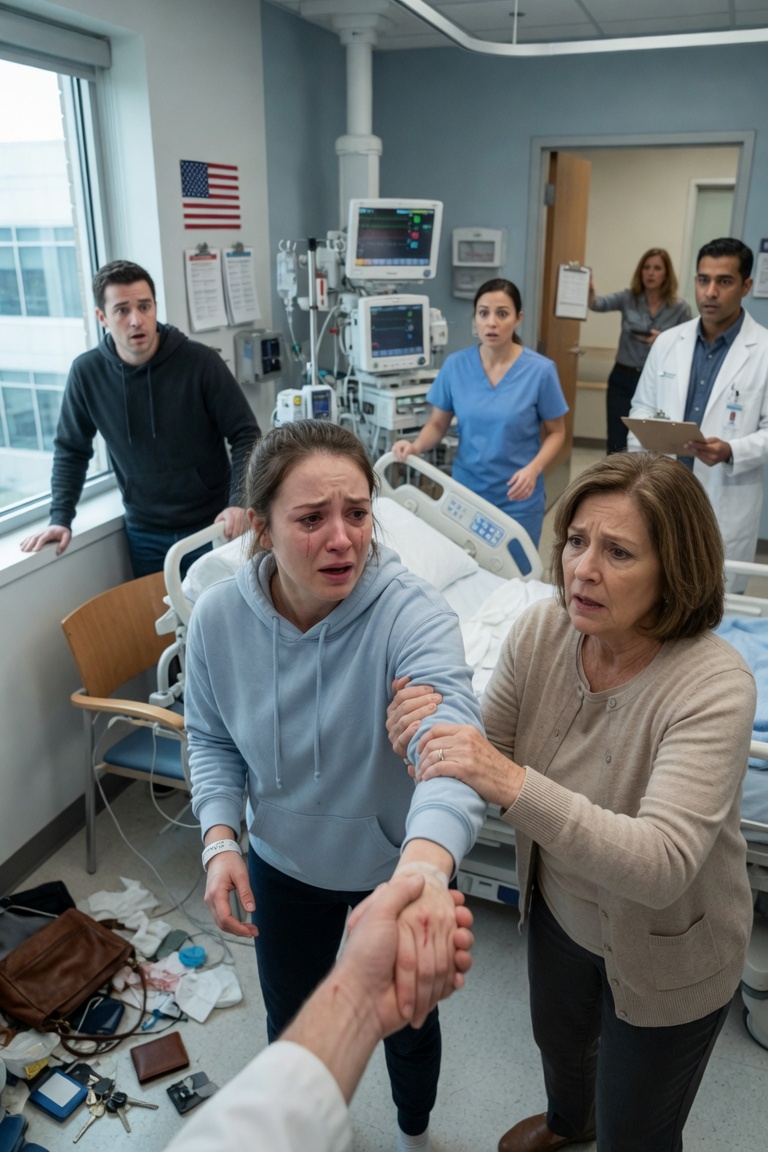
Brenda reached for my wrist.
Maybe she meant to calm me.
Maybe she meant to control me.
Maybe she simply believed her hand was still allowed to decide what happened next.
I yanked away.
That was when I saw it.
A faint red line across her knuckle.
It was small.
It was almost nothing.
But some evidence does not need to be large to become impossible to unsee.
Her hand had been over Lily’s crib.
Her hand had made Mark go silent in rooms where he should have been safe.
Her hand had taught him, before I ever met him, that crying only made things worse.
I looked at Mark.
He looked at Brenda.
Then he whispered, “She used to do it to me.”
The words barely crossed the room.
Still, they changed everything.
Brenda stood so fast her purse tipped over and spilled tissues, a phone charger, and a folded visitor badge onto the floor.
“Mark,” she hissed. “You are grieving. You don’t know what you’re saying.”
He did not look at her face.
He looked at her hand.
“You hated crying,” he said.
Brenda shook her head.
“Stop.”
“You hated it,” he repeated.
His voice was not loud.
That made it worse.
It sounded like a child reporting weather.
Plain.
Old.
True.
The nurse stepped closer to Lily’s bed.
The doctor stayed near the doorway.
Nobody told Mark to stop talking.
For the first time in his life, there were witnesses who did not belong to Brenda.
He said she used to put her hand over his mouth when he cried.
He said she slapped his arms because bruises there were easier to explain.
He said she told him no one liked weak boys.
He said his father traveled for work and believed whatever version she gave him.
Each sentence seemed to make him smaller and taller at the same time.
Smaller because he was back there.
Taller because he was finally leaving.
Brenda’s face hardened.
The grieving grandmother disappeared.
Underneath was the woman I had heard in the nursery.
“I raised you,” she said.
Mark’s eyes filled with tears.
“You scared me quiet. That’s not the same thing.”
The social worker came back then with a clipboard.
Behind her stood a hospital security officer.
The top page on the clipboard was labeled INFANT INJURY REPORT.
Brenda saw it.
Her mouth opened, but no sound came out.
The social worker asked Brenda to step into the hallway.
Brenda looked at Mark as if he were betraying her.
That was the final cruelty.
Even then, standing beside the bed of the granddaughter she had hurt, she believed she was the one being wronged.
Mark did not move toward her.
He did not defend her.
He did not translate her anger into something softer.
He just said, “No.”
One word.
It cost him thirty-three years.
Security guided Brenda into the hallway.
She kept looking back, first at Mark, then at me, then at Lily’s bed.
Not with remorse.
With outrage.
The police came later.
There were statements.
There were photographs.
There was a medical examiner.
There was a report with times, observations, injuries, and names typed in black ink.
I learned how grief becomes paperwork because the world needs boxes checked before it can call a thing by its real name.
At 8:03 a.m., Mark gave his first statement.
He told the officer what he remembered from childhood.
Not all of it.
Not yet.
Enough.
His hands shook so badly the officer gave him a cup of water.
He held it without drinking.
I sat beside him and kept one hand on his knee because I did not know how else to tell him he had not failed Lily by being afraid of his mother for so long.
Fear is not loyalty.
Silence is not consent.
A child learns survival before he ever learns justice.
The days after Lily died blurred into phone calls, funeral arrangements, and the unbearable smallness of her things.
A package of diapers sat unopened in the hallway.
A bottle still waited in the refrigerator.
Her onesies came out of the dryer soft and warm, and I sank to the laundry room floor because there was no baby left to put them on.
Mark found me there and sat beside me without speaking.
For once, silence did not feel like hiding.
It felt like staying.
Brenda was charged after the investigation was completed.
I will not pretend the process was clean or quick.
Nothing about losing a child becomes clean because a document is filed.
There were interviews.
There were family members who called Mark and told him not to ruin his mother’s life.
He stopped answering after the third call.
One aunt left a voicemail saying Brenda had always been strict but never cruel.
Mark listened to it once.
Then he deleted it.
“They knew,” he said.
I did not ask him how he knew.
His face was answer enough.
Months later, in a family court hallway during a related hearing over protective orders and contact, Mark stood beside me under a wall-mounted American flag and did not shake when Brenda was brought in.
She looked smaller than I remembered.
Not weaker.
Just exposed.
There is a difference.
When she saw Mark, she tried one last time.
“You know me,” she said.
He looked at her for a long moment.
“Yes,” he answered. “I finally do.”
That was the first time I saw her confidence drain instead of rearrange itself.
The full criminal case took longer than anyone wants to hear.
The hospital records mattered.
The injury report mattered.
The statements mattered.
Mark’s testimony mattered too, not because the past was on trial by itself, but because patterns leave fingerprints even when decades pass.
When the prosecutor asked him why he had not spoken sooner, Mark looked down at his hands.
Then he said, “Because she taught me that crying made things worse.”
The courtroom went quiet.
Not dramatic quiet.
Human quiet.
The kind that happens when people understand they are hearing the sentence that shaped someone’s whole life.
Brenda did not look at him.
She looked at the table.
I thought about Lily then.
I thought about her tiny hand on the hospital sheet.
I thought about all the rooms where Mark had been a little boy with nobody stepping between him and the hand that taught him fear.
And I understood something I wish I had never needed to learn.
A family secret does not stay buried because it is harmless.
It stays buried because too many people benefit from the quiet.
Lily’s life was not a lesson.
I hate when people say that about the dead, especially children.
She was not sent here to teach us anything.
She was my daughter.
She was warm milk on cotton burp cloths, tiny fingers, soft breathing against my chest, and one month of love that should have become a lifetime.
But what happened to her tore open the locked room Mark had been carrying inside himself.
It forced the truth into light.
It made witnesses out of people who would have preferred to remain polite.
It made documents out of whispers.
It made the word discipline collapse under the weight of what Brenda had really done.
Years later, I still hear monitors in grocery store scanners sometimes.
I still smell hospital sanitizer and feel my body go cold.
Mark still has nights where he wakes up before he knows why.
But now, when he reaches for me, he does not apologize for being afraid.
He speaks.
That matters.
We keep Lily’s photo on a small shelf near the front window.
Beside it is the hospital bracelet they gave me, sealed in a clear box because I could not bear to touch it and could not bear to throw it away.
On her birthday, we put fresh flowers there.
No speeches.
No grand meaning.
Just flowers, a candle, and the truth.
My daughter should have been wrapping her hand around my finger.
She should have been smearing milk on onesies and reaching for my face in the dark.
She should have had a life louder than anyone’s anger.
Instead, the room went silent because one woman believed crying was something to punish.
And the silence that protected Brenda for decades finally ended beside a hospital bed, with a red mark across her knuckle and my husband saying what no one in his family had ever wanted spoken aloud.
She used to do it to me.
That was where the lie broke.
Not in a shouting match.
Not in a perfect courtroom moment.
In a bright ICU room that smelled like sanitizer and cold coffee, beside the smallest body in the world, while a mother, a father, a nurse, a doctor, and a social worker finally saw the same truth at the same time.
Lily had not just been left with an impatient grandmother.
She had been left with a woman who had done this before.
And this time, nobody looked away.