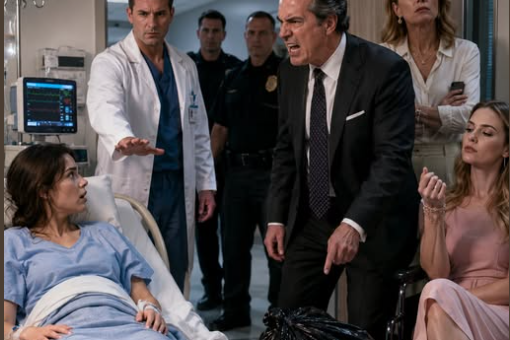
After a devastating car accident, I was rushed to the hospital. My husband burst into my room, furious.

- Part 1: Twenty-One Days
- Part 2: The Word That Changed Everything
- Part 3: Learning What Safe Really Means
Part 1: Twenty-One Days
Rebecca Walker became familiar with the rhythm of the hospital room long before she learned how to rest inside it. Every few seconds the heart monitor beeped beside her bed, the air vent clicked overhead, and the fluorescent light hummed softly through the quiet nights. Both of her legs were trapped in heavy plaster casts, her ribs ached with every breath, stitches hid beneath her hair, and bruises still marked her body from the crash that had shattered her life three weeks earlier.
The accident itself remained a blur of hot pavement, broken glass, and distant sirens. Rebecca could still remember someone begging her not to move before she instinctively asked for her husband, Caleb. It was the kind of thing wives did when their world fell apart. They reached for the person they believed would help hold the pieces together.
During those twenty-one days in the hospital, Caleb visited only when he felt obligated. Once he brought their thirteen-year-old daughter, Emma, who quietly held Rebecca’s hand as though she feared letting go might make her mother disappear. Another time he arrived carrying insurance paperwork, complaining that the hospital kept calling him about payments instead of asking how Rebecca was recovering.
One evening he came after Rebecca had already taken pain medication. Rather than asking whether she was frightened or how much pain she was in, he wanted to know whether she understood how expensive her hospital stay had become. He never brought flowers, comfortable socks, or even the lip balm she always kept at home. He brought numbers, bills, and complaints instead.
The man Rebecca married eleven years earlier hadn’t seemed cruel in the beginning. He had simply seemed practical. He managed money carefully, organized every schedule, and approached emotions with the same cold efficiency. At the time, she mistook that practicality for reliability, never realizing how dangerous it could become once kindness disappeared from it.
After Emma was born, Caleb convinced Rebecca to leave her accounting career so one parent could stay home with their daughter. His arguments sounded perfectly reasonable, and because trust often disguises itself as logic inside a marriage, she believed him without hesitation.
From then on, Rebecca devoted herself entirely to their family. She packed lunches before sunrise, managed every household bill from the kitchen table, answered school emails, waited in pickup lines, and stretched grocery money carefully enough that Emma never noticed how often her mother quietly went without.
At first Caleb appreciated everything she did. Gradually, appreciation turned into expectation, and expectation became entitlement until he behaved as though the house simply cared for itself. Rebecca spent years confusing peacekeeping with love, never realizing she had slowly become invisible inside her own home. Only later did she understand that everyone noticed the furniture only after it stopped moving.
She didn’t recognize the truth all at once. Instead, it arrived in quiet moments, through the sighs whenever she asked Caleb for help, the way he dismissed her tears as being dramatic after his mother insulted her, and the constant reminders that his paycheck supposedly kept the family alive. Somehow, her sacrifice of an entire career never counted as contributing to the household they had built together.
By the time the accident happened, Rebecca had already learned which conversations to avoid and which silences kept the peace for one more evening. But hospitals have a way of stripping away everyday distractions until all that remains are white walls, beeping machines, and the people who choose whether or not to stand beside you when you can no longer stand for yourself.
On the twenty-first day, Caleb arrived alone.
The door swung open hard enough to strike the wall. Rebecca looked up, remembering that Emma had asked him to bring flowers, but instead she saw him step inside wearing neatly pressed clothes and an expression so cold it seemed to lower the temperature of the room. He quietly closed the door behind him, and before Rebecca could even greet him, he spoke.
“Stop this drama.”
Part 2: The Word That Changed Everything
Rebecca stared at Caleb, convinced she had misunderstood him. The medication still clouded her thoughts, and for a fleeting moment she imagined he was making some cruel joke.
“What?”
“Get up,” he said. “We’re leaving.”
She looked down at the thick casts covering both of her legs before meeting his eyes again.
“Caleb, I can’t.”
“Don’t start.”
“My legs are broken.”
“I heard the doctors.”
Caleb leaned over the bed rail until Rebecca could smell the mint gum on his breath.
“I also heard the hospital intake desk ask about payment again,” he said. “I’m done wasting money on this performance.”
The word performance struck harder than she expected. Rebecca looked down at the hospital gown covering her bruised body, the IV taped to her swollen hand, and the chart outside the room that clearly identified her as a patient. She wasn’t pretending. She wasn’t a burden. She wasn’t simply another unpaid bill waiting to be cleared.
For the first time in years, she answered him instead of swallowing the pain.
“I gave up everything for this family,” she said quietly. “You are my husband. You’re supposed to help me.”
Caleb’s face changed, but not with guilt. It was irritation, the kind that appeared whenever she dared to speak the truth he preferred to ignore.
“Help you?” he replied. “You’re a burden.”
Those three words echoed through every year of their marriage. Rebecca suddenly remembered the lunches she packed before sunrise, the school forms she completed, the sleepless nights caring for a sick child while Caleb rested because he had work the next morning. She remembered every time she had chosen silence because keeping the peace seemed safer than defending herself.
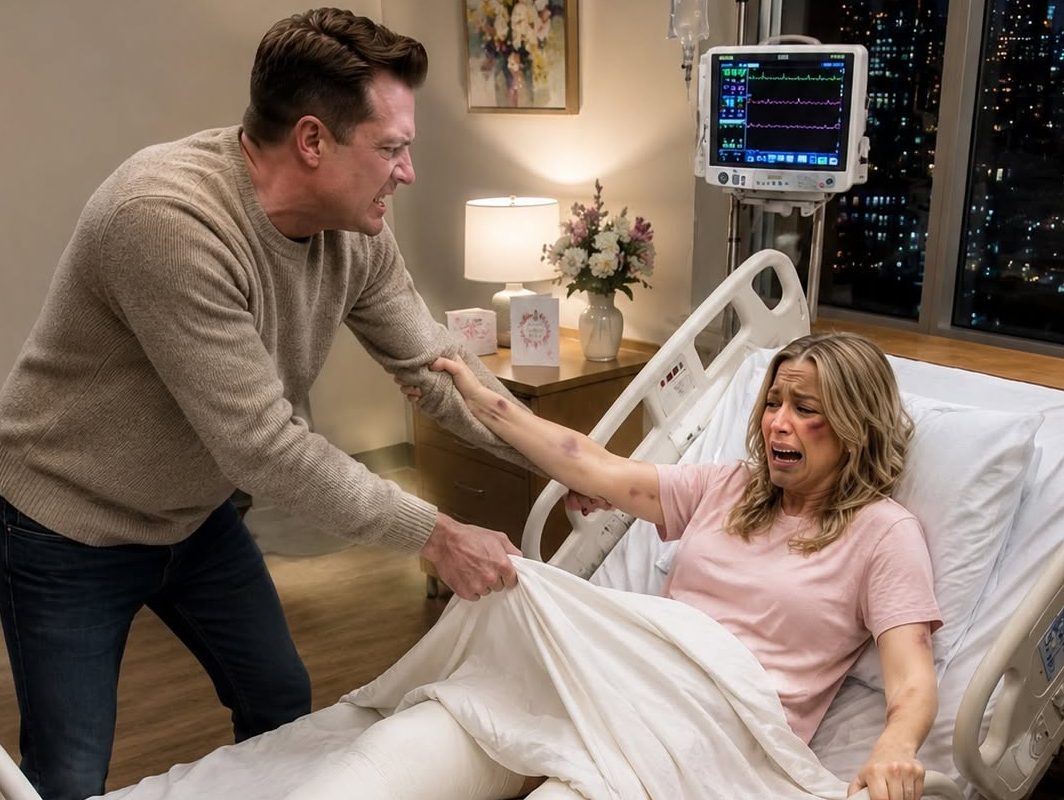
Without another word, Caleb grabbed the blanket and yanked it away, exposing her casts and the thin hospital gown. Then he seized her upper arm and pulled hard enough to send sharp pain through her ribs.
“Caleb, stop.”
He ignored her completely.
The casts scraped across the mattress as he dragged her toward the edge of the bed. The heart monitor beside her immediately changed rhythm, its steady beeps becoming rapid, frantic alarms.
“Get out of that bed,” Caleb hissed. “I’m not paying for a wife who can’t even be useful.”
Something inside Rebecca refused to break.
It wasn’t courage in the dramatic sense people often describe later. It was smaller than that, quieter than that. It was simply the last untouched part of herself refusing to be treated like another piece of furniture inside Caleb’s house.
She gripped the metal bed rail with both hands.
“No.”
For a split second, Caleb looked genuinely shocked.
Then he slammed both fists into her stomach.
Pain exploded through Rebecca’s body, stealing every breath from her lungs. She folded forward as far as the casts allowed while the heart monitor erupted into a shrill alarm. Caleb loomed over her, one hand still twisting the blanket while the other lifted again.
“You don’t get to talk back to me,” he said. “Do you understand?”
Rebecca barely heard him anymore. Through the haze of pain, she stared toward the open hallway where life continued as though nothing extraordinary was happening. A cart rolled past, nurses laughed somewhere near the station, and a telephone rang in the distance while her entire world narrowed to the shadow standing over her bed.
Then, just before Caleb’s hand could fall again, the silver door handle turned.
The door opened.
A nurse in navy scrubs stood frozen in the doorway with one hand still gripping the handle. Behind her, the charge nurse stepped into the room carrying a clipboard, and for one long second, nobody moved except the monitor, whose alarm continued screaming through the silence.
Part 3: Learning What Safe Really Means
Hospital security escorted Caleb out of the room while he continued insisting Rebecca was confused. He repeated the same excuse to every nurse and security officer who crossed his path, but this time no one accepted it. Before disappearing down the hallway, he turned back one last time and shouted,
“You’ll regret this when the bills come.”
Rebecca closed her eyes. For the first time in years, she let his words pass without answering.
The hospital moved quickly once the attack had been witnessed. Doctors examined Rebecca for new injuries, nurses carefully documented everything they found, and the charge nurse completed the incident report before her shift ended. A social worker soon arrived with a folder of forms and gently pulled a chair beside Rebecca’s bed, asking questions no one had ever asked during her marriage.
No one asked why she had stayed.
No one asked what she had done to make Caleb angry.
Instead, they asked a much simpler question.
“Do you feel safe?”
Rebecca didn’t know how to answer at first. During eleven years of marriage, safe had come to mean avoiding arguments, keeping Emma asleep before Caleb came home irritated, and never asking for anything that might make him sigh. Lying in that hospital bed, she realized safety was supposed to mean far more than a quiet house.
“Yes,” she answered instinctively before stopping herself.
“No. Not with him.”
The social worker nodded as though both answers made perfect sense. By evening, the incident report had been entered into Rebecca’s medical file, a police officer had taken her statement with the charge nurse present, and Caleb’s name had been permanently removed from the hospital’s visitor list. Every signature, every timestamp, and every page of documentation became something solid she could finally hold onto while the rest of her life shifted beneath her.
The hardest conversation came when she called Emma. Their thirteen-year-old daughter answered almost immediately.
“Mom? Dad said you were being dramatic and he had to come home.”
Rebecca stared at the blanket covering her legs. There was that word again. Dramatic. The label Caleb had always used whenever her pain became inconvenient.
“Sweetheart,” she said gently, “I need you to listen to me. I’m safe. I’m at the hospital. But your dad is not allowed to visit me right now.”
Emma fell silent.
“What did he do?”
Rebecca closed her eyes while the social worker quietly encouraged her to keep speaking.
“He hurt me,” she said. “And people saw enough to help.”
A sound escaped Emma that Rebecca had never heard before, somewhere between a sob and a gasp.
“He yells when you’re not home,” Emma whispered.
Rebecca’s heart sank.
“What?”
“He yells at the kitchen… at your chair… at the bills… and at me if I ask when you’re coming home.”
In that instant, Rebecca understood something she had spent years refusing to see. Caleb hadn’t become cruel after the accident. The accident had simply removed the one person who had always softened his anger before it reached their daughter.
The following morning, Rebecca signed every form placed in front of her with trembling hands. She removed Caleb as her emergency contact, named her sister instead, and requested copies of the incident report, nursing notes, visitor logs, and every medical record connected to the assault. She had no idea how she would pay the bills, where she and Emma would live, or how long recovery would take.
But she knew one thing with complete certainty.
She was finished protecting Caleb from the truth.
Recovery came slowly. Physical therapy left her in tears, simple movements felt impossible, and every small improvement demanded patience she didn’t know she possessed. Throughout it all, Emma stayed close, bringing homework to the hospital and pretending not to notice each time her mother winced in pain. Meanwhile, the hospital social worker helped Rebecca build a safe plan for the future instead of simply sending her back to the life she had escaped.
Months later, Rebecca stood inside a family courtroom with a walker, a thick folder of hospital records, and her sister beside her. Caleb looked smaller than she remembered, not because he had changed, but because he no longer had a closed door, an injured wife, or years of silence protecting him. His attorney argued that everything had been misunderstood, but the judge quietly read the nursing notes, the visitor log, and the incident report before making a decision.
The temporary protective order was granted.
Caleb’s contact with Emma was restricted, and all future communication would have to go through approved legal channels. Rebecca didn’t celebrate the ruling. She was simply too exhausted for triumph.
Outside the courtroom, Emma waited beside Rebecca’s sister with a terrible cup of coffee from the courthouse vending machine. It was much too hot and barely drinkable, yet it became one of the kindest gifts Rebecca had ever received.
“Are we going to be okay?” Emma asked.
Rebecca looked into her daughter’s frightened eyes before answering with complete honesty.
“We are going to be honest. That’s where okay starts.”
Life didn’t become perfect after that day, but it slowly became peaceful. The house grew quieter, Rebecca found part-time accounting work she could do from home, and every paycheck reminded her that she was capable of standing on her own again. She taped the confirmation of her very first deposit inside her planner, not because the money solved everything, but because it proved she had begun rebuilding a life that belonged to her.
Nearly a year after the accident, Rebecca drove herself to Emma’s school. Her legs still ached whenever rain rolled in, but as she waited by the curb, she watched her daughter walk toward the car with a smile that wasn’t cautious or forced.
It was simply happy.
Rebecca smiled back, finally understanding the difference between keeping the peace and being loved. Love wasn’t a husband standing over an injured wife and calling her a burden. Love was a nurse who opened a door and refused to look away. Love was a daughter offering bad coffee in a courthouse hallway. Love was finding the strength to sign her own name on the first document that truly protected her.
And she finally understood one more thing.
Sometimes freedom doesn’t begin with a dramatic speech.
Sometimes it begins with a single whispered word from a hospital bed.
“No.”