
He Challenged a Quiet Mom—Then Learned Why She Never Bragged-iwachan

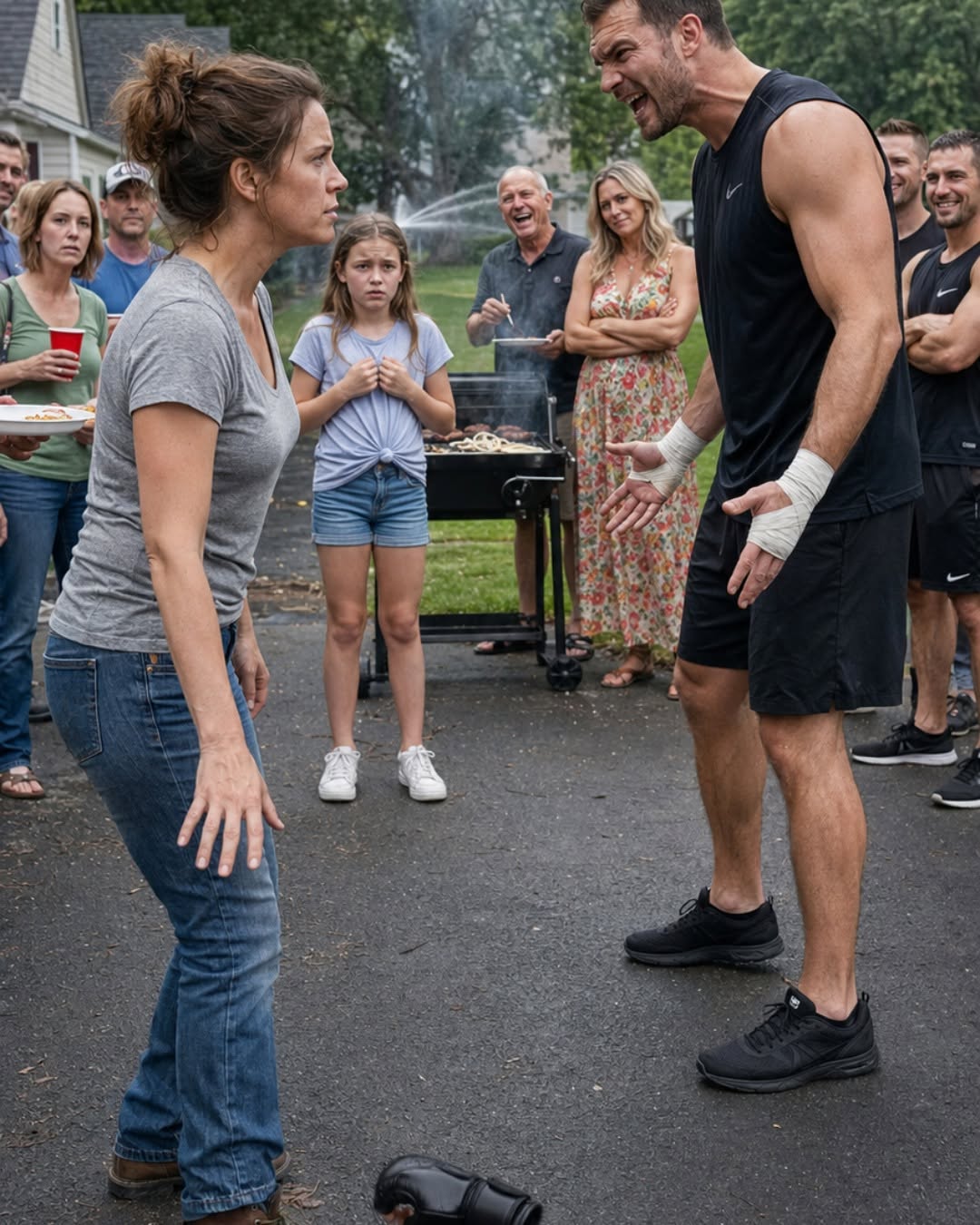
I slid my right hand into the glove, tightened the strap with my teeth, and left the second glove where Travis had thrown it.
His grin widened because he thought picking it up meant I had accepted his challenge.
It didn’t.
“Sophie,” I said without taking my eyes off him, “go stand beside Mr. Palmer.”
My daughter moved immediately, but Travis stepped sideways as if he meant to block her path.
I shifted between them before his boot finished touching the pavement.
The movement was small, but two of the men from his gym stopped smirking.
Travis noticed.
“You going to hide behind your kid now?” he asked.
“No,” I said. “I’m putting myself between my child and the man who just threatened to hospitalize her mother.”
A few people lowered their paper plates.
Grant laughed again, though it sounded thinner this time.
“Everybody heard her agree,” he announced.
The youngest of the four gym men looked at him, then at Travis.
“No, we didn’t,” he said. “You told us she had challenged you.”
Travis turned his head sharply.
“Stay out of it, Owen.”
That single exchange changed the air around us.
Until then, most of the neighbors had probably assumed they were witnessing some ugly family argument that had gotten out of hand.
Now they understood that Travis had invited four fighters to a neighborhood cookout because he expected a woman half his size to be publicly beaten.
I flexed my gloved fingers once.
“I am not agreeing to a fight,” I said clearly. “I am telling you not to come any closer to me or my daughter.”
Travis glanced at the crowd.
He still had a way out.
He could laugh, call the entire thing a joke, and let the afternoon collapse into uncomfortable gossip.
His pride would not let him take it.
He rushed me.
He came in fast for a man his size, right hand reaching for my shoulder while his left arm widened to trap me against his chest.
I stepped outside his lead foot, caught his taped wrist, and turned my hips before his weight could settle.
Momentum did the rest.
Travis hit the grass on his side with a heavy grunt, and I followed him down just far enough to control his wrist and elbow without driving either joint beyond its safe range.
The glove he had given me pressed against the back of his hand.
His face was inches from the lawn.
His free fist dug into the dirt, but he could not get his knees beneath him.
“Stop fighting,” I told him.
He twisted harder.
I tightened the position by less than an inch.
Pain made him slap the grass twice.
I released him immediately and stood.
The entire exchange had taken only a few seconds.
Travis rolled onto his back, breathing hard and staring up at me as if I had violated some law of nature.
I stepped away instead of looming over him.
That mattered to Sophie, and Sophie was the only person there whose opinion I cared about.
Grant charged forward two steps, but Mr. Palmer planted himself between us with his barbecue spatula still in one hand.
“Your son threatened her, then rushed her,” he said. “Don’t make this worse.”
Grant pointed past him at me.
“She attacked Travis.”
“No,” Owen said. “She warned him. We all heard it.”
One of the other gym men nodded reluctantly.
Travis pushed himself upright.
“You knew some trick,” he said. “That’s all.”
“It wasn’t a trick.”
“Then what are you?”
Natalie’s arms were no longer folded.
For the first time that afternoon, she looked uncertain.
I pulled the glove off and dropped it beside its mate.
“I served as a Special Operations major,” I said. “I spent years training for situations where losing control got people killed. What you just experienced was me using the least force necessary to stop you.”
Natalie stared at me.
“A major?”
Grant scoffed.
“She processes paperwork.”
“I do process paperwork now,” I said. “That’s the job I chose after leaving active service.”
Travis climbed to his feet, brushing grass from his shirt.
His gym friends no longer stood behind him.
They had moved several feet to the side, creating a visible gap between themselves and the man they had arrived with.
Travis saw it and turned his anger toward Natalie.
“Tell them,” he said. “Tell them what Claire said about me.”
Natalie looked at the neighbors, then at her husband.
Her mouth opened, but nothing came out.
I already knew there had been a lie.
I just did not know its exact shape.
Three days earlier, Sophie had returned from Natalie’s backyard pale and unusually quiet.
I had waited until we were home before asking what happened.
She told me Travis had grabbed her wrist while demonstrating an escape technique she had not asked to learn.
When she tried to pull away, he laughed and told her she would never survive in the real world if her mother kept raising her soft.
There had been no bruise, but there did not need to be one.
Sophie had said no, and an adult man had treated her fear as entertainment.
I called Natalie that evening and told her Sophie would not return to their house unless I was present.
I had not insulted Travis’s gym.
I had not challenged his ability.
I had set one clear boundary around my child.
Now Travis stood in the middle of the street demanding that my sister repeat whatever story had transformed that boundary into a public fight.
“Natalie,” I said, “what did you tell him?”
She rubbed one hand over the other.
“I told him you thought he was dangerous.”
“I said he was not allowed to put his hands on Sophie again.”
“You made it sound like he attacked her.”
“I told you exactly what she told me.”
Travis stepped closer to his wife.
“Tell them the rest.”
Natalie flinched at his tone.
It was quick enough that some people missed it.
I did not.
Neither did Sophie.
My daughter’s fingers closed around Mr. Palmer’s sleeve.
Natalie looked at me, and I recognized the expression on her face because I had seen it throughout our childhood.
It was the look she wore when she had already chosen the safer person to disappoint.
“I told Travis you said his training was fake,” she admitted. “I said you thought you could handle him because you had military experience.”
A low murmur moved through the crowd.
“You knew that wasn’t true,” I said.
“I was angry.”
“Because I protected my daughter?”
“Because you always act like you know better than everyone.”
There it was.
Not concern for Sophie.
Not a misunderstanding about training.
Natalie had turned my boundary into an insult because telling Travis the truth would have required her to challenge him.
Grant moved beside his son.
“This is family business,” he said. “Everyone should go home.”
Mr. Palmer glanced at the grill, then set the spatula on the side tray.
“This was my cookout,” he said. “You made it everyone’s business when you staged a fight in the street.”
Travis pointed at Owen.
“You came here with me. You know she agreed.”
Owen shook his head.
“You said she had been running her mouth for weeks and wanted to prove she was tougher than you.”
“She did.”
“No,” Natalie said.
The word came out softly, but it stopped Travis more effectively than shouting would have.
He turned toward her.
“What did you say?”
Natalie’s hands trembled at her sides.
“She never agreed to fight you.”
Travis walked toward her until only a few inches separated them.
“You told me she challenged me.”
“I told you she insulted you.”
“That is a challenge.”
“No, Travis. It isn’t.”
The neighbors could finally see what I had missed for years.
Natalie had not merely married into a loud family.
She had learned to manage them by feeding them smaller targets.
When Grant criticized her job, she mentioned my modest salary.
When Travis complained that she was too sensitive, she told him I was the fragile one.
When they mocked her for growing up without money, she reminded them that I still drove an old SUV and bought used furniture.
I had treated those comments as ordinary sibling cruelty.
Standing there, I understood they had served a purpose.
Natalie stayed safe inside her marriage by making sure the Caldwell men always had someone else to look down on.
This time she had used Sophie’s fear to do it.
Travis reached for Natalie’s upper arm.
I stepped forward.
He stopped before touching her.
“Don’t,” I said.
His eyes moved from me to the two gloves on the pavement.
For the first time, calculation replaced rage.
He knew I would intervene.
He also knew everyone would understand why.
Grant tried another approach.
“My son got carried away,” he said. “Claire embarrassed him, and he responded badly. We can settle this privately.”
“You invited forty people,” I said. “There is nothing private about what you did.”
“We invited neighbors to a barbecue.”
“You brought four men from his gym and athletic tape for his hands.”
Grant’s jaw tightened.
The tape mattered because it made his explanation impossible.
Travis had not lost his temper in the moment.
He had prepared for the confrontation.
Owen looked down at Travis’s knuckles, and something in his face hardened.
“You taped up before you came over,” he said.
Travis glared at him.
“So?”
“You told us Claire asked for a demonstration. You said it was friendly.”
Grant stepped between them.
“You boys should leave.”
Owen did not argue.
He turned to the other three men, and together they walked toward the cars parked near the end of the block.
Travis watched them go.
He had expected them to make him look powerful.
Their departure made him look isolated instead.
Sophie finally released Mr. Palmer’s sleeve and came toward me.
I crouched so we were eye level.
“Are you okay?” I asked.
She nodded, but her eyes were wet.
“I thought he was going to hurt you.”
“I know.”
“Were you scared?”
“Yes.”
That answer surprised her.
I could have told her I had faced worse men in worse places.
I could have made myself sound fearless.
Instead, I told her what I wanted her to remember.
“Being scared tells you something matters,” I said. “It doesn’t get to decide what you do next.”
She looked at the gloves.
“You could have hurt him.”
“Yes.”
“But you didn’t.”
“No.”
Behind us, Natalie began crying.
I did not go to her.
For most of my life, her tears had been the signal that I was supposed to forget whatever she had done and help her feel better about it.
This time, the person who needed me was already holding my hand.
Travis told Natalie to get in their SUV.
She did not move.
He repeated himself more loudly.
Grant opened the passenger door and waited as though the decision had already been made for her.
Natalie looked toward their house, then toward mine.
“You made me look like an idiot,” Travis said.
“No,” she replied. “You threatened my sister in front of her child.”
“You started this.”
“I lied to you.”
Grant slammed the SUV door shut.
“Then fix it,” he said.
Natalie wiped her face with both hands.
“I can’t.”
That was the first honest thing she had said all afternoon.
She could not fix Travis’s humiliation without lying again.
She could not repair what she had done to Sophie with an apology delivered for the crowd.
She could not step back into her old role without admitting that the role itself had helped create the scene.
Travis gave her one final order to come with him.
Natalie shook her head.
He and Grant walked back toward the Caldwell property alone.
No one applauded.
Mr. Palmer turned off the grill, and neighbors quietly gathered cups, folding chairs, and abandoned plates from the grass.
The cookout ended the way real disasters often do—not with a grand speech, but with ordinary people cleaning around the place where something ugly had happened.
Natalie remained near the curb.
She asked whether she could come inside my house.
“No,” I said.
Her face folded.
“Claire, please.”
“Sophie needs to feel safe at home.”
“I’m your sister.”
“You were my sister when you told Travis I challenged him.”
“I didn’t know he would go this far.”
“You knew he grabbed Sophie after she told him to stop. You knew he was angry that I set a boundary. Then you gave him a lie that aimed that anger at me.”
Natalie stared at the pavement.
“I thought he would scare you.”
The confession hurt more than I expected.
She had not predicted the exact threat or the gloves, but she had wanted me frightened enough to withdraw the boundary.
She had wanted my daughter to return to a house where her no had already been ignored.
“I’m not letting you near Sophie until she decides she is ready,” I said. “And I will not speak to Travis or Grant without another adult present.”
“You’re cutting me off?”
“I’m setting terms for contact.”
“That’s the same thing.”
“No. Cutting you off would be easier.”
She looked toward Sophie, but my daughter moved closer to me.
Natalie saw it.
For once, I did not soften the consequence for her.
I gave her the number of a nearby hotel from memory, then watched her call for a ride because Travis had taken the family SUV.
She waited on Mr. Palmer’s porch steps while Sophie and I walked home.
Inside, Sophie went straight to the kitchen and filled two glasses with water.
Her hands were still shaking, so I carried them to the table.
For several minutes, we listened to the familiar sounds I had moved there to find: a lawn mower two blocks away, a cabinet closing, the refrigerator motor turning on.
Then Sophie asked why I had never told her I was a major.
I considered giving her the answer I had used with everyone else.
The work was complicated.
Some details were private.
The past did not matter.
But those were only pieces of the truth.
“I didn’t want my old job to become the reason you trusted me,” I said. “I wanted you to trust the mother who packs your lunch and forgets where she leaves her coffee.”
She studied my face.
“Can both be true?”
“Yes.”
“Can I see your medals?”
I led her to the hall closet and pulled the winter blankets from the bottom shelf.
Beneath them sat the fireproof case I had not opened since we moved.
The decorations inside were arranged in plain boxes beside old photographs, unit patches, and folded papers I could show her without exposing anything that still needed to remain private.
Sophie did not react to the medals the way adults often did.
She did not ask how many people I had fought or whether I had ever been shot.
She picked up a photograph of me standing with a tired group of men and women beside a dusty vehicle.
“You look younger,” she said.
“I was.”
“You look mad.”
“We had been awake for a long time.”
She smiled for the first time since the cookout.
Then she pointed to the rank on an old uniform photograph.
“So you really were the boss?”
“Sometimes.”
“Were you good at it?”
“I was good at bringing people home.”
Her smile faded, but not from fear.
She understood that the answer carried weight.
She placed the photograph back carefully.
“Did Aunt Natalie know?”
“She knew I served. She did not know everything.”
“Why not?”
“Because she never asked without turning it into a competition.”
Sophie considered that, then closed the case.
The next morning, Natalie called from the hotel.
I put the phone on speaker only after Sophie said she was comfortable hearing her voice.
Natalie apologized, but her first apology centered on the public scene.
She said she was sorry everything had become so humiliating.
Sophie looked at me and shook her head.
I understood.
“This is not about embarrassment,” I told Natalie. “Tell Sophie what you did.”
There was a long pause.
Then Natalie said, “I told Travis that your mom insulted him because I was angry she would not let you come back to our house.”
Sophie said nothing.
Natalie continued.
“I knew he had grabbed your wrist. I should have protected you. Instead, I acted like you were overreacting because it was easier than confronting him.”
Sophie’s eyes filled again.
“Why didn’t you believe me?” she asked.
“I did believe you.”
That answer was worse.
Sophie looked away from the phone.
Natalie began crying, but my daughter did not comfort her.
“You believed me and still wanted me to go back,” Sophie said.
“Yes.”
“Then I don’t want to talk right now.”
I ended the call.
Natalie did not get forgiveness because she had finally described the harm accurately.
She got the chance to stop lying about it.
Over the following weeks, she remained away from the Caldwell house while deciding what she wanted to do about her marriage.
I did not direct that decision for her.
I helped her find practical information, but I refused to become her commander, rescuer, or excuse.
When she tried to blame Grant for raising Travis badly, I reminded her that she had made her own choices.
When she tried to blame Travis’s temper, I reminded her she had aimed that temper at us.
Eventually, she stopped explaining and began listening.
Travis sent several messages demanding that I admit the fight had been mutual.
I did not respond.
Mr. Palmer and several neighbors had already written down what they had witnessed while the details were fresh, and Owen had sent Natalie a message confirming that Travis told the gym group I had agreed to spar.
I kept those accounts together, not as a weapon, but because clear records make it harder for a loud person to replace an event with a more convenient story.
Travis never apologized.
Grant continued telling anyone who would listen that I had ambushed his son with secret military training.
The explanation did not improve with repetition.
People had seen me warn Travis, release him when he tapped, and step away.
They had also seen Travis prepare his hands, threaten my arm, and rush me after I refused to fight.
The neighborhood did not need a dramatic verdict.
The Caldwell invitations simply stopped being accepted.
Six weeks later, Natalie asked to speak with Sophie again.
This time, she did not begin with how much she missed her.
She began by asking Sophie what would make a conversation feel safe.
Sophie chose our front porch in daylight, with me sitting nearby.
Natalie agreed.
She brought no gifts and made no promises about becoming a different person overnight.
She answered questions.
Some answers made Sophie angry.
Some made her cry.
Natalie stayed in the chair and listened without defending herself.
When the conversation ended, Sophie did not hug her.
She said, “You can come back next Saturday if Mom is here.”
Natalie accepted the boundary without bargaining.
That was the first useful step she took toward repairing anything.
By winter, the fireproof case no longer sat beneath the blankets.
Sophie asked me to move it to the living-room cabinet, not because she wanted visitors to see the medals, but because she wanted access to the photographs.
She had started a school project about leadership and chose to write about the difference between controlling people and taking responsibility for them.
I helped her with spelling and refused to write the conclusion for her.
The black MMA gloves remained in a paper bag on the top shelf of the garage for months.
Mr. Palmer had picked them up after the cookout and handed them to me because neither Travis nor Grant returned for them.
At first, I kept them in case the facts were ever disputed.
Later, when it became clear that everyone who mattered understood what had happened, I asked Sophie what she thought we should do with them.
She carried the bag to the driveway, opened it, and removed the glove I had worn.
Then she tightened the strap around her small hand and held it up.
“Can you teach me?” she asked.
I looked at her carefully.
“To fight?”
“To get away.”
That distinction told me she was ready.
I took the glove off her hand and set it on the porch rail.
We began without equipment, practicing how to use her voice, create distance, move toward safe adults, and trust the warning inside her body when someone ignored her no.
The gloves Travis had thrown as a threat became something different in our house.
One stayed in the garage.
The other sat beside Sophie’s sneakers near the back door, waiting for the Saturday mornings when she chose to train.