My Father Threw Me Out After I Donated My Kidney to My Stepsister—But the Hospital Recording Exposed…

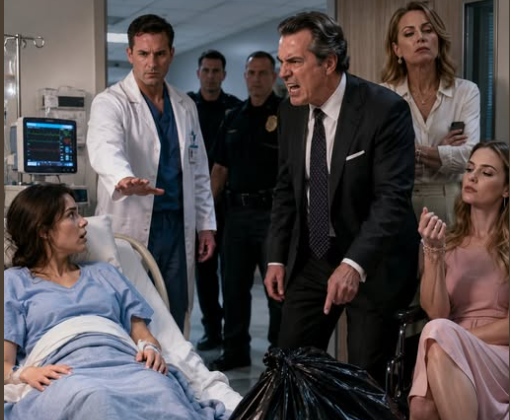
Dr. Evans didn’t raise his voice.
He didn’t need to.
The silence inside my hospital room became heavier than any accusation.
He looked directly at my father.
“Before you call her useless again,” he said calmly, “you should know what else we found.”
Richard frowned.
“I’m afraid I don’t know what you’re talking about.”
Dr. Evans opened a tablet and turned the screen toward the police officer.
“During our routine review of transplant documentation, several irregularities appeared.
Hospital policy required us to investigate.”
Evelyn suddenly shifted her weight.
“What irregularities?”
“The donor authorization process.”
The room became perfectly still.
Dr. Evans continued.
“The consent forms appear to be legally signed.
However, yesterday evening one of our transplant coordinators reported that the donor repeatedly asked whether she had any choice.”
I closed my eyes.
I remembered that conversation.
I had whispered the question while lying on the examination bed.
“What happens if I say no?”
Before the nurse answered, my father had stepped into the room.
“You won’t say no,” he had smiled.
I thought it was encouragement.
Now I understood it had been pressure.
Dr. Evans looked at me gently.
“Several staff members documented concerns that the donor may have been under significant emotional coercion.”
The police officer nodded.
“We’ve already interviewed those employees.”
Richard laughed.
“So what? She agreed.”
“No,” Dr. Evans replied quietly.
“She surrendered.”
Those words struck harder than any shout.
For the first time in my life, someone had described exactly what had happened.
I hadn’t chosen.
I’d spent twenty-four years trying to earn a family that never intended to love me.
The officer asked my father a simple question.
“Did you tell your daughter she would finally be accepted into the family if she donated?”
Richard folded his arms.
“I encouraged her.”
“Did you promise she could come home afterward?”
He didn’t answer.
“Did you already have contractors scheduled to convert her bedroom before the surgery was completed?”
Evelyn’s face lost its color.
“How did you—”
“The construction company confirmed the booking.”
Another officer entered carrying several folders.
“The renovation deposit was paid eight days before the transplant.”
Eight days.
My room had been erased before I even entered the operating room.
The garbage bag hadn’t been a sudden decision.
It had been the final step of a carefully prepared plan.
Maya finally spoke.
“This is ridiculous! She wanted to help me!”
Dr. Evans looked at her.
“Did you know your bedroom renovation plans included removing every photograph of your sister?”
Maya hesitated.
“I…that’s Mom’s decision.”
“No,” Dr. Evans answered.
“It became your decision when you watched her being thrown away and said nothing.”
She looked down for the first time all day.
Then another nurse hurried into the room.
“Doctor.”
He turned.
“We received the outside laboratory confirmation.”
He opened the envelope.
His expression changed immediately.
He looked at Maya.
“When were you diagnosed with kidney failure?”
“Nine months ago.”
“And before that?”
“I…I don’t remember.”
Dr. Evans placed the report on the table.
“The independent pathology review indicates something very unusual.”
Everyone stared.
“The damage to Maya’s kidneys was not caused by genetics.”
Richard blinked.
“What?”
“It was caused by prolonged exposure to a prescription medication.”
Evelyn grabbed the edge of the chair.
“That’s impossible.”
“No.”
Dr. Evans met her eyes.
“It isn’t.”
The officer slowly turned toward Evelyn.
“Our investigation found multiple pharmacy records under your name.”
She swallowed.
“I take medication.”
“Not this medication.”
He placed printed documents on the table.
“The prescriptions were collected every month.”
Richard looked confused.
“I’ve never seen those.”
The officer continued.
“Security footage from the pharmacy shows Mrs. Whittaker collecting them personally.”
Evelyn’s breathing became uneven.
Richard stared at his wife.
“What medication?”
Dr. Evans answered softly.
“A drug known to cause progressive kidney damage if taken continuously.”
Nobody moved.
Richard whispered,
“Why would anyone…”
Then realization spread across his face.
He looked at Evelyn like he’d never seen her before.
“No.”
She began crying instantly.
“I didn’t mean…”
“What did you do?”
Her voice cracked.
“I only wanted Maya to stay close to us.”
Richard stepped backward.
“What are you saying?”
She buried her face in her hands.
“Maya was talking about studying overseas…she wanted independence…I thought if she stayed sick…”
The room exploded with disbelief.
Maya stared at her mother.
“You made me sick?”
“I never thought it would become this serious!”
“You poisoned me?”
“I only adjusted your vitamins…”
The officer immediately stepped forward.
“Mrs. Whittaker, don’t say anything else.”
She collapsed into the chair, sobbing uncontrollably.
Richard looked like someone had removed the ground beneath him.
Everything he believed had vanished in less than sixty seconds.
He slowly turned toward me.
His eyes filled with tears.
Real tears this time.
“I’m…”
He couldn’t finish.
Because no apology existed for sacrificing one daughter to save another from a tragedy his own wife had secretly created.
The officers escorted Evelyn from the room.
Maya cried harder than anyone.
Not because of her surgery.
Because she realized her entire illness had been manufactured by the person she trusted most.
Days later, investigators confirmed there was no evidence anyone besides Evelyn had known.
Richard had been arrogant.
Cruel.
Emotionally abusive.
But he had also been manipulated.
It didn’t excuse what he had done.
It only explained why everything collapsed so quickly.
My recovery wasn’t easy.
Learning to live with one kidney took monThS.
Learning to live without hoping for my father’s approval took even longer.
Hospital social worker Angela visited every day.
She helped me apply for temporary housing.
She connected me with counseling.
She reminded me that surviving wasn’t the same thing as living.
One afternoon she smiled.
“Someone wants to meet you.”
An elderly woman slowly walked inside.
She introduced herself as Margaret Collins.
“I received a kidney transplant eleven years ago.”
I smiled politely.
She held my hand.
“My donor was a stranger.”
Her eyes became moist.
“I promised myself that if I ever met someone who gave another person a second chance at life, I’d help them the way someone once helped me.”
She owned a small publishing company.
A month later she offered me an administrative position while I finished recovering.
It wasn’t charity.
It was opportunity.
For the first time in my life, someone believed I had value before asking what I could give.
Six months passed.
Physical therapy ended.
I rented my own apartment.
It was tiny.
The kitchen barely fit one person.
The windows looked toward a parking lot instead of mountains.
It was the most beautiful place I had ever lived.
Because every object inside belonged to me.
Every choice belonged to me.
Every tomorrow belonged to me.
One rainy afternoon, there was a knock at my door.
Richard stood outside.
He looked twenty years older.
No expensive watch.
No confident smile.
Just a tired father carrying a cardboard box.
“I found these.”
Inside were my childhood drawings.
School certificates.
Birthday cards I had made for him that had never been displayed.
He had rescued them before the renovation crew destroyed everything.
“I should have done this years ago.”
I didn’t invite him inside immediately.
He understood.
“I don’t expect forgiveness.”
He looked at the floor.
“I only wanted you to know I finally read every letter you ever wrote me.”
I remembered those letters.
Every Father’s Day.
Every birthday.
Every Christmas.
Letters begging him to notice me.
He continued quietly.
“I didn’t deserve them.”
We stood in silence.
Finally I spoke.
“I believe people can regret what they did.”
He nodded.
“But regret doesn’t erase consequences.”
“I know.”
“You don’t get to be my father again simply because you’re sorry.”
Tears rolled down his face.
“I understand.”
I accepted the box.
Nothing more.
Nothing less.
Sometimes healing doesn’t mean reopening the door.
Sometimes healing means closing it gently instead of slamming it.
A year later, I attended a charity event supporting living organ donors.
Dr. Evans was there.
Angela was there.
Margaret was there.
Even Maya came.
She had spent months in therapy.
She apologized without making excuses.
“I should have protected you.”
“You were a victim too,” I answered.
“We both deserved better.”
For the first time in our lives, we hugged as sisters instead of competitors.
Not because the past disappeared.
Because neither of us wanted to carry it anymore.
During the ceremony, Dr. Evans invited me onto the stage.
“I’d like everyone to meet someone who reminded our hospital why ethics matter.”
The audience applauded.
I looked across hundreds of faces.
Some were transplant recipienTS.
Some were donors.
Some were families.
I thought about the frightened young woman who believed giving away part of herself was the only way to earn love.
She no longer existed.
In her place stood someone who finally understood the truth.
Real family never measures your worth by what they can take from you.
Real love never asks you to disappear so someone else can feel complete.
As the applause echoed through the hall, sunlight poured through the windows.
For years I believed losing a kidney had cost me everything.
Instead, it removed the one thing that had been slowly destroying me.
The desperate hope that people without love would someday learn how to give it.
Walking out of the hospital that afternoon, I touched the small scar beneath my ribs.
It would always remain.
Not as a reminder of betrayal—
but as proof that even after losing a piece of yourself, your future can still become whole.
And for the first time in my life, I wasn’t walking toward the house I had been thrown out of.
I was walking toward a home I had finally built for myself.