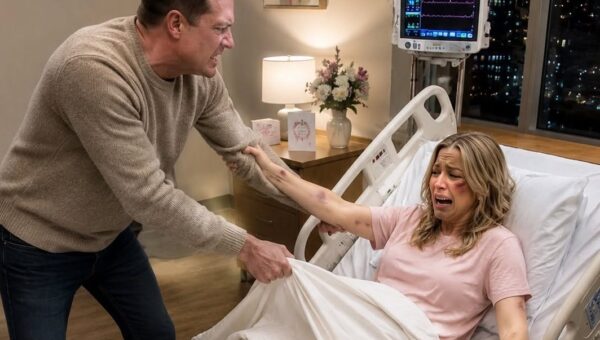
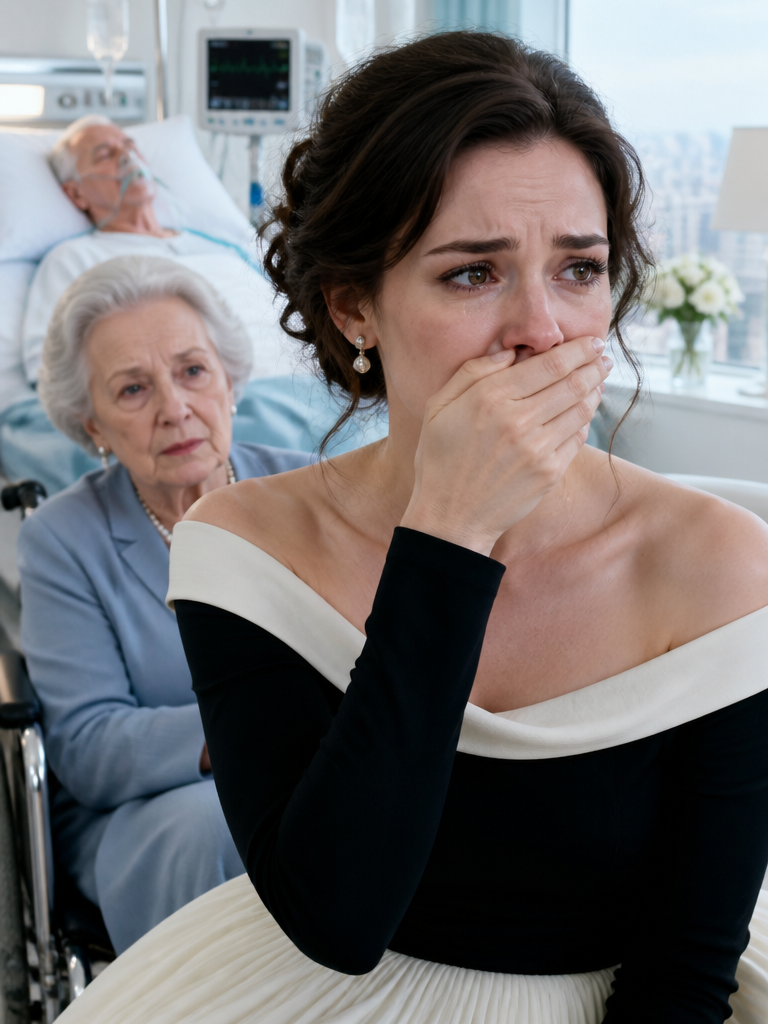
My father was dying in the ICU when an elderly woman in a wheelchair leaned over and whispered,

PART 1
“If you can still walk, go home tonight. Your husband is counting on you staying here.”
The elderly woman in room 412 spoke from her wheelchair, her voice so low that for a moment, I thought I had misheard her.
My father, Victor Vance, was connected to a ventilator on the fourth floor of St. Jude Medical Center in downtown Chicago. He had suffered a massive stroke two days earlier. The doctors repeatedly told us his condition was critical, that we just had to wait, and that any slight change could be decisive.
I had been sitting in front of the intensive care observation window for nearly forty hours. My husband, Adrian Sterling, had taken charge of everything: he spoke with the specialists, reviewed the medical charts, paid the hospital bills, and dictated exactly when I should eat or rest. For five years, I had mistakenly called that suffocating level of control “love.”
“Do we know each other?” I asked the old woman.
“No,” she replied. “But I know that look in your eyes. It’s the look of a woman who no longer knows if her own thoughts belong to her.”
Her name was Eleanor Miller. She had terminal cancer and, according to a nurse, she had spent the last few weeks staring down the hallway as if waiting for something. Right before she closed her hospital room door, she handed me a small digital voice recorder.
“Last night, your husband took a phone call out on the balcony,” Eleanor whispered. “He said they needed to disconnect your father before the weekend. And that afterward, ‘the daughter’ wouldn’t be a problem anymore.”
I felt the floor drop beneath my feet.
Adrian appeared a few minutes later, impeccably dressed in his tailored navy suit, carrying a bag of food. He kissed my forehead, handed me a dry salad without dressing, and asked if I had drunk enough water. He didn’t ask how I was feeling.
When he walked down to the cafeteria to get coffee, I hurried back to Eleanor’s room.
“Check the lining of your purse,” she ordered.
The honey-colored leather handbag had been an anniversary gift from Adrian. I locked myself in the hospital bathroom, used a pair of tweezers from my makeup bag to rip the inner seam, and found a hidden Apple AirTag stitched securely into the lining. Suddenly, his “casual” phone calls every time I visited a friend, went to a bookstore, or even considered accepting a job offer made terrifying sense. It wasn’t intuition. He was tracking me.
I quickly stitched the tracker back exactly where I found it. If Adrian realized I knew, he would change his strategy.
At five in the morning, I stood by my father’s bed and held his hand. His fingers squeezed mine—just once. It wasn’t a muscle spasm. He was conscious. He had heard everything.
I texted Adrian, telling him I was running home to shower and get clean clothes. At the hospital entrance, I paid a delivery courier fifty bucks to carry my leather purse to a coffee shop on the north side of the city. While my tracker moved away from the hospital, I caught a cab straight to our house in the affluent suburb of Oak Brook.
I slipped into Adrian’s home office and began searching. Taped beneath the bottom drawer of his desk, I found a hidden burner phone. The passcode was my birthdate.
The first message, sent six years ago, read: “The girl is insecure. Her father is sitting on a fortune. It will be easy to isolate her.”
Further down was a recent text thread with Celine Rivers, the primary ICU nurse assigned to my father. “I increased the heparin dose. Nobody suspects a thing.”
I unlocked the wall safe hidden behind a framed mirror and pulled out a forged Last Will and Testament. It stated that my father’s entire logistics company, all real estate properties, and his private accounts—totaling over twenty million dollars—would pass directly to Adrian. One of the signed witnesses on the document was my uncle, Arthur.
Then, the burner phone buzzed in my hand.
“Job’s done. I cut the brake lines on your wife’s SUV.”
I looked out the office window. My SUV was parked in the driveway, waiting for me like an open grave.
PART 2
I didn’t go near the SUV. I slipped out the back door, ordered an Uber down the street, and called Lauren Davis, my best friend from college—the woman Adrian had successfully isolated me from three years ago.
Lauren was a corporate attorney specializing in estate fraud. She listened in stunned silence as I frantically told her about the tracker, the burner phone, the heparin, the forged will, and the cut brake lines.
“Clara, we never actually had a falling out,” Lauren said softly when I finished. “Adrian would answer your phone and tell me you didn’t want to see me anymore. Furthermore, four years ago, he came to my firm asking hypothetical questions about how to contest a will and declare an elderly family member mentally incompetent.”
Half an hour later, Lauren and I sat in a discreet diner downtown, across from Detective Robert Hayes of the Chicago Police Department’s Financial Crimes Unit.
Detective Hayes was already quietly investigating my uncle Arthur for suspicious asset transfers involving elderly clients. But the most painful revelation came next.
“Your father contacted me eight days before his stroke,” Hayes explained. “He discovered that Adrian had embezzled over a million dollars from his company using phantom offshore vendors. Your father knew Adrian was tracking you, and he knew he couldn’t speak to you without putting the entire investigation at risk.”
“So… the stroke was induced?” I asked, my voice trembling.
“No, the stroke was real,” Hayes replied. “But your father had been experiencing symptoms for weeks and chose to document everything before checking into the hospital. He wanted to force Adrian to make a visible, undeniable mistake.”
I had believed I was protecting my father, when in reality, he had turned himself into bait to save my life.
I handed over the burner phone. The police and the State’s Attorney immediately requested simultaneous search and arrest warrants for Adrian, Celine, and Uncle Arthur. However, the judge demanded that the original forged documents in the safe be legally secured by investigators first. Until that happened, I had to return to the hospital and pretend I knew absolutely nothing.
“You’ve played the role of the obedient, submissive wife for five years,” Lauren told me, squeezing my hand. “You just need to play it for a few more hours.”
I returned to the ICU wearing clean clothes and a tired smile. Adrian asked why I had taken so long. I blamed morning traffic on the expressway. He nodded, completely unsuspicious.
Throughout the afternoon, I watched Nurse Celine. Every time Adrian stepped out of the room, she stepped in. They never spoke in front of anyone, but they communicated through brief, calculated glances. Detective Hayes later confirmed that her scheduled shifts perfectly matched every single one of my husband’s hospital visits over the past three weeks.
That night, I received an encrypted email from Helen, my father’s loyal secretary of twenty years. Attached was a covert audio recording of a secret meeting between Adrian and my uncle Arthur.
“The will is finalized,” Adrian’s voice echoed from my phone. “We just need the medical event to finish its course.”
“And the split?” Arthur asked.
“Sixty for me, forty for you. First, we eliminate Victor. Then, Clara will unfortunately suffer a tragic car accident.”
I forwarded the audio file to Detective Hayes. The arrest warrants were approved just before dawn.
The next morning, Dr. Harrison, my father’s lead physician—who was now cooperating with the police—spoke to Adrian in the hallway, purposefully leaving the door slightly ajar.
“Mr. Vance may not survive another forty-eight hours,” Dr. Harrison said grimly. “Any pending estate or legal matters should be resolved today.”
Adrian immediately left the hospital, returning an hour later carrying a black leather briefcase.
He walked into my father’s room, closed the door behind him, and placed three documents on the rolling tray table. He pulled a heavy fountain pen from his breast pocket.
“We need your signature before it’s too late, Victor,” Adrian whispered.
He took my father’s motionless hand and pressed the tip of the pen against the paper.
Right then, my father’s left eyelid twitched three times.
The trap had just snapped shut, but what my father did next changed everything forever.
PART 3
“Go ahead,” I said, ensuring my voice sounded completely docile. “You always know what’s best for us.”
Adrian eyed me with a mixture of satisfaction and caution. For years, he had trained himself to detect the slightest hint of resistance in me—an unexpected question, a lingering silence, a sustained gaze. Because of that, I lowered my eyes and clasped my hands together, exactly as I always did whenever he discussed finances.
Laid out on the table were a general power of attorney, a transfer of deed for our summer house in Lake Geneva, and a change-of-beneficiary form for multiple life insurance policies. All three documents were fraudulently backdated to the day before the stroke. If he managed to stamp my father’s signature on them, Adrian could legally argue that Victor Vance had acted of his own free will before losing consciousness.
“I’m just going to guide his hand,” Adrian explained smoothly. “The doctor can confirm he’s still responding to physical stimuli.”
“But he can’t express his actual will.”
“We both know what he wanted, Clara. He wanted to make sure you were protected.”
Hearing those words from the man who had just ordered my murder washed a strange, icy calm over me. I no longer needed to argue. The truth was out of my hands: it was in the burner phone secured by the police, in Helen’s audio recordings, in the AirTag stitched into my purse, in the severed brake lines of my car, and in the bank transfers my father had meticulously tracked.
Adrian wrapped my father’s limp fingers around the heavy pen.
The tip of the pen touched the paper.
In that exact instant, my father opened his eyes.
It wasn’t the confused, groggy awakening of a dying man. He stared directly at Adrian with a fierce, piercing lucidity that left my husband completely petrified. My father released the pen, letting it clatter onto the table, and with an enormous, agonizing effort, he moved his lips.
“I… won’t… sign.”
Adrian stumbled backward, his face turning ghost white. “Victor, calm down! You’re disoriented—”
My father spoke again, his voice barely a rasping thread:
“Thief.”
The hospital room door swung open. Detective Hayes walked in, flanked by two armed officers, Dr. Harrison, and Lauren. A female officer immediately spun Adrian around, slamming him against the wall, while another agent photographed the forged documents and bagged the pen as evidence.
“Adrian Sterling, you are under arrest for attempted murder, forgery, criminal conspiracy, corporate fraud, and unlawful surveillance,” Detective Hayes announced, pulling out a pair of steel handcuffs.
For the first time in five years, my husband’s flawless mask completely vanished.
“Clara, this is insane!” he screamed, struggling against the officers. “I did all of this for us! Your father always hated me! He always tried to tear us apart!”
He turned to look at me, desperately searching for the submissive, gaslit woman he had molded over the past five years—the woman who doubted her own memory and asked for permission just to grab coffee with a friend.
“Look at me, Clara!” he ordered.
I looked right at him.
“I did that for far too long.”
He tried to lunge toward me, but the officers slammed him down and cuffed him. Down the hall, Nurse Celine was arrested at the nurses’ station. Investigators found unregistered vials of heparin in her locker, along with deleted text messages that digital forensics would easily recover. Simultaneously, a SWAT team raided Uncle Arthur’s sprawling estate in the suburbs. Inside his home office, they found the forged contracts, practice sheets bearing my father’s forged signature, offshore shell account ledgers, and the direct contact information for the mechanic who had cut my brakes.
Uncle Arthur tried to blame Adrian.
Adrian tried to blame Nurse Celine.
Celine claimed she was only following orders because Adrian had promised her a luxury condo and a massive payout.
But the evidence revealed a much darker truth: every single one of them had participated willingly and enthusiastically. Arthur had provided insider family information and forged the documents. Celine had intentionally altered life-saving medication to worsen my father’s condition. And Adrian had masterminded the surveillance, the embezzlement, and the two murders he planned to disguise as inevitable tragedies.
The mechanic confessed in exchange for a reduced sentence. He testified that Uncle Arthur had paid him in cash and provided photos of my SUV. He also handed over a voicemail where Arthur explicitly warned him:
“It has to look like a tragic accident. Once the old man is gone, she’s the only heir left.”
My father remained hospitalized for another three weeks. The excess heparin had dangerously aggravated his hemorrhage, but Dr. Harrison managed to stabilize him. He slowly regained his speech and required months of intense physical therapy to walk with a cane.
Our first real conversation took place late one night when the hospital ward was dead quiet.
“I’m so sorry I didn’t tell you anything,” my father whispered, holding my hand.
“You were trying to protect me, Dad.”
“I was also ashamed,” he admitted, tears welling in his eyes. “I watched Adrian isolate you from everyone you loved, and I kept hoping you’d realize it on your own. I confused respecting your marriage with staying dangerously silent.”
He told me he had discovered the phantom invoices six months prior. When he tried to bring it up to me, Adrian suddenly showed up unannounced at his office. After that, my father realized someone was tracking my every move. He hired Detective Hayes privately and instructed Helen to secure copies of every corporate document. The stroke had struck before he could finalize the case, but Dr. Harrison had been briefed on the plan and kept the police informed.
“I squeezed your hand that night because I heard you say you knew,” my father added. “It was the only muscle I could move.”
I rested my head against his chest, crying as I listened to the steady, real rhythm of his heartbeat. For years, I thought being an adult meant never asking for help. That night, I finally understood that true independence doesn’t mean facing the world completely alone—it means having the power to choose who you open your door to.
I went looking for Eleanor Miller the day before my father was discharged. I found her sitting by the window in her room, looking out at the city skyline.
“They arrested them,” I told her.
She nodded slowly, as if she had expected the news from the very beginning. “Then you can finally go home.”
“You saved my life, Eleanor.”
“No,” she replied softly. “I simply spoke up. You were the one who decided to listen.”
She told me that her daughter, Lily, had died ten years ago in a car crash engineered by a controlling, abusive husband. Right before the crash, Lily had called her, screaming that her brakes weren’t working. Eleanor had suspected for months that the man was isolating and poisoning her daughter, but she hadn’t wanted to interfere in their marriage.
“I kept telling myself it wasn’t my business,” Eleanor whispered, tears falling down her wrinkled cheeks. “That phrase haunted me all the way to this hospital bed. When I saw you, I recognized the exact way your body went completely rigid whenever Adrian touched you. My daughter used to do the exact same thing.”
I promised her I would come back to visit.
The criminal trial lasted fourteen grueling months. Adrian’s defense team tried to paint me as a bitter, hysterical wife who had illegally broken into his office. However, the police search warrants validated every single photograph. Digital forensics pulled drafted wills, GPS logs of my daily routes, AirTag registration data, and internet searches for “unwitnessed fatal car accidents” directly from his hard drive. Bank transfers definitively linked his shell companies to Uncle Arthur. And the hospital’s internal audit proved Celine had tampered with the medication logs.
During his testimony, Adrian claimed everything he did was a desperate attempt to “protect the family’s assets.” The prosecutor simply asked him how ordering a mechanic to cut his wife’s brake lines protected her.
Adrian had no answer.
Celine took a plea deal and received twelve years in federal prison. Uncle Arthur was sentenced to sixteen years for fraud, conspiracy, and attempted murder. Adrian received thirty-two years without the possibility of parole.
As the judge read the final sentence, Adrian turned to look at me one last time.
“You’re nothing without me,” he sneered before the bailiffs grabbed him.
My father, sitting beside me leaning on his cane, answered for me:
“Without you, she finally gets to be herself again.”
Months later, I signed the final divorce papers and legally reclaimed my maiden name: Clara Vance. My father’s logistics empire was returned to its rightful owners. With the embezzled funds recovered from the frozen offshore accounts, we paid off the debts caused by Adrian’s fraud and protected the jobs of over one hundred and twenty employees.
I also returned to the university to teach a graduate seminar in finance. On my first morning, I stood frozen outside the lecture hall for several minutes. Adrian had spent years convincing me that I was incompetent, that my degree was a useless piece of paper, and that he understood the world infinitely better than I ever could. But when I finished my first lecture, a student walked up to my desk and told me she had never understood the material so clearly.
I cried in the faculty bathroom—but this time, it wasn’t out of fear.
I also sold the house in Oak Brook. I didn’t want to keep a single room of a place where every object had been carefully selected to make me feel small. I rented a modest, sunlit apartment in Lincoln Park, with big windows looking out at the trees, signing a lease with only my name on the dotted line. The first night, I slept on an air mattress because the furniture hadn’t arrived yet. No one knew exactly where I was, no one was tracking a blue dot on a GPS screen, and no one called to interrogate me about why I took a different route home.
At first, the silence terrified me. Then, I realized it wasn’t abandonment. It was freedom. I picked out my own curtains, bought a bright yellow coffee mug that Adrian would have deemed “tacky,” and learned how to make small decisions without having to justify them. Each small choice was a step back to myself.
I returned to St. Jude Medical Center with a large bouquet of white lilies. At the reception desk, the head nurse lowered her eyes.
“Eleanor passed away three weeks ago,” the nurse informed me gently. “She went peacefully in her sleep. She left this envelope for ‘the dark-haired girl from the fourth floor.’”
Inside was a handwritten note on hospital stationary.
“Clara:
I never caught your real name, but I recognized your eyes. My daughter used to look people straight in the eye before she was taught to stare at the floor. For years, I was polite, prudent, and quiet while other women vanished behind closed doors.
If you are reading this, it means you survived.
Live for yourself now. And whenever you see someone shrink into themselves because the person who claims to love them walks into the room—speak up. Even if it isn’t your business. Especially then.
Eleanor.”
I sat on a bench outside the hospital, reading the letter while the busy Chicago traffic rushed by as if nothing extraordinary had happened. I thought about how many people see the warning signs and rationalize them away just to avoid making anyone uncomfortable. How many families dismiss emotional abuse as “marital issues,” controlling behavior as a “strong personality,” and stalking as “being protective.”
A year later, I founded the Speak Up Initiative, a non-profit organization offering free legal and financial advocacy to victims of economic abuse, family fraud, and elder exploitation. Lauren stepped in as the director of our legal team. My father served as a senior advisor for corporate fraud cases. In the lobby of our office, we painted Eleanor’s final words on the wall:
“Sometimes the person who saves your life is someone who doesn’t even know your name yet.”
Our first hotline call came on a Tuesday at nine in the morning. A seventy-eight-year-old woman tearfully explained that her son had secretly mortgaged her house and constantly told her she was too confused to manage her own bank accounts.
I pulled out a fresh legal pad and grabbed a pen.
“Tell me everything from the very beginning,” I told her gently. “I have all the time in the world. I’m listening.”
For five years, I believed that love demanded blind trust without questions. Now I know that true love doesn’t track your movements, it doesn’t shrink your world, it doesn’t dictate who you can speak to, and it never uses your fear as proof that you are “exaggerating.”
My father survived because a secretary secretly saved an audio file, a doctor refused to look the other way, a friend answered a phone call after three years of silence, and an elderly woman decided that my life was, in fact, her business.
The justice system punished the men who tried to destroy us, but putting them in prison wasn’t my greatest victory.
My true victory was finding my voice again.
And ever since that day, whenever someone whispers to me that something isn’t right behind closed doors, I never turn away and say it isn’t my business.